


The Saturday morning youth soccer league coordinator stared at her phone. Three cancellations for tomorrow's games. No referees for the 9am matches. The snack stand volunteer never confirmed. Again.
This wasn't a people problem. The volunteers cared deeply about the club. They just couldn't keep track of their shifts buried in group texts and spreadsheets that nobody updated.
Most volunteer-run clubs lose around 40% of their active volunteers each year. Not because people stop caring, but because the scheduling chaos burns them out. The constant last-minute scrambling, the guilt when they forget a shift, the frustration of unclear expectations — it adds up until stepping back feels like the only option.
Why volunteer scheduling for clubs breaks differently than employee scheduling
Employee scheduling software assumes people show up or face consequences. Volunteer scheduling operates on an entirely different psychological framework. When someone donates their Saturday morning to referee youth basketball, they're making a gift of their time. The moment that gift feels unappreciated or chaotic, they quietly disappear.
Traditional scheduling tools fail because they treat volunteers like employees who need shift coverage. But volunteers need something fundamentally different: clarity about expectations, appreciation for their contribution, and a system that respects their time by preventing the chaos before it starts.
Board members spend 15-20 hours monthly just coordinating volunteers. WhatsApp threads explode with hundreds of messages trying to fill last-minute gaps. The same reliable people get asked repeatedly until they burn out, while newer volunteers never get plugged in because nobody remembers they offered to help.
A rowing club in Portland discovered this pattern after losing their volunteer coordinator. They had 180 members, with about 45 volunteering regularly for regattas and equipment maintenance. Those 45 were actually the same 12 people rotating through multiple roles because the signup process lived across three different Google Sheets that the previous coordinator managed solo. When she left, they found 33 other members who had volunteered once, never got scheduled again, and assumed they weren't needed.
Template rules that prevent the scramble
The solution isn't more reminder emails or guilt-driven recruitment campaigns. It's building scheduling templates that encode your club's operational knowledge into repeatable patterns.
Keep your membership organized and engaged.
Clubyly simplifies member management, event coordination, and payment collection—effortlessly.
- Unified member database
- Automated payment tracking
- Event scheduling & reminders
No credit card required
Start with rotation templates. Every volunteer role in your club probably follows a pattern, even if you haven't documented it yet. Youth sports leagues need two referees per game, rotating through certified volunteers on a predictable schedule. Sailing clubs need race committee boats staffed with specific roles every regatta weekend. Community gardens need plot inspections monthly, tool maintenance quarterly, and event coordination seasonally.
A rotation template for a tennis club running weekend junior programs:
| Role | Schedule | Rotation Rule | Capacity Limit |
|---|---|---|---|
| Court supervisor | Saturday 8am-12pm | Max once monthly | 8 certified parents |
| Check-in desk | Saturday 8am-12pm | Can repeat weekly | 2 volunteers |
| Equipment setup | Saturday 7:30am-8:30am | Different each week | 4 volunteers |
| Snack coordination | Saturday 11am-12:30pm | One family per week | Scheduled quarterly |
The template knows that court supervisors burn out if scheduled more than once monthly, but check-in desk volunteers often prefer the same shift weekly because they build relationships with the families. It automatically spreads equipment duty across different people and assigns snack duty far enough in advance that families can plan.
When someone signs up for court supervisor duty, the system won't let them get scheduled again for four weeks. When a family handles snacks, they're blocked from that role for the rest of the quarter.
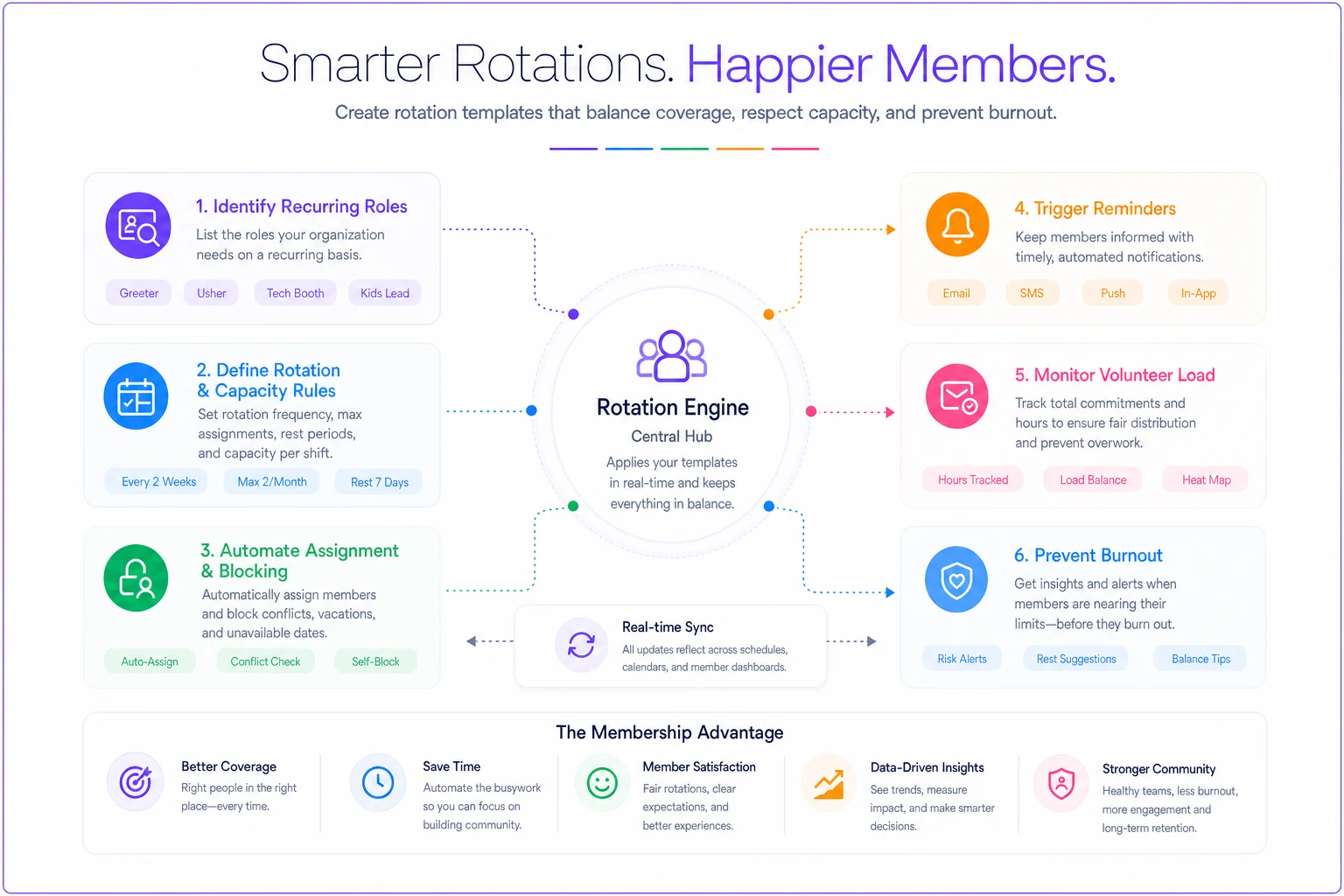
This workflow shows how templates assign roles and enforce limits.
Backfill logic that fills gaps without pestering everyone
The Thursday night panic text asking who can cover Saturday's event needs to die. Smart backfill rules handle gaps systematically, not desperately.
Effective backfill operates on tiers of availability. Not everyone who volunteers has the same capacity or reliability. Your scheduling system needs to understand these tiers and work through them methodically.
Tier 1: The reliables
These volunteers consistently show up and often volunteer for extra shifts. Clubs burn these people out by constantly asking them to fill gaps. Backfill rules should protect these volunteers by limiting how often they can be asked to cover.
Tier 2: The specialists
Some volunteers only help with specific activities. The certified referee who only does championship games. The parent who runs sound equipment for concerts. Backfill rules need to respect these boundaries while still utilizing their expertise when appropriate.
Tier 3: The occasionals
Members who want to help but have unpredictable schedules. They can't commit weeks in advance but might be available with 48 hours notice. These are perfect backfill candidates if you ask them the right way.
A swim club with 320 member families built this tiered system after their meet coordinator nearly quit from exhaustion. They tracked volunteer patterns for a season and discovered that their "emergency fill" requests always went to the same 15 families — the ones who always said yes. Meanwhile, 80+ families had indicated willingness to help but never got asked because they weren't in the coordinator's mental rolodex.
Their new backfill process: When someone cancels, the system first checks if any Tier 3 volunteers haven't been asked in the past month. Only if nobody from that pool responds within 24 hours does it move to Tier 2 specialists. Tier 1 reliables only get asked if an event genuinely risks cancellation. This simple hierarchy distributed requests across 4x more families and reduced coordinator stress significantly.
Protect Tier 1 volunteers by capping how often the system can auto-request them to backfill within a month.
The backfill sequence follows predictable steps that prevent the same people from getting hammered with requests while ensuring coverage doesn't fall through the cracks.
Recognition workflows beyond the thank-you email
Volunteers don't need awards ceremonies. They need to know their contribution mattered and see how it fits into the club's bigger picture.
Most clubs default to generic appreciation — the annual volunteer dinner, the newsletter shoutout, the "thank you for your service" email. These aren't bad, but they miss what actually keeps volunteers engaged: understanding their impact and feeling connected to the mission.
Recognition that prevents burnout is operational, not ceremonial. It shows volunteers how their Saturday morning shift enabled 60 kids to play soccer safely. It connects their equipment maintenance work to the sailing team's regional championship. It demonstrates that their time investment created specific, measurable outcomes for the club.
A climbing gym co-op learned this after volunteer hours dropped by half over two years. They surveyed former volunteers expecting to hear about scheduling conflicts or time constraints. Instead, the consistent feedback was "I never knew if my work mattered." People spent hours belaying for youth programs or maintaining equipment but never heard whether those programs succeeded or whether anyone noticed the improvements.
They rebuilt recognition around operational outcomes:
-
After each youth program session
volunteers receive a summary showing attendance numbers, skill progressions, and parent feedback
-
Monthly maintenance crews
get before/after photos of their work plus usage statistics showing how many climbers benefited
-
Event volunteers
receive event metrics within 48 hours — attendance, revenue generated for club programs, and specific member feedback
Making recognition automatic and data-driven works better than depending on a coordinator remembering to say thanks. It creates a feedback loop that shows volunteers their efforts translate into real results.
Sign-up friction that silently kills volunteer programs
The distance between "I'd like to help" and actually helping determines your volunteer participation rate. Most clubs create massive friction in their signup process without realizing it.
Your current volunteer onboarding probably works like this: Someone expresses interest at an event. They get handed a clipboard or told to email someone. That email might get answered in a few days with a link to a Google Form. The form asks for availability across multiple roles they don't understand. They submit it and nothing happens for weeks. By the time someone reaches out about an actual opportunity, their initial enthusiasm has evaporated.
This isn't laziness or lack of commitment. It's operational failure.
Low-friction signup means capturing interest the moment it exists and converting it into action before enthusiasm fades. This requires immediate role clarity and instant scheduling connection.
A rugby club with 400+ members discovered their volunteer signup form was actually preventing participation. It listed 23 different volunteer roles with descriptions like "Match Day Coordinator" and "Facilities Liaison" that meant nothing to new members. People abandoned the form because they couldn't figure out what they were signing up for.
They simplified to three initial paths:
-
Event day help (2-4 hour chunks)
-
Ongoing team support (weekly commitment)
-
Special skills (coaching, medical, technical)
Only after someone picked a path did they see specific opportunities. Event day help showed concrete shifts: "Setup crew for Spring Tournament - May 15, 7-9am" or "Concession stand during home games - flexible 2-hour blocks." Ongoing support offered team manager or equipment coordinator roles with clear weekly time estimates.
This structure reduced signup abandonment by around 60%. More importantly, it got new volunteers actually scheduled instead of lost in communication gaps.
The deadliest phrase in volunteer coordination: "We'll be in touch about opportunities." Every day between signup and first assignment increases the chance someone never actually volunteers. Smart clubs schedule the first volunteer shift during the signup process itself.
Building schedules that respect capacity limits
Volunteer burnout often happens gradually, then suddenly. Someone helps once, does a good job, gets asked again. They say yes because they care about the club. Soon they're covering multiple shifts monthly, feeling guilty about saying no, until they hit their breaking point and disappear completely.
Capacity limits prevent this spiral by encoding sustainable participation directly into scheduling rules.
A youth orchestra with parent-run operations learned this lesson painfully. Their most dedicated volunteers — usually board members or long-time parents — would handle everything from concert setup to fundraising events. One family was scheduled for volunteer roles at 14 of 18 events during the fall season. They didn't complain; they just didn't re-enroll their child the following year.
Effective capacity management tracks multiple dimensions:
-
Frequency caps Maximum volunteer shifts per month/quarter
-
Recovery periods Mandatory gaps between intensive roles
-
Role diversity Preventing the same person from being pigeonholed
-
Family burden Total household volunteer hours, not just individual
The orchestra's new rules:
-
No family scheduled more than once monthly for major events
-
Board members blocked from operational roles during their term
-
Anyone who coordinates an event can't be scheduled for 30 days after
-
Automatic alerts when someone approaches 10 hours monthly
Some coordinators worried they wouldn't have enough coverage. Instead, enforcing capacity limits forced them to activate dormant volunteers who'd been overlooked because a small group always said yes.
This approach distributes work more evenly and prevents the typical pattern where reliable volunteers get overused while willing members never get asked.
When template-driven scheduling makes sense (and when it's overkill)
Not every volunteer situation needs complex scheduling automation.
Template-driven scheduling works when you have recurring events with predictable volunteer needs. Weekend sports leagues, monthly community events, seasonal regattas — these benefit from encoded patterns and rotation rules. If you're losing volunteers to burnout rather than lack of interest, templates and automation fix the root cause.
Multiple coordinators handle scheduling at many clubs. When volunteer management gets distributed across board members or committee chairs, templates ensure consistency and prevent double-booking. With more than 20 active volunteers, human memory can't reliably track everyone's preferences and availability.
Keep it simple when your volunteer needs are genuinely unpredictable. Emergency response teams or disaster relief organizations need flexibility more than templates. Small clubs with under 50 total members often thrive on personal relationships and informal coordination. Adding systematic scheduling might feel impersonal.
Volunteer work that's project-based rather than recurring needs project management, not rotation templates. Building a new dock or organizing an annual gala requires different coordination approaches.
The operational shift that changes everything
The difference between clubs that thrive with volunteer support and those that constantly struggle isn't motivation or community spirit. It's operations.
When volunteer scheduling runs on templates, automated backfill, and recognition workflows, several things happen simultaneously. Coordinators spend time on strategic planning instead of last-minute scrambling. Volunteers feel valued because the system respects their time and preferences. New members actually get plugged in instead of lost in communication gaps.
The institutional knowledge about how to run your club stops living in one coordinator's head. It gets encoded into repeatable processes that survive leadership transitions.
A sailing club that implemented template-driven volunteer scheduling saw measurable changes within one season. Volunteer hours increased by roughly 35%, but more tellingly, the number of unique volunteers doubled. They weren't working their core group harder; they were distributing work across more members who finally had a clear path to participation.
The technology enabling this isn't complex. Modern volunteer scheduling for clubs combines simple concepts: rotation patterns, availability tracking, automated reminders, and basic recognition workflows. What makes it powerful is encoding your specific operational knowledge — that Jim prefers morning shifts, that the concession stand needs two people during tournaments, that anyone who coordinates the annual fundraiser needs a month off afterward.
These patterns already exist in your club. They live in the coordinator's memory, in post-event discussions about what went wrong, in the resignation letters from burned-out volunteers. Template-driven scheduling simply captures this knowledge and applies it consistently.
The clubs that will thrive over the next decade won't be those with the most passionate members or the biggest budgets. They'll be the ones that respect volunteer time through operational excellence. That starts with scheduling that prevents problems instead of scrambling to solve them.
Ready to streamline your club operations?
Join 500+ clubs using Clubyly to save time, boost member engagement, and grow their communities.