



Multi-chapter club operations create chaos that most managers don't see coming until they're drowning in spreadsheets at 11 PM on a Tuesday. Your main chapter runs smooth - maybe 400 members, solid dues flow, events working. Then you expand. Second location, third location, maybe a virtual chapter. WhatsApp groups explode, treasurers start using different payment systems, and nobody knows which membership database has the right numbers.
The centralization question isn't philosophical. It's whether your Saturday morning gets spent reconciling three different member lists or actually planning programs.
Each chapter develops its own culture and way of doing things, which makes standardization tricky. Downtown professional chapter runs board meetings with Robert's Rules. University chapter operates on Discord and makes decisions through emoji reactions. Force them into the same box and engagement craters.
Without some centralization though, you're basically running three separate organizations pretending to be one. Member data lives everywhere. Financial reporting becomes archaeological excavation. New member onboarding varies wildly depending on which chapter door they walked through first.
Why chapters naturally drift toward operational chaos
First treasurer uses QuickBooks because that's what they know from their business. Second treasurer insists on Wave because it's free. Third chapter just tracks everything in Google Sheets because their volunteer accountant refuses to learn new software. Six months later, you're trying to prepare consolidated financials for the annual meeting and realize you're running three different accounting departments.
The membership database problem makes this worse. Main chapter started with a simple spreadsheet. Worked fine for 50 members. By 200, someone migrated to Airtable. Second chapter launched straight into Wild Apricot because someone got a nonprofit discount. Now you've got members who exist in one system but not another, duplicate records everywhere, and no single source of truth for who's actually active.
Communication channels fragment the same way. Original chapter lives on email. New chapter prefers Slack. Student chapter won't touch anything except Discord. Parents coordinating across chapters maintain three different apps just to stay informed. Messages get lost, announcements reach different audiences, and you can't even run a simple "all-member" survey without three different collection methods.
Event management becomes its own nightmare. Each chapter runs their own registration, collects their own fees, manages their own attendance tracking. When someone from Chapter A wants to attend Chapter B's workshop, nobody knows how to handle the payment. Do they pay their home chapter? The host chapter? Is there a transfer process? Usually it just doesn't happen because the friction is too high.
The hidden operational tax of decentralized data
Data fragmentation creates drag that compounds over time. Take new member onboarding. Chapter A has a three-step process - application, payment, welcome packet. Takes about 4 days. Chapter B added background checks and orientation requirements. Takes 2 weeks. Chapter C simplified everything to just payment and email confirmation. Takes 1 day.
Keep your membership organized and engaged.
Clubyly simplifies member management, event coordination, and payment collection—effortlessly.
- Unified member database
- Automated payment tracking
- Event scheduling & reminders
No credit card required
Member switches chapters for work relocation. Their history disappears. Awards, participation, committee service - all trapped in the original chapter's system. They basically start over as a new member despite five years of involvement.
Financial reconciliation turns into forensic accounting. Dues come in through different channels per chapter. Tracking who paid what when becomes a part-time job. Late payment notices go out incorrectly because each system has different logic for "current" status. Some members get three reminders, others get none. The member who paid through Venmo to the wrong chapter account stays marked delinquent for months.
Reporting to national organizations or grant funders requires data archaeology. "How many active members across all chapters?" Simple question, three-day project to answer accurately. "What's your demographic breakdown?" Hope you standardized those intake forms (you didn't).
Building your centralization decision framework
Not everything needs centralization. The decision framework comes down to three factors: operational impact, member experience consistency, and compliance requirements.
High centralization priority:
-
Member database (single source of truth)
-
Financial reporting (consolidated visibility)
-
Dues collection (standardized processes)
-
Communication for organization-wide matters
-
Brand standards and public-facing materials
-
Legal compliance and insurance requirements
Moderate centralization (standardize but allow flexibility):
-
Event management platforms (same tool, different accounts)
-
Communication for chapter-specific matters
-
Volunteer management systems
-
Program delivery methods
Low centralization (let chapters choose):
-
Internal planning tools
-
Social activities coordination
-
Local partnership management
-
Chapter meeting formats
-
Recognition programs
The framework shifts based on your growth stage. Under 500 total members across chapters? You can probably survive with lighter centralization. Over 1,000 members? The operational tax of decentralization starts crushing productivity.
Technical governance patterns that actually work
Effective technical governance doesn't mean forcing everyone into the same rigid system. It means creating interoperability between chapter choices while maintaining critical centralization points.
Hub and spoke model: Central member database feeds chapter-specific tools. Each chapter can use their preferred event platform, but member data syncs from the central system nightly. Chapters maintain autonomy for daily operations while preserving data integrity.
API-first integration: Instead of forcing tool standardization, require that any tool must integrate with your central systems. Chapter wants to use a different payment processor? Fine, but it needs to push transaction data to the central financial system automatically.
Managed federation: Chapters run their own instances of the same platform with centralized administration. Think multiple Slack workspaces under an Enterprise Grid, or separate QuickBooks accounts that roll up to a parent entity.
Data warehouse approach: Let chapters use whatever operational tools they want, but require regular data exports to a central warehouse. Run all reporting and analytics from the warehouse, not from individual chapter systems.
A professional association with 12 chapters uses Salesforce as the central member database. Each chapter has their own WordPress site for local content, but member authentication flows through Salesforce single sign-on. Events run through different platforms (Eventbrite, Cvent, custom forms) but all registration data flows back to Salesforce via Zapier or direct API.
A youth sports league with 8 regions maintains central registration through a custom database but lets each region manage their own scheduling and communication. Weekly data syncs ensure the central office knows participation numbers, but regions maintain operational autonomy.
Onboarding chapters without destroying their culture
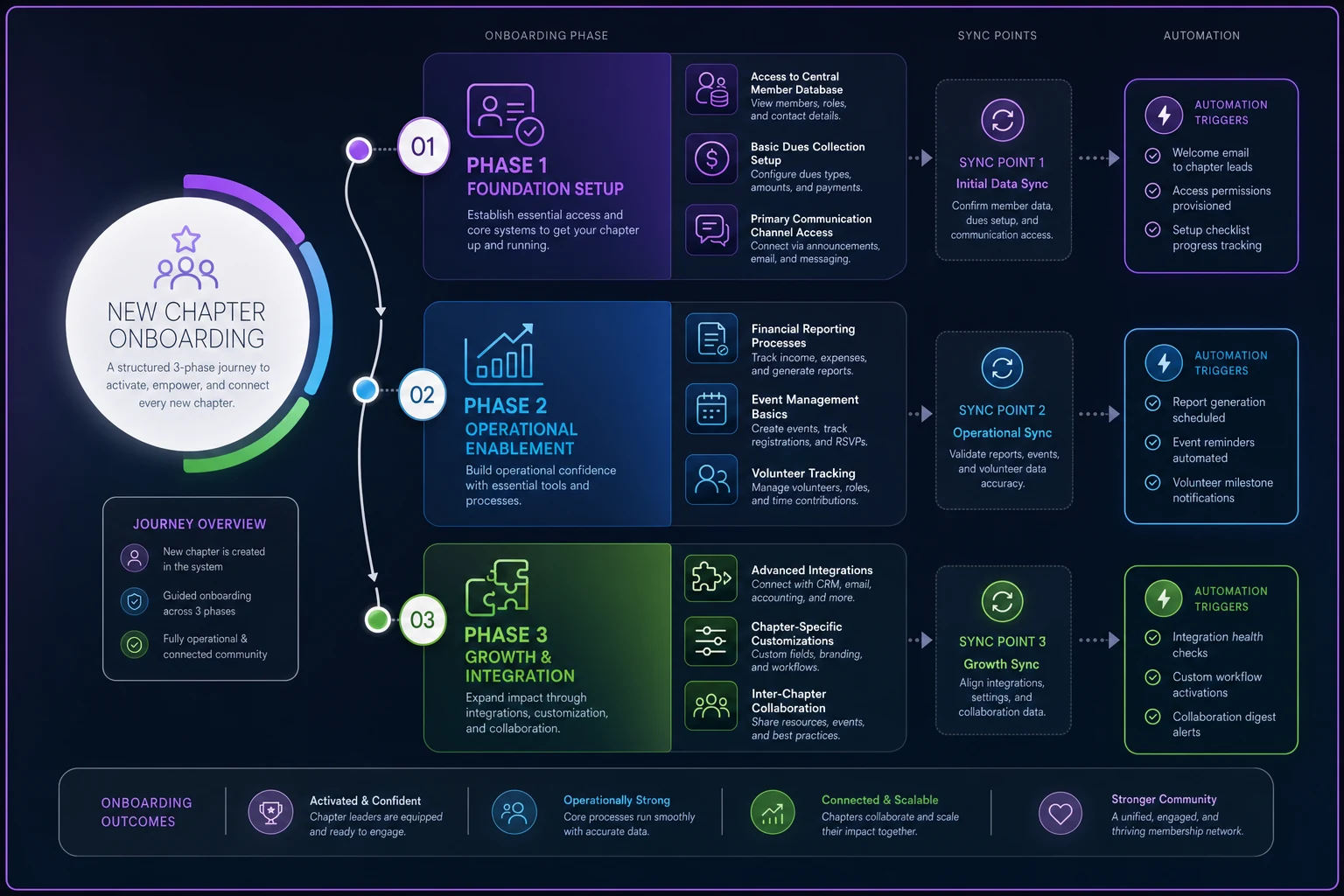
New chapter onboarding fails when you dump a 50-page operations manual on volunteers and expect compliance. Successful onboarding happens in phases, with technology doing the heavy lifting for standardization.
Phase 1 (First 30 days): Critical systems only
-
Access to central member database
-
Basic dues collection setup
-
Primary communication channel access
-
Minimum viable reporting requirements
Phase 2 (Days 31-90): Operational foundations
-
Financial reporting processes
-
Event management basics
-
Volunteer tracking systems
-
Member onboarding workflows
Phase 3 (After 90 days): Optimization and culture
-
Advanced features and integrations
-
Chapter-specific customizations
-
Performance metrics and goals
-
Inter-chapter collaboration tools
Smart onboarding uses templates and automation. Don't make the new chapter treasurer figure out the chart of accounts - give them a pre-configured QuickBooks template. Don't make them design member applications from scratch - provide the standard fields as a starting point they can customize.
Use templates and automation so new chapters focus on building membership instead of building systems.
Below is a simple visual of the phased onboarding workflow to share with chapters and volunteers.
A music education organization launches new chapters with a "starter kit" - pre-configured Google Workspace with templates for everything from board meeting agendas to concert programs. New chapters can focus on building membership instead of building systems.
Practical rules for dues flows that prevent chaos
Dues management across chapters needs clear rules that software can enforce, not policies that rely on human compliance.
| Rule | Description | Automation Requirement |
|---|---|---|
| Single payment destination per member | Members pay once to one place, regardless of chapter participation | Central payment processing with automatic distribution |
| Automated distribution with clear formulas | Pre-set percentages split automatically when payment processes | No manual journal entries or quarterly reconciliation |
| Grace periods and status changes sync everywhere | Delinquent status updates across all chapter systems immediately | Real-time status syncing between systems |
| Refunds follow the same path as payments | Refunds process through original payment system with automatic adjustments | Reverse the distribution automatically |
| Multi-chapter members pay premium, not double | Additional chapter participation as add-on fee, not full dues | System tracks primary chapter and additional affiliations |
A professional society with 6 chapters moved from chapter-collected dues to centralized processing. Delinquency rates dropped from around 18% to 11% just from consistent reminder emails and single payment portal. Finance committee meetings went from 3-hour reconciliation sessions to 45-minute reviews.
The automation piece is critical here. Volunteers don't have time to manually calculate chapter distributions or chase down payment discrepancies. The system needs to handle the complexity so humans can focus on member engagement.
Shared services that actually save money and time
Not every chapter needs their own everything. Shared services work when they reduce overhead without sacrificing chapter autonomy.
Centralized services that scale:
-
Bookkeeping and accounting makes the biggest impact. Instead of 5 volunteer treasurers each spending 10 hours monthly on books, one professional bookkeeper handles all chapters in 15 hours total. Standardized reporting, consistent processes, actual financial controls.
-
Member support and inquiries work better centralized too. Central help desk handles password resets, payment issues, basic questions. Chapters focus on programming and engagement instead of technical support.
-
Marketing and design support prevents the "each chapter creates their own flyer in Word" problem. Central team creates templates and assets chapters customize. Professional quality materials without five different design subscriptions.
-
Technology infrastructure consolidation saves money and headaches. One IT volunteer managing centralized systems beats five chapters each trying to maintain their own technical stack.
Services to keep distributed:
-
Local event planning stays with chapters. They know their venues, their volunteers, their member preferences.
-
Community partnerships and sponsorships need local management. These relationships are personal and location-specific.
-
Program delivery and content should reflect each chapter's member needs, not central mandates.
-
Volunteer recruitment and recognition works better locally since it's culture-specific and relationship-driven.
Shared services work when they reduce overhead without sacrificing chapter autonomy.
The cascading failures of poor centralization choices
Bad centralization decisions compound into operational nightmares. A hobby club with 4 chapters decided to centralize event registration to "simplify" operations. Forced all chapters onto a single Eventbrite account. Sounds reasonable in theory.
Chapter A runs professional development workshops. Needs LinkedIn integration, CPE credit tracking, corporate billing options. Chapter B runs social mixers. Needs Facebook events, casual RSVPs, Venmo for bar tabs. Chapter C runs competitions. Needs heat assignments, judge scheduling, equipment tracking.
Eventbrite handles none of these specialized needs well. Each chapter starts building workarounds. Google Forms for additional data. Spreadsheets for tracking. Manual processes everywhere.
Six months later, event attendance drops roughly 30% across all chapters. Registration friction increased. Members couldn't find their chapter's events among all the listings. Reminder emails went to everyone for every event. Competition participants got wine tasting invitations. Professional workshop attendees got marked absent from social mixers they never signed up for.
The "simplification" created more work, confused members, inaccurate tracking, and lost revenue. Reversal took four months and damaged member trust in online systems.
This pattern repeats when organizations centralize without understanding the operational differences between chapters. Centralization for the sake of simplicity often creates complexity in different places.
Data governance patterns that prevent information silos
Information silos kill multi-chapter operations slowly. Member joins Chapter A, volunteers extensively, builds relationships. Transfers to Chapter B for work. They're a stranger in the system. Their history, contributions, connections - all invisible.
Core data that must be centralized:
-
Member identity and contact information
-
Payment history and current status
-
Participation records and achievements
-
Communication preferences and opt-outs
-
Emergency contacts and medical information (if relevant)
Data that can live locally with sync requirements:
-
Event attendance (sync monthly)
-
Volunteer hours (sync quarterly)
-
Local program participation (sync annually)
-
Chapter-specific preferences (sync as needed)
Effective data governance needs clear rules about who can change what. Members update their own contact info. Only finance can modify payment status. Chapters manage local program enrollment.
One version of truth rule prevents conflicts: Any data point has one authoritative source. Member email? Central database. Local event attendance? Chapter system, synced to central monthly.
Regular reconciliation schedules matter too. Not "whenever someone remembers" but systematic. Weekly member status syncs. Monthly financial reconciliation. Quarterly volunteer hour compilation.
Software infrastructure that supports smart centralization
The technical stack for multi-chapter operations needs to balance centralization with flexibility. Monolithic systems promise everything but deliver rigidity. Completely distributed systems promise flexibility but deliver chaos.
Pattern 1: Central platform with chapter workspaces Using something like Monday.com or Notion at the organization level, with separate workspaces per chapter. Central templates and automation, local customization. Single billing, multiple operational spaces.
Pattern 2: Integrated best-of-breed Central CRM (like HubSpot) for member data. Distributed operational tools (various project management systems) connected via integration platform (Zapier/Make). Each chapter picks their tools, but data flows to central repository.
Pattern 3: Industry-specific with modules Association management system (Wild Apricot, MemberClicks) as the core. Chapters enable/disable features based on needs. Unified member experience, varied chapter operations.
Pattern 4: Custom middleware approach Chapters keep existing systems. Custom API layer sits between them, handling data synchronization and standardization. Higher initial investment, maximum flexibility long-term.
The anti-pattern to avoid: "Excel sheets and email forwards." A 6-chapter organization tried to manage 2,400 members this way. Treasurer spent 20+ hours monthly just consolidating reports. Members complained about receiving 14 duplicate emails for one event. New member onboarding took 3-4 weeks because forms got lost between chapters.
Modern AI-powered operational software helps with translation between different chapter formats. Chapter A submits expenses in PDF receipts, Chapter B uses expense reports, Chapter C forwards email receipts. AI processes all three into standardized financial records without forcing behavior change.
Making the transition without organizational revolt
Moving from decentralized chaos to smart centralization requires careful change management. Dropping new systems on chapters triggers resistance, shadow IT, and passive non-compliance.
-
Identify the bleeding wounds - What operational problem keeps everyone up at night? Start there.
-
Find your early adopter chapter - Usually the one whose treasurer is already building elaborate spreadsheet systems. They become your success story.
-
Run actual pilot programs - Not demos or trials, but real operational testing with willing chapters.
-
Provide transition support that matters - Data migration assistance, parallel running periods, regular office hours for questions, chapter-specific customization sessions.
-
Set realistic timelines - Full multi-chapter standardization takes 12-18 months minimum for established organizations. Rushing triggers errors and abandonment.
-
Build feedback loops - Monthly chapter representative calls where complaints get addressed, not just noted. Quarterly system reviews where you actually change things.
The organizations that succeed with these transitions treat it as organizational development, not just technology implementation. They invest in relationships and communication as much as software and processes.
The operational payoff of getting this right
Proper centralization transforms multi-chapter operations from constant firefighting to strategic growth. A regional professional association with 5 chapters made these changes over 14 months:
Before:
-
5 different member databases (3 spreadsheets, 1 Access database, 1 Google Sheets)
-
Monthly financials took 15-20 hours to compile
-
Member transfers required multiple emails and manual updates
-
Event cross-promotion happened randomly if at all
-
No accurate total membership count without calling each chapter
After implementing smart centralization:
-
Single member database with chapter tags
-
Automated financial reporting (2 hours monthly for review)
-
Member transfers happen with one form submission
-
Automated event promotion to relevant segments
-
Real-time membership dashboard for all leaders
Results after one year:
-
Membership grew roughly 22% (better retention from consistent experience)
-
Event attendance increased around 35% (cross-chapter promotion working)
-
Volunteer hours for administration dropped approximately 40%
-
First clean audit in organizational history
-
Launched 2 new chapters with 3-week onboarding instead of 3 months
The freed administrative capacity went into actual member value - more programs, better events, stronger advocacy. Volunteers could focus on why they joined the organization instead of fighting with spreadsheets.
The financial impact was significant too. Reduced administrative overhead meant more dues revenue stayed in programming. Better member retention improved long-term financial stability. Accurate membership data supported successful grant applications that had been impossible with fragmented records.
Lessons from organizations that got it wrong
Not every centralization attempt succeeds. A martial arts federation with 15 schools tried to centralize everything overnight. Forced uniform class scheduling software, standardized curriculum delivery, centralized belt testing records. Within 8 months, 4 schools dropped out of the federation.
What went wrong? They centralized operations that needed local flexibility while ignoring the infrastructure that actually needed coordination. Class schedules need to work with local gym availability and member preferences. But belt testing records absolutely should have been centralized - student moves between schools and their progress disappears.
Another example: A photography club network centralized social media management. Every chapter
Ready to streamline your club operations?
Join 500+ clubs using Clubyly to save time, boost member engagement, and grow their communities.