


The rowing club had 400 members and zero functioning governance structure. Board meetings ran three hours with nothing decided. The treasurer quit mid-season after discovering $18,000 in undocumented expenses. Two board members started a rival club, taking 60 members with them.
This wasn't some unique disaster. It's Tuesday in small club governance.
After working with clubs ranging from 50-member hobby groups to 3,000-member sports leagues, the same governance failures repeat themselves. Not because people are incompetent. Because clubs operate with corporate-sized complexity using napkin-level governance systems.
Most clubs think governance means filing annual reports and holding elections. That's compliance, not governance. Real governance is knowing exactly what happens when your treasurer disappears, your biggest sponsor pulls funding, or half your board resigns simultaneously. It's having escalation triggers before situations explode. It's documenting decision authority so you're not relitigating who can approve what every meeting.
The hidden complexity multiplier nobody talks about
Small clubs face governance challenges that corporations solve with entire departments. A 200-member tennis club might handle tournament operations across multiple venues, coaching staff management, equipment procurement and maintenance, member discipline issues, facility contracts worth hundreds of thousands, youth program compliance requirements, and sponsor relationships and obligations.
Now layer in volunteer board turnover every 12-24 months. New treasurers inheriting undocumented financial processes. Presidents learning their actual authority limits through conflict. Committees operating in silos with conflicting priorities.
The governance playbook isn't about legal frameworks. It's about operational reality. What breaks. What needs escalation paths. What causes clubs to implode.
Your risk register needs operational teeth
Traditional risk registers list obvious things like "financial loss" or "reputation damage." Useless. Your risk register needs specific triggers tied to specific actions.
Keep your membership organized and engaged.
Clubyly simplifies member management, event coordination, and payment collection—effortlessly.
- Unified member database
- Automated payment tracking
- Event scheduling & reminders
No credit card required
Financial triggers:
-
Bank balance drops below 2 months operating expenses → Immediate spending freeze except pre-approved items
-
Any single expense over 15% of monthly budget → Requires two board signatures
-
Membership drops 20% in any quarter → Activate retention protocol, pause new initiatives
-
Sponsor payment delayed 30+ days → CFO personally contacts, board notified at 45 days
Operational triggers:
-
Key volunteer misses 3 consecutive commitments → Backup activated, succession planning triggered
-
Event registration below 60% two weeks out → Go/no-go decision required
-
Member complaint unresolved for 14 days → Escalates to VP automatically
-
System downtime exceeds 4 hours → Emergency communication protocol activated
Governance triggers:
-
Board attendance below 50% for two consecutive meetings → Special session required
-
Committee goes 60 days without reporting → Committee suspended, responsibilities reassigned
-
Conflict between board members becomes public → External mediator engaged within 72 hours
-
Vote fails to reach quorum twice → Decision defaults to executive committee
These aren't vague concerns. They're specific situations with specific thresholds and specific responses. When these triggers hit, everyone knows exactly what happens next without emergency texts or panic meetings.
The escalation matrix that prevents midnight crisis calls
Most clubs handle escalation like this: problem happens, people panic, everyone texts everyone, eventually someone makes a decision, nobody knows if it was the right person, drama ensues.
Build your escalation matrix before you need it:
| Issue Category | Level 1 Response | Level 2 (if unresolved 48hrs) | Level 3 (crisis mode) |
|---|---|---|---|
| Member disputes | Committee chair handles | VP Member Services | Full board review |
| Financial shortfall | Treasurer + President | Executive committee | Emergency board meeting |
| Venue/facility problem | Operations manager | Facility committee | President negotiates |
| Safety incident | Immediate suspension | Insurance + legal counsel | Crisis communication team |
| Volunteer no-show | Coordinator finds backup | Committee restructure | Board recruits directly |
| Technology failure | Admin attempts fix | Vendor support engaged | Manual processes activated |
| Sponsor conflict | Relationship manager | Development committee | President intervenes |
Each level has different authority. Level 1 can spend up to $500 solving problems. Level 2 can authorize $2,500. Level 3 has full emergency powers. Document this. Share it. Update it quarterly based on what actually happened.
Keep a one-page printed matrix in the operations binder for night-time calls.
The beauty of this system? When someone calls you at 11 PM about a venue cancellation, you check the matrix and know exactly who handles it. No debate about authority. No wondering if you're overstepping.
Template: The committee charter that actually works
Committees without clear charters become either dictatorships or ghost towns. Neither helps your club.
[Committee Name] Operating Charter
Decision Authority:
-
Can approve expenses up to $[amount] per item, $[total] per month
-
Can make operational decisions affecting fewer than [number] members
-
Cannot change club-wide policies without board approval
-
Cannot enter contracts exceeding $[amount] or [duration]
Reporting Requirements:
-
Monthly update to board (5 minutes max)
-
Quarterly metrics
[specific KPIs]
-
Annual budget request by [date]
-
Immediate escalation if
[specific triggers]
Composition:
-
Minimum [number] members, maximum [number]
-
Must include at least one board member
-
Terms
[duration] with [overlap structure]
-
Removal
[specific process]
Meeting Cadence:
-
Required
[frequency]
-
Quorum
[number/percentage]
-
Decisions documented within 48 hours
-
Minutes accessible to all board members
Scope Boundaries:
-
Explicitly responsible for
[list]
-
Explicitly NOT responsible for
[list]
-
Requires board approval for
[list]
-
Coordinates with [other committees] on
[list]
Fill this out for every committee. The finance committee can't suddenly decide they own member communications. The events committee can't commit to venue contracts beyond their authority. Everyone knows their lane.
This template works because it eliminates the endless arguments about who can do what. When questions arise, you check the charter. Done.
The member incident flowchart everyone needs but nobody has
Member issues spiral because nobody knows the process. Someone complains about inappropriate behavior. Who investigates? What's the timeline? When does suspension happen? How do appeals work?
-
Incident Reported - Any board member or staff can receive report, document within 24 hours using standard form, notify president and relevant committee chair immediately. If safety issue: immediate temporary suspension allowed.
-
Initial Assessment (48 hours) - Designated investigator assigned (rotate list), determine if immediate action needed, contact involved parties for statements, document everything in shared (but confidential) system.
-
Investigation (5-7 days) - Gather evidence, interview witnesses, review relevant policies, prepare recommendation.
-
Decision - Minor issues
Committee decides. Moderate issues: Executive committee decides. Major issues: Full board decides. Criminal issues: Refer to authorities, suspend pending outcome.
-
Communication - Notify affected parties within 24 hours of decision, update incident log. If suspension/expulsion: notify necessary systems/access points. If pattern emerging: trigger policy review.
-
Appeal Process - Member has 14 days to appeal, different panel reviews, final decision within 30 days, board decision final.
Use this flow as your club's incident process map.
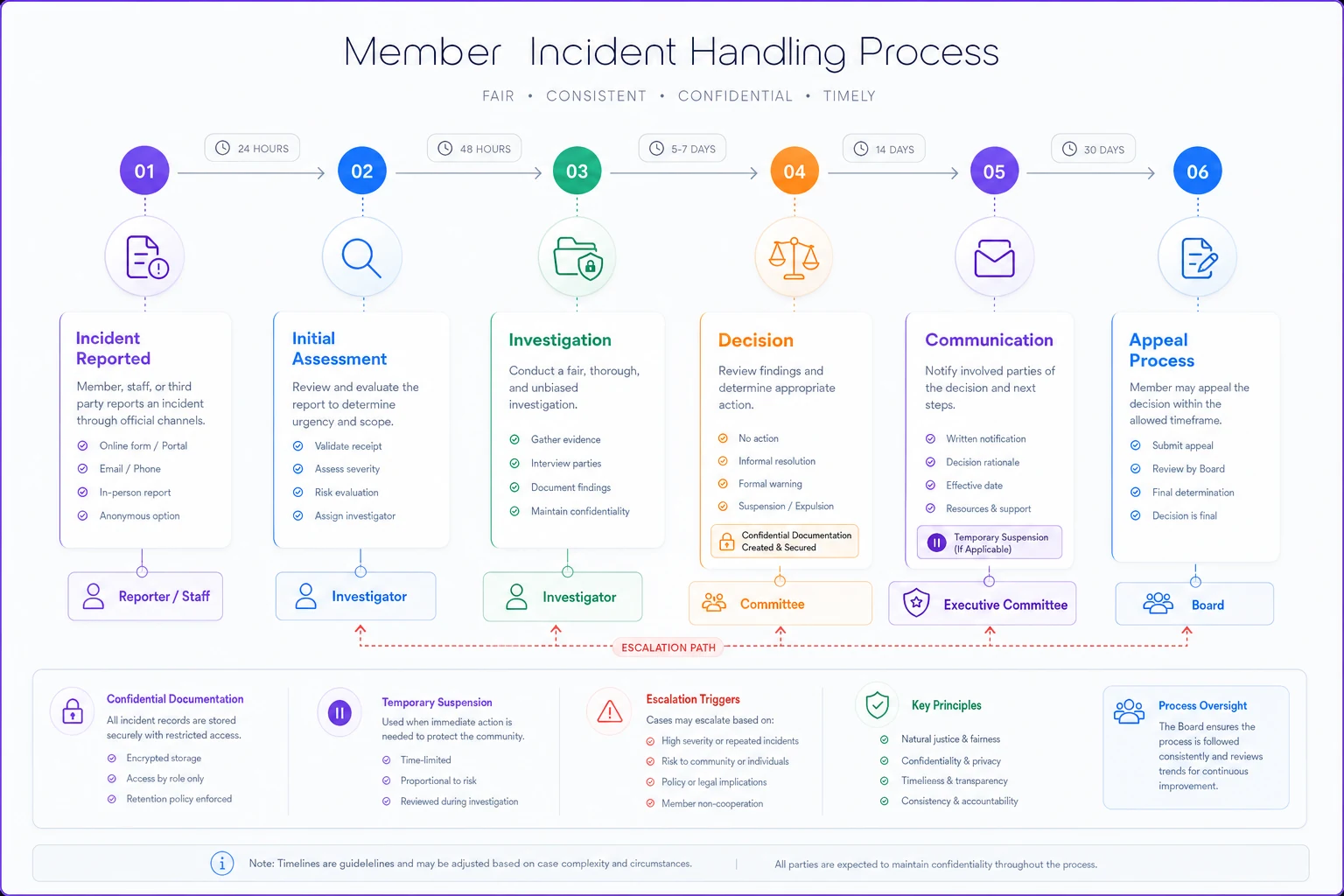
Having this mapped means nobody improvises during emotional situations. The process exists. Follow it. Defend it if questioned.
The key insight? Most member incidents become disasters because of process failures, not because the incident itself was unsolvable.
When succession planning means survival
Youth soccer club, 800 members. Treasurer managed everything through personal spreadsheets. Had a stroke. Nobody could access accounts for three weeks. Nearly missed payroll for 12 coaches. Lost $40,000 in early registration discounts because nobody knew the process.
Succession planning isn't about death. It's about Tuesday when someone doesn't show up.
Critical Role Redundancy Map:
-
Every critical role has a documented backup
-
Backup has system access (view-only minimum)
-
Monthly 15-minute shadow session
-
Quarterly role swap (backup performs role for one cycle)
-
Annual full documentation review
Access Continuity:
-
All passwords in shared management system
-
Bank accounts require two active signatories
-
Critical vendors know primary and backup contacts
-
Domain names/tech accounts owned by organization not individuals
-
Physical keys/access cards tracked centrally
Knowledge Transfer Triggers:
-
Role change announced
30-day overlap required
-
Unexpected absence >72 hours
Backup activates
-
Performance concerns raised
Shadow increase to weekly
-
Term ending in 6 months
Successor identification begins
The rowing club that started this article? Their treasurer disappeared. But they had built these systems. New treasurer was operational in 48 hours instead of 48 days.
The financial controls that prevent your next scandal
The sailing club treasurer ran personal expenses through the club card for two years. Nobody noticed until the audit. The tennis league president's spouse got paid $30,000 for "consulting." The board approved it... verbally... allegedly.
Financial governance isn't about trust. It's about systems that protect everyone.
Automated Controls:
-
Dual approval for anything over $1,000
-
Monthly variance reports auto-generated
-
Vendor payments require invoice attachment
-
Board members can't approve their own reimbursements
-
Credit card statements visible to entire board
Review Cycles:
-
Monthly
Treasurer reports actuals vs budget
-
Quarterly
Different board member spot-checks 10 transactions
-
Annually
External review (doesn't need to be full audit)
-
Change of treasurer
Complete handoff audit required
Conflict Documentation:
-
Board members declare conflicts annually
-
Specific declaration before relevant votes
-
Documented recusal from discussion and vote
-
Vendor relationships disclosed and tracked
-
Family member employment requires supermajority approval
These controls seem bureaucratic until they save your club from scandal. Then they seem brilliant.
Building your operational decision log
Clubs relitigate the same decisions because nobody documents what was decided or why. Should we allow guests at member events? Didn't we vote on this last year? Who knows, Sarah quit and took her notes.
Your decision log captures:
-
Date of decision
-
Who participated
-
What was decided
-
Vote count
-
Key considerations
-
Review trigger (when to revisit)
-
Implementation owner
This becomes searchable institutional memory. New board members review it during onboarding. Committees check it before proposing changes. You stop having the same arguments every time board composition changes.
The log isn't just record-keeping. It's pattern recognition. You'll notice which decisions keep getting revisited, which board members consistently oppose certain types of changes, which committees need more authority to function effectively.
The communication protocol that prevents information chaos
Information silos kill clubs. The membership committee doesn't know the finance committee froze spending. The events team doesn't know facilities double-booked the venue. The president doesn't know the secretary quit three weeks ago.
Structured Information Flow:
-
Daily Operations
Handled within committees, logged in shared system
-
Weekly Exceptions
Anything unusual flagged to executive committee
-
Monthly Rollup
All committees provide standard update
-
Quarterly Strategy
Board reviews trends, adjusts priorities
-
Annual Planning
Full membership gets transparency report
Emergency Communications:
-
Priority 1 (Safety)
Immediate all-board notification, response within 1 hour
-
Priority 2 (Operational)
Executive notification, response within 4 hours
-
Priority 3 (Administrative)
Next business day response acceptable
-
Priority 4 (Strategic)
Addressed at next regular meeting
System Integration Points:
This is where governance meets modern operations. Instead of email chains and forgotten updates, operational platforms track decisions automatically. When the facilities committee approves venue spending, finance sees it immediately. When membership flags a complaint, the ethics committee gets notified. When volunteer hours drop below threshold, the board gets an alert.
AI-powered governance tools now handle the mundane tracking that burns out volunteer boards. Automated escalation when thresholds hit. Intelligent routing of member issues. Pattern detection on financial anomalies before they become problems. The governance playbook stays the same, but the execution gets dramatically more efficient.
Modern operational software transforms governance from reactive firefighting to proactive management. The same decisions get made, but with better information, faster routing, and documented trails that survive board turnover.
The early warning dashboard you'll wish you'd built sooner
Traditional board reports show what already happened. Useful like yesterday's weather forecast. You need leading indicators that show problems forming.
Operational Health Signals:
-
Volunteer hours trending (3-month rolling average)
-
Member engagement score (event attendance + program participation)
-
Days to resolve member issues (median not average)
-
Committee meeting attendance rates
-
Financial runway in months
-
Percentage of budget committed vs elapsed time
When volunteer hours drop 20% month-over-month, you're six weeks from program failures. When member issue resolution stretches beyond 10 days, you're about to see retention problems. When committee attendance drops below 60%, decisions stall and frustrated volunteers quit.
Track the signals that predict problems, not just document disasters. This dashboard becomes your club's early warning system, highlighting brewing issues before they explode into emergency board meetings.
Moving from reactive to systematic governance
Small clubs fail at governance because they treat it like paperwork instead of operations. They focus on bylaws instead of workflows. They document policies but not processes.
Your governance playbook isn't about legal compliance. It's about operational reality. Knowing exactly what happens when things go wrong because you've mapped it. Having escalation triggers before personality conflicts become organizational crises. Building systems that survive volunteer turnover.
The rowing club from the beginning? They implemented this playbook. Board meetings dropped to 90 minutes. Financial transparency went from annual surprise to monthly routine. When their next treasurer left (planned this time), the transition took two days not two months. When board conflicts arose, they had a mediator engaged before members even heard about it.
Governance failures aren't inevitable. They're predictable. And preventable. But only if you build the operational systems before you need them.
Most clubs won't. They'll keep running three-hour meetings discussing the same issues. They'll keep losing institutional knowledge every election cycle. They'll keep handling crises through group texts and emergency meetings.
Your club doesn't have to be most clubs. Build the playbook. Document the triggers. Map the escalations. Create the templates. The best time was three years ago. The second best time is before your next board meeting.
Because Tuesday's coming, and with it, another completely preventable governance crisis that somebody's club won't be ready for. Don't let it be yours.
Ready to streamline your club operations?
Join 500+ clubs using Clubyly to save time, boost member engagement, and grow their communities.