


Most clubs lose around 40% of new members within the first month. Not because people change their minds about joining—because the gap between signup and first real engagement stretches too long. A cycling club I worked with last year got 50 new signups after their spring recruitment drive, then watched 20+ disappear before the first group ride.
The problem wasn't their welcome packet or membership benefits. It was the dead zone between clicking "join" and actually feeling like a member.
Working with different clubs—book clubs with 30 members, professional associations with thousands—the same pattern shows up. New members need specific touchpoints at specific intervals, or they drift away. Not because they're uninterested, but because clubs assume enthusiasm carries itself forward without operational support.
Why Traditional Welcome Sequences Fail
Standard club onboarding: automated welcome email, maybe a PDF handbook, invitation to next month's meeting. Then radio silence for three weeks. By the time that meeting happens, the new member has mentally moved on.
Clubs treat onboarding like a one-way information dump instead of a two-way activation process. You're not just informing new members—you're watching for engagement signals and adjusting based on their responses.
A chess club in Portland tracked their numbers. Members who got their standard welcome packet had 55% attendance at their first event. Members who got daily touchpoints for two weeks? 85% showed up, and 70% were still active after three months.
The difference was operational cadence. Instead of one big welcome followed by silence, they created multiple small reasons to engage. Not overwhelming—just consistent presence that made new members feel part of an active community from day one.
The Framework That Actually Works
This sequence produces strong activation rates across different club types. It's pulled from operational data across hobby groups and professional associations.
Keep your membership organized and engaged.
Clubyly simplifies member management, event coordination, and payment collection—effortlessly.
- Unified member database
- Automated payment tracking
- Event scheduling & reminders
No credit card required
Here's a visual of how the sequence flows.
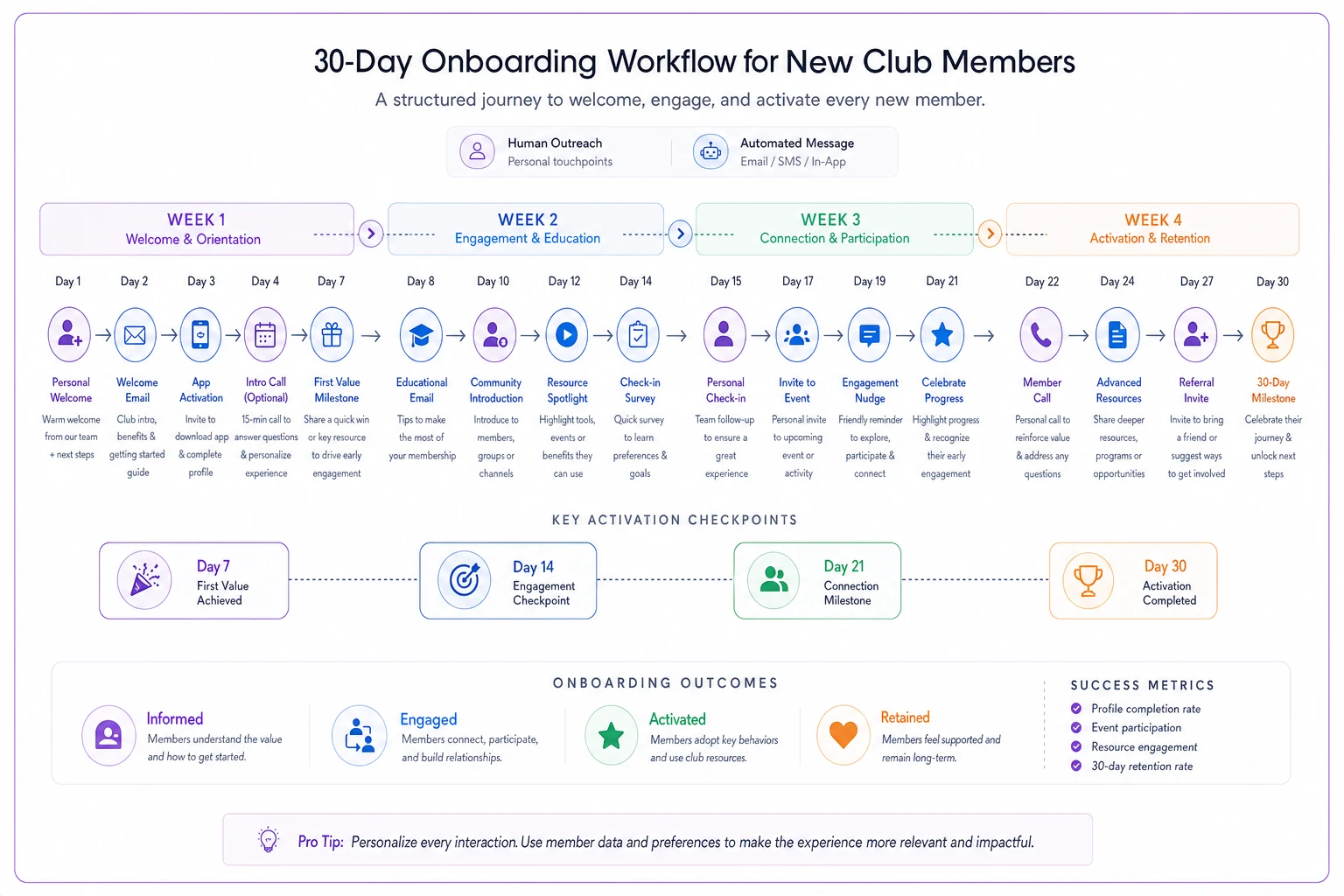
Days 1-7: Immediate Integration
Day 1: Personal welcome + quick win Send two things within 4 hours of signup. First, a personal message from an actual member (not the president, someone relatable). Second, give them something they can do immediately—access to your resource library, discount code, whatever makes membership feel worthwhile right away.
Day 2: Show them the community Share something happening now in the club. Photos from yesterday's workshop, discussion highlights from your forum, preview of next week's speaker. Make them see activity, not just read about benefits.
Day 3: First soft ask One simple way to engage with minimal commitment. Vote in a poll about next month's event. Comment on a discussion post. RSVP interest (not commitment) for an upcoming activity.
Day 4: Member spotlight Feature another relatively new member who's getting value from the club. Include their story about why they joined and what they've gained. This tackles imposter syndrome early.
Day 5: Direct outreach Have an actual human send a personal message. Not a form letter—reference something specific from their application. Ask one question they can easily answer.
Day 6: Resource deep dive Highlight one specific club resource they might have missed. Don't list everything again—pick what's most relevant to why they joined and show them exactly how to use it.
Day 7: Week one celebration Acknowledge they've been a member for a week. Share what's coming in week two. Include testimonial from a long-term member about their first month.
Days 8-14: Building Connections
Day 8: Volunteer micro-opportunity The smallest possible volunteer task. Something that takes 10 minutes online. Survey feedback, caption contest judge, anything that makes them contribute without overwhelming them.
Day 9: Social introductions Facilitate introductions to 2-3 other members with similar interests. Don't suggest they network—literally make the introduction with context about what they have in common.
Day 10: Educational content Share your best educational content related to the club's focus. Position it as "what our current members say helped them most when starting out."
Day 11: Event spotlight with social proof Detail your next event, but focus on who's attending. "Jennifer and Marcus from last month's new member group will be there, along with..."
Day 12: Progress checkpoint Brief survey (3 questions max) about their experience so far. This gathers feedback and makes them reflect on membership value.
Day 13: Exclusive new member perk Something only available to members in their first 30 days. Early registration for a popular workshop, one-on-one time with an expert member, something special and time-sensitive.
Day 14: Two-week milestone Celebrate the two-week mark with data about what other members typically achieve by this point. Positive peer pressure through success examples.
Days 15-21: Deepening Engagement
Day 15: Committee introduction Explain your club's different committees or interest groups. Don't recruit yet—just help them understand the ecosystem and where they might fit.
Day 16: Behind-the-scenes content Share something about how the club operates. Budget allocation, how events get planned, what the board does. Transparency builds trust.
Day 17: Member matching Use their survey responses to suggest specific members they should connect with. Provide conversation starters based on shared interests.
Day 18: Skill-sharing invitation Ask what skills they could share with other members. Everyone has something to contribute—help them identify it and feel valuable.
Day 19: Subgroup nudge If you have geographic or interest-based subgroups, encourage joining the most relevant one. Smaller communities often drive stronger connections.
Day 20: Relevant success story Detailed case study of a member with similar goals who achieved something meaningful through the club. Make it specific enough they can see themselves in it.
Day 21: Three-week reflection Personal video or voice message from leadership thanking them and highlighting what makes new members valuable.
Days 22-30: Activation and Commitment
Day 22: Real volunteer ask They've seen the community, understand the value, made connections. Present 2-3 specific opportunities with clear time commitments.
Day 23: Peer testimonial Message from someone who joined around the same time last year. Include honest challenges alongside successes.
Day 24: Advanced learning opportunity Access to content or training usually reserved for established members. Position it as investing in their development early.
Day 25: Community contribution request Ask them to create something small. Blog post, resource recommendation, photo from applying what they've learned.
Day 26: Next month preview Detailed preview of next month's activities with personal recommendations based on their interests and engagement patterns.
Day 27: Feedback implementation Show how feedback from new members has shaped recent club decisions. Their voice matters even as newcomers.
Day 28: Connection celebration Highlight the connections they've made and encourage strengthening one specific relationship.
Day 29: Mentor matching Introduce mentorship opportunities. They know enough now to choose wisely rather than getting randomly assigned.
Day 30: Graduation and next steps Celebrate completing their first month with specific acknowledgment. Present clear pathways for deeper involvement with 3-month and 6-month milestones.
Tracking What Matters
The right metrics tell you whether your onboarding works rather than hoping it does.
| Metric | Target by Day 30 | Red Flag If Below |
|---|---|---|
| First engagement (any action) | 95% by Day 3 | 80% |
| Event attendance | 60% attend something | 40% |
| Community interaction | 70% post/comment | 50% |
| Volunteer interest expressed | 40% show interest | 25% |
| Profile completion | 80% fully complete | 60% |
| Second month renewal | 85% continue | 70% |
Raw numbers only tell part of the story. Track engagement velocity—how quickly members move from one activation milestone to the next. Members who hit three milestones in week one are much more likely to remain active at six months.
Common Pitfalls
Overwhelming with options A hiking club sent new members their full event calendar (47 events) on day two. Engagement dropped to zero. Too many choices paralyze. Recommend 2-3 specific opportunities based on their interests.
Generic messaging Your 22-year-old college members and 55-year-old professionals need different approaches. Not different content necessarily, but different framing. A photography club doubled their activation rate by creating three persona-based sequences.
Stopping after first response Many clubs celebrate when a new member RSVPs to an event, then stop the sequence. That's when you should increase touchpoints—they've shown interest but haven't committed behavior yet.
Delegating without systems Volunteer-run clubs often assign new member outreach to whoever's available, without templates or tracking. One member gets three phone calls, another gets forgotten. The operational breakdown happens fast when there's no consistent process.
When Automation Helps
The most effective sequences blend automated consistency with human touchpoints. Set up your operational platform to handle routine tasks while flagging moments for personal intervention.
A professional association I worked with automated daily content sends and engagement tracking, but their system notified volunteers when members hit certain triggers—first forum post, event registration, concerning inactivity patterns. Volunteers could focus on high-impact personal outreach rather than managing spreadsheets.
Automate the schedule and tracking, personalize the critical moments. Your welcome email can be automated. Your response when they share why they joined should feel human. Event reminders can be systematic. The message after they attend their first event should reference specific moments from that gathering.
AI-powered operational software helps with pattern recognition—identifying which members are at risk based on engagement patterns compared to successful activations. Instead of guessing who needs extra attention, your system flags specific members with context about their interests and activity.
Adapting for Different Club Types
Professional associations need immediate value through resources and networking. Front-load industry insights, member directory access, and professional development opportunities in week one.
Hobby clubs should reduce skill intimidation. Day 3 might include "beginner-friendly" event labeling and partnering new members with patient mentors early rather than late.
Athletic clubs require earlier physical participation. Virtual engagement only goes so far when the core value is physical activity. Push for in-person attendance by day 10, even if just watching.
Service organizations should introduce mission impact immediately. Show exactly how member participation translates to community benefit. Include volunteer opportunities from day 5, starting small.
The Discipline Problem
This system requires operational discipline most clubs lack. Not because it's complex, but because it demands consistent execution for every single new member, every month. Clubs that succeed either have dedicated staff (rare), incredibly committed volunteers (temporary), or operational systems that make consistency automatic (sustainable).
A 300-member professional group tried implementing this manually with volunteer coordination. They lasted six weeks before the system collapsed. After setting up automated workflows with manual triggers for personal touchpoints, they've maintained it for 18 months with less total effort.
Investment in proper 30-day onboarding—whether through disciplined volunteer coordination or operational automation—pays off through reduced churn, increased engagement, and members who actually become part of your community rather than names on a roster. Most clubs know this sequence works because they've seen it succeed elsewhere. The gap between knowing and doing is where operational software makes the difference.
Making It Sustainable
The gap between knowing this works and actually implementing it consistently is where most clubs fail. You need clear ownership, systematic tracking, and gradual automation of what works.
-
Start by running the sequence manually for one cohort.
-
Document everything—what messages resonate, which touchpoints get responses, where people disengage.
-
Use this data to refine your approach before scaling.
Then build your operational foundation. Whether that's spreadsheets and calendar reminders or a proper membership management platform, you need systems that ensure no member falls through the cracks. The cycling club that lost 40% of spring signups? They now retain around 75% because their system automatically tracks engagement and alerts volunteers when someone needs attention.
The transformation doesn't happen because of any single message or touchpoint. It happens because you maintain presence and provide value consistently enough that joining your club becomes part of their identity, not just another subscription they forgot about.
Ready to streamline your club operations?
Join 500+ clubs using Clubyly to save time, boost member engagement, and grow their communities.