


Running a membership organization feels deceptively simple until you hit about 200 members. That's when the spreadsheet tracking new applicants stops syncing with the renewal database, your chapter leads start making conflicting decisions about member status, and you realize three months too late that your highest-value members quietly churned because nobody noticed their engagement dropping.
The problem isn't that club managers don't care about member lifecycles. Most clubs treat each stage—prospect, applicant, new member, active member, at-risk, churned, alumni—as separate operational problems instead of one connected system. You end up with seven different tracking methods, no clear handoff points between stages, and critical decisions getting made based on whoever happens to check their email first.
You end up with seven different tracking methods, no clear handoff points between stages, and critical decisions getting made based on whoever happens to check their email first.
The Operational Reality Most Clubs Face
A typical 400-member professional association might have members spread across something like this: 60 prospects in various stages of interest, 25 active applications, 280 current members (with wildly different engagement levels), 20 members whose renewal is overdue, and 15 recent departures who might come back. Each group needs different things, gets tracked differently, and falls under different staff responsibilities.
What usually happens? The membership director owns prospect tracking in a CRM. The admin team manages applications through email and spreadsheets. Chapter leads handle member engagement through their own systems. Finance tracks renewals in QuickBooks. Alumni relations... that's usually just an email list that gets updated twice a year.
This fragmentation creates three specific operational failures that compound as you grow.
You lose visibility into transitions. When someone moves from prospect to applicant, or from active to at-risk, there's no systematic handoff. The membership director might spend weeks nurturing a prospect, but once they apply, all that context disappears into an admin inbox. An engaged member starts missing events, but nobody notices because engagement tracking lives in a different system than renewal tracking.
Decisions happen in isolation. Your New York chapter might approve members with completely different criteria than your Boston chapter. One staff member might offer a discount to win back a lapsed member while another is strictly enforcing late fees. There's no central decision framework, so every situation becomes a one-off judgment call.
Automation becomes impossible. You can't set up intelligent workflows when your data lives in seven places. You can't trigger retention campaigns based on engagement drops when engagement and membership status are tracked separately. Every action requires manual intervention, which means important actions simply don't happen.
Why Traditional Fixes Make Things Worse
Most clubs try to solve this by adding more tools or more process documentation. They'll implement a new CRM for prospects, add engagement tracking software for active members, create detailed SOPs for each lifecycle stage. But adding more systems to a fragmented operation just creates more fragmentation.
Keep your membership organized and engaged.
Clubyly simplifies member management, event coordination, and payment collection—effortlessly.
- Unified member database
- Automated payment tracking
- Event scheduling & reminders
No credit card required
A 1,200-member trade association spent $40,000 on enterprise software that was supposed to unify their member management. Six months later, they were still using spreadsheets for half their processes because the software couldn't handle their chapter structure, their event types, or their certification pathways. The vendor kept promising customization, but every customization broke something else.
The other common attempt is to centralize everything through pure human coordination. Hire a "Member Success Manager" to manually track everyone through every stage. This works until that person takes vacation, or until you grow past what one person can track, or until they quit and take all the institutional knowledge with them.
Neither approach addresses the core issue: you need a single operational system that handles the entire lifecycle, not just better tracking of individual stages.
Building a True Lifecycle System
A functioning membership lifecycle system connects three elements that usually operate separately: stage definitions with clear transition triggers, role-based decision authority, and automated workflows that actually match how your club operates.
Start with stage definitions that reflect operational reality, not marketing theory. Instead of generic labels like "engaged member," define stages based on actions and timeframes. "Applied within last 14 days." "Attended 2+ events in past quarter." "Renewal due within 30 days." "Lapsed 31-90 days ago." These aren't just labels—they're operational triggers that determine what happens next.
Each transition between stages needs three things documented:
The trigger: What specific event or timeframe moves someone to the next stage? Application submitted. Payment processed. Three months without event attendance. These need to be observable facts, not subjective assessments.
The decision owner: Who has authority to handle edge cases? Can chapter leads override automatic transitions? Who approves expedited applications? Who decides if a lapsed member gets a win-back offer versus standard renewal notice?
The handoff process: What information moves forward, what gets archived, and what triggers the next set of actions? When someone becomes an active member, their application data should transform into their member profile, their prospect nurture sequence should stop, and their onboarding sequence should start.
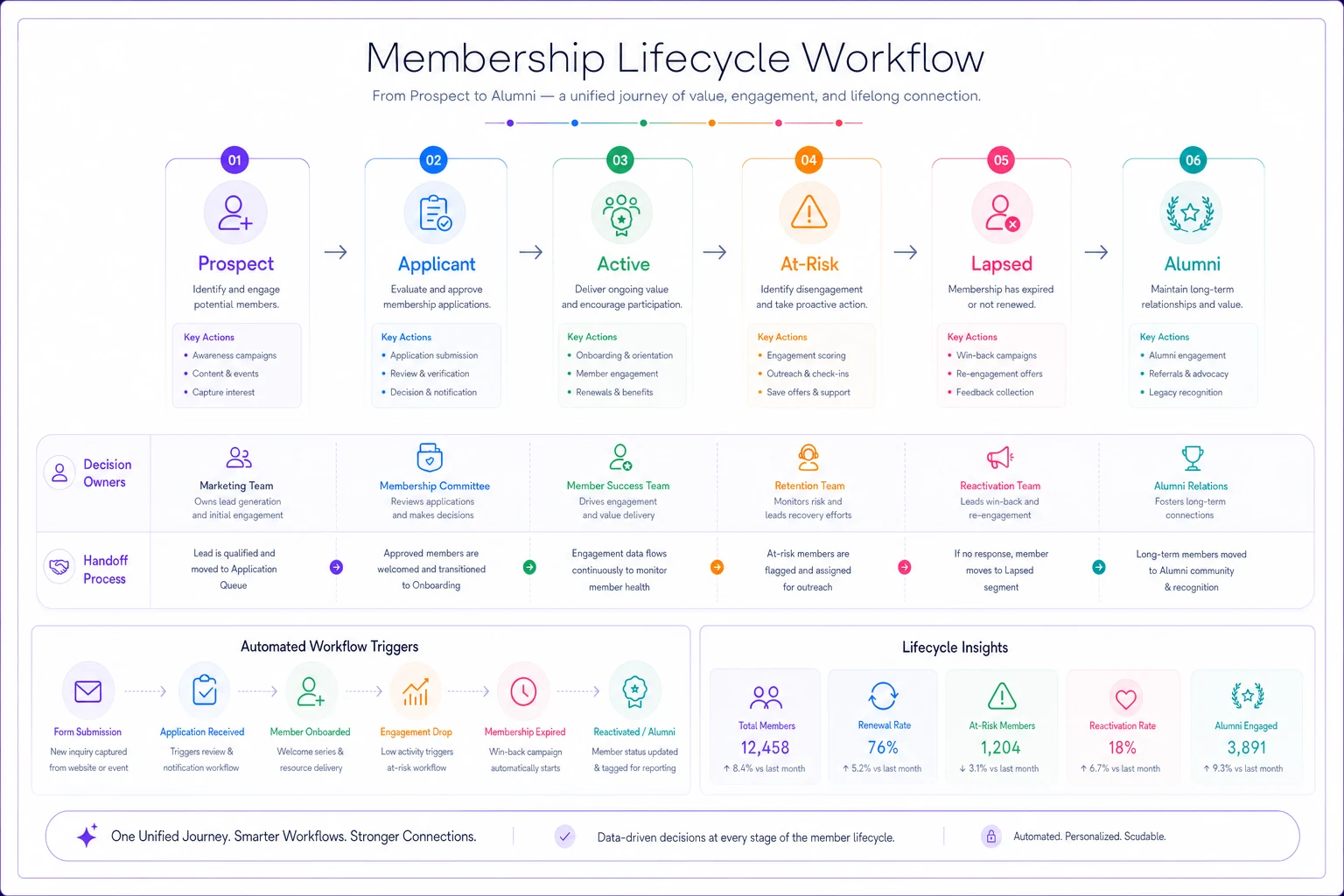
This diagram shows how stage definitions, decision authority, and automated workflows connect in a single operational system.
When these three elements are connected, decisions are consistent, handoffs are visible, and automation can be safely applied.
KPIs That Actually Drive Decisions
KPIs in a lifecycle system aren't just for reporting—they're operational triggers. Most clubs track vanity metrics like total membership or renewal rate. But operational KPIs need to drive immediate action.
For acquisition stages, track velocity rather than just volume. How long does someone stay in prospect stage before applying or dropping off? If your average prospect-to-application time is 47 days but someone's been a prospect for 90 days, that's an operational trigger for intervention, not just a statistic.
For active members, track engagement patterns, not just engagement scores. If someone usually attends monthly events but misses two in a row, that pattern change matters more than their overall engagement score. A previously active committee member who stops volunteering is a leading indicator of churn, not just a participation metric.
For at-risk and lapsed stages, track response rates to interventions, not just intervention volume. If your 30-day win-back campaigns have a 15% response rate but your 60-day campaigns only get 3%, that tells you something critical about timing. You can only track this if interventions are systematic, not ad hoc.
Your KPIs should create a feedback loop:
-
Stage-specific metrics trigger interventions
-
Interventions get tracked for effectiveness
-
Effective interventions become standard workflows
-
Workflows generate new metrics to track
Your KPIs should create a feedback loop:
Automation Points That Scale Without Breaking
The temptation with lifecycle automation is to automate everything immediately. This breaks down the moment you hit an edge case, which in membership organizations is roughly every third application.
Instead, identify automation points based on two criteria: volume and variance. High-volume, low-variance processes should be automated first. Standard renewal reminders. Welcome emails for approved members. Event registration confirmations. These happen frequently and follow consistent patterns.
Low-volume or high-variance processes need human decision points with automated support. Complex applications might need review, but the review request, information gathering, and communication can be automated. A high-value member showing churn signals might need personal outreach, but identifying them and alerting the right person should be automatic.
Start with high-volume, low-variance automations like renewals and confirmations to build confidence and measurable gains before tackling edge cases.
Automation at different scales:
| Scale | Automation |
|---|---|
| Under 200 members | Automate communications and reminders. Application confirmations, renewal notices, event announcements. Keep decisions and exception handling manual but systematically tracked. |
| 200-500 members | Add automated stage transitions for clear-cut cases. Approved applicants automatically become new members. Members who don't renew within 60 days automatically move to lapsed status. But keep override ability for edge cases. |
| 500+ members | Implement conditional automation with branching logic. If a lapsed member was highly engaged, trigger win-back campaign A. If they were minimal participants, trigger campaign B. If they're corporate sponsored, alert account manager instead. |
Under 200 members: Automate communications and reminders. Application confirmations, renewal notices, event announcements. Keep decisions and exception handling manual but systematically tracked.
Team Roles Across the Full Lifecycle
Most membership organizations assign roles by function: someone handles applications, someone else handles renewals, someone else handles events. But lifecycle management requires roles that span stages while maintaining clear ownership.
The Acquisition Owner manages prospects through new member onboarding. They need visibility into why prospects don't convert, why applications get abandoned, and how quickly new members engage. Their KPIs include prospect-to-member conversion rate and new member 90-day retention.
The Engagement Owner manages active member experience and early warning systems. They track participation patterns, identify at-risk members before they churn, and coordinate retention interventions. They need to see both individual member journeys and cohort patterns.
The Recovery Owner handles at-risk through alumni stages. This isn't just about win-back campaigns—it's about understanding why members leave, which ones are worth pursuing, and how to maintain alumni relationships for potential future re-engagement.
In smaller organizations, these might be the same person wearing different hats. The roles and responsibilities need to be distinct, with clear handoffs between lifecycle stages.
Rollback and Triage Flows
Not every member follows a linear path from prospect to alumni. Your system needs to handle rollbacks and special situations without breaking.
Common rollback scenarios:
-
An approved member's payment fails after onboarding starts
-
A lapsed member reactivates mid-campaign
-
An alumni wants to rejoin but has outstanding obligations
-
A new member immediately becomes at-risk due to a service issue
Each rollback needs a defined process. If a payment fails after approval, do they return to applicant status or enter a grace period? If a lapsed member reactivates, do they get new member onboarding or returning member recognition? These aren't just policy questions—they're operational workflows that need to be systematically handled.
Triage flows handle urgent situations that cut across normal lifecycle stages. A high-value member threatening to leave. A corporate account considering cancellation. A service failure affecting multiple members. These need escalation paths that bypass normal stage progression while still maintaining systematic tracking.
Alumni Pathways Beyond "Former Member"
Most organizations treat alumni as "former members" and nothing more. Alumni pathways can be revenue and engagement drivers if you build them into your lifecycle system.
Alumni aren't a single category:
-
Positive departures (relocated, retired, changed careers)
-
Neutral departures (financial priorities, time constraints)
-
Negative departures (service issues, disagreements)
-
Forced departures (non-payment, policy violations)
Each category needs different treatment. Positive departures might get alumni benefits and event invitations. Neutral departures might get periodic win-back campaigns. Negative departures might require issue resolution before re-engagement.
Track alumni engagement just like active member engagement. Email opens, event attendance (even if free alumni events), referrals, social engagement. An engaged alumnus is more likely to return or refer new members than a disengaged current member.
The Technology Reality Check
You don't need expensive enterprise software to build this system. What you need is operational clarity and the right automation layer. Many clubs successfully run sophisticated lifecycle systems using modern membership lifecycle systems built on integrated databases and workflow automation.
Choose technology that adapts to your operation, not forcing your operation into rigid software. If your chapters need different application processes, your system should handle that. If you have multiple membership types with different lifecycle paths, build that in from the start.
Most importantly, your technology needs to connect rather than fragment. One database for all member information. One workflow engine for all automation. One reporting system for all KPIs. The moment you split these across multiple systems, you're back to the fragmentation problem.
Measuring System Performance
A functioning lifecycle system shows specific improvements within 90 days:
-
Faster stage transitions Application processing drops from days to hours. Renewal processing becomes instant. At-risk identification happens in real-time, not quarterly reviews.
-
Higher conversion rates More prospects become applicants because follow-up is systematic. More applicants become members because the process is smooth. More at-risk members recover because intervention is timely.
-
Lower operational overhead Staff spend less time on routine tasks and more time on high-value interactions. Questions about member status disappear because everyone sees the same information. Decisions become consistent because the framework is clear.
-
Better member experience Members don't fall through cracks. Communications are relevant to their stage and situation. Problems get resolved before they become departures.
Track these improvements at the system level, not just stage by stage. If acquisition improves but retention degrades, your system isn't working. If renewals are automated but alumni engagement disappears, you've just moved the problem.
The Path Forward
Building a membership lifecycle system isn't about perfect process documentation or expensive technology. It's about recognizing that member management is one connected operation, not seven separate problems.
Start by mapping your current reality. Where do members actually get stuck? Where do handoffs fail? Where do decisions bottleneck? Build your system to address these specific issues, not theoretical best practices.
Focus on connection over perfection. A simple system that tracks everyone through every stage beats a sophisticated system that only covers half your lifecycle. Better to have basic automation that works than complex workflows that break.
Treat this as operational infrastructure, not a project. Your lifecycle system needs to evolve as your organization grows, as member expectations change, as new opportunities emerge. Build it to be modified, not to be permanent.
The clubs that thrive over the next decade won't be the ones with the most members or the best events. They'll be the ones that can systematically guide hundreds or thousands of individuals through personalized journeys while maintaining operational efficiency. That requires more than good intentions and spreadsheets. It requires a real system.
Ready to streamline your club operations?
Join 500+ clubs using Clubyly to save time, boost member engagement, and grow their communities.