



That sinking feeling when your board spends three months redesigning membership tiers, only to watch renewal rates drop 22% the following quarter? A professional association in Denver discovered this pain last year. They figured adding a "Young Professional" tier would attract fresh blood. Instead, 140 existing members downgraded to save $85 annually, costing them roughly $12,000 in immediate revenue.
The problem wasn't the tier itself. They launched without testing who would actually migrate, at what price points, and which benefits members actually cared about.
Successful tier restructures follow a predictable pattern. They map member personas to benefits before changing anything. Test price sensitivity with small groups. Identify upgrade triggers through actual behavior data, not surveys.
Most importantly, they do this without hiring expensive consultants.
Why traditional tier redesigns fail
Club boards love comparison charts. They benchmark against similar organizations, create tier matrices, debate benefit combinations for hours. Then reality hits.
The rowing club near Austin learned this lesson expensively. Their competitor analysis showed similar clubs charging $180 for junior memberships. They matched it perfectly. What they missed: their member base included mostly dual-income families who preferred paying $240 for expanded guest privileges because grandparents visited constantly during summer.
Revenue dropped $34,000 in year one.
The core mistake happens during planning. Clubs design tiers based on assumptions about what members want, or worse, what the finance committee needs for budget balance. Actual member behavior tells a completely different story. That family paying $500 annually might gladly pay $750 if you solve their real problem — like priority boat storage during peak season.
Standard consulting approaches compound this issue. They apply frameworks designed for thousand-location retail chains to 400-member clubs where the treasurer knows everyone's kids. The PowerPoint presentations look sharp. Implementation crashes into operational reality where volunteer committees can't execute complex migration strategies.
Persona-to-benefit mapping that reflects actual behavior
Demographic segments don't drive membership decisions. Behavioral patterns do.
Keep your membership organized and engaged.
Clubyly simplifies member management, event coordination, and payment collection—effortlessly.
- Unified member database
- Automated payment tracking
- Event scheduling & reminders
No credit card required
Take the typical golf club. Traditional thinking says "seniors want discounts." But observe actual behavior: the Tuesday morning group books identical tee times weekly, values consistency over price, and represents 35% of food revenue. They don't need cheaper dues — they need guaranteed Tuesday slots.
The mapping process starts with transaction data, not surveys. Pull 18 months of actual member activity. Look for natural clusters: who uses facilities when, which services they combine, how often they bring guests. Patterns emerge quickly.
A sailing club in Maryland discovered three distinct personas:
-
Weekend warriors (Friday evening through Sunday, 68 members)
-
Lunch racers (Tuesday/Thursday afternoons, 42 members)
-
Social sailors (events only, rarely sail, 95 members)
Each group valued completely different benefits. Weekend warriors needed slip access and guest privileges. Lunch racers wanted race committee positions and protest room access. Social sailors just needed bar minimums and event invitations.
Traditional tier design would create "Silver/Gold/Platinum" levels. Instead, they built tiers around actual usage patterns. The "Racing Membership" included protest filing rights and committee positions — things social members never wanted but racers considered essential.
Map benefits to behaviors you can verify, not preferences people claim in surveys. Members say they want "networking opportunities." Transaction logs show they attend two events annually. Design for reality.
Use transaction timestamps to identify repeat behaviors rather than rely on survey claims.
Map benefits to behaviors you can verify, not preferences people claim in surveys. Members say they want "networking opportunities." Transaction logs show they attend two events annually. Design for reality.
Finding real price anchors
Every club committee starts tier pricing wrong — pulling competitor rate sheets and picking something in the middle. This guarantees mediocre results.
Price anchoring in membership organizations works differently than retail. Members don't comparison shop between clubs like they compare gym memberships. They evaluate value within your specific context.
A tennis club outside Phoenix lost 80 members after "premium" tier repricing. They benchmarked against country clubs charging $400 monthly. Their members weren't comparing to country clubs — they compared to their current $180 rate. The jump felt arbitrary and unjustified.
Month 1-2: Offered 20 members a "Founders Premium" upgrade at $220 (22% increase) with court reservation privileges. 14 accepted immediately.
Month 3-4: Tested $240 with the next cohort, adding guest passes. 11 of 20 upgraded.
Month 5-6: Pushed to $260 with premium parking. Only 4 of 20 upgraded.
The sweet spot emerged at $235 — a 31% premium their specific members would pay for tangible daily benefits.
Your anchor price isn't what similar clubs charge. It's the maximum current members will pay before the upgrade conversation becomes difficult. Test in small batches. Find the resistance point. Back off slightly.
Upgrade triggers hiding in operations data
Members rarely upgrade because you sent them a comparison chart. They upgrade when specific friction points become painful enough to justify spending more.
The patterns are predictable:
Capacity constraints create natural triggers. The fitness studio that can't accommodate Saturday morning yoga sees members paying 40% premiums for guaranteed spots. But only after they've been waitlisted three times.
Life changes drive tier migration. The member who just had twins doesn't care about young professional discounts — they need childcare during events. Track these transitions through registration patterns.
Social proof accelerates decisions. When the bridge club's competitive players all hold premium memberships, intermediate players upgrade to access the same tournaments. But only after seeing results posted publicly.
A swim club in Virginia tracked upgrade patterns across 400 members. The findings challenged assumptions:
-
Members who upgraded did so 4-7 months after joining (not immediately)
-
73% upgraded after a specific negative experience (couldn't book lanes)
-
Price sensitivity dropped 40% during summer months
-
Members who brought guests 3+ times were 5x more likely to upgrade
Instead of broad marketing campaigns, they built trigger-based offers. Member waitlisted twice? Automated email about guaranteed lane access. Brought multiple guests? Upgrade pitch focusing on expanded guest privileges.
Conversion rates jumped from 12% to 34% by timing offers to behavioral triggers instead of calendar quarters.
Low-cost experiments that beat expensive consultants
The country club that spent $45,000 on tier redesign consulting got identical results to the sailing club that ran three simple tests over 90 days. Practical experiments beat theoretical frameworks.
Test 1: The Thursday Night Preview
Instead of launching new tiers club-wide, run preview events for specific segments. A racquet club tested their "Executive Tier" by inviting 30 high-usage members to exclusive Thursday clinics for two months. Cost: $400 in pro fees. Result: 19 members pre-committed to the tier at $180 premium monthly.
Test 2: Benefit Swap Trials
Don't guess which benefits matter. Let members trade. Offer current premium members the option to swap two unused benefits for one they actually want. A golf club discovered 60% would trade range balls for earlier tee time booking windows — saving $8,000 annually while increasing satisfaction.
Test 3: The Reverse Auction
Start high, reduce until resistance disappears. Email 10 members about a "limited premium upgrade opportunity" at 50% above current dues. No takers? Drop to 40% next week. Continue until you hit 30-40% acceptance. That's your real price ceiling.
These experiments cost almost nothing. They generate better data than surveys. Most importantly, they reflect actual purchase decisions, not hypothetical preferences.
Building your testing sequence without operational chaos
The trap: trying to test everything simultaneously. This creates chaos and corrupts data. Sequential testing delivers cleaner results without overwhelming staff.
Practical 16-week sequence:
-
Weeks 1-4
Behavioral Clustering
Pull transaction data. Identify natural usage patterns. Document which members use which services when. No member communication needed yet. -
Weeks 5-8
Benefit Valuation
Survey your top 20% most engaged members about benefit priorities. Verify against actual usage data. The disconnect reveals opportunity. -
Weeks 9-12
Price Sensitivity Testing
Run small cohort tests with 5-10% of membership. Start with members showing upgrade signals (high usage, multiple guests, waitlist frequency). Test price points incrementally. -
Weeks 13-16
Migration Modeling
Based on test results, model different tier structures. Calculate member migration scenarios. Identify members likely to downgrade and prepare retention offers.
Critical: Run tests during your quiet season. The yacht club testing in January gets cleaner data than testing during summer racing season. Peak period behavior doesn't predict off-season decisions.
Track everything in basic spreadsheets. You need consistent data capture and someone comfortable with Excel pivot tables.
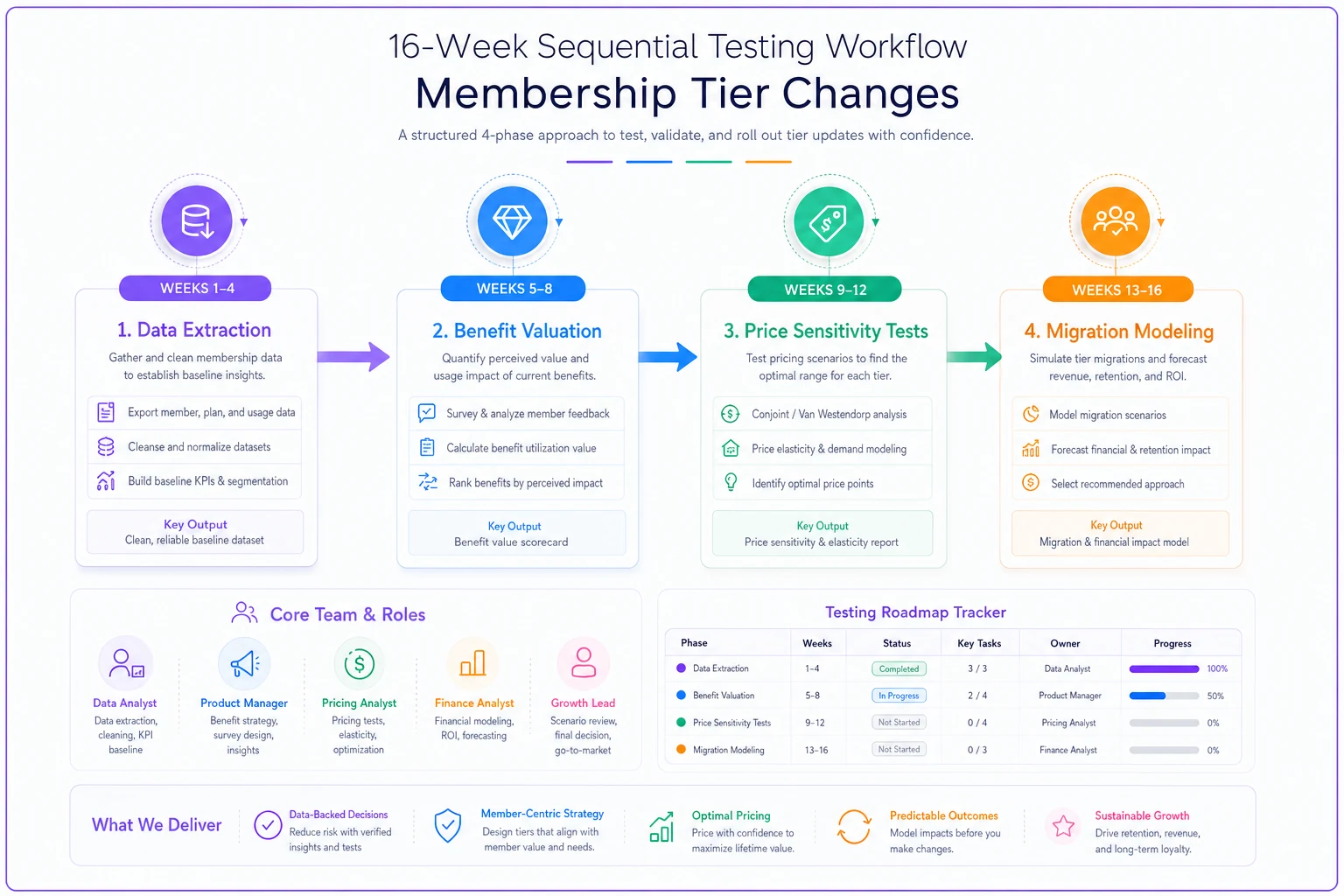
Visualizing the 16-week sequence helps keep the team on track.
When tier restructuring is wrong
Not every membership challenge needs tier redesign. Sometimes you're solving the wrong problem.
Skip tier redesign when:
-
Your retention rate exceeds 85%. The marina with 90% renewal doesn't need new tiers — they need capacity expansion. Adding complexity reduces satisfaction without solving the constraint.
-
Price isn't the primary objection. If members leave citing "lack of value" but won't specify what's missing, tiers won't help. You have an engagement problem, not a pricing problem.
-
Operational capacity can't support complexity. The volunteer-run club with one part-time administrator can't manage seven tiers with different benefit packages. Keep it simple until operations scale.
Proceed with tier design when:
-
Clear behavioral segments exist with different needs. The tennis club with serious competitors and social players needs different offerings.
-
Revenue concentration creates risk. When 40% of revenue comes from 10% of members, tier restructuring can stabilize income.
-
Migration paths would increase lifetime value. Young professional members who age into family memberships need logical progression options.
Migration paths would increase lifetime value. Young professional members who age into family memberships need logical progression options.
AI-powered platforms change the testing game
The measurement challenge historically killed most tier experiments. Tracking who used what, when, and how often required manual logs or expensive consultants. Modern operational software eliminates this friction.
Platforms with integrated analytics automatically track member behavior patterns. The sailing club using AI-powered membership management discovered their Wednesday night racing series attracted completely different members than Saturday races — insight that drove separate tier creation.
Automated trigger detection replaces manual monitoring. When a member hits predetermined usage thresholds, the system flags them for upgrade outreach.
The advantage: testing velocity. Clubs running experiments through integrated platforms test 3-4x more variations in the same timeframe. The feedback loop from test to result to iteration happens in days, not months.
This particularly matters for smaller clubs without dedicated staff. The volunteer membership director managing tier testing between their day job needs automation to maintain testing discipline.
Common testing mistakes that wreck data
Even well-intentioned tests fail when execution breaks down:
Testing during abnormal periods. The golf club testing new tiers during course renovation gets worthless data. Member behavior during disruption doesn't predict normal patterns.
Offering tests to friends first. Board members naturally want their tennis partners to preview new benefits. This biases results toward members least likely to leave anyway.
Changing multiple variables simultaneously. Test price or benefits or timing — never all three. You won't know what drove results.
Ignoring seasonal patterns. The swim club testing winter pricing for summer memberships misses how desperation changes willingness to pay.
Communicating tests as "trials." Members resist committing to things positioned as temporary. Frame tests as "exclusive early access" to drive real commitment.
The implementation checklist
After testing, implementation determines success. Most clubs get the analysis right but fumble execution.
| Phase | Actions |
|---|---|
| Pre-launch (4 weeks before) | Lock in early adopters from testing phase; Prepare migration guides for each current tier; Train staff on benefit differences; Set up tracking systems; Draft downgrade retention offers |
| Launch week | Announce to highest-value members first; Provide comparison tools (not just charts); Open upgrade window for 72 hours only; Track every inquiry and objection |
| Weeks 2-4 | Follow up with members who inquired but didn't act; Adjust messaging based on actual objections; Offer 1-on-1 consultations for complex situations; Document edge cases |
| Month 2 | Close initial migration window; Analyze movement patterns; Adjust tier benefits based on early feedback; Prepare for renewal season |
| Month 3 | Lock tiers for minimum 9 months; Stop tweaking based on individual complaints; Focus on delivering promised value |
The discipline to stop adjusting matters. Clubs that constantly tweak tiers create confusion and erode trust. Test thoroughly, launch decisively, then hold steady.
Beyond basic tiers
Once basic tier optimization works, advanced strategies emerge. The yacht club that mastered three core tiers might add corporate memberships or seasonal options. But only after the foundation proves stable.
Dynamic pricing based on capacity represents the next evolution. Tennis clubs already experimenting with peak/off-peak court fees naturally extend this to membership tiers. Summer memberships cost more than winter. Weekend access carries premiums.
Family structures become sophisticated. Instead of "family = 2 adults + children," successful clubs create modular family add-ons. Grandparent privileges, nanny access, adult children visiting from college — each becomes a discrete upgrade.
The operational complexity requires robust systems. Manual tracking breaks down quickly.
Test small, implement deliberately
The professional association that lost $12,000 trying to attract young professionals? They recovered using systematic testing. Turns out their young professionals valued mentorship programs and leadership opportunities, not discounts. The new "Future Leaders" tier at $20 MORE than standard membership attracted 200 members in year one.
Membership tier design for clubs doesn't require expensive consultants or complex frameworks. It requires systematic testing, behavioral observation, and the discipline to act on data instead of opinions.
Start with your current operations data. Map actual behaviors to potential benefits. Test prices in small cohorts. Build triggers based on real usage patterns. Resist the urge to overcomplicate what should be a straightforward value exchange.
The best tier structure isn't the one that looks perfect in committee presentations. It's the one your actual members choose with their wallets when given clear options based on tested value propositions.
Your next step: Pull last quarter's usage data and look for natural behavioral clusters. The patterns hiding in your existing operations will tell you more than any competitor analysis or member survey ever could.
The best tier structure isn't the one that looks perfect in committee presentations. It's the one your actual members choose with their wallets when given clear options based on tested value propositions.
Your next step: Pull last quarter's usage data and look for natural behavioral clusters. The patterns hiding in your existing operations will tell you more than any competitor analysis or member survey ever could.
Ready to streamline your club operations?
Join 500+ clubs using Clubyly to save time, boost member engagement, and grow their communities.