


Picture a rowing club treasurer opening their payment processor dashboard on a Tuesday morning. Seventeen failed payments from the weekend. Not unusual for a 400-member organization charging monthly dues. What happens next determines whether those seventeen members remain active or become part of the 23% involuntary churn rate that plagues membership organizations.
Most clubs treat failed payments like an administrative nuisance. Send an email, hope for the best, cancel after thirty days. But renewal dunning for clubs requires something more sophisticated than hope. After analyzing payment recovery patterns across sports clubs, professional associations, and hobby groups, the operational difference between high-performing and struggling organizations comes down to systematic recovery workflows, not better payment processors.
Why standard dunning kills member relationships
Traditional dunning feels transactional because it is. Credit card expires, automated email fires, member gets annoyed, relationship deteriorates. The psychology of membership payments differs fundamentally from subscription services. Members aren't buying access—they're maintaining belonging.
Consider how a photography club member experiences a failed payment notification. Unlike a streaming service cancellation, losing club access means missing the monthly critique session, losing gallery submission privileges, potentially embarrassing conversations with other members. The stakes feel personal, not financial.
Standard payment recovery ignores this emotional context. Generic retry schedules assume all failed payments stem from the same causes. But a competitive cycling team member whose card declined during peak training season needs different handling than a book club member who forgot to update their expired card.
The operational challenge compounds when volunteer-run organizations lack dedicated staff for payment follow-ups. A sailing club treasurer managing dunning alongside their day job can't implement complex recovery sequences manually. Yet automating everything removes the human touch that distinguishes membership organizations from commercial subscriptions.
Building recovery cadences that actually work
Effective renewal dunning for clubs starts with segmented recovery paths based on payment failure patterns, not member types. The operational framework looks different than you'd expect.
Keep your membership organized and engaged.
Clubyly simplifies member management, event coordination, and payment collection—effortlessly.
- Unified member database
- Automated payment tracking
- Event scheduling & reminders
No credit card required
Immediate soft failures (insufficient funds, processor errors)
Members facing these issues usually need quick action. The money might be there tomorrow, but their stress level is high today.
-
Instant retry with reduced amount if partial payment possible
-
3-day delay, early morning processing
-
5-day delay, alternate payment method request
-
Personal outreach from membership coordinator
Card expiration scenarios
These are preventable problems that require different timing:
-
Pre-expiration
14-day warning with update link
-
Post-expiration
Immediate notification with 48-hour grace period
-
Follow-up
Text message if no email response within 72 hours
-
Final notice
Phone call from board member before suspension
Repeated failure patterns
Pattern recognition changes everything. Someone failing for the third time in six months isn't dealing with a simple expired card.
-
First occurrence
Standard recovery sequence
-
Second occurrence within 6 months
Immediate personal contact
-
Third occurrence
Membership review with payment plan option
-
Pattern detection
Flag for potential financial hardship discussion
A youth soccer league implemented this segmented approach after losing 47 members to involuntary churn in one season. Their recovery rate jumped from 61% to 89% within two months. The key wasn't better technology—it was matching intervention intensity to failure patterns.
The multi-channel sequence that recovers 9 out of 10 failed payments
Email alone recovers maybe 40% of failed payments. Adding SMS pushes recovery to 65%. But the breakthrough happens when you orchestrate channels based on member engagement patterns, not arbitrary timelines.
Recovery Timeline
| Day | Action | Channel | Recovery Rate |
|---|---|---|---|
| 0 | Automated retry attempt | System | 22% |
| 1 | Payment update email | +35% | |
| 3 | SMS if no email response | Text | +20% |
| 5 | Personal coordinator email | +10% | |
| 7 | Phone call attempt | Voice | +8% |
| 10 | Final suspension notice | +3% | |
| 14 | Access suspension | System | +2% |
A visual workflow helps see how channels escalate across days.
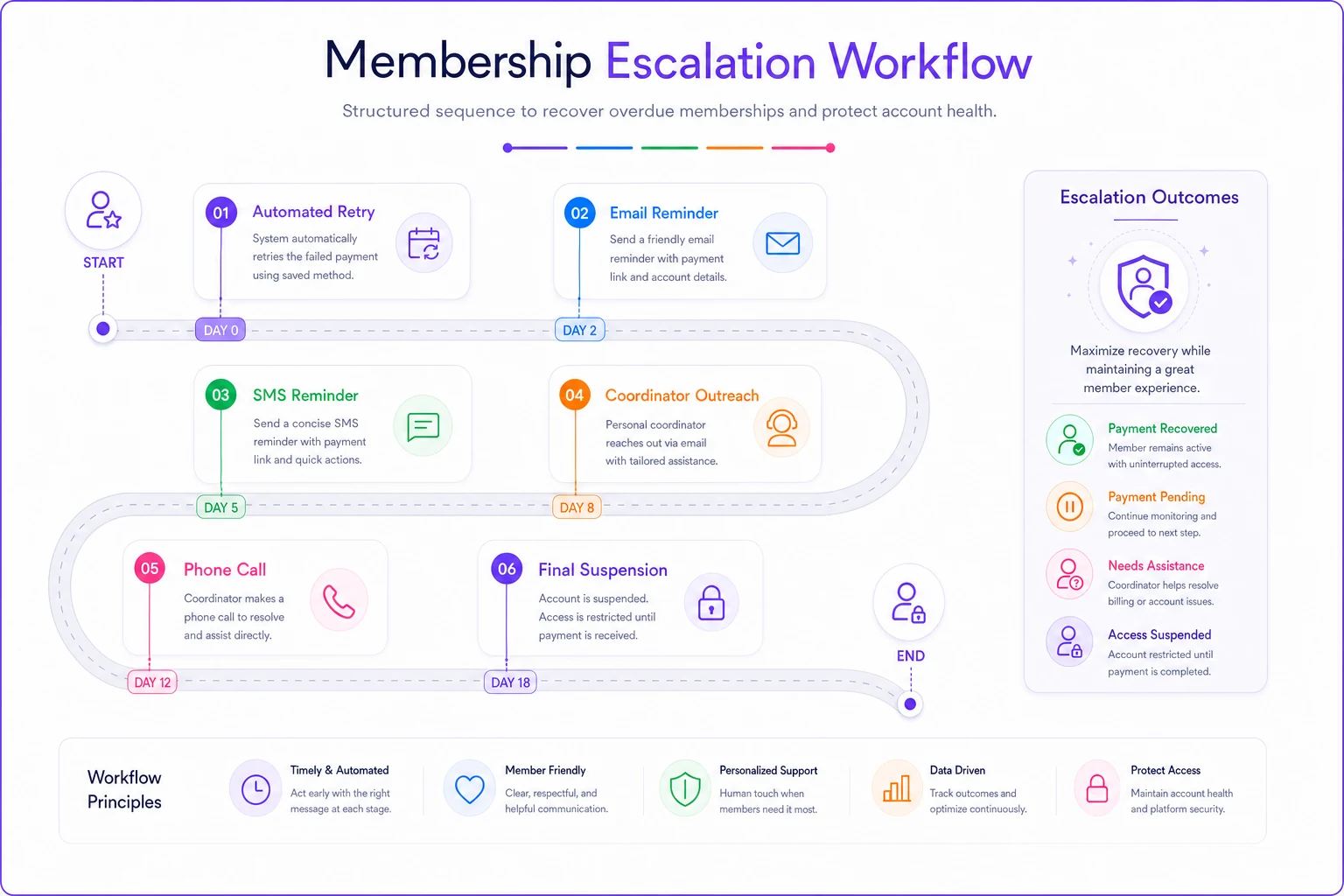
Day 0 (Failure detected):
-
Automated retry attempt (catches 22% immediately)
-
In-app notification if member uses club app
-
No external communication yet
Day 1:
-
Email with payment update link
-
Emphasis on maintaining access, not payment failure
-
Subject line
"Quick update needed for your club access"
Day 3:
-
SMS if no email engagement
-
Message
"Hi [Name], your [Club] membership needs a quick payment update. Update here: [link] or reply HELP for assistance"
-
Triggers personal follow-up if HELP response
Day 5:
-
Second email from membership coordinator (not automated)
-
Offers payment plan if amount exceeds $200
-
Includes specific upcoming events member might miss
Day 7:
-
Phone call attempt during optimal contact hours
-
Voicemail with callback number and email reminder
-
Board member makes call for long-term members
Day 10:
-
Final email with suspension date
-
Clear reactivation process outlined
-
Invitation to discuss financial options
Day 14:
-
Access suspension with reactivation hold
-
Notification to relevant committee chairs
-
30-day grace period before full cancellation
The timing matters less than the escalation logic. A member who opens every newsletter gets different treatment than someone who hasn't logged in for months. Active participants receive earlier phone calls. Sporadic attendees get longer email sequences.
Scripts that preserve dignity while recovering payments
The worst dunning communication sounds like debt collection. The best sounds like member support. Every interaction should reinforce value while addressing the payment issue.
Initial email that works:
"Hi Sarah, We noticed your payment for November didn't process successfully—this happens sometimes with bank updates or card changes. Your access to the studio workshop and the upcoming holiday exhibition remains active. To keep everything running smoothly, could you update your payment details here: [link] If you're having any issues or need to discuss payment options, just reply to this email or call me at [number]. Thanks, Jamie Membership Coordinator"
SMS that gets responses:
"Hi Tom, quick heads up that your Running Club payment needs updating. Still plenty of spots for Saturday's trail run! Update here: [link] or text back if you need help"
Phone call framework:
Opening: "Hi Maria, this is David from the Garden Club. Do you have a quick moment?" Context: "I'm following up because your recent payment didn't go through, which sometimes happens with card updates." Value reminder: "I wanted to make sure you don't miss the plant swap next week since I know you've been looking forward to it." Solution focus: "What's the easiest way for you to update your payment info? I can send you a secure link, help you over the phone, or set up an alternative if the timing isn't great right now."
Objection handling for common scenarios:
"I forgot to update my card" → "Happens all the time! I can send you the update link right now, takes about 30 seconds." "I'm not sure I want to continue" → "I understand. Would you like to pause your membership instead? That way you can keep your member rate when you're ready to return." "The charge was unexpected" → "Let me check your billing cycle... looks like this is for [specific period]. Would you prefer to switch to annual billing to avoid monthly charges?" "I can't afford it right now" → "Thanks for letting me know. We have a few options—I can set up a payment plan, or we have financial assistance available. What would work better for you?"
Creating accountability without creating enemies
Failed payment recovery walks a tightrope between persistence and harassment. You need to protect revenue while preserving relationships.
A professional development association learned this after aggressive dunning tactics caused 31 formal complaints. They shifted to "supportive recovery"—treating payment failures as member service opportunities rather than collection events.
Their new approach works like this: Members still receive regular club communications during dunning. Suspension affects access, not recognition—they're still listed in the directory, still get newsletters. Volunteer board members never make collection calls anymore. Payment discussions always include value reminders, and every third contact offers assistance rather than requesting payment.
Recovery rates actually increased after softening the approach. Members who felt supported rather than pursued were three times more likely to resolve payment issues and remain long-term.
Something counterintuitive happens when you stop treating payment failures like adversarial situations. Members start volunteering information about their situations. They suggest solutions themselves. They even refer new members during the recovery process because they feel cared for rather than chased.
Tracking recovery performance beyond collection rates
Most clubs track payment recovery wrong. They measure collection percentage and call it success. But renewal dunning for clubs requires deeper operational metrics that reveal process health, not just outcomes.
Primary recovery metrics
Recovery rate by failure type shows which payment issues you're actually solving. A climbing gym discovered their 94% recovery rate for expired cards masked a 41% recovery rate for NSF failures. The operational fix was different for each.
Days to recovery indicates process efficiency. Quick recovery (under 5 days) suggests good initial communication. Extended recovery (10+ days) points to escalation problems.
Recovery cost per member catches hidden efficiency drains. Email costs nothing, phone calls cost staff time, manual processing costs even more. One flying club found they spent $47 recovering $35 monthly dues from certain members.
Secondary indicators
Channel effectiveness by segment reveals communication preferences. Young professional groups might show 78% SMS recovery versus 31% email. Retirement communities might flip those numbers.
Voluntary versus involuntary churn ratio indicates whether payment recovery masks deeper retention issues. If voluntary churn exceeds involuntary by 3:1, payment recovery won't fix your member retention problem.
Support ticket volume during dunning shows process friction. Complicated update procedures or confusing communications generate unnecessary support burden.
Leading indicators
Pre-dunning card update rate measures proactive member engagement. Clubs that remind members before expiration see fewer failures.
Payment method diversity reduces failure concentration. Organizations dependent on single payment types face systematic risk.
Member payment history patterns predict future failures. Members who fail twice annually need different strategies than one-time failures.
Common mistakes that tank recovery rates
Treating all failures identically A martial arts dojo sent the same aggressive dunning sequence to everyone—longtime instructors and trial members alike. Senior members felt insulted by form letters after years of participation. New members felt overwhelmed by immediate phone calls. Recovery rates plummeted until they segmented based on membership tenure and engagement level.
Suspending access too quickly A professional association suspended portal access after 3 days of payment failure. Members couldn't update their payment methods because they couldn't log in. The circular problem created unnecessary friction and angry phone calls. Moving to a 14-day grace period with limited access improved recovery and reduced support tickets.
Ignoring seasonal patterns A sailing club ran aggressive dunning in January when many members had holiday credit card bills. Recovery rates stayed low, relationships soured. Shifting to gentler January messaging with payment plan options improved both recovery and retention.
Over-automating member communications A coworking space automated their entire dunning process. Members received identical emails whether they'd been members for five years or five weeks. Long-term members felt devalued. Adding personal touches for 2+ year members improved recovery rates by 31%.
Setting retry rules that respect processor limits
Payment processors aren't unlimited retry machines. Each attempt costs money, repeated failures trigger velocity controls, excessive retries can flag merchant accounts. You need to maximize recovery within processor constraints.
Effective retry logic for clubs requires smart timing and amount strategies. Full amount first retry, then 90% amount second retry if partial payment is allowed. Some clubs try split payments on the third retry, with minimum viable amounts for final attempts.
Timing optimization
-
First retry
24 hours after initial failure
-
Second retry
3 days after first retry
-
Third retry
5 days after second retry
-
Final retry
7 days after third retry
Processor rotation strategies
Primary processor for first attempt, backup processor for NSF failures. Alternative payment methods for repeated failures. Manual processing for high-value members.
Prioritize retry timing and amounts based on failure codes (NSF vs expired card) rather than a fixed schedule.
A soccer league reduced their processor fees by 24% after implementing smart retry rules. Instead of hammering failed payments daily, they optimized timing based on failure codes. NSF failures retry after typical payroll cycles. Expired cards don't retry at all—they trigger update requests.
When to stop trying (and when to make exceptions)
Not every payment is worth recovering. The operational math of dunning includes knowing when to quit.
Calculate your recovery threshold:
-
Average staff time per recovery attempt
12 minutes
-
Staff hourly cost
$35
-
Per-attempt cost
$7
-
Add processor fees
$0.30 per retry
-
Add communication costs
$0.50 per contact
-
Total recovery cost for 5 attempts
roughly $40
If monthly dues are $30, aggressive dunning loses money. But membership organizations aren't pure transactions. Consider lifetime value, volunteer contributions, community impact.
Exception scenarios worth extra effort include board members or key volunteers, long-term members (3+ years), recent high-engagement members, and members with previous perfect payment history. A cycling club creates "never suspend" flags for members who contribute beyond dues—ride leaders, event organizers, maintenance volunteers. These members get unlimited recovery attempts and personal payment plans.
The math changes when you factor in replacement costs. Acquiring a new member typically costs 5-7 times more than retaining an existing one. Suddenly that $40 recovery investment for a $30 monthly payment makes sense when you consider the alternative is spending $150-200 to replace that member.
Preventing the next wave of payment failures
The best dunning strategy is avoiding dunning entirely. Operational prevention beats recovery every time.
A tennis club reduced payment failures by 47% through prevention measures. Card updater services automatically refresh expired card information. Worth the cost for organizations over 500 members. Payment method diversification reduces single points of failure. Offering ACH alongside credit cards cuts failure rates significantly.
Proactive expiration alerts catch problems before they happen. Send update reminders 30, 14, and 7 days before expiration. Annual payment incentives eliminate monthly failure opportunities. A 10% discount often pays for itself in reduced dunning costs.
Smart billing dates avoid problem periods. Don't bill on the 1st (rent due) or 15th (credit card payments). Mid-month, mid-week billing sees fewer failures. Member payment dashboards enable self-service fixes. Members who can see upcoming charges and update methods independently reduce support burden.
Building your club's custom dunning playbook
Generic dunning templates fail because every club operates differently. Your playbook needs to match your operational reality.
Start with this framework:
-
Map your current failure patterns. Pull six months of payment data. Identify failure types, recovery rates, time to recovery. Find your operational baseline.
-
Design segmented recovery paths. Create different sequences for new members (under 6 months), standard members (6 months to 2 years), senior members (2+ years), and VIP members (board, volunteers, sponsors).
-
Build your communication templates. Write emails, SMS, and call scripts that sound like your organization, not a collection agency. Test them with friendly members first.
-
Set escalation triggers. Define when automated becomes personal. When email becomes phone. When standard becomes exception.
-
Establish measurement rhythms. Weekly recovery reports during implementation. Monthly reviews once stable. Quarterly optimization based on patterns.
-
Document exception protocols. Who can approve payment plans. When to write off dues. How to handle hardship cases.
Your playbook isn't a set-it-and-forget-it document. Payment patterns change, member demographics shift, economic conditions fluctuate. Plan quarterly reviews to adjust your approach based on actual results.
Recovery as member retention
Payment recovery in membership organizations isn't about collecting money—it's about maintaining relationships. Every failed payment represents a member at risk of leaving, not just revenue at risk of loss.
The clubs that excel at renewal dunning for clubs treat payment failures as service opportunities. They balance automation with human connection. They preserve dignity while protecting revenue. They solve the operational challenge without sacrificing the community feeling that makes membership meaningful.
Your dunning playbook becomes part of your member experience. Make it reflect your values. A rugby club might take a direct, no-nonsense approach. An art association might emphasize understanding and flexibility. A professional organization might focus on maintaining status and access.
The metrics matter, but the relationships matter more. Track recovery rates, but also track member satisfaction during recovery. Optimize payment collection, but also optimize member retention. Build operational efficiency, but maintain human connection.
Modern clubs need both systematic processes and genuine member care. AI-powered operational software can handle the repetitive parts—retry scheduling, message triggers, payment updates—freeing staff and volunteers to focus on the human parts—understanding situations, making exceptions, preserving relationships. The combination of smart automation and human judgment creates recovery systems that actually work.
The seventeen failed payments from the weekend don't have to become seventeen lost members. With the right operational playbook, they become seventeen opportunities to demonstrate that your club values members beyond their monthly dues. That's renewal dunning that builds community rather than destroying it.
Ready to streamline your club operations?
Join 500+ clubs using Clubyly to save time, boost member engagement, and grow their communities.