

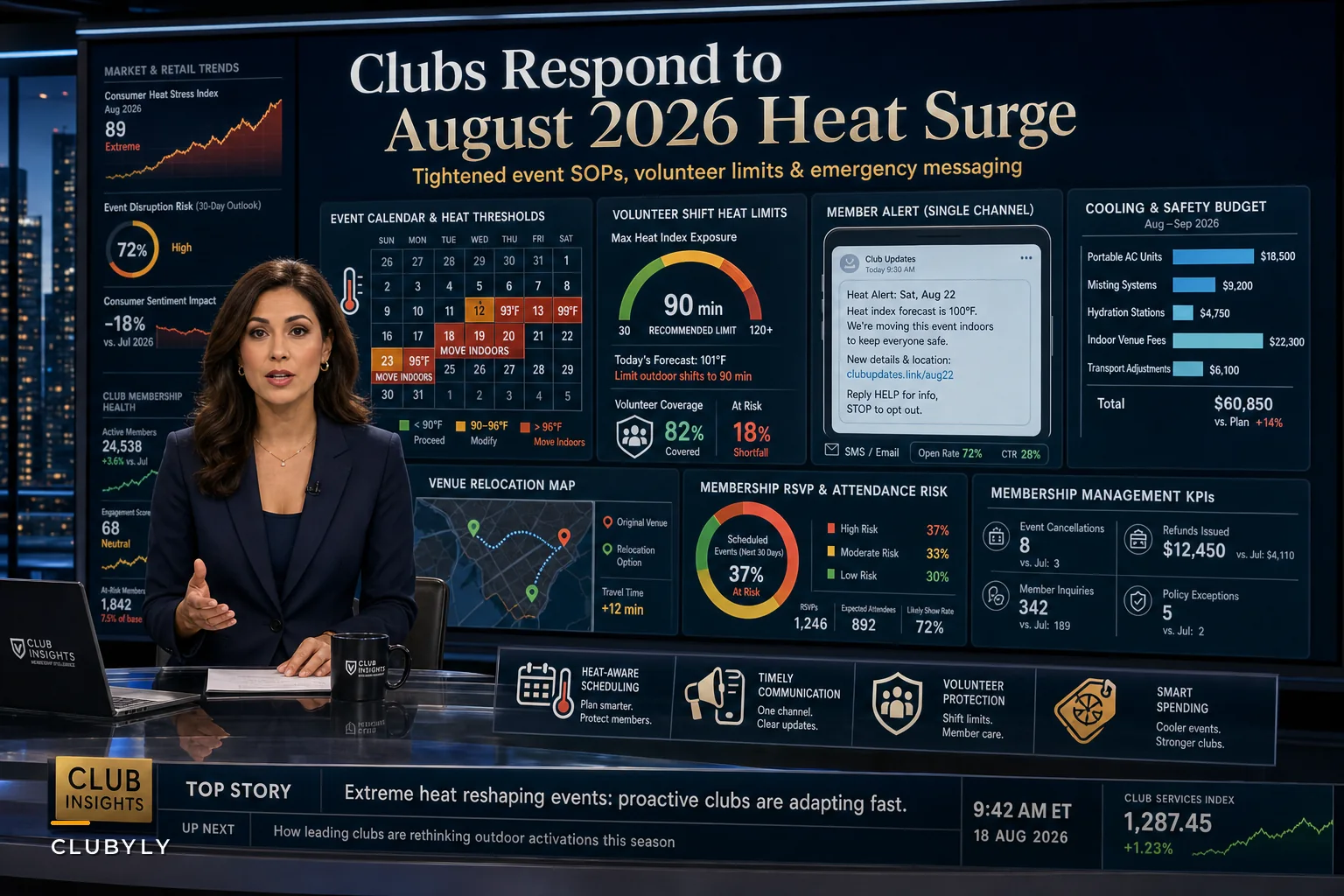

The heat this August isn't just uncomfortable — it's rewriting the assumptions most clubs built their event calendars on. A Reuters report from mid-August noted that extreme heat is becoming more frequent and intense, and NOAA's near-term hazard forecasts have flagged sustained high-temperature stretches across large parts of the country. For most people that's a headline. For club managers running a Saturday member picnic or a Tuesday-evening outdoor social, it's a scheduling and safety problem that landed with almost no warning.
This post isn't about the weather. It's about what the weather exposes in how clubs plan, staff, and communicate — and what to actually change before the next stretch of 100-degree days forces your hand.
The heat didn't create a new problem — it revealed an old one
Most clubs plan events around dates, not conditions. You pick the second Saturday, book the pavilion, send the invite, and assume the day will cooperate. That model worked fine when weather was a background variable. It breaks the moment weather becomes something you have to actively manage.
The pattern worth noticing: clubs that struggled most this August weren't the ones with outdoor events. They were the ones with no decision framework for when to move, modify, or cancel an outdoor event. The heat didn't cause the chaos. The absence of a pre-agreed trigger did.
When there's no rule, every hot day becomes a fresh argument. The events chair thinks it's fine. A board member worried about an older volunteer thinks it's reckless. Someone starts a group text at 6 a.m. the day of. Members get three conflicting messages. That's not a heat problem — that's a decision-making gap that heat happened to expose.
The three places heat actually hits your operations
Break it down and the impact clusters in three areas, each with its own failure mode.
Keep your membership organized and engaged.
Clubyly simplifies member management, event coordination, and payment collection—effortlessly.
- Unified member database
- Automated payment tracking
- Event scheduling & reminders
No credit card required
1. Attendance and cancellations. Outdoor events in extreme heat see attendance drop well before you cancel them. RSVPs stay high but actual turnout collapses — people just don't show when it's 102°F. You've already paid for catering, rentals, and staff based on the RSVP count. So you eat the cost of a full event and get a half-full room.
2. Volunteer availability and safety. This is the one clubs consistently underestimate. A meaningful share of volunteers in most membership organizations are retirees, and older adults carry significantly higher heat risk. An outdoor setup shift from 11 a.m. to 3 p.m. isn't just uncomfortable for them — it's a genuine health liability. When your most reliable volunteers are also your most heat-vulnerable, "the show must go on" quietly becomes a bad call.
3. Cost and venue constraints. Cooling costs, last-minute indoor venue rebookings, extra water and shade rentals, and in some regions, permit or insurance limits on large outdoor gatherings during heat advisories. A club that budgeted $600 for a summer social can find itself staring at $1,100–$1,400 in real costs once it scrambles to move indoors two days out.
Reactive planning versus condition-based planning
Most clubs don't realize they're in reactive mode until something goes sideways. The comparison below is worth sitting with — not because the right column is harder, but because it shows exactly where the work is getting done either way.
| Factor | Reactive (date-locked) | Condition-based planning |
|---|---|---|
| Cancellation decision | Made day-of, under pressure | Triggered by a pre-set threshold |
| Member communication | Scrambled, often contradictory | Pre-written, sent on schedule |
| Volunteer safety | Handled case-by-case | Built into role assignments |
| Backup venue | "We'll figure it out" | Identified before the season |
| Cost exposure | High (last-minute everything) | Contained (planned alternatives) |
The right column isn't more work overall — it's the same work done earlier, once, instead of every single time under pressure.
Set your heat triggers before the season, not the morning of
The single most useful thing a club can do is decide — in advance, in writing — what conditions change what. This removes the argument entirely. Nobody debates at 6 a.m. because the rule already decided.
A workable trigger structure looks like this:
-
Below 90°F forecast Event runs as planned.
-
90–98°F Event runs with modifications — earlier start time, mandatory shade and water stations, shortened program, volunteer shifts capped at 45 minutes with rotation.
-
99–104°F Move indoors if a backup venue exists; otherwise reschedule. Outdoor volunteer roles suspended.
-
Above 104°F or active heat advisory Automatic reschedule or cancel. No day-of debate.
Tie the numbers to a source everyone trusts. NOAA's probabilistic hazards outlook gives you a defensible reference point, so decisions aren't based on how hot it feels to whoever checks their phone first.
The exact thresholds matter less than having them agreed on and documented. What kills clubs is discretion under pressure, not the specific temperature.
Here's a quick visual workflow to use when mapping your triggers and communications.
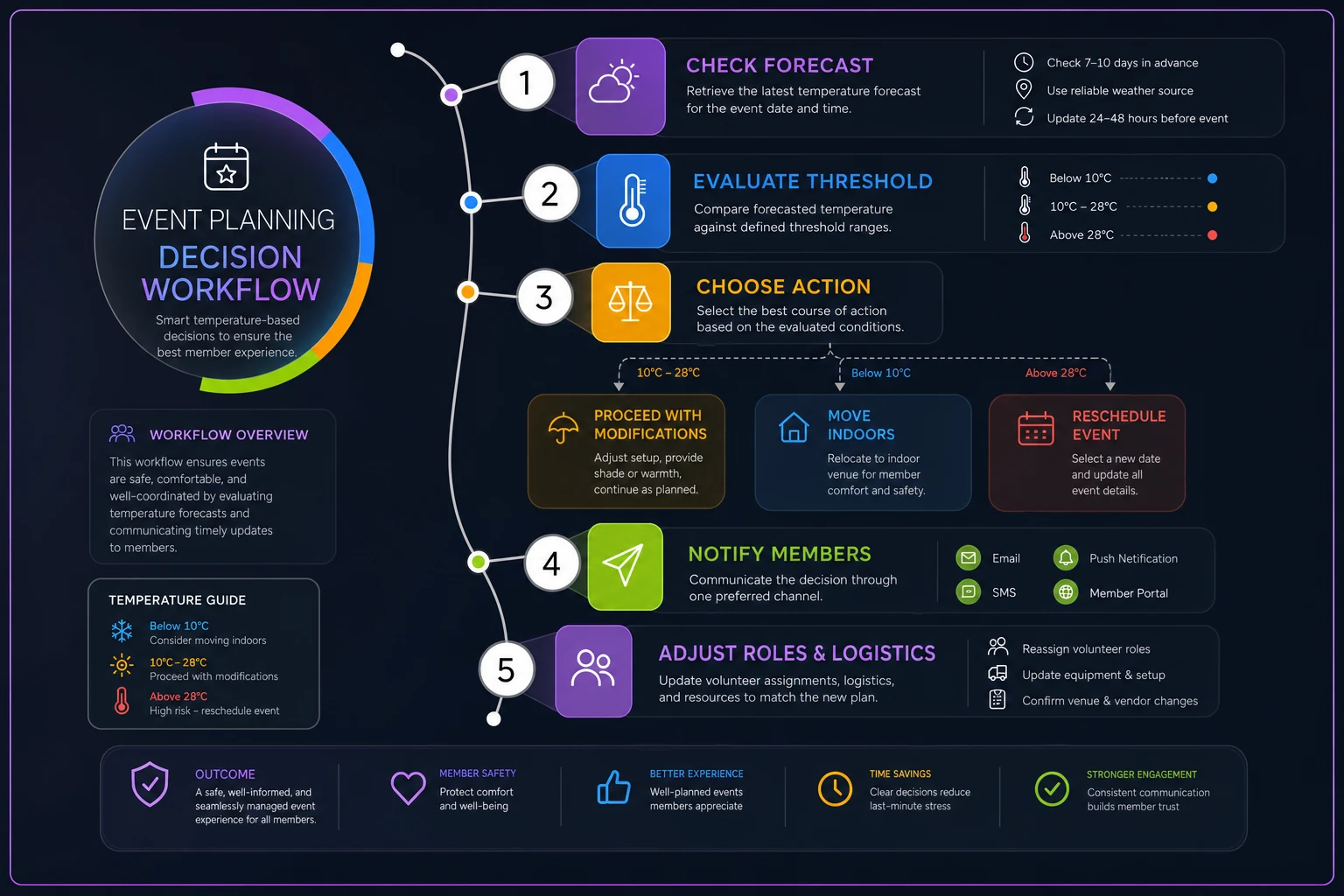
Use this to align who does what when a trigger fires.
Rewrite your member communications around the decision, not the event
Most member communication assumes the event happens. Heat forces you to communicate the conditions of the event — and that's a different message entirely.
Members need to know three things, ideally before they even RSVP:
-
What the heat plan is (shade, water, indoor backup, revised timing)
-
When and how they'll be told if something changes
-
What the cutoff decision time is, so they're not refreshing their inbox at dawn
A practical rule that reduces confusion dramatically: commit to a single decision time and a single channel. For example — "If the event changes due to heat, we'll notify all registered members by 4 p.m. the day before, via email and text." One time, one message, one source of truth. The confusion clubs experienced this August almost always came from staggered, informal updates across group chats and Facebook comments where nobody knew which message was current.
Set the two template variables as dropdowns in your membership system so sending is a click, not a compose.
Pre-writing the messages matters more than you'd think. When a heat advisory drops, the last thing an already-stretched manager needs to be doing is composing a thoughtful reschedule notice from scratch. Have three templates ready: proceeding with modifications, moving indoors, and rescheduling. Fill in two variables and send.
A real scenario
A regional hobbyist club — roughly 280 members, mostly running monthly outdoor meetups and a big summer showcase — got caught flat during an early-August heat stretch. Their showcase was date-locked to a Saturday that hit 103°F. They had about 190 RSVPs. Actual turnout was closer to 70. They'd catered and staffed for 190. Two older volunteers running the outdoor registration table left early feeling unwell, which understandably rattled the board.
Total avoidable loss for that one day sat somewhere around $900–$1,100 in catering and rental waste, plus a genuinely uncomfortable safety near-miss.
For the following month's event, they did three things: set written temperature triggers, identified a community-center backup room they could book on 48 hours' notice, and pre-wrote their notification templates with a fixed 4 p.m.-day-before decision time. The next hot-weather event got moved indoors cleanly. Turnout held around 80% of RSVPs, catering matched the actual headcount, and no volunteer stood in direct sun for two hours. Same club, same heat — completely different outcome, driven entirely by decisions made in advance.
Where safety planning has to catch up
Heat changes what "onsite safety" means. It's no longer just first-aid kits and knowing where the exits are. It's shade coverage, hydration stations, shorter volunteer rotations, someone specifically watching for heat-stress symptoms, and a clear escalation path if a member or volunteer goes down.
This is exactly the kind of thing that belongs in a documented runbook rather than living in one person's head. If you haven't formalized onsite roles and escalation timelines yet, our event safety runbook for small clubs walks through the role assignments and post-incident steps that make heat response repeatable instead of improvised. Heat just makes having that runbook non-optional.
A quick checklist for heat-specific onsite readiness:
-
[ ] Designated shade and seating for volunteers and older members
-
[ ] Water available at multiple points, not one table
-
[ ] Volunteer shift caps (30–45 min in direct heat) with a rotation list
-
[ ] One named person responsible for watching heat-stress signs
-
[ ] Written escalation steps if someone shows symptoms
-
[ ] Backup indoor space confirmed and bookable on short notice
-
[ ] Cooling/shade rental vendors identified before you need them
Getting this list out of your head and into a shared document is the actual work. Once it's written down and role-assigned, executing on it is straightforward. Without that, you're relying on whoever shows up earliest to remember all of it under pressure.
When condition-based planning is overkill
Not every club needs the full framework. If your events are already indoor and climate-controlled year-round, most of this doesn't apply — focus your energy elsewhere. If you run two events a year, a lightweight version (just the triggers and one backup venue) is plenty. Building an elaborate system for a club that meets in an air-conditioned hall twice a year is wasted effort.
The clubs that genuinely need this are the ones with recurring outdoor programming, a volunteer base skewed older, or events large enough that permits and insurance come into play. For them, ad-hoc decision-making isn't just messy — it's a real liability.
The underlying fix: decisions and communications shouldn't live in someone's memory
Strip away the heat angle and the real lesson is about where your operational decisions live. Clubs that struggled this August had their event rules, contact lists, volunteer availability, and notification history scattered across a personal phone, a shared spreadsheet, and whoever happened to be around. When conditions forced a fast decision, there was no single place to act from.
The clubs that handled it well had their member contacts, RSVP lists, volunteer rosters, and message templates in one operational system — so sending a coordinated reschedule notice, checking which volunteers were flagged as heat-sensitive, and confirming the backup venue was a ten-minute task, not a two-hour fire drill. Whether that's a proper membership platform or a well-disciplined shared setup matters less than the principle: your decision triggers and your communication channels have to be centralized and ready before the pressure hits.
Automated reminders help here too — a scheduled message that fires the day before with the current event status means members aren't left guessing, and staff aren't manually texting 200 people at once. It's a small operational lift to set up and a significant one to skip when things get chaotic.
The takeaway
The August heat surge is a preview, not a one-off. Forecasters are clear that these stretches are getting more frequent, which means "we got unlucky with the weather" stops being a valid explanation and starts being a planning failure. The clubs that adapt won't be the ones with the biggest budgets — they'll be the ones that decided their rules in advance, wrote their messages before they needed them, and stopped treating the calendar date as more important than the conditions on it.
Set your triggers. Pick your backup venue. Write your templates. Do it now, while it's just a task on a list — not later, at 6 a.m., with a heat advisory active and 190 people expecting an answer.
Set your triggers. Pick your backup venue. Write your templates. Do it now, while it's just a task on a list — not later, at 6 a.m., with a heat advisory active and 190 people expecting an answer.
Ready to streamline your club operations?
Join 500+ clubs using Clubyly to save time, boost member engagement, and grow their communities.