

Most clubs don't get a safety plan until something goes wrong. A member trips on a loose extension cord at the holiday mixer, someone has a medical episode during the annual dinner, or a guest gets aggressive after a few drinks and nobody knows who's supposed to step in. In the moment, everyone looks around waiting for someone else to act. That pause — the "who handles this?" pause — is where small incidents turn into big ones.
This isn't about liability language or insurance clauses. That's a separate conversation for your board and your attorney. This is the operational side: who does what, in what order, and how you talk about it afterward. An event safety runbook for clubs is a plain-language document that turns "someone should do something" into "Dana handles medical, Marcus handles the exit, and I'm calling it in."
The gap most clubs never notice until an event goes sideways
Clubs run 15–20 events a year. Most are quiet — a speaker night, a committee lunch, a small fundraiser. Nothing happens, so nobody thinks about safety roles. Then the one event with 120 attendees, an open bar, and a rented venue turns into the night someone slips on a wet floor near the coat check.
The problem isn't that clubs are careless. It's that responsibility gets assumed rather than assigned. The event lead thinks the venue staff will handle it. The venue staff think the organizer will. Two volunteers both start calling 911, or worse, nobody does because each assumed the other already had.
This usually happens when the event roster and the safety roster are the same list. The people setting up chairs and checking name tags are also, in theory, responsible for emergencies — but nobody told them that, and they're busy with logistics. Safety becomes an afterthought stacked on top of ten other jobs.
A runbook fixes this by separating event roles from safety roles and making the safety roles boringly explicit. Not heroic. Boring. Boring is what works under stress.
Prevention: the 20 minutes that stop most incidents
The vast majority of what goes wrong at small gatherings is preventable with a walkthrough. Not a fancy audit — a slow lap around the space before doors open.
Keep your membership organized and engaged.
Clubyly simplifies member management, event coordination, and payment collection—effortlessly.
- Unified member database
- Automated payment tracking
- Event scheduling & reminders
No credit card required
-
Exits
Are all marked exits unlocked and unblocked? Chairs, boxes, and coat racks migrate. Move them.
-
Trip hazards
Tape down every cord. Check for loose rugs, uneven thresholds, and dark stairs.
-
Spills and floors
Where will drinks be poured? Is there a wet-floor sign somewhere accessible?
-
Capacity
Do you actually know the room's posted capacity? Compare it to your RSVP count.
-
First aid location
Where's the kit? Does at least one person on site know CPR or basic first aid?
-
Contact list
Do you have the venue manager's cell number, not just the front desk?
-
Alcohol plan
If you're serving, who's watching for over-service? Is there a cutoff time?
-
Weather/parking
Ice on the walkway, a dark lot, a single narrow entrance — note anything that funnels people.
Do the safety walkthrough as a separate pass from the setup walkthrough so you don't miss hazards while thinking about furniture and AV.
Most clubs do a setup walkthrough (where do the tables go) but skip the safety walkthrough (what could hurt someone). They're different mental modes. Do them as two separate passes, even if it's the same person doing both.
Onsite roles: assign four, not everyone
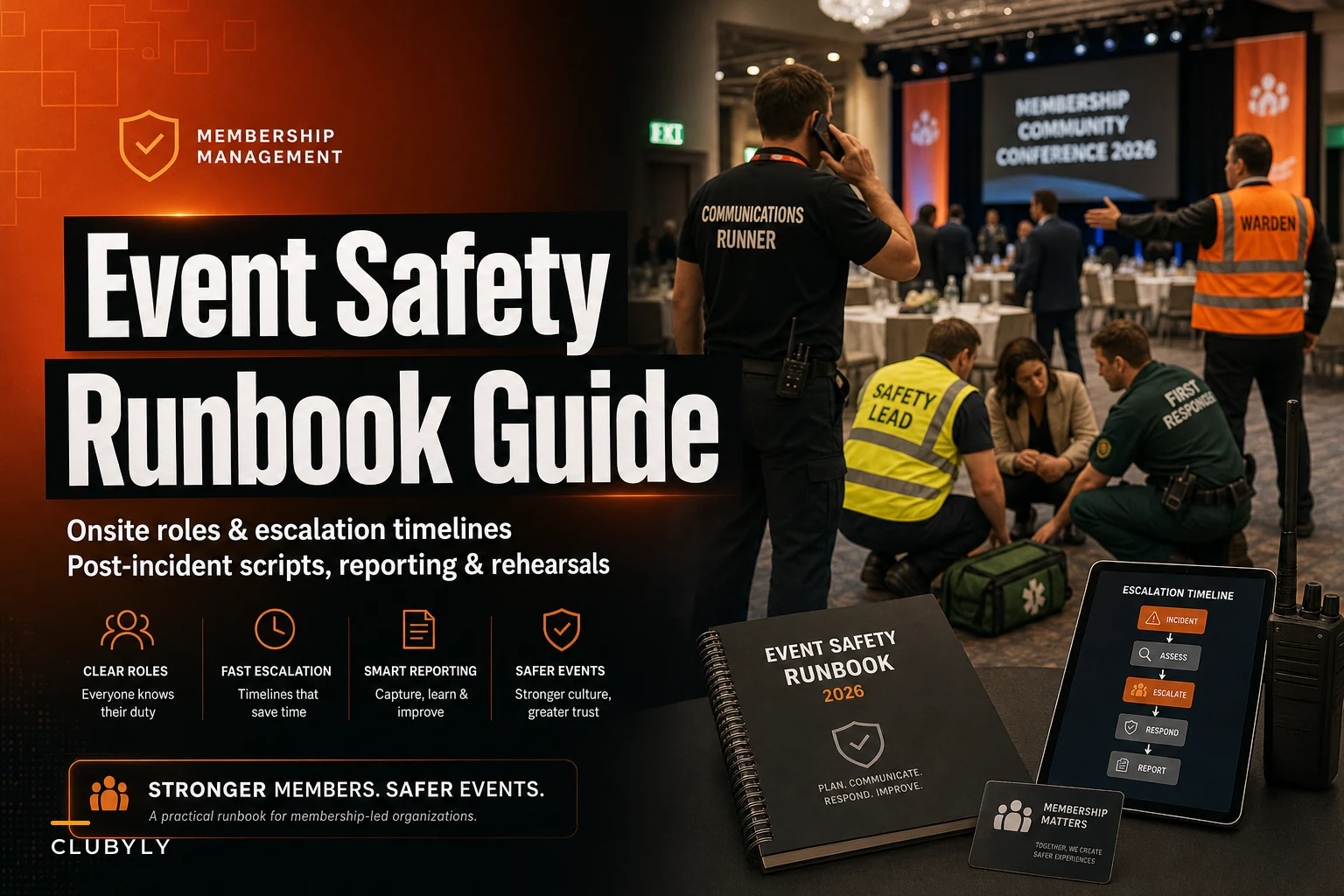
You don't need a big safety team. For a gathering under 150 people, four defined roles cover almost everything. The key is that these are named before the event, and each person knows their one job.
| Role | Primary job | What they carry | Backup |
|---|---|---|---|
| Safety Lead | Makes the call on escalation; single decision-maker | Phone, venue contacts, this runbook | Event Lead |
| First Responder | Handles medical/injury until pros arrive | First aid kit, knows CPR | Any trained volunteer |
| Crowd/Exit Warden | Clears exits, directs people, manages a room clear | Flashlight, door keys | Setup volunteer |
| Comms Runner | Calls 911, meets responders at the door, logs the timeline | Phone, notepad | Safety Lead |
A few things that matter more than they look:
The Safety Lead is one person, not a committee. In a real incident, the failure mode isn't too little authority — it's too much. Three people arguing about whether to call 911 wastes the only resource you can't get back. One person decides. Everyone else executes.
The Comms Runner meeting responders at the door sounds trivial. It isn't. EMS arriving at a 40,000-square-foot event hall with no one waving them to the right room loses several minutes. Assign someone to physically stand at the entrance.
If you're already thinking about how to rotate these roles across a season of events without exhausting the same three people, that overlaps directly with the mechanics in automating volunteer schedules: rotation, backfill and reminder rules that cut burnout in volunteer-run clubs. Safety roles should rotate the same way shifts do — with a defined backfill so a no-show doesn't leave a gap.
Escalation timeline: what happens in the first ten minutes
The hardest part of any incident isn't the crisis itself — it's the ambiguity in the first two minutes. People freeze because they don't know the threshold for acting. A clear timeline removes the guesswork.
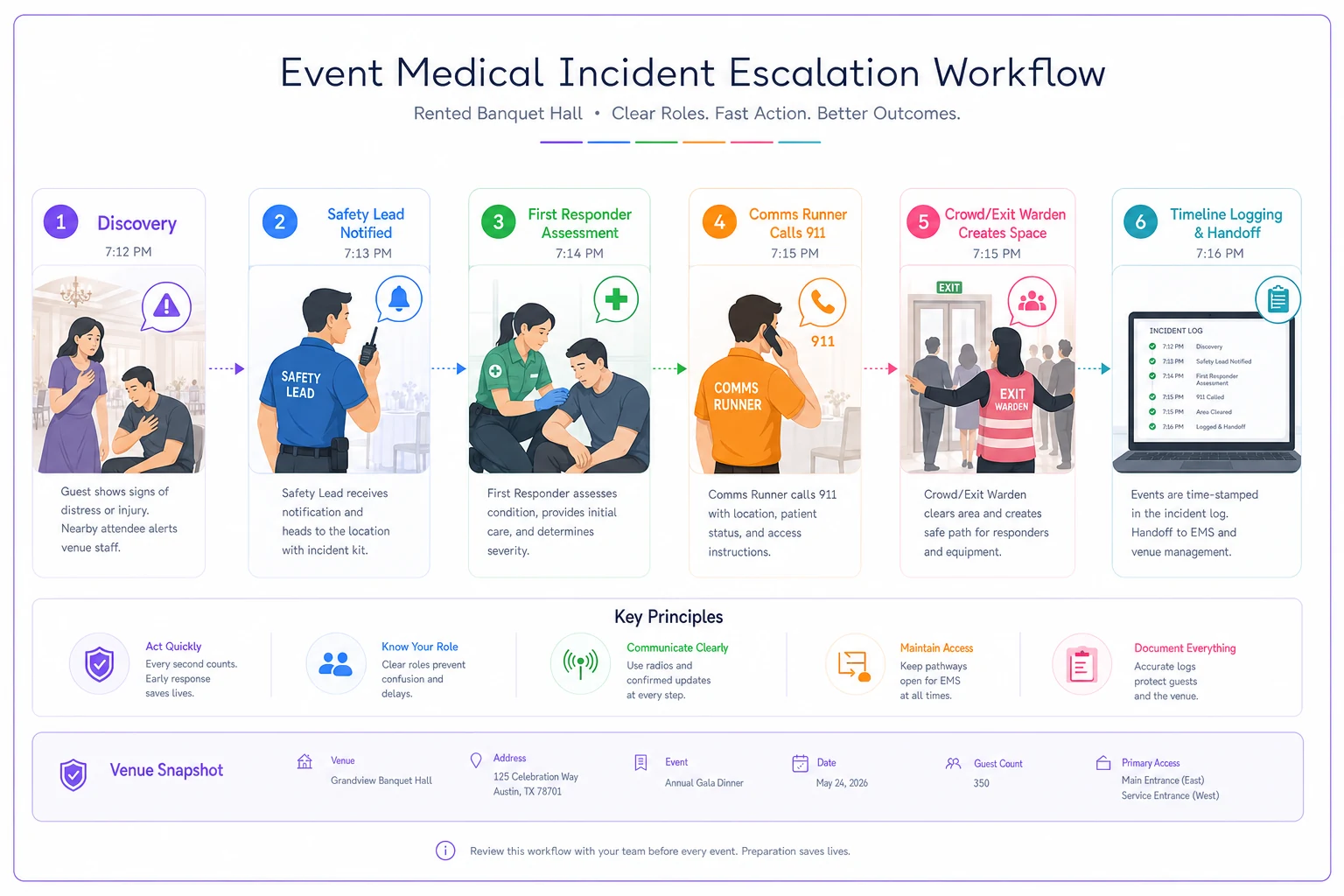
This workflow shows the first two minutes and who does what so there is no ambiguity when someone discovers a medical issue.
-
1. 0
00 — Discovery.
Anyone who sees the incident alerts the nearest volunteer and does not leave the person alone. -
2. 0
30 — Safety Lead notified.
Word reaches the Safety Lead. They move to the scene. First Responder is dispatched. -
3. 1
00 — Assessment.
First Responder evaluates. Safety Lead decides: handle internally or call 911? When in doubt, escalate. Nobody has ever regretted calling too early for a chest-pain complaint. -
4. 1
30 — Call placed.
Comms Runner calls 911, gives the exact address and room, then heads to the entrance to flag responders. -
5. 2
00 — Crowd managed.
Exit Warden creates space, keeps a clear path, and prevents a crowd from forming around the person. -
6. Ongoing — Timeline logged. Comms Runner writes down times and actions as they happen. Not for blame — so the post-incident report is accurate.
Most of this is about reducing decisions under stress. The threshold ("when in doubt, escalate"), the single decision-maker, the pre-assigned caller — each one removes a moment of hesitation.
When a full runbook makes sense — and when it's overkill
Not every gathering needs this. Applying a four-role safety structure to a six-person book club meeting is theater, and members will roll their eyes.
When a runbook actually makes sense:
-
Events over ~50 people, especially with alcohol
-
Any event in a rented or unfamiliar venue
-
Outdoor events, where weather and terrain add variables
-
Events with older members or anyone with known health conditions
-
Fundraisers or public-facing events where guests (not just members) attend
When it's overkill:
-
Small recurring meetings in a familiar space
-
Virtual events (obviously)
-
Gatherings under ~20 people where everyone knows each other
One exception worth calling out: clubs that regularly serve alcohol to large crowds. If that's you, the four-role structure isn't optional, and you probably want trained security or a medical presence on top of it. Don't try to save a few hundred dollars on an EMT at a 200-person open-bar gala. That's the exact event where the math goes wrong.
A real scenario: the fundraiser that almost went wrong
A regional alumni club — around 400 members — ran an annual dinner for roughly 130 attendees at a rented banquet hall. Open bar, older crowd, average age north of 60.
The year before they built a runbook, a guest fainted during dessert. Two people called 911 with slightly different room descriptions, nobody met the paramedics, and it took close to seven minutes for EMS to find the room in a building with three event spaces on two floors. The guest was fine, but the seven minutes rattled everyone, and the board spent the next meeting arguing about who was supposed to have done what.
The following year they assigned the four roles, ran a 15-minute rehearsal, and put a laminated one-pager at the check-in table. Mid-event, a different guest had a minor fall near the bar. The First Responder was there in under a minute, the Comms Runner made one clean 911 call and was waving at the ambulance from the curb, and the Exit Warden kept the crowd back. EMS reached the guest in a little over two minutes. Same building, same chaos potential — the difference was entirely the assigned roles and one short rehearsal.
The cost of the fix was essentially zero.
Post-incident reporting: write it down while it's fresh
After the adrenaline fades, most clubs do nothing — or they do the worst thing, which is trade half-remembered accounts by email a week later. By then the timeline is mush and everyone's version subtly protects themselves.
-
What happened
One factual paragraph. No speculation about cause.
-
Timeline
The times the Comms Runner logged. Discovery, escalation, 911 call, EMS arrival.
-
Who was involved
Roles, not blame. Who filled each safety position.
-
What worked
Be specific. "Comms Runner met EMS at the door" is a keeper.
-
What didn't
Also specific. "Exit was partially blocked by coat rack."
-
Fixes for next time
One or two concrete changes.
The single most useful field is what didn't work, and it's the one clubs skip because it feels like admitting fault. It isn't. It's the only way the runbook improves. A club that runs 15 events a year and logs honest notes will have a genuinely tight operation within two seasons.
Communication scripts: what you say, and to whom
When something happens, three audiences want different things, and the instinct to over-explain gets clubs in trouble. Keep it factual, keep it brief, and route it through one person.
> "At last night's dinner, a guest experienced a medical issue and received prompt care from emergency responders. They are being looked after, and the event concluded safely. Thank you to our volunteers who responded quickly."
> "We had a medical situation that was handled by EMS. Out of respect for the person's privacy, I can't share details. The important thing is that they got care quickly."
> "We can confirm an incident occurred at our event and that emergency services responded. Out of respect for those involved, we won't be sharing further details at this time."
Two rules that keep clubs out of trouble: one designated spokesperson, and never speculate about cause or fault. "The floor was wet because the venue didn't clean it up" is exactly the kind of off-the-cuff statement that becomes a problem later. Facts, care, privacy — that's the whole script.
Rehearsal: the step everyone skips
A runbook nobody has practiced is just a nice PDF. The rehearsal doesn't need to be elaborate — 15 minutes at the start of an event does it.
-
1. Gather the four role-holders before doors open.
-
2. Each person says their role and their one job out loud. Saying it beats reading it.
-
3. Walk the exits together. Everyone should physically see them.
-
4. Confirm the first aid kit location and who's trained.
-
5. Run one 30-second "what if" — "someone collapses by the bar, go." Just talk through the first two minutes.
-
6. Confirm the venue contact and the exact address for a 911 call.
That last one trips people up constantly. Ask three volunteers for the venue's street address and you'll often get three different answers. Nail it down before you need it.
Where the runbook lives, and keeping it current
A runbook buried in someone's email is functionally gone. The version that works is the one attached to the event itself — role assignments, walkthrough checklist, venue contacts, all sitting alongside the RSVP list and the volunteer schedule for that specific event.
Clubs running their operations on a shared management platform have a real edge over the ones juggling spreadsheets and group texts here. When your event record already holds the attendee count, the assigned volunteers, and the venue details, adding a safety role assignment and a walkthrough checklist to that same record takes minutes — and it carries over to the next event instead of getting rebuilt from scratch. Reminder automation can nudge the assigned Safety Lead to complete the walkthrough before doors open. The point isn't the software; it's that the runbook stays attached to the event and actually gets used, instead of living as a document nobody opens.
Start with your next big event
You don't need to roll this out across every gathering at once. Pick your next event over 50 people. Assign the four roles. Do the 20-minute walkthrough and the 15-minute rehearsal. Put a one-pager at the check-in table. Log a report afterward, even if nothing happens — especially if nothing happens, because that's how you learn what the quiet version looks like.
The clubs that handle incidents well aren't the ones with the most detailed plans. They're the ones where four people knew their one job and didn't have to think about it. That's the entire goal of a runbook: to make the right response boring, automatic, and already decided long before anyone needs it.
The clubs that handle incidents well aren't the ones with the most detailed plans. They're the ones where four people knew their one job and didn't have to think about it. That's the entire goal of a runbook: to make the right response boring, automatic, and already decided long before anyone needs it.
Ready to streamline your club operations?
Join 500+ clubs using Clubyly to save time, boost member engagement, and grow their communities.