

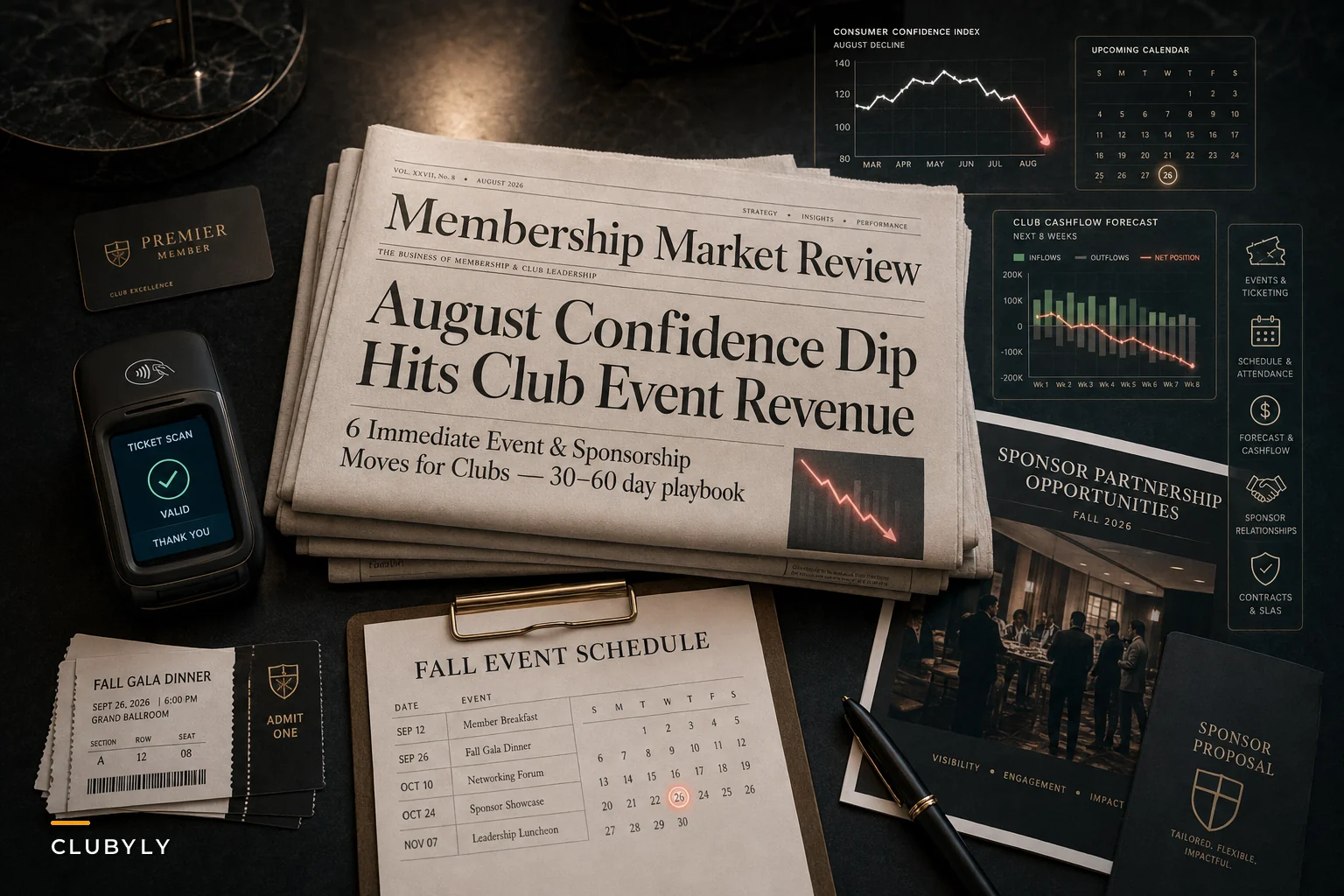

When the Conference Board's August 2026 read came in at 89.4, down from 90.2, most people skimmed the headline and moved on. Club leaders shouldn't. The number itself is small. What sits underneath it is the part that matters: the Expectations Index slipped, and consumers reported feeling more pessimistic about short-term income, jobs, and business conditions. As Reuters noted in its coverage, the softness was concentrated in how people feel about the near future — which is precisely the window you're selling into when fall events go on sale and dues invoices hit inboxes.
That timing is the whole story. Discretionary spending tightens when people expect leaner months ahead, and clubs live almost entirely on discretionary money. Tickets, sponsorships, upgrades, gala tables, the extra $40 add-on — all of it competes with a member's gut feeling that they should hold back a little this quarter. You don't need a recession for revenue to wobble. You just need hesitation, and hesitation is exactly what this report is measuring.
So rather than rewrite your fall calendar out of fear, the smarter move is a handful of targeted adjustments that reduce friction and protect the revenue you're most likely to lose first. Here are six.
1. Re-sequence your fall asks so the low-friction ones come first
Most clubs front-load their biggest revenue event — the gala, the tournament, the fall banquet — because it anchors the season. In a confidence dip, that's backwards.
When people feel cautious, they say yes to small, familiar commitments faster than big discretionary ones. If your first fall touchpoint is a $125 gala ticket, you're leading with the exact purchase members are most likely to defer. Lead instead with the renewal itself, a low-cost member mixer, or a free-to-attend kickoff, and you keep engagement momentum alive while the wallet-sensitive asks come later — once people have already said yes to something.
Clubs that renew before they sell the big event tend to hold attendance better, because renewal reactivates the emotional reason people belong. Selling a $125 ticket to a lapsed-feeling member is a cold pitch. Selling it to someone who renewed three weeks ago is a warm one.
Practically, this means re-ordering your fall communications so the sequence looks like:
-
Renewal invite (emotional reconnection, low dollar friction if you offer installments)
-
Free or near-free community event (rebuild attendance habit)
-
Mid-tier ticketed event ($20–$40 range)
-
Flagship event (the big ask, sold to an already-warm base)
You're not cutting anything. You're changing the order so the fragile purchases land after the resilient ones.
2. Split your ticket price into a floor and a "real" price
Flat pricing punishes you in a soft market. If your fall dinner is $75 and a member is hesitating, the only options are pay $75 or don't come — and "don't come" wins more often than it should when people feel pinched.
Keep your membership organized and engaged.
Clubyly simplifies member management, event coordination, and payment collection—effortlessly.
- Unified member database
- Automated payment tracking
- Event scheduling & reminders
No credit card required
Tiered pricing gives hesitant members a yes that isn't "no." A few structures that tend to work:
| Approach | How it works | Best for |
|---|---|---|
| Early-bird floor | $45 early, $75 at door | Events with a long sales runway |
| Pay-what-you-can tier | Suggested $60, minimum $30 | Mission-driven or community clubs |
| Bundle discount | 2 tickets for $120 vs $75 each | Events people attend as couples/friends |
| Member vs guest split | $50 member, $80 guest | Clubs wanting to reward renewal |
The point isn't to slash prices across the board — that trains people to wait for discounts and quietly erodes margins. The point is to give the cautious member a lower entry that still clears your cost-to-serve. A well-set floor price recovers attendees who would have skipped entirely, and those attendees often buy drinks, add-ons, or next year's ticket once they're in the room.
One caution: publish the tiers as deliberate structure, not as a panic discount blasted three days before the event. "Prices go up at the door" reads as normal. "50% off — we need to fill seats!" reads as desperate and depresses future full-price sales.
3. Protect sponsorship revenue by shrinking the commitment, not the relationship
Sponsorship is usually the first thing local businesses trim when they feel uncertain — and this confidence report reflects business-condition pessimism too, not just consumer mood. A sponsor who wrote a $2,500 check last fall may look at their own Q4 forecast and hesitate this year.
-
Break the annual into quarterly. A $2,500 sponsor becomes four payments of roughly $650. Same total, far easier to approve inside a nervous budget.
-
Add a lower entry tier. If your smallest package was $1,000, create a $350 "supporter" level. A $350 sponsor who renews beats a $1,000 slot that goes empty.
-
Offer performance-based add-ons. Base package plus a small bonus tied to attendance or reach. Sponsors like this in uncertain periods because the downside is capped.
-
Lock in multi-year at a slight discount. For sponsors who aren't nervous, a two-year deal at 10% off takes them off the table before a competing club calls.
A realistic example: a mid-sized recreation club heading into fall had six local sponsors averaging around $1,800 each. Two signaled they'd pause for the year. Instead of accepting the loss, the event lead offered both a quarterly payment split and a smaller $500 tier. One took the quarterly split at the full amount; the other stepped down to $500. That preserved roughly $2,300 out of a potential $3,600 loss, and both relationships stayed intact heading into the following year.
If sponsorship is a meaningful chunk of your season revenue, it's worth revisiting the fundamentals of the whole pipeline rather than improvising sponsor by sponsor. How you keep those relationships from going cold matters more than any single package tweak.
4. Tighten your short-term cash forecast to a rolling 8 weeks
Annual budgets are basically useless in a wobbly quarter. They assume revenue arrives on schedule, and the whole problem right now is that it might not — tickets sell slower, sponsors pay later, upgrades stall.
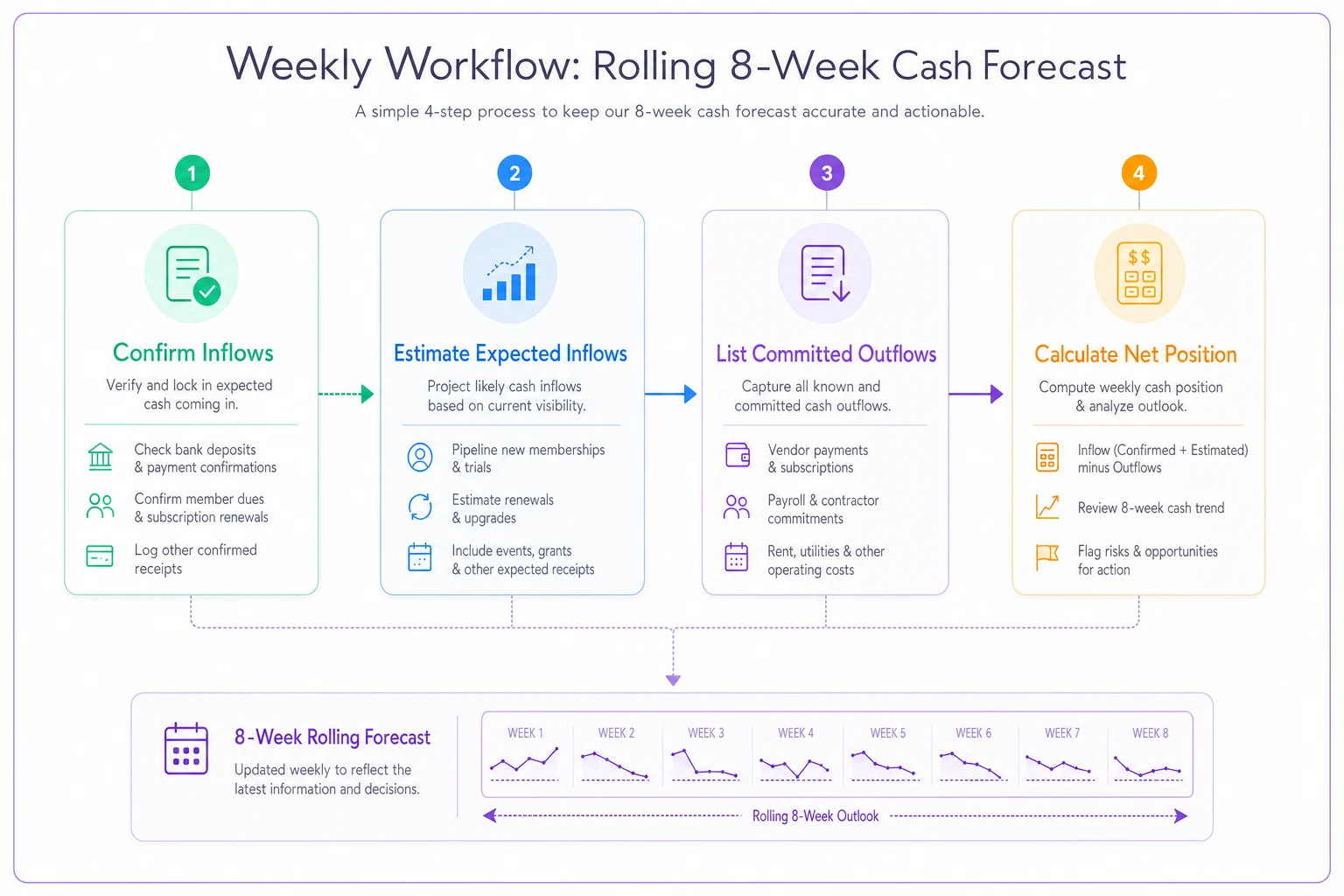
What treasurers actually need this fall is a rolling 8-week cash view that updates weekly. Not a full re-budget. Just a simple forward look at money in versus money committed, so you spot a shortfall while you can still act on it.
A lightweight version any volunteer treasurer can run:
-
Column 1 Confirmed inflows (renewals paid, tickets sold, sponsor checks received)
-
Column 2 Expected-but-unconfirmed inflows (invoices sent, verbal sponsor yeses) — discount these by 20–30% in a soft market
-
Column 3 Committed outflows (venue deposits, vendor payments, insurance)
-
Column 4 Net position each week
The discount on Column 2 is the step people skip, and it's the one that saves you. In a normal year you can treat a verbal sponsor yes as near-certain. In a nervous quarter, treat it as maybe. A venue deposit is due whether or not that sponsor comes through, so if your forecast assumes the money's already in, you can walk into a deposit you can't cover.
Use this workflow to update the rolling 8-week view weekly.
The clubs that get burned aren't the ones with weak seasons. They're the ones who found out about the weak season two weeks before a payment was due.
5. Rewrite renewal messaging to lead with certainty, not urgency
Urgency-based renewal copy — "Don't miss out!", "Last chance!" — works fine in a confident market. In a cautious one it can backfire, because it puts the focus on the transaction at the exact moment people are most wary of transactions.
-
Emphasize what stays the same
"Your dues haven't changed" is a genuinely reassuring line right now.
-
Make the low-commitment path visible
offer installments up front rather than burying them.
-
Reconnect to value they've already used
"You attended 4 events this year" beats "renew now."
-
Cut the false deadline unless it's real. Manufactured urgency reads as pressure, and pressure amplifies hesitation.
There's a subtle but important shift here. In a good economy you sell the future ("look what's coming!"). In a nervous one you also sell the safety of the known ("here's what you already count on"). Members renewing in an uncertain quarter are quietly asking "is this still worth it?" — answer that question directly instead of shouting about deadlines.
6. Remove every payment obstacle you can find before September
Higher payment friction is one of the most predictable effects of a confidence dip, and it's the one clubs control most directly. When people feel cautious, any small annoyance in the checkout flow becomes a reason to close the tab and "come back later" — and later rarely happens.
Run a quick friction audit before your fall push:
-
Can members pay in fewer than three clicks from the email? Every extra step loses people.
-
Do you offer installments on higher-dollar renewals? A $200 renewal split into two $100 payments converts hesitant members who'd otherwise stall.
-
Are you accepting the payment methods people actually use — mobile wallets, not just a mailed check or a clunky form?
-
Does a failed payment retry automatically, or does it silently drop into churn?
-
Is the "why am I paying this" clear on the invoice itself? Confused members don't pay; they wait to ask, then forget.
A hobby club with around 260 members ran renewals through a form that required manual card re-entry and offered no installment option. Their fall renewal completion typically hovered in the low 70s percentage-wise. Adding a saved-payment option and a simple two-part installment plan pushed completed renewals into the low 80s — not a dramatic transformation, but roughly two dozen members who would otherwise have drifted. In a soft quarter, those are exactly the members you lose if checkout makes them think twice.
This is also where an operational platform quietly earns its keep. Automated retries on failed cards, saved payment methods, and installment scheduling handle the friction points that a volunteer treasurer simply can't monitor manually across a few hundred members. Not because the software is magic, but because payment drop-off happens in small moments no human is watching in real time.
The deeper problem this exposes
None of these six moves are hard. What a confidence dip really exposes is that most clubs have no shock absorber. When one revenue stream softens — event tickets, sponsorships, upgrades — there's nothing to cushion it, so a mildly nervous quarter turns into a genuine budget hole.
Clubs that ride out soft periods well tend to have one thing in common: their income doesn't all move in the same direction at the same time. When ticket sales dip, a small merch line, a recurring micro-fundraiser, or a modest facility rental holds. That's not luck; it's structure.
If a single confidence report can meaningfully threaten your fall, that's the signal to build a second and third revenue leg. The framework for evaluating which ones actually fit your club is worth working through in our guide to diversifying revenue beyond dues.
The August number will move again — up some months, down others. You can watch the Conference Board's confidence readings and react each time, or you can build a fall operation that doesn't flinch when the number drops. The six moves above buy you this fall. The revenue structure buys you every fall after that.
Bottom line for this season
Don't overreact to 89.4. Re-sequence your asks so the fragile purchases come last. Give hesitant buyers a floor price instead of a wall. Restructure sponsorships into commitments people can actually approve. Run a rolling cash view so nothing surprises your treasurer in October. Lead renewal messaging with stability, not pressure. And clear every payment obstacle before September, because in a cautious quarter, friction is the churn.
Do those six things and a soft-confidence fall becomes a manageable one — not because the economy cooperated, but because your operation was ready for it not to.
Do those six things and a soft-confidence fall becomes a manageable one — not because the economy cooperated, but because your operation was ready for it not to.
Ready to streamline your club operations?
Join 500+ clubs using Clubyly to save time, boost member engagement, and grow their communities.