



Most clubs don't fail at non-dues revenue because the ideas are bad. They fail because nobody ran the math on what it actually costs to deliver the thing. A merch store that nets $400 a year after a treasurer spent 60 hours managing inventory isn't a revenue line — it's a hobby that lost money in disguise.
That's the trap. Dues are predictable, boring, and easy to reason about. The moment you add a sponsorship program, a paid workshop series, or an affiliate arrangement, you're introducing variability, seasonality, and hidden labor that volunteer boards almost never budget for. And because the person running the pilot is usually a volunteer treasurer with a day job, the effort side of the equation gets ignored until burnout sets in.
So this isn't a list of "20 ways to make money for your club." You can find that anywhere. This is about how to evaluate non-dues revenue for clubs as a system — how to score fit, model cost-to-serve, forecast without a finance degree, and run a pilot small enough that failing costs you a weekend instead of a fiscal year.
Why non-dues revenue quietly breaks small clubs
The failure pattern is almost always the same, and it has nothing to do with the idea itself.
A board gets nervous about flat membership. Someone proposes a new revenue stream — a paid annual conference, a branded credit card partnership, reselling training courses. It sounds great in the meeting. Everyone's excited. It gets approved with a rough revenue guess and zero cost model.
Then reality shows up. The conference needs a venue deposit six months out, a registration system, someone chasing speakers, a refund policy, and a volunteer to answer 200 emails. The "profit" projection was gross revenue. Nobody subtracted the 90 hours of coordination, the payment processing fees, the printing, or the fact that it competes for the same volunteers who run everything else.
New revenue lines don't compete with nothing — they compete with your existing operations for the scarcest resource you have, which is attention. Add a revenue stream without accounting for that, and you don't get "dues plus extra." You get "dues, but now your best volunteers are exhausted and the newsletter is late."
The other thing that breaks: seasonality mismatches. Dues renew on a cycle you understand. A new revenue line often has a completely different rhythm — sponsorships land in Q4 budget cycles, event revenue spikes once a year, merch sells around a single gathering. If your cash flow modeling assumes revenue arrives evenly, you'll misjudge when you can actually spend it.
The four-lens evaluation framework
Before any pilot, run the idea through four lenses. This takes about 30 minutes and kills roughly half of proposed ideas on the spot — which is the point. You want to fail cheap on paper, not expensive in reality.
Keep your membership organized and engaged.
Clubyly simplifies member management, event coordination, and payment collection—effortlessly.
- Unified member database
- Automated payment tracking
- Event scheduling & reminders
No credit card required
1. Fit. Does this serve your existing members, or does it pull you away from them? Revenue that deepens member value (a paid advanced workshop your members already want) is fundamentally safer than revenue that requires you to build a new audience from scratch (selling ad space to strangers). Off-mission revenue isn't automatically bad, but it carries a hidden governance cost — boards spend meeting time debating whether it "fits," and members sometimes push back.
2. Seasonality. When does the money actually arrive, and when do the costs hit? A stream that costs money in March and earns it in November needs float. Map the cash timing, not just the annual total.
3. Cost-to-serve. This is the one everyone skips. Every dollar of non-dues revenue has a delivery cost: labor hours, fees, materials, software, and the risk of things going wrong. We'll model this below.
4. Concentration risk. If 70% of your non-dues revenue comes from one sponsor or one annual event, you haven't diversified — you've just added a single point of failure on top of your dues. One sponsor leaving or one bad-weather event weekend can wipe the whole line out.
| Lens | Weak (1–2) | Strong (4–5) |
|---|---|---|
| Fit | Requires new audience, off-mission | Deepens value for current members |
| Seasonality | Costs and revenue badly mismatched | Predictable, or revenue arrives before costs |
| Cost-to-serve | Heavy manual labor, high fees | Mostly automated, low marginal effort |
| Concentration | One buyer / one event = everything | Spread across many small sources |
Anything scoring below ~12 out of 20 shouldn't get a pilot yet. Not because it's a bad idea, but because the operational math isn't in your favor and you'll pay for it in volunteer goodwill.
This simple flow can help you prioritize quickly.
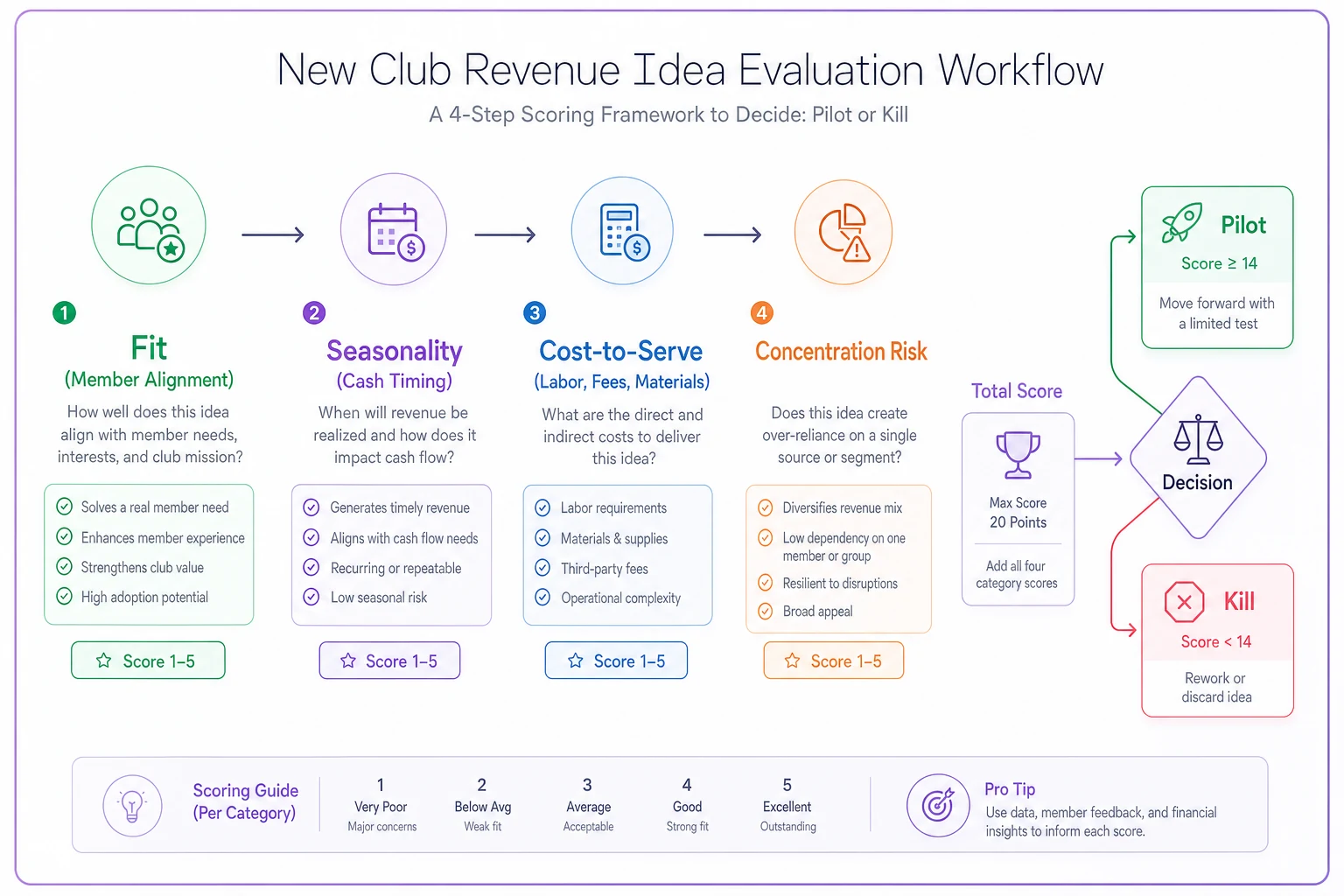
Score each idea 1–5 on each lens, and be honest about cost-to-serve (reverse the score — low cost is good):
Modeling cost-to-serve without a finance background
This is where most volunteer treasurers get it wrong, and it's genuinely simple once you see it laid out.
Cost-to-serve is everything it takes to deliver one unit of the revenue line, including the stuff that never shows up on an invoice. For a paid workshop, one "unit" might be one attendee. For sponsorship, one "unit" is one sponsor relationship per year.
-
Direct costs materials, venue, food, the physical stuff you can point at.
-
Transaction costs payment processing (usually 2.5–3%), platform fees, refunds.
-
Labor cost volunteer or staff hours × a realistic hourly value. Yes, count volunteer time. Even if you don't pay it in cash, you pay it in burnout and turnover.
-
Overhead drag software subscriptions, insurance riders, the admin tail.
A typical example: a regional professional association runs a paid evening workshop series, six sessions a year, charging $35 a head, averaging around 40 attendees per session.
Gross looks great: 6 × 40 × $35 = roughly $8,400 a year.
-
Speaker stipends and room rental
about $2,600 across the series
-
Food and printing
around $1,400
-
Payment processing (~3% of $8,400)
roughly $250
-
Volunteer labor
promotion, registration, setup, follow-up — realistically 12–15 hours per session. Six sessions is close to 80 hours. Valued conservatively at $25/hour, that's about $2,000 in "cost" you're absorbing somewhere.
Net cash surplus is maybe $4,100 — but the real economic surplus after labor is closer to $2,100, and that surplus is being paid for by two volunteers who will eventually quit if nobody notices. Suddenly the decision changes: is $2k worth 80 volunteer hours, or would batching registration and payment automation cut that labor in half and make it genuinely worth doing?
That's the whole point of the exercise. You're not trying to kill the idea. You're trying to see where the hidden cost lives so you can design it out before scaling.
A forecasting template even a nervous treasurer can run
Forget sophisticated models. Volunteer boards need something they can update in ten minutes and defend in a meeting. Use a three-scenario forecast: conservative, expected, and optimistic.
Here's the process:
-
Estimate units at three levels. For the workshop above
conservative 25 attendees, expected 40, optimistic 55. Don't overthink the numbers — use last year plus a gut check.
-
Apply your per-unit net (revenue minus direct and transaction costs, before labor). Say that's about $30 net per attendee after food and fees.
-
Multiply and lay it across the calendar. This forces the seasonality question. Put the numbers in the actual months revenue lands.
-
Subtract fixed costs and the labor estimate as a separate line so the board can see it.
-
Track the gap. After each real event, log actual vs. expected. Three data points and you'll forecast far better than any spreadsheet formula.
The magic isn't precision — it's the range. When you tell a board "this brings in somewhere between $2k and $6k depending on turnout, and costs us roughly 80 volunteer hours either way," you get a real decision instead of wishful thinking. The fixed-cost-regardless-of-turnout insight is what stops clubs from launching things that only work at optimistic attendance.
This forecasting habit also feeds directly into your regular board materials. If you've already built a reporting rhythm — and if you haven't, the approach in Board-ready reporting architecture for small clubs is a good starting point — new revenue lines slot into the same cadence instead of becoming a separate mess of one-off updates.
Governance controls: the part boards regret skipping
Non-dues revenue introduces risk categories that pure dues never touch. Money handling by more people. Contracts with outside parties. Tax implications (unrelated business income can affect nonprofit status). Refunds and chargebacks. Reputation exposure when you attach the club's name to a sponsor.
You don't need a legal department. You need a few controls agreed before the money starts moving:
-
A dollar threshold that triggers board approval. Under $500, a committee decides. Over that, the board votes. Write it down so nobody has to interpret it later.
-
Dual control on anything over a set amount. Two people see every deposit and every sponsor payment. This isn't about distrust — it's about protecting good volunteers from ever being suspected.
-
A written kill-switch. Define upfront what result ends the pilot. "If the fall event nets under $1,500 or eats more than 100 volunteer hours, we don't repeat it." Deciding this while you're calm is far easier than after everyone's emotionally invested.
-
A sponsor/partner vetting checklist. One page
does this partner conflict with member interests, does it create a tax issue, does it commit us to anything multi-year?
-
Clean separation of restricted vs. general funds. If a grant or sponsorship comes with strings, it can't quietly get spent on the coffee budget.
The pattern worth naming: clubs that skip governance on small revenue lines almost always get burned not by fraud, but by confusion. A volunteer means well, pays a vendor from the wrong account, forgets to log a refund, and six months later the treasurer can't reconcile the books. The controls exist to prevent honest chaos more than dishonesty.
The low-effort pilot playbook
The core rule: a pilot should be small enough that failing costs a weekend, not a fiscal year.
-
Pick the smallest testable version. Not "launch a conference." Test "one paid half-day workshop." Not "build a merch store." Test "pre-order 30 shirts before printing anything."
-
Set a single success metric and a stop date. One number, one deadline. If you can't name what success looks like, you're not ready.
-
Cap the resources upfront. "We'll spend up to $600 and up to 20 volunteer hours." When you hit the cap, you stop and evaluate — full stop.
-
Assign one owner and one backup. Shared ownership on a pilot means nobody owns it. The backup matters because volunteers get sick and life happens.
-
Instrument it before you launch. Decide what you'll measure and where it gets recorded before money moves, or you'll be reconstructing numbers from memory afterward.
-
Debrief within two weeks. Actual vs. expected on revenue, cost, and hours. Kill, tweak, or scale — and write the decision down.
A real scenario
A hobby club with about 220 members — photography, model railroad, that kind of group — wanted a second revenue line because dues alone (roughly $9k–$10k a year) barely covered their meeting space.
Instead of launching a big annual show, they piloted a single paid guest-instructor session. Cap: $500 spend, 15 volunteer hours. They charged $20, opened 35 seats, sold 31. Gross was around $620. After the instructor fee and snacks, net cash was close to $250 — modest, but the pilot revealed something more valuable: registration and payment collection ate almost all the volunteer time, not the event itself.
So the next round they moved registration and payment to a single online form with automatic confirmations, cutting the coordination from roughly 12 hours to about 3. Same event, same revenue, a fraction of the labor. They now run these quarterly and net somewhere in the $1,200–$1,600 range annually with barely any burnout — because they solved the cost-to-serve problem before scaling volume.
The lesson wasn't "workshops make money." It was "the first pilot exists to find the hidden labor, not to make money."
When this makes sense — and when it doesn't
When diversifying revenue actually makes sense:
-
Dues cover under ~80% of your operating costs and you don't want to keep raising them.
-
You have members already asking for things you could reasonably charge for.
-
You have at least one or two volunteers with genuine bandwidth, not just enthusiasm.
When it's a bad idea:
-
Your existing operations are already strained and volunteers are stretched thin. Adding revenue lines to a burning-out team accelerates the collapse.
-
You haven't fixed your core dues economics yet. If members are confused about what they're already paying for, sort that first — the audit approach in Turn confusion into upgrades usually recovers more money with less effort than any new stream.
-
The idea only pencils out at optimistic attendance. If conservative-scenario numbers lose money, don't launch.
Who should genuinely NOT do this: clubs mid-leadership-transition, or ones without any bookkeeping discipline yet. New revenue on top of shaky books just creates a bigger reconciliation nightmare for whoever comes next.
Making it sustainable as you grow
The framework scales, but the failure points shift. At a small scale, the risk is volunteer burnout and messy books. As non-dues revenue grows past a few thousand dollars and multiple streams run at once, the risks become coordination and tracking — who owns which line, whether the numbers are reconciled consistently, whether one stream is quietly subsidizing another's losses.
This is where a shared operational system earns its keep. Not because software makes money, but because it removes the invisible labor that kills good revenue ideas. When registration, payment, member records, and reporting live in one place instead of six spreadsheets and three volunteers' inboxes, the cost-to-serve on every revenue line drops — and automated confirmations, reminders, and reconciliation handle the repetitive work that used to burn out treasurers. The revenue lines that survive long-term are almost always the ones where the delivery got systematized early.
But the tooling is secondary. The discipline is what matters: score the fit, model the true cost including labor, forecast in ranges, put a few controls in place, and pilot small enough that a failure is survivable. Do that, and non-dues revenue stops being a gamble that exhausts your best people and becomes what it should be — a steady, boring second income that keeps the lights on without another dues increase.
Start with one idea. Run it through the four lenses this week. Kill it if the math says so. The clubs that build durable revenue aren't the ones with the most ideas — they're the ones willing to say no to the expensive-looking ones before spending a single volunteer hour.
Ready to streamline your club operations?
Join 500+ clubs using Clubyly to save time, boost member engagement, and grow their communities.