

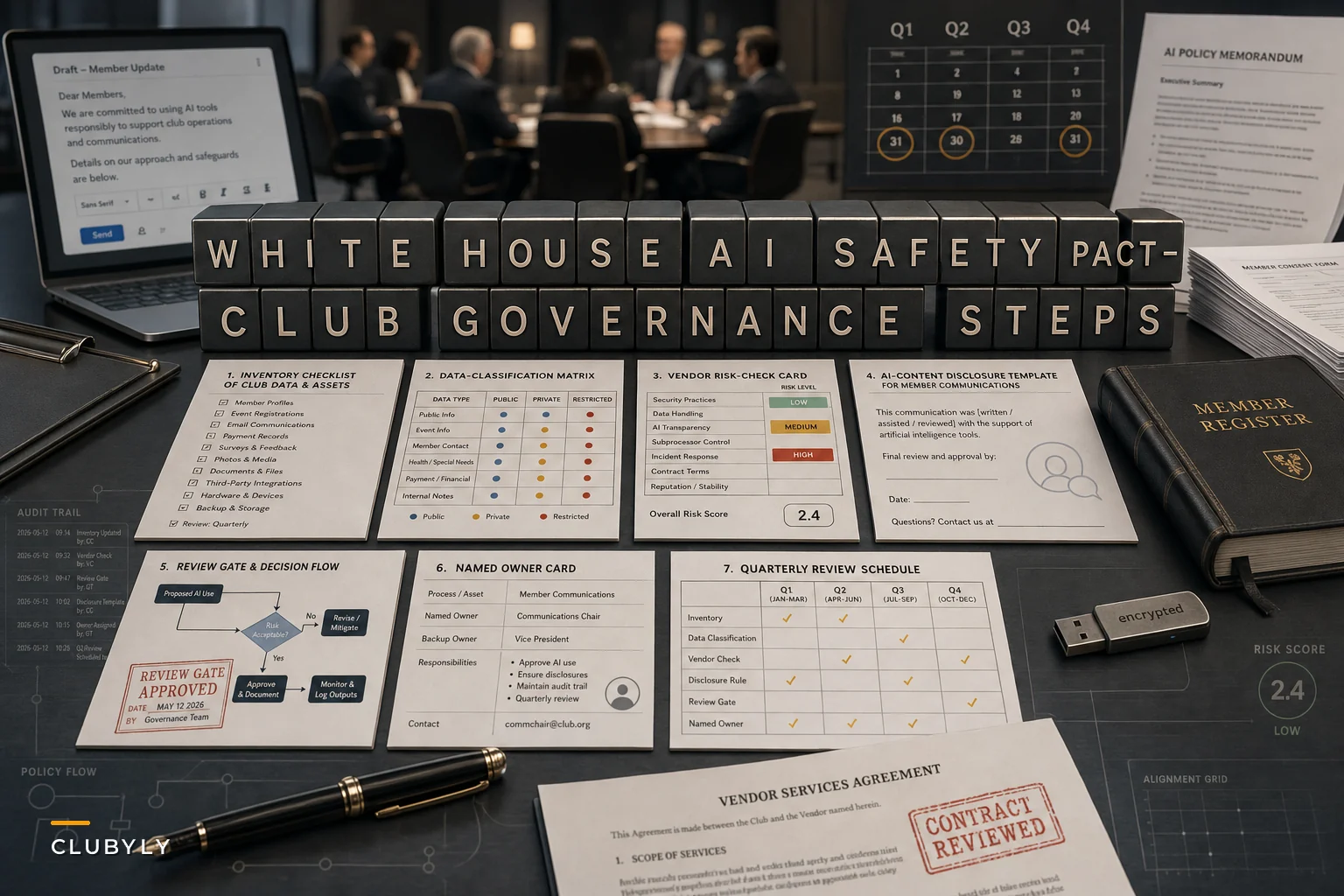

On September 29, 2026, the White House brought a room full of tech executives together, signed what was described as a "morally binding" voluntary AI safety accord, and rolled out an executive order aimed at advanced AI and new federal AI services. CNBC covered the luncheon and the CEO statements, and Reuters went deeper on the voluntary pact and data commitments.
Most club leaders will read a headline like that and move on. Understandably — none of it creates a rule you have to follow next Monday. But it does shift the baseline. When the biggest AI vendors publicly commit to safety, disclosure, and data handling standards, that expectation trickles down to everyone using their tools. Including the volunteer drafting your member emails with a chatbot. Including the personalization engine deciding which lapsed members get the "we miss you" sequence.
If your club uses AI anywhere in member communications, the practical question isn't "are we regulated?" It's "if a member asked us how we use their data in AI tools, could we answer in plain English?" Most clubs can't. That's the gap worth closing.
The exposure clubs don't realize they already have
AI rarely lives in one big system in a typical membership operation. It's scattered:
-
A board member uses an email generator to write renewal reminders, pasting in member names and sometimes payment history for "context."
-
Your email platform quietly added an AI subject-line optimizer that trains on your open-rate data.
-
A chatbot on your member portal answers dues questions and logs every conversation somewhere nobody has checked.
-
Someone exported your member list into a free "segmentation" tool to find who to target for an event.
Each of these feels harmless in isolation. Stacked together, member data is flowing through three or four AI systems that nobody formally approved, with no record of what's stored, for how long, or who the vendor shares it with.
The underlying problem the federal attention exposes isn't primarily legal risk. It's that most clubs have AI use but no AI inventory. You can't govern what you haven't listed. When something goes wrong — a hallucinated dues amount in an auto-generated email, a chatbot giving a member bad renewal information, a personalization engine surfacing data a member thought was private — there's no paper trail and no owner.
A real scenario: the regional alumni chapter
Consider a regional alumni association with around 1,400 members, run by two part-time staff and a rotating volunteer committee. They adopted an AI email assistant to cut newsletter drafting time, which worked — roughly from four hours a week down to about ninety minutes.
Keep your membership organized and engaged.
Clubyly simplifies member management, event coordination, and payment collection—effortlessly.
- Unified member database
- Automated payment tracking
- Event scheduling & reminders
No credit card required
What they didn't notice: the volunteer drafting emails was pasting segments of the member spreadsheet — names, graduation years, lapsed status, and in some cases donation history — to get "personalized" copy. That data was going into a consumer AI tool with no data-processing agreement and default settings that allowed content to be retained.
It surfaced when a member replied asking why an email referenced their donation from two years prior — information they'd given privately. Nothing illegal happened. But the board spent a tense meeting realizing they had no idea how many tools touched member data, and pulling together a clear answer took about three weeks.
The fix wasn't expensive. It was a one-page inventory, a disclosure line in AI-assisted emails, and a rule that no raw member data goes into any tool without approval. Drafting time stayed low. The anxiety went away. Small, boring governance preventing a bad afternoon — that's the whole thing.
What "responsible AI for clubs" actually requires (the short version)
Forget the enterprise frameworks. For a volunteer-led or small-staff club, responsible AI comes down to five questions you should be able to answer:
-
What AI tools touch member data, and who approved them?
-
What data goes into each tool, and does the vendor retain or train on it?
-
When a message is AI-generated, do members know?
-
If AI gives a member wrong information, how do we catch and correct it?
-
Who is the single person accountable for this?
Answer those five and you're ahead of most organizations your size — including plenty of businesses far larger than you.
A comparison: ad-hoc AI use vs. governed AI use
Most clubs land somewhere in the left column below without realizing it. It's not recklessness — it's just the default, and defaults don't change without a nudge.
| Dimension | Ad-hoc (where most clubs are) | Governed (where you want to be) |
|---|---|---|
| Tool approval | Anyone adds tools informally | Short approval step before data goes in |
| Data entering AI | Raw member records pasted freely | Minimized, anonymized where possible |
| Vendor terms | Nobody read them | Checked for retention/training clauses |
| Disclosure | Members don't know AI is used | Simple, consistent AI-assisted notice |
| Error handling | Mistakes found by accident | Review step before send; correction path |
| Accountability | Diffuse / nobody | One named owner |
The gap between those two columns is usually a few hours of work spread across a couple of weeks, not a policy project.
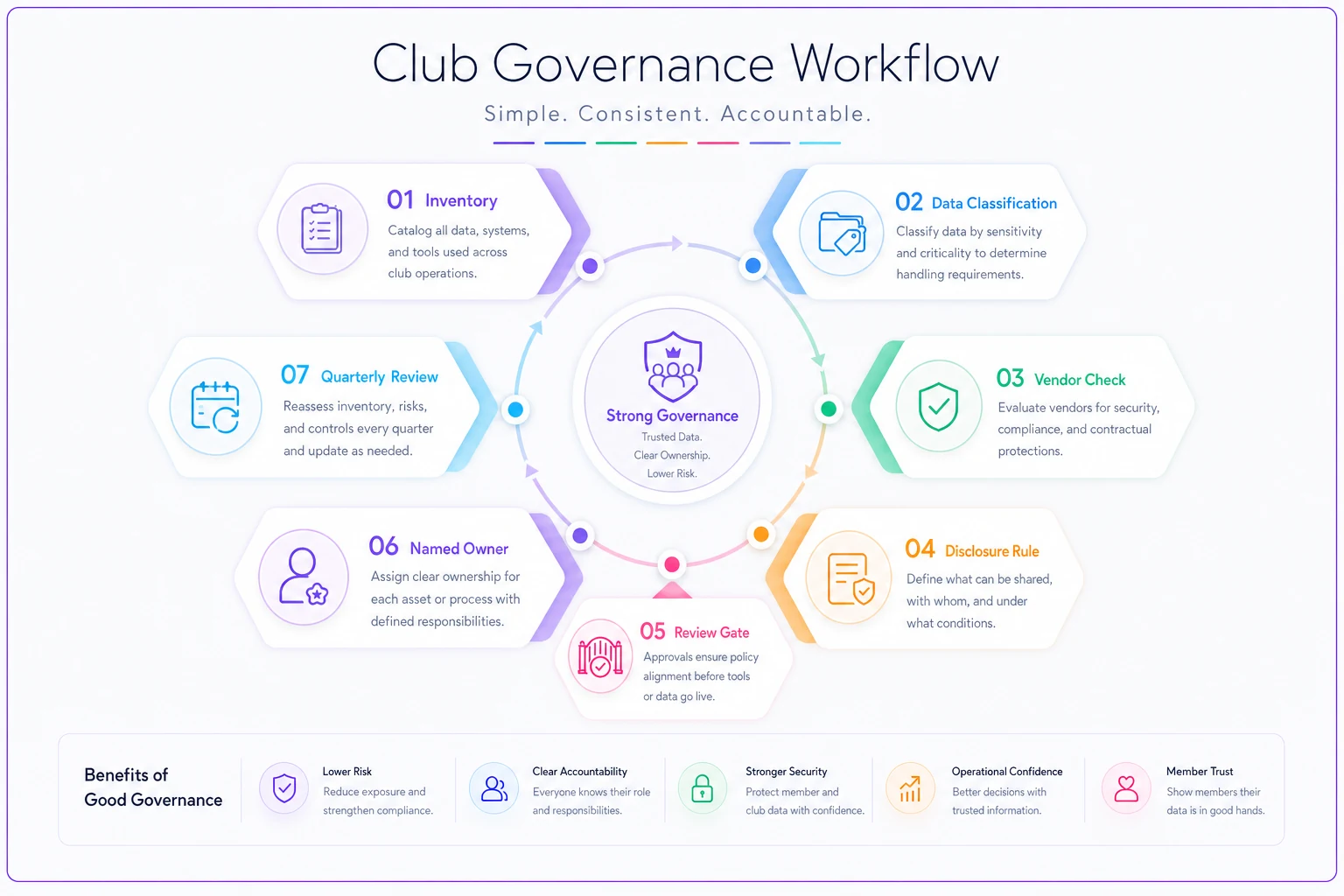
The practical governance steps, in order
You don't need a committee or a consultant. A small club can work through this in a couple of weeks using the steps below.
1. Build a one-page AI inventory
List every tool that touches member data or generates member-facing content. For each: what it does, what data it sees, who uses it, and whether you've checked the vendor's data terms. Half the value is just seeing the full list for the first time.
2. Classify what data is allowed in
Decide plainly what can and cannot go into AI tools. A rule that works for most clubs: names and general segment labels are fine; payment history, health info, private notes, and anything a member marked confidential are not — unless the tool has a proper data agreement. This single rule prevents most of the ugly scenarios.
3. Add a vendor attestation step
Before adopting any AI-powered tool, ask the vendor three things in writing: Do you train on our data? How long do you retain it? Can we delete it on request? The safety accord the big vendors signed makes these answers easier to get — reputable providers now expect the question. If a vendor dodges, that's your answer.
4. Write a disclosure rule
Decide when members should know a message was AI-assisted. You don't need a disclaimer on every email. A reasonable standard: disclose when AI handles the substance of a member interaction — like a chatbot answering account questions — and skip it for internal drafting help. Consistency matters more than frequency.
5. Insert a human review gate
The highest-risk failure in club communications is an AI tool stating something factually wrong about a member's account — a dues amount, a renewal date, a benefit. One human review before anything account-specific goes out catches nearly all of these. Thirty seconds, not a workflow overhaul.
6. Name one owner
Governance without an owner disappears the moment the volunteer who cared about it rotates off. Pick one person. Put it in their role description. Revisit the inventory quarterly.
Getting these steps done once is the hard part. After that, it's mostly maintenance.
Your quick-start checklist
Use this as the actual to-do list:
-
[ ] List every AI tool touching member data (the one-pager)
-
[ ] Write a "what data is allowed in AI tools" rule
-
[ ] Read the data terms on your top 3 AI tools
-
[ ] Draft a short vendor question set for future tools
-
[ ] Decide your AI disclosure standard
-
[ ] Add a human review step for account-specific messages
-
[ ] Assign one accountable owner
-
[ ] Schedule a quarterly review (15 minutes is enough)
None of these need budget. They need a decision.
When this level of governance makes sense — and when it's overkill
This makes sense if you use AI for member-facing communication, personalization, or any analytics on member data. The moment member data enters an AI system, you want the inventory and the data rule at minimum.
This is lighter-touch if your AI use is purely internal and never sees member data — say, drafting public social posts from scratch. You still want the inventory, but the consent and disclosure pieces matter less.
Don't overbuild if you're a tiny club with one tool and twenty members. A paragraph in your operating notes beats a ten-page policy nobody reads. For small clubs, the failure mode isn't too little policy — it's policy so heavy it gets ignored, which creates false confidence rather than actual protection.
Where this connects to the work you've probably already started
Most of this isn't really an "AI problem." It's a data-and-consent problem wearing a new coat. If you've already built clear records of what data you hold, why you hold it, what members consented to, and how long you keep it — adding AI tools to that framework is a small extension, not a new project. If you haven't, AI just makes the gaps more visible and more expensive to ignore.
That's why the strongest move after this federal news isn't buying something new. It's tightening your member data governance and consent workflows so every tool, AI or not, plugs into one consistent set of rules. When your data practices are solid, vendor attestations and disclosure rules become checkboxes instead of fire drills.
A pattern that holds up in practice: keep one canonical record of what data you hold and what each member consented to, and treat every AI tool as something that must comply with that record — not the other way around. When an email generator, chatbot, or analytics tool wants member data, the question is always "does this fit our consent and retention rules?" If your club runs operations through a central membership platform rather than scattered spreadsheets and disconnected tools, enforcing that becomes significantly easier, because the data rules live in one place and don't depend on each volunteer remembering them independently.
The quieter takeaway
Federal attention on AI will keep raising expectations, and the executive order itself signals this isn't a one-off news cycle. But clubs waiting for a specific rule before acting are solving the wrong problem. Members who notice AI missteps aren't checking compliance frameworks — they're reacting to an email that got their details wrong, or a chatbot that fumbled their renewal.
Responsible AI at club scale is mostly about not surprising your members and being able to explain yourself when asked. The inventory, the data rule, the review gate, the named owner — that's enough. Do the boring version now, while it's a quiet afternoon's work, rather than later when it's a tense board meeting.
Responsible AI at club scale is mostly about not surprising your members and being able to explain yourself when asked. The inventory, the data rule, the review gate, the named owner — that's enough. Do the boring version now, while it's a quiet afternoon's work, rather than later when it's a tense board meeting.
Ready to streamline your club operations?
Join 500+ clubs using Clubyly to save time, boost member engagement, and grow their communities.