


Most clubs don't have a data problem because someone ignored a law. They have a data problem because the person who understood the rules left the board two years ago, and nobody wrote down what they knew. The privacy policy still lives in a Google Doc. The consent checkbox on the signup form hasn't been touched since 2021. And when a member emails asking "what data do you have on me and who did you share it with?" — three volunteers spend a frantic afternoon reconstructing an answer from four different spreadsheets.
That's the real shape of member data governance for clubs. Not compliance theater. Not a 40-page policy nobody reads. It's the practical machinery that lets a rotating group of unpaid people make consistent decisions about member data without needing a lawyer on call.
This is about building that machinery — consent defaults that survive turnover, a decision matrix for who sees what, a clean way to handle third-party requests, audit logs that don't require a database admin, and a change-control rhythm small enough that volunteers actually follow it.
Why data governance quietly falls apart in volunteer-run clubs
The failure isn't dramatic. It's slow and structural.
A club collects member data across five or six touchpoints — signup form, event registration, payment processor, email tool, a member directory, maybe a Slack or Discord. Each of those got set up by a different volunteer at a different time, each with their own assumptions about consent. Nobody sat down and decided, as a group, what "yes" and "no" mean across all of them.
So you end up with contradictions. A member ticked "don't share my email" on the signup form, but the volunteer running the mentorship program exported the full member list — including that email — into a separate sheet to coordinate pairings. Nobody did anything malicious. The consent decision just didn't travel with the data.
This happens because governance lives in people's heads, not in the workflow. The treasurer knows you're not supposed to email non-consenting members. The events lead doesn't, because nobody told her, because the person who knew that rule handed off her role in a 20-minute coffee chat that covered venue contracts and forgot the data stuff entirely.
What breaks at scale is coordination. A 60-person club can survive on tribal knowledge. A 400-person club with three chapters and eight volunteer teams cannot. The number of people touching member data grows faster than the number of people who understand the rules, and the gap between those two curves is where privacy incidents live.
If you want the deeper foundation on what data you should even be storing and how it's structured, that belongs in your membership data strategy — the canonical schema and retention rules. Governance sits on top of that. You can't govern data you haven't defined.
Start with consent defaults, not consent options
The single highest-leverage decision you'll make is what your consent defaults are — because most members never change them.
Keep your membership organized and engaged.
Clubyly simplifies member management, event coordination, and payment collection—effortlessly.
- Unified member database
- Automated payment tracking
- Event scheduling & reminders
No credit card required
Worth internalizing: whatever you set as the default is what roughly 80–90% of your membership will effectively "choose," because people click through forms. That means your default is your policy for most of your members, regardless of what the checkbox technically offers.
So the design question isn't "should we offer a choice?" It's "what should happen when nobody makes one?"
-
Operational contact — dues reminders, event logistics, safety notices. Default: on. These aren't optional if you want to run the club.
-
Community communication — newsletters, general announcements. Default: on, easy opt-out.
-
Directory listing — appearing in the member directory at all. Default: off or minimal. This is the one you don't assume.
-
Third-party sharing — sponsors, partner orgs, other members' projects. Default: off, always explicit.
-
Photography and media — event photos, testimonials. Default
needs its own answer, especially with minors involved.
The mistake clubs make is collapsing these into one. When you do, you can never honor a partial preference, because you never captured one. A member who's happy to get event emails but doesn't want to be in a public directory has no way to express that, so they either over-share or leave.
Write down each default and why it's the default. That "why" is what survives a board transition. "Directory is off by default because we can't verify who's browsing it" is a sentence the next membership chair can actually reason from when a new situation comes up.
The directory exposure decision matrix
Your member directory is usually the highest-risk surface, because it's the one place member data is deliberately shown to other people. Everything else is contact-out; the directory is expose-in.
A decision matrix keeps this from becoming a case-by-case judgment call that changes depending on which volunteer is answering. The logic runs along two axes: who's asking to see it and how sensitive is the field.
| Field | Public / non-members | Any logged-in member | Verified members only | Board/admin only |
|---|---|---|---|---|
| Display name | Opt-in | Yes | Yes | Yes |
| City / region | No | Opt-in | Yes | Yes |
| Email address | No | No | Opt-in | Yes |
| Phone number | No | No | No | Yes |
| Employer / role | No | Opt-in | Yes | Yes |
| Membership tier | No | No | No | Yes |
| Join date | No | No | Opt-in | Yes |
| Payment status | No | No | No | Yes |
The point of the matrix isn't the exact cells — your club will tune those. The point is that every field has a predetermined exposure level, so no volunteer has to improvise. When someone asks "can we make the directory searchable by employer for a networking feature?" you check the matrix, see employer is member-opt-in, and the answer designs itself.
Two patterns worth flagging. First, "verified members only" is doing a lot of work in that table, and verification is where clubs get sloppy — a login isn't verification if anyone can create an account. Second, payment status and tier almost never belong anywhere but admin, and yet they leak constantly through exported spreadsheets used for other purposes.
The full treatment of public-versus-private listings, verification steps, and search UX lives in the dedicated piece on making your member directory useful without risking privacy. The matrix above is the governance layer that sits under those UX decisions.
Handling third-party requests without panic
Third-party data requests come in more often than clubs expect, and almost never in a form you're prepared for. A sponsor wants attendee emails. A partner nonprofit wants to co-market to your members. A researcher wants demographic data. A member wants the full roster to promote their side business. A vendor wants to "help you clean your list."
The instinct is to answer each one on its own merits in the moment. That's exactly the wrong move, because the person answering is usually a volunteer who wants to be helpful and doesn't want to seem obstructive to a sponsor the club depends on.
Build a standing intake form for third-party requests. Not to be bureaucratic — to slow the decision down just enough that it goes through the same gate every time. A minimal version captures:
-
Who is requesting and their relationship to the club
-
Exactly what data they want — fields, not vibes ("member emails" is a field; "our audience" is a vibe)
-
What purpose it serves and whether it's one-time or ongoing
-
What consent basis covers it — does the third-party-sharing consent we captured actually authorize this?
-
Who approves — anything touching contact data or ongoing access goes to a named role, not "whoever saw the email first"
The unlock here is step 4. If your consent defaults already established that third-party sharing is off unless explicitly granted, most requests resolve instantly: "We can share aggregate counts, not individual emails, because our members didn't consent to that." You're not making a hard call under pressure. You're reading back a decision you already made calmly, months ago.
A pattern worth noting: the requests that cause incidents aren't the obviously sketchy ones. They're the friendly ones from trusted partners, where the relationship pressure makes a volunteer skip the form. Which is precisely why the form has to be routine, not reserved for suspicious cases.
Audit logs that don't require a database expert
"Audit log" sounds like enterprise overhead. For a club it means something much simpler: can you reconstruct who did what to member data, and when?
You need this for two reasons. When a member asks what happened to their data, you need an answer. And when something goes wrong — an accidental export, a wrong email blast — you need to know the blast radius fast.
-
Log exports. Every time someone exports member data to a spreadsheet, they note it: who, when, why, which fields, where the file went. This single habit prevents most silent leaks, because exports are where consent decisions get orphaned.
-
Log consent changes. When a member changes a preference, keep the old value, the new value, and the timestamp. "Did they opt out before or after we sent that?" needs a definite answer.
-
Log access grants. When you give a new volunteer access to member data, record it — and record when you revoke it. Stale access from former volunteers is a classic quiet vulnerability.
-
Log third-party shares. Every approved request from the intake form gets an entry.
Most modern membership platforms track a lot of this automatically — preference changes, logins, admin actions — and that's genuinely where software earns its keep, because manual audit logs decay the moment things get busy. AI-powered operational platforms can go further, flagging unusual export patterns or access anomalies that a busy volunteer coordinator would never catch. But the governance decision is what you consider worth logging, and that's yours to make regardless of tooling. A tool that logs everything and a team that reviews nothing is no better off than a shoebox of notes.
Require field-selection on exports by default to prevent accidental sharing.
The realistic standard for a small club: you should be able to answer "what data do you hold on me, where did it come from, and who's seen it" within a day or two, using records that exist, not memory. If reconstructing that answer requires a scramble across four people, your audit trail isn't real yet.
A change-control cadence sized for volunteers
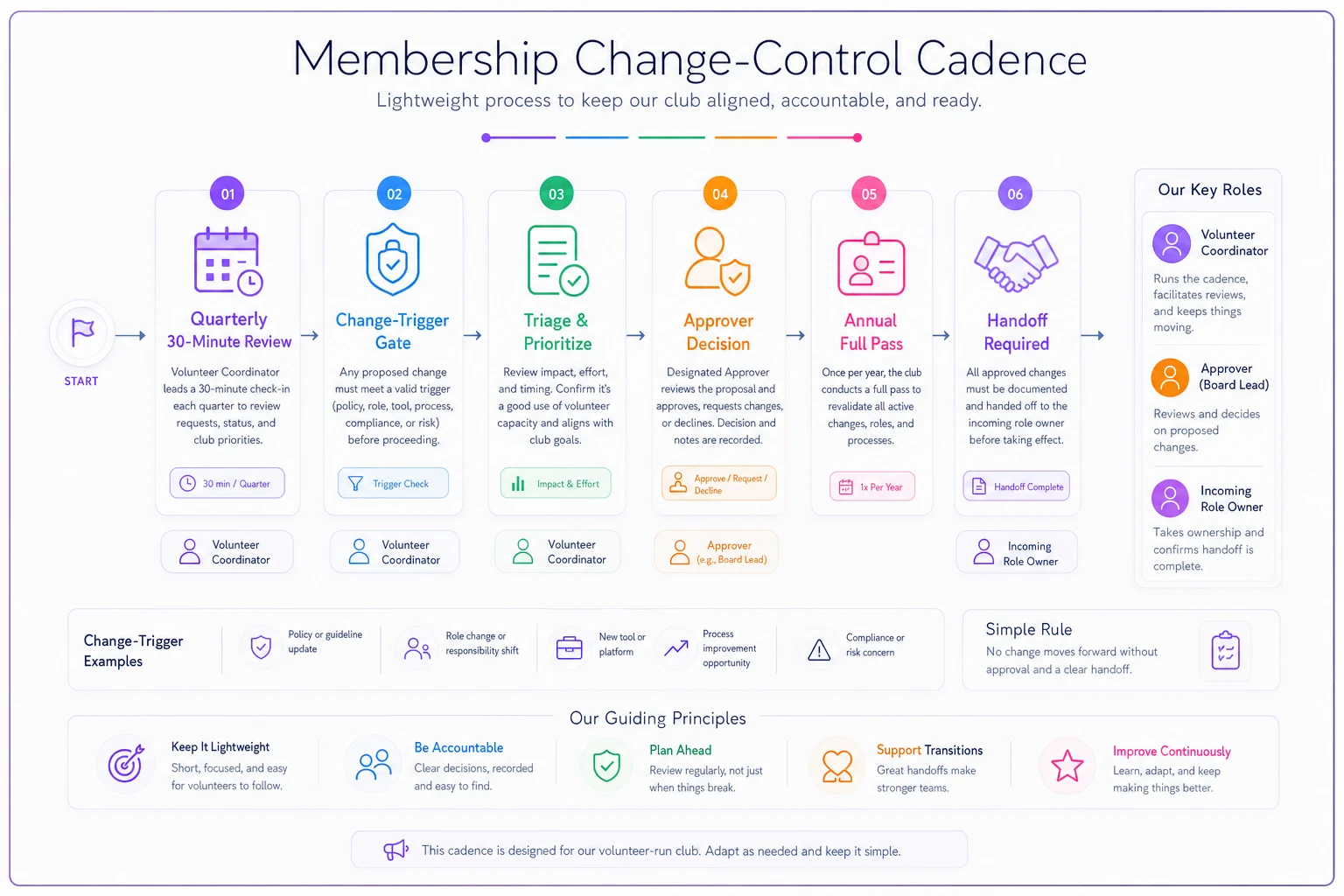
Governance documents don't fail because they're wrong. They fail because they go stale and nobody notices. A consent policy written for a club with one email tool becomes fiction the day you add a text-message reminder system, if nobody updates it.
Enterprise change control is overkill here. But no change control is how you end up with a privacy policy describing a club that no longer exists. The right size is a light, recurring rhythm.
-
Quarterly 30-minute review. One agenda item
"Did anything change about how we collect, store, or share member data this quarter?" New tool, new form field, new sponsor arrangement — flag it against the policy.
-
Change-triggered check. Any time someone proposes a new data collection point or integration, it doesn't go live until someone confirms it fits the consent defaults and updates the matrix if needed. This is the single most important gate.
-
Annual full pass. Once a year, read the whole thing top to bottom, prune retention that's overdue, and re-confirm access lists.
-
Handoff requirement. Data governance is a named line item in every role transition. The outgoing volunteer walks the incoming one through the defaults, the matrix, and the audit practices — not as an afterthought, as a checklist item.
That fourth point matters more than the first three combined. The reason governance decays in clubs isn't neglect during someone's tenure — it's the cliff at every transition. A governance system that isn't explicitly handed off will always drift back to tribal knowledge within two board cycles.
Here's a simple workflow to visualize the change-control cadence in practice.
This connects directly to the broader set of governance mistakes small clubs make and how to escalate them. Data governance is one instance of a general pattern: rules that live in people fail, rules that live in workflow survive.
A real scenario: the mentorship-program leak
A regional professional association, roughly 350 members across two chapters, ran an annual mentorship program. The coordinator did what coordinators do — exported the full member roster into a shared spreadsheet to match mentors with mentees, then dropped the file in a shared drive so the committee could collaborate.
The roster included email addresses and employer info. About 40 of those members had, at signup, opted out of having their contact details visible to other members. The spreadsheet ignored all of that, because the export didn't carry the consent flags — it just dumped every field. The committee, maybe six volunteers, now had a fully browsable list with data those 40 members had explicitly restricted.
Nobody noticed until one of those members recognized their private email in a group message and asked how it got there. The club had no audit trail of the export, no record of who'd opened the shared file, and no fast way to confirm whether the data had gone further.
The cleanup took the better part of two weeks — locking the file, notifying the affected members, and reconstructing what happened from memory and Slack scrollback. No regulator got involved, but a handful of members didn't renew, and the board spent a meeting on damage control instead of programming.
What would have changed the outcome wasn't a lawyer. It was three things already covered above: consent flags that travel with exported data, an export log that notes purpose before a full roster leaves the system, and a directory matrix that marks employer and email as member-opt-in, so the "just export everything" habit gets caught at the design stage. After the incident the club implemented exactly that — exports now require selecting fields and confirming purpose, and the mentorship match runs off a filtered view that respects preferences. The next cycle ran without a single flag.
When a formal governance system is overkill — and when it isn't
You don't need all of this on day one.
A brand-new club under roughly 50 members, one email tool, no directory, no sponsors — you need clear consent defaults and a written note of them. That's it. Building a change-control cadence for a club that changes nothing is procedure for its own sake.
Skip the heavy version if your data footprint is tiny and stable, everyone touching data is in one room, and you have no third-party sharing. Add pieces as you add surfaces.
You genuinely need the full system when you cross a few thresholds at once: more than a couple hundred members, multiple volunteer teams touching data, a live member directory, any third-party sharing, or multiple chapters. That combination is where informal governance stops scaling and quiet incidents start.
Who should not DIY this at all: clubs handling health data, data on minors, or anything a member could be materially harmed by if leaked. At that point the operational workflows in this article still apply, but the policy underneath them should get a real legal review. Translating templates into workflows assumes the templates are sound to begin with.
Bringing it together
The clubs that avoid privacy headaches aren't the ones with the longest policies. They're the ones where the answer to "what happens to member data" is built into the workflow instead of stored in someone's head.
Consent defaults that most members inherit by not choosing. A directory matrix that answers exposure questions before they're asked. A third-party intake form that turns pressure decisions into routine ones. Audit habits that let you reconstruct what happened. And a change cadence light enough that busy volunteers actually keep it alive across every transition.
None of it is legal work. It's operational design — the same discipline you'd apply to volunteer scheduling or event safety, pointed at the question of who gets to touch member data and under what rules. Get that machinery running once, hand it off cleanly each cycle, and the frantic afternoon reconstructing an answer from four spreadsheets simply stops happening.
Ready to streamline your club operations?
Join 500+ clubs using Clubyly to save time, boost member engagement, and grow their communities.