



Most privacy trouble in clubs doesn't come from a dramatic data breach. It comes from small, boring operational gaps: a checkbox that was pre-ticked, a volunteer who forwarded a member list to a sponsor "just this once," a directory export that nobody logged. Each one feels harmless in the moment. Stacked up over a year, they're how a membership organization ends up emailing people who explicitly said no, and finding out only when someone complains to the board.
This piece is narrowly about the operational side — the actual language on your forms, the defaults you set, how you handle outside requests for member data, and a lightweight way to log who touched what. Not the legal framework. You still want someone qualified to sign off on your policy, but the controls below are what actually make the policy hold up day to day.
The quiet failure: consent that technically exists but operationally doesn't
A club has a membership form with a line like "I agree to receive communications and to be included in the member directory." One checkbox. Already ticked. The member signs up to join a hiking group, barely reads it, and moves on.
Eighteen months later that same person gets added to a public-facing directory with their phone number, forwarded to a partner organization's event blast, and sent a renewal reminder they never asked for. Technically they "consented." Operationally, they consented to nothing specific — they agreed to a vague bundle because the form forced them to.
The failure isn't the intent. It's that one checkbox was doing the work of four separate decisions:
-
Do you want club operational emails (renewals, event logistics)?
-
Do you want optional marketing/newsletter content?
-
Do you want to appear in the member directory?
-
If so, which fields — name only, or name plus contact info?
When those collapse into one line, you lose the ability to honor the member's actual preference later. And you lose the ability to prove what they agreed to. That second part is what bites clubs when a dispute escalates.
Checkbox language that actually means something
The single biggest improvement most clubs can make costs nothing: unbundle your consent and never pre-tick anything that's optional.
Keep your membership organized and engaged.
Clubyly simplifies member management, event coordination, and payment collection—effortlessly.
- Unified member database
- Automated payment tracking
- Event scheduling & reminders
No credit card required
Operational communications — dues reminders, "the venue changed" notices, the stuff a member genuinely needs — can be framed as a condition of membership. That's fine. But anything optional should be a separate, empty box with plain language.
Compare the two approaches:
| Weak consent language | Operationally sound language |
|---|---|
| ☑ I agree to communications and directory listing (pre-checked) | ☐ Add me to the member directory (name only) |
| ☐ Also show my email in the directory | |
| ☐ Send me the monthly newsletter and event announcements | |
| (bundled, implied) | ☐ Share my contact info with vetted partner organizations for member discounts |
The right column gives you something the left never can: a clean record of exactly what each person wanted. When someone later says "I never agreed to be in the directory," you can look at their record and see an unchecked box. No argument.
A few specific rules that matter more than they look:
-
Default to off for anything optional. Opt-in beats opt-out every time, both ethically and operationally. Pre-checked boxes create consent you can't actually trust.
-
Separate "name only" from "name plus contact." These are completely different exposure levels and should never share a checkbox.
-
Write the box in the member's language, not yours. "Share with vetted partners" is clearer than "third-party communications." People consent more honestly when they understand the sentence.
-
Store the form version. If you update your form wording in March, you need to know whether a member signed the January version or the March one.
That last point is where clubs get sloppy. Consent isn't just "yes/no" — it's "yes to what, on which version of the form, on what date." If your membership data schema doesn't capture consent as structured fields with timestamps, you'll be reconstructing it from memory at exactly the moment you can least afford to.
Opt-in defaults: the setting most clubs get backwards
There's a subtle trap in how membership platforms and spreadsheets get configured. Someone sets up the new member workflow and, to be "helpful," defaults everyone into the newsletter, the directory, and the partner-sharing list. The logic is "they can always opt out."
In practice, almost nobody opts out — not because they're happy, but because they're not paying attention. So your directory fills with people who never actively wanted to be there. Engagement metrics look inflated. And the first time a member notices their info is public, you've got a trust problem that's much louder than a handful of extra newsletter subscribers was ever worth.
-
Operational emails
on by default (condition of membership, clearly stated).
-
Marketing/newsletter
off by default, offered at signup and in member self-service settings.
-
Directory inclusion
off by default, with a simple "add me" toggle.
-
Partner/third-party sharing
off by default, always. This one should never be default-on, full stop.
The pattern worth internalizing: the more a setting exposes a member to people outside the club, the harder the default should lean toward off. Internal operational contact is low-risk. A public directory listing is medium-risk. Handing data to an outside organization is the highest-risk thing you do, so it gets the strictest default.
One more thing about how these settings drift: defaults set once tend to get copied forever. If the person who built your 2021 signup flow defaulted directory-sharing to on, every member since has inherited that choice without knowing it. Audit your defaults at least once a year — it takes twenty minutes and it's probably the cheapest privacy fix available.
The third-party request: where good intentions leak data
This is the scenario that causes the most avoidable damage, and it almost never involves bad actors.
A sponsor who funded your spring event asks for "the attendee list so we can follow up." A sister chapter wants your member emails to promote a joint workshop. A board member's friend is doing a survey and "it would really help." These requests come through casual channels — a text, a hallway conversation, a reply-all — and because the person asking is friendly and the cause seems fine, someone exports a list and sends it.
That's a data-sharing event with no form, no approval, and no record. If a member later asks "how did this sponsor get my email?" nobody can answer, because the decision happened in a DM.
The fix is routing every external data request through a simple intake form, no exceptions — even for the club president. Not because you distrust people, but because a form forces the right questions to get asked before data moves.
A minimal third-party request form should capture:
-
Who is requesting (name, organization, relationship to club)
-
Exactly what data is requested (which fields, which members)
-
The purpose and how long they'll keep it
-
Whether the requested members actually opted into partner-sharing
-
Who on the board or staff approved it, and the date
-
What was actually sent, and when
The critical gate is the fourth item. You can only share data for members who opted into that specific type of sharing. If a sponsor wants attendee emails but only 40% of attendees opted into partner-sharing, the sponsor gets 40% of the list — or you ask the other 60% directly. The form makes that math unavoidable instead of invisible.
This also protects the volunteer who'd otherwise be put on the spot. "I can't send that directly — all external requests go through our intake form, I'll get it to the right person" is a much easier sentence when it's just the policy, not a personal judgment call. Clubs that formalize this remove a whole category of awkward situations, where a well-meaning volunteer either overshares or feels rude for refusing.
A simple audit-log workflow for teams without a compliance department
You don't need enterprise tooling to know who touched member data. You need a habit and a place to write it down. The goal of an audit log isn't surveillance — it's being able to answer "what happened to this member's data and when?" without guessing.
What to log:
-
Every data export (who exported, which fields, how many records, why)
-
Every third-party share (tied back to the request form above)
-
Every bulk preference change (e.g., "migrated 300 members to new platform, directory settings mapped on X date")
-
Every deletion or anonymization request and when it was completed
How to run it without it becoming a burden:
-
Keep one log — a single sheet or a table in your membership system — not five scattered notes.
-
Make logging a step inside the task, not a separate chore. The person doing the export writes the log line before closing the file. If it's a separate task, it won't happen.
-
Use plain entries
date, person, action, scope, reason. Five columns. Don't overdesign it.
-
Review the log quarterly for anything weird — exports with no stated reason, shares to organizations nobody recognizes.
-
Tie deletion requests to a deadline so "please remove my data" doesn't sit unactioned for three months.
Make logging part of the export workflow so it's completed before the file is closed.
The reason this matters: membership roles turn over constantly in clubs. The volunteer who exported a list in June is gone by December. Without a log, that knowledge leaves with them. A log is how institutional continuity survives turnover — the same discipline that keeps your broader governance from falling apart during handoffs.
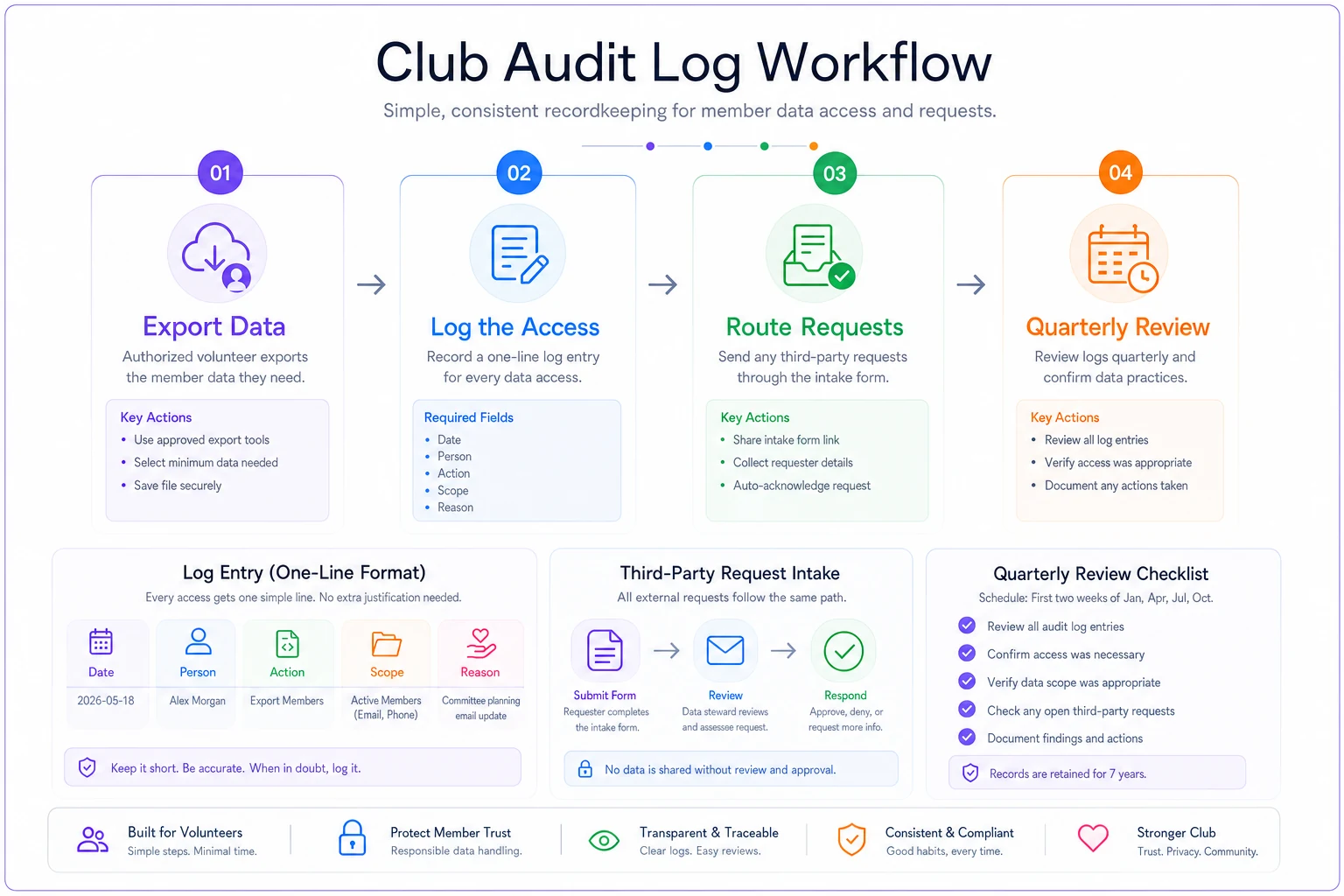
A quick visual of the audit-log steps makes it obvious where the log entry sits in the task.
A real scenario: the regional hobby club and the sponsor list
A regional club of roughly 600 members was running on a shared spreadsheet and a general-purpose email tool. Their signup form had the classic single bundled checkbox, pre-ticked. Directory-sharing defaulted to on. External requests were handled ad hoc.
The trigger was ordinary: an event sponsor asked for the attendee list and a volunteer sent all 240 attendee emails. A handful of those attendees had, at some earlier point, asked to be kept off any sharing — but that preference lived in an old email thread, not in the data. Three complaints came back to the board within a week, plus a wave of unsubscribes and one genuinely angry long-time member.
The fix wasn't expensive. They unbundled consent into four separate opt-in boxes, flipped directory and partner-sharing to default-off, built a one-page third-party request form, and started a five-column audit log. The next time a sponsor asked, the volunteer routed it through the form, the club cross-checked partner-sharing consent, and roughly 90 of the 240 attendees qualified. The sponsor got 90 clean contacts. Nobody complained. The whole changeover took part of one weekend and no outside spend.
The lesson: the problem was never that they shared data. It's that they shared data they couldn't account for. Once consent was structured and sharing was gated, the same activity became completely defensible.
When stricter controls are overkill — and when they're not
A tiny club of 30 people who all personally know each other doesn't need a formal intake form for every request; the overhead would outweigh the risk. But the moment you cross into "members don't all personally know the board," or you start taking sponsor money, or you have any public-facing directory, these controls stop being optional overhead and start being the thing that protects your reputation.
The controls are also wasted if you don't enforce the defaults. An opt-in checkbox that a volunteer "helpfully" fills in for members during manual data entry is worse than no checkbox, because now your record is inaccurate. If you adopt opt-in defaults, you have to mean them all the way down to data entry.
And none of this works as a one-time project. Defaults drift, forms get edited, new volunteers invent new shortcuts. The clubs that stay clean treat a once-a-year review of their checkbox language, default settings, and audit log as a standing calendar item — not a scramble triggered by a complaint.
The through-line
Member privacy in a club isn't primarily a legal document. It's a set of small operational decisions made dozens of times a year: what the checkbox says, whether it's pre-ticked, where a sponsor request goes, whether anyone wrote down the export. Get those right and your actual policy becomes easy to honor, because the day-to-day operation already matches the promise. Get them wrong and the best-written policy in the world can't save you from a volunteer forwarding a list in good faith.
Start with the cheapest fixes first: unbundle the consent, flip the risky defaults to off, and route every external request through one form. The audit log can follow. None of it requires a budget — just the decision to stop treating member data as something anyone can share without leaving a trace.
Ready to streamline your club operations?
Join 500+ clubs using Clubyly to save time, boost member engagement, and grow their communities.