


The awkward truth about running email experiments clubs depend on for real decisions: with a list of 400 people, most A/B tests you run are statistically meaningless. You send version A to 200, version B to 200, one gets a 24% open rate, the other gets 27%, and someone in the board meeting says "the second subject line won, let's use that style going forward." Except it didn't win. That gap is noise. Flip a coin 200 times twice and you'll see bigger swings than that.
Small lists break the standard email-testing playbook because that playbook was written for people sending to 50,000 subscribers. When you're a membership org with a few hundred to a couple thousand contacts, you need different rules — different sample-size logic, different things worth testing, and a lot more patience about what "a result" even means.
This is the guide for that. No 10,000-recipient assumptions. Just what works when your whole list is smaller than a single test cell at a big company.
The core problem: your list is too small to detect small differences
To reliably detect a 2-percentage-point difference in open rate — say, 25% vs. 27% — you'd need thousands of recipients per variation. Most clubs don't have that. So when you split a 500-person list in half and see a small difference, you genuinely cannot tell whether you found a real effect or just watched randomness do its thing.
But here's the part most "just run A/B tests!" advice skips: you can reliably detect big differences on small lists. A subject line that moves opens from 22% to 34% is detectable on a few hundred people. A change that moves clicks from 3% to 7% is detectable. The trick isn't running more tests. It's only testing things capable of producing large swings, and ignoring the small stuff entirely.
What "detectable" roughly looks like at club sizes
This table is a rough field guide, not a formal power calculation. Treat it as "don't bother testing below this gap."
| Your list size (per send) | Smallest open-rate gap worth trusting | Smallest click-rate gap worth trusting |
|---|---|---|
| ~200 total (100 per variation) | ~12–15 points | ~6–8 points |
| ~500 total (250 per variation) | ~8–10 points | ~4–5 points |
| ~1,000 total (500 per variation) | ~6–7 points | ~3–4 points |
| ~2,000 total (1,000 per variation) | ~4–5 points | ~2–3 points |
If your variations differ by less than the number in the relevant column, don't declare a winner. Call it a tie and move on. The most common mistake across small membership orgs is treating a 2–3 point difference as a decision when it's squarely inside the margin of noise.
What's actually worth testing (and what's a waste of your list)
Every time you run a test, you "spend" some of your list on the losing variation. On a small list, that's expensive. So you want each experiment to earn its keep.
Keep your membership organized and engaged.
Clubyly simplifies member management, event coordination, and payment collection—effortlessly.
- Unified member database
- Automated payment tracking
- Event scheduling & reminders
No credit card required
Worth testing on a small list:
-
Subject line angle (curiosity vs. direct benefit vs. deadline) — these produce big swings
-
Send day (Tuesday vs. Sunday can be a 10+ point open-rate difference for volunteer-heavy clubs)
-
Send time relative to your members' actual routine
-
Whether you personalize the subject with a first name at all (not the wording — the presence)
-
Call-to-action format
one clear button vs. a wall of links
Not worth testing on a small list:
-
Button color
-
"Register" vs. "Sign up" wording
-
Minor phrasing tweaks in the subject
-
Emoji vs. no emoji (unless you suspect a real cultural mismatch with your members)
-
Anything you'd describe as "a slight change"
Small lists reward testing categories of approach, not word-level polish. Find the winning category first. Polish it later.
A sample-size rule you can actually apply in a board meeting
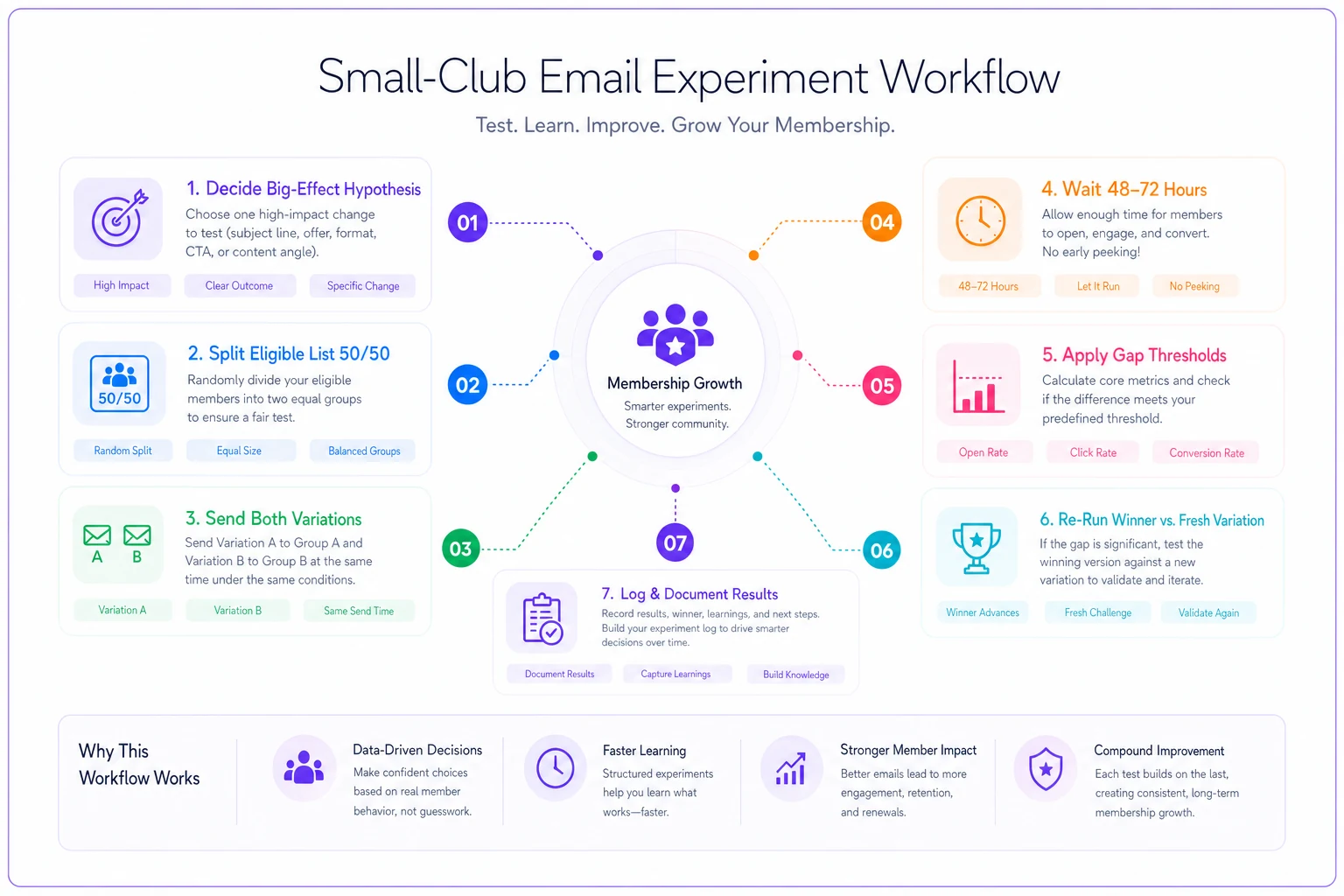
Forget calculators. Here's a practical decision rule that holds up well for clubs under roughly 2,000 members.
-
Only run a test if you expect a big effect. If your gut says "this might change things a little," skip it.
-
Split 50/50 and send to your whole eligible list. Don't hold back a "control group" — you don't have the people to spare.
-
Wait a full 48 hours before reading opens (72 for clicks). Club members check email erratically; early numbers lie.
-
Apply the "gap test" from the table above. If the gap clears the threshold, you have a probable winner. If not, it's a tie.
-
Re-run the winner once more against a fresh variation before you make it a permanent habit. One test is a hint. Two consistent tests pointing the same direction is a pattern.
That last step is what separates clubs that actually improve from clubs that lurch between random subject-line styles all year. A single win on a 400-person list is weak evidence. Two wins pointing the same direction is something worth building on.
If you want the metrics side of this to connect to your broader dashboard rather than just living inside your email tool's reporting, it's worth aligning these tests with the KPIs you already track — the framework in which engagement metrics actually matter for small clubs pairs well here, because open and click rates only matter when they map to something you actually care about downstream.
Here's a quick visual of the workflow for running a small-club email test.
That last step is what separates clubs that actually improve from clubs that lurch between random subject-line styles all year.
Ready-to-copy subject-line formulas
These are structured to produce large swings — exactly what small lists need to detect anything real. Each pairs a formula with a filled example so you can drop it straight in.
1. The specific-benefit formula
> [Concrete outcome] in [timeframe] — [event/thing]
Example: "Meet 3 new members before Thursday — RSVP for the mixer"
2. The deadline formula
> [Time left] to [do the thing]
Example: "Last 24 hours to grab your early-bird workshop seat"
3. The curiosity-gap formula
> The [surprising thing] about [topic members care about]
Example: "The one thing our top members do every month"
4. The direct-ask formula
> Can you [small action]? (takes [time estimate])
Example: "Can you vote on next month's speaker? (takes 20 seconds)"
5. The personal-relevance formula
> [First name], your [thing that's theirs] [status/update]
Example: "Priya, your membership renews in 8 days"
6. The insider/exclusive formula
> Members-only: [specific perk]
Example: "Members-only: early tickets to the fall dinner"
The single most useful test on a small list is often #1 vs. #3 — direct benefit against curiosity. They tend to produce the largest gaps, and knowing which one your specific members respond to is genuinely worth the send.
Preview-text swaps that punch above their weight
Preview text is the most neglected asset in club email. Most orgs let the inbox auto-pull the first line, which ends up being "View this email in your browser" or "Hi everyone," — a wasted second line of subject-line real estate on every single send.
Preview text doesn't need testing at first. It just needs using. Then, once you're using it deliberately, it becomes one of the better things to experiment with because a good one can meaningfully lift opens.
Swap the auto-generated text for one of these patterns:
-
Extend the subject Subject asks a question, preview gives the stakes. "Vote on the fall schedule" → preview: "Two options, poll closes Friday night."
-
Add urgency the subject doesn't "Workshop registration open" → preview: "Only 12 seats and last year sold out."
-
Add warmth for renewal/dues emails "Your membership renews soon" → preview: "No action needed if you're all set — details inside."
-
Tease the payoff "New member perks this quarter" → preview: "Including something a lot of you asked for."
One thing worth noting: preview text matters more for lists with older or less email-native members, because those inboxes often display more preview characters and those readers actually read them.
Send-time recipes for real club audiences
Generic "best time to send email" studies are mostly useless for clubs. Your members aren't a generic B2C audience — they're organized around your club's specific rhythm. A running club's members are up at 6am. A retirees' social club reads email mid-morning with coffee. A young-professionals networking group opens things at 9pm.
Start with these recipes based on club type, then test send-day first (it almost always produces a bigger effect than time-of-day):
-
Volunteer/community service clubs Sunday evening or Wednesday ~7pm. People plan their week Sunday and do a mid-week check-in Wednesday.
-
Professional/networking groups Tuesday or Thursday morning ~8am, or a second wave Tuesday ~8pm.
-
Hobby/recreation clubs (fitness, outdoors) Very early morning or Friday afternoon before weekend plans lock in.
-
Retiree/senior social clubs Weekday mid-morning, ~10am. Avoid evening sends.
-
Parent/family-oriented clubs After 8:30pm on weekdays, once kids are down.
Run a send-day test with a big-effect subject line first; it usually teaches you more than fiddling with time-of-day.
These are starting points. Run one send-day test with a big-effect subject line, apply the gap test, and you'll usually learn more in two sends than a year of "I think Tuesdays feel right."
A real scenario: a 620-member community club
A neighborhood volunteer club with about 620 contacts was getting open rates hovering around 21–23% on event announcements and couldn't figure out why turnout kept slipping.
They'd technically been "A/B testing" — swapping single words, testing exclamation points — and reporting 1–2 point differences as wins. Nothing changed because nothing they tested was capable of changing anything.
They switched approach:
-
Test 1 Direct-benefit subject vs. curiosity-gap subject, whole list split 50/50. Direct benefit came in around 24%, curiosity around 33% — a ~9 point gap on roughly 310 per side, clearing the threshold. A real result.
-
Test 2 (confirmation) A fresh curiosity subject vs. a fresh direct one. Curiosity won again, roughly 31% vs. 25%. Two consistent wins — a pattern, not a fluke.
-
Then they fixed preview text across all sends (they'd been shipping "Hi neighbors," as the preview) and started adding a genuine second-line hook.
-
Send-day test Wednesday evening vs. Sunday evening. Sunday landed noticeably higher.
Over the next couple months, event announcement opens settled in the low 30s, and — the part that actually mattered — RSVPs climbed enough that two events that usually scraped by hit capacity. No new list growth. Same 620 people. They just stopped wasting tests on noise and started testing things large enough to see.
When this makes sense — and when it doesn't
When it's worth running experiments:
-
Your list has at least ~150–200 active openers per send
-
You send at least twice a month (you need volume to accumulate learnings)
-
You're testing big categorical differences, not word polish
When it's a bad idea:
-
Your list is under ~100 openers — just use the subject formulas above and skip formal testing entirely; you can't detect anything reliably at that size
-
You're sending once a quarter — the world changes between sends and results won't compound
-
You're tempted to test five things at once — small lists can barely support one clean test per send
Who should not do this: clubs whose email deliverability is broken. If a chunk of your list isn't receiving mail at all — dead addresses, spam-foldered domains — every "test result" is contaminated. Clean the list first, then test.
Keeping the experiment log so learnings don't evaporate
The last piece that quietly determines whether any of this sticks: writing it down. Small clubs run on volunteers, and volunteers rotate. The person who figured out "our members respond to curiosity subjects and open on Sunday nights" leaves, and the next comms lead starts testing exclamation points again from scratch.
A simple experiment log fixes this. One row per test:
-
Date sent
-
What you tested (the two variations)
-
List size per variation
-
Result (open/click for each)
-
Did the gap clear the threshold? (yes/tie)
-
Decision made
This is where lightweight operational software earns its keep — not by running the tests, but by keeping the log, the winning formulas, and the send-time recipes in one place that survives volunteer turnover. When your subject-line playbook and test history live in the same system as the rest of your membership operations, the next person inherits a track record instead of a blank page. That's the difference between a club that gets sharper every year and one that re-learns the same lessons every time leadership changes.
Run fewer tests, make them bigger, wait the full 48 hours, respect the gap thresholds, and write down what you learn. On a small list, that discipline beats volume every single time.
Ready to streamline your club operations?
Join 500+ clubs using Clubyly to save time, boost member engagement, and grow their communities.