

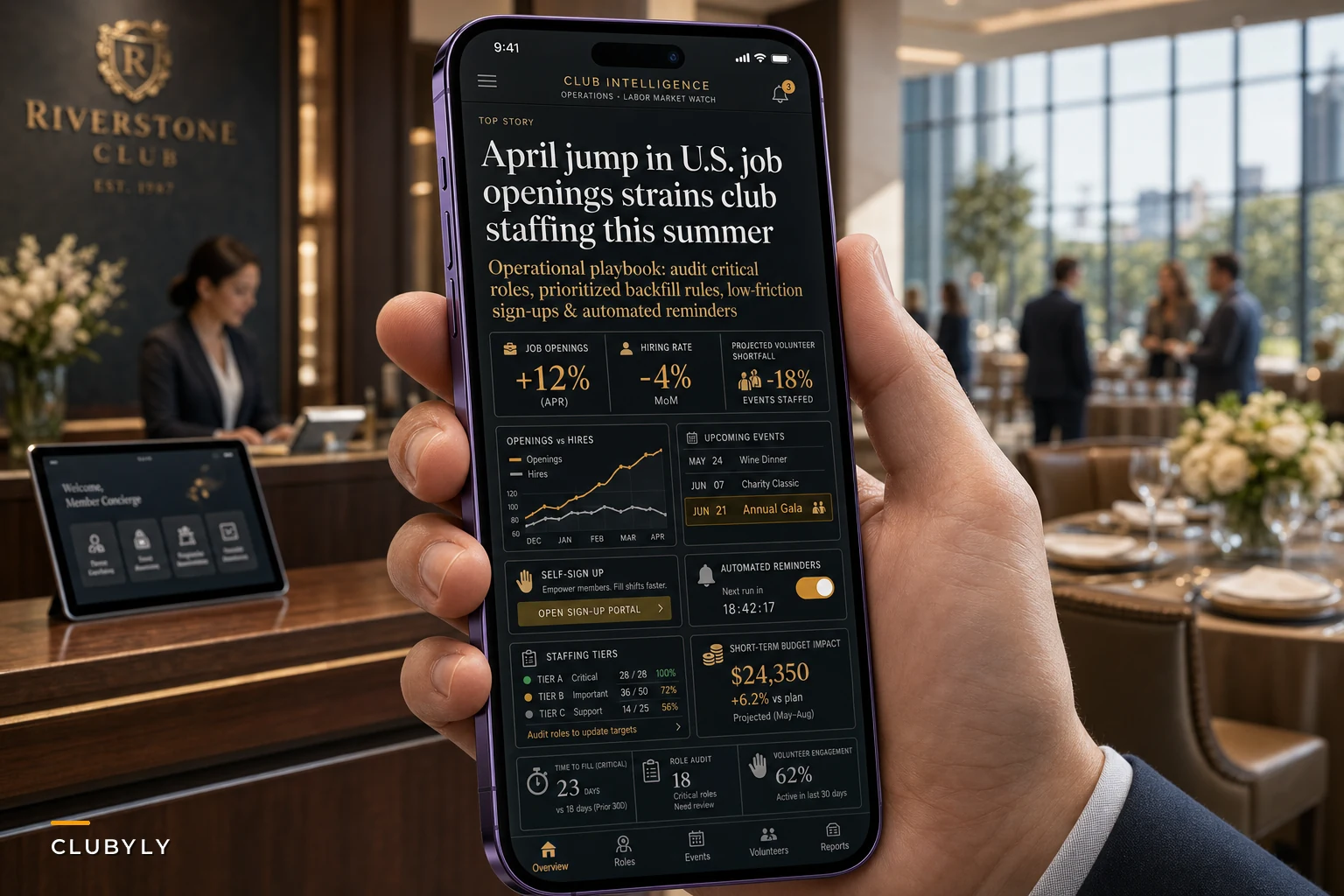

The labor market just threw clubs a curveball at the worst possible time. Job openings jumped to 7.6 million in April—the highest we've seen in nearly two years—while actual hiring barely moved. That disconnect between openings and hires creates a specific problem for membership organizations: your reliable volunteers are getting poached by paying employers right as summer programs kick into high gear.
I watched this exact scenario unfold at a youth sports league last month. Their volunteer coach coordinator, someone who'd been managing schedules for three years, accepted a part-time position at a local rec center. Within two weeks, four other regular volunteers followed suit—they'd all been recruited through the same job fair. The league had to cancel two tournaments and combine three age divisions just to keep basic programming running.
When the broader job market heats up like this, it fundamentally changes how people view their unpaid commitments. That Saturday morning shift at the club doesn't look as appealing when Target's offering $22 an hour for weekend shifts, or when that side consulting gig finally has enough clients to go full-time.
The compound effect of volunteer shortages
Most clubs think volunteer shortages mean scaling back a few events or asking board members to cover gaps. The actual operational impact runs much deeper.
When you lose two volunteers from your event team, you don't just lose two pairs of hands. You lose their institutional knowledge about vendor relationships, their ability to train new people, and their connections to other potential volunteers. The remaining volunteers absorb extra work, get frustrated faster, and start eyeing the exits themselves.
First 30 days of a volunteer shortage crisis:
Week 1-2: The scramble phase Your volunteer coordinator starts texting everyone on the backup list. Board members jump in to cover immediate gaps. Events still run, but barely. Nobody notices the cracks yet except the people directly involved.
Week 2-3: The quality drop Programs start running differently. The youth sailing class that usually has three safety boats now has two. The monthly member mixer gets shortened from three hours to ninety minutes. Registration desks open later and close earlier. Members start noticing but assume it's temporary.
Week 3-4: The cascade Your remaining volunteers are exhausted from covering extra shifts. They start calling out sick more often—and some of those sick days are actually job interviews. New member signups drop because nobody's following up on inquiries within 48 hours anymore. Current members start questioning whether their dues are worth it when programs keep getting modified or canceled.
The cascade phase creates a negative feedback loop. Fewer volunteers means worse member experience, which means fewer members willing to volunteer, which means even fewer volunteers available.
Why traditional volunteer recruitment fails in tight labor markets
Every club manager knows the standard volunteer recruitment playbook: member newsletters, signup sheets at events, personal asks from board members, maybe some social media posts. These tactics work fine when people have discretionary time. They completely fail when everyone's picking up extra shifts or freelance work to deal with inflation.
Keep your membership organized and engaged.
Clubyly simplifies member management, event coordination, and payment collection—effortlessly.
- Unified member database
- Automated payment tracking
- Event scheduling & reminders
No credit card required
The math just doesn't work anymore. A typical club volunteer contributes about 8-12 hours monthly. At current wage rates, that's $180-260 in opportunity cost for someone who could be working instead. Add in gas, parking, and the mental load of managing another commitment, and you're asking people to essentially donate $300+ monthly in value.
Traditional recruitment also assumes people make volunteering decisions based on passion for the mission. But when labor demand spikes like we're seeing now, the decision framework shifts. People start evaluating volunteering like they evaluate jobs: what skills will I gain, who will I network with, how does this advance my goals?
Clubs try to combat this with volunteer appreciation events and recognition programs. These help with retention but do nothing for recruitment. You can't appreciate your way out of a structural labor shortage.
Operational strategies that actually work during volunteer droughts
The clubs surviving this labor crunch aren't the ones with the best recruitment campaigns. They're the ones who've fundamentally rethought how volunteer work gets done.
Strategy 1: Micro-volunteering and task unbundling
Instead of asking for ongoing commitments, break everything into discrete, one-time tasks. Rather than a "tournament coordinator" role requiring 20 hours over three weeks, create ten different two-hour positions: parking coordinator, registration desk lead, awards table manager, vendor check-in coordinator.
A sailing club in Maryland restructured their entire regatta staffing this way. They went from needing 12 committed volunteers for a weekend event to filling 45 micro-volunteer slots. Much easier to get someone to commit to "Saturday 10am-noon parking duty" than "help run the whole regatta."
Strategy 2: The hybrid model—mixing paid and volunteer positions
Start paying for critical positions while keeping others volunteer-based. This isn't about converting everything to paid staff. It's strategic placement of compensation where it prevents cascade failures.
Common positions to convert first:
-
Volunteer coordinator (even if just 10 hours weekly)
-
Event setup/breakdown crews
-
Technology and database management
-
Safety and compliance roles
Keep volunteer-based:
-
Board positions
-
Committee participation
-
Member engagement activities
-
Mentorship and coaching
The key is paying for roles that, if vacant, would shut down programs entirely. Everything else stays volunteer-driven but becomes easier to fill when the core infrastructure runs reliably.
Strategy 3: Automation-assisted scheduling and coordination
This is where operational software becomes critical. Manual volunteer scheduling—texts, emails, spreadsheets—falls apart when you're constantly juggling cancellations and recruiting new people. You need systems that handle the logistics automatically so your remaining human coordinators can focus on relationship building.
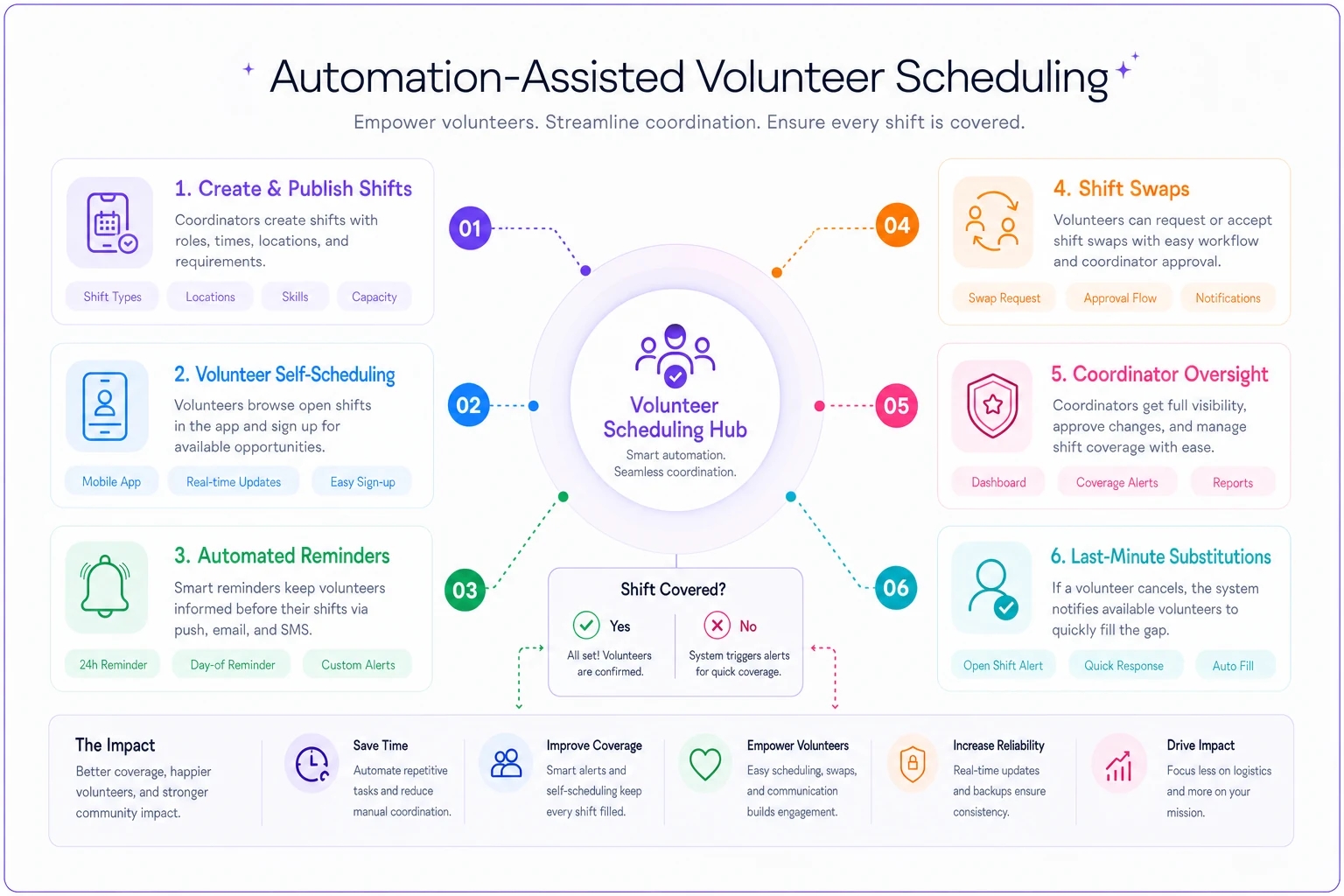
Automated scheduling platforms can handle rotation rules, send reminders, and manage last-minute substitutions without someone manually updating spreadsheets at 10pm. When volunteers can self-schedule through an app, swap shifts with each other, and see exactly what positions need coverage, you remove the administrative friction that makes volunteering feel like work.
A tennis club implemented automated scheduling and saw volunteer hours increase by 22% without recruiting a single new person. Turns out their existing volunteers were willing to do more—they just couldn't navigate the chaos of their previous signup system.
Here's a simple workflow visualization.
Strategy 4: The professional development angle
Stop positioning volunteering as charity and start positioning it as professional development. Create structured roles with clear skill development paths. Offer LinkedIn recommendations. Provide actual training that translates to resume bullet points.
Examples that work:
-
"Social Media Coordinator" with monthly analytics reports they can portfolio
-
"Event Operations Manager" with budget management experience
-
"Membership Database Administrator" with CRM platform training
-
"Youth Program Designer" with curriculum development credentials
One professional association started issuing "micro-certifications" for volunteer positions—basically formal recognition of skills gained. Their volunteer applications increased 40% in three months, primarily from people under 35 looking to build experience.
Advertise micro-volunteer slots with specific times and clear outcomes to make them easier to commit to.
The clubs that will thrive aren't necessarily the ones with the biggest budgets or most passionate members. They're the ones willing to acknowledge that volunteer management in 2026 requires the same operational sophistication as running a small business.
Hidden costs of ignoring volunteer shortages
Club managers often underestimate the financial impact of volunteer shortages until it's too late. The obvious costs—canceled events, reduced programs—are just the beginning.
| Cost Category | Immediate Impact | 6-Month Impact |
|---|---|---|
| Direct Revenue Loss | $2-5k from canceled events | $15-30k from reduced membership |
| Replacement Costs | $3-8k for emergency contractors | $25-40k for part-time staff |
| Member Attrition | 5-10% drop in renewal rates | 15-25% reduction in new members |
| Operational Efficiency | 20-30 extra hours weekly for staff | Staff burnout and turnover |
| Reputation Damage | Negative event reviews | Difficulty recruiting future volunteers |
The reputation damage is particularly insidious. When members have bad experiences due to understaffing, they don't blame the labor market—they blame the club. Those complaints spread through the same networks you rely on for recruiting both members and volunteers.
When to sound the alarm vs when to adapt
Not every volunteer shortage is a crisis. Sometimes it's just Tuesday. But there are clear indicators when you need to shift from normal management to crisis mode.
Sound the alarm when:
-
Core safety positions can't be filled
-
You've canceled the same program twice
-
Board members are covering operational roles weekly
-
Volunteer hours have dropped 30% or more in 60 days
-
Multiple volunteers resign within the same month
Adapt and monitor when:
-
You're down 10-15% on volunteer hours
-
Specific programs are affected but not core operations
-
You have coverage but it's thin
-
Recruitment is slower but not stopped
The mistake clubs make is waiting for things to get better on their own. In a tight labor market, they won't. Every week you delay implementing new strategies is another week for the situation to compound.
Building resilience into volunteer operations
The current labor crunch won't last forever, but it's exposed how fragile traditional volunteer models really are. Clubs that want to survive the next shortage need to build operational resilience now.
Start by documenting everything. When that veteran volunteer who "just knows how everything works" takes a paying job, you lose years of institutional knowledge overnight. Create operation guides, record training videos, build process checklists. Make the knowledge transferable.
Then look at your volunteer pipeline. Most clubs recruit reactively—they look for volunteers when they need them. Build a constant pipeline instead. Run monthly orientation sessions even when fully staffed. Keep a bench of trained alternates. Create junior positions that feed into senior roles.
Consider implementing AI-assisted operational platforms that can maintain continuity even as volunteers cycle through. These systems can track volunteer histories, automate onboarding sequences, manage certifications and training requirements, and ensure consistent communication regardless of who's currently in charge. When the platform holds the institutional memory, losing individual volunteers becomes less catastrophic.
Finally, diversify your volunteer sources. Most clubs fish from the same pond—current members and their families. Branch out to corporate volunteer programs, university service learning requirements, retiree organizations, and skill-based volunteering platforms. Each source has different availability patterns, so diversification protects against single-source shortages.
The path forward for clubs
The April job numbers sent a clear signal: the competition for people's time is intensifying. Clubs pretending they can operate like it's 2019 will find themselves chronically understaffed and underwhelming their members.
But this challenge also presents an opportunity. Clubs forced to modernize their volunteer operations often discover they can deliver better member experiences with fewer total volunteer hours. They find that strategic automation and paid positions actually strengthen their volunteer culture by removing the thankless tasks that burn people out.
The clubs that will thrive aren't necessarily the ones with the biggest budgets or most passionate members. They're the ones willing to acknowledge that volunteer management in 2026 requires the same operational sophistication as running a small business. Because ultimately, that's what you're doing—running a complex operation that just happens to be powered by voluntary participation rather than traditional employment.
The labor market will eventually cool. Volunteer availability will improve. But the clubs that adapt their operations now won't need to wait for external conditions to change. They'll have built something more valuable than a roster of volunteers—they'll have built a sustainable operating model that can weather whatever the economy throws at them next.
The April job numbers sent a clear signal: the competition for people's time is intensifying. Clubs pretending they can operate like it's 2019 will find themselves chronically understaffed and underwhelming their members.
But this challenge also presents an opportunity. Clubs forced to modernize their volunteer operations often discover they can deliver better member experiences with fewer total volunteer hours. They find that strategic automation and paid positions actually strengthen their volunteer culture by removing the thankless tasks that burn people out.
The clubs that will thrive aren't necessarily the ones with the biggest budgets or most passionate members. They're the ones willing to acknowledge that volunteer management in 2026 requires the same operational sophistication as running a small business. Because ultimately, that's what you're doing—running a complex operation that just happens to be powered by voluntary participation rather than traditional employment.
The labor market will eventually cool. Volunteer availability will improve. But the clubs that adapt their operations now won't need to wait for external conditions to change. They'll have built something more valuable than a roster of volunteers—they'll have built a sustainable operating model that can weather whatever the economy throws at them next.
Ready to streamline your club operations?
Join 500+ clubs using Clubyly to save time, boost member engagement, and grow their communities.