


Most club software gets bought the same way: a board member remembers a name from a conference, someone signs up for a "free" plan, and eighteen months later three different tools are half-configured, nobody remembers the admin password, and the treasurer is quietly paying $340 a year for something two people use. That's not a purchasing decision. That's drift.
The uncomfortable truth about technology procurement for clubs is that volunteer teams almost never fail because they picked the wrong vendor. They fail because there was no repeatable way to decide. Every purchase was a one-off judgment call made by whoever happened to care that month. When that person rotates off the board, the reasoning walks out with them, and the next person starts from scratch — usually by buying something new.
So this isn't a list of "best tools." It's a decision system light enough that a volunteer with 40 minutes and no technical background can actually run it, and structured enough that it survives leadership turnover. That second part matters more than people think.
Why club procurement breaks differently than business procurement
A business has continuity. The same operations manager evaluates a tool, negotiates it, owns it, and lives with the fallout. That feedback loop naturally improves decisions over time.
-
Nobody documented why a tool was chosen, so nobody knows what problem it was supposed to solve.
-
The person who understood the integration left, and now the data flows are a black box.
-
A "quick free trial" quietly became the system of record for 900 members, and switching costs are now enormous.
That last one is the killer. What starts as a low-stakes experiment becomes load-bearing infrastructure without anyone ever deciding it should be. This is exactly why your underlying data model matters before you go shopping for anything — if you haven't figured out your membership data strategy and canonical schema, every new tool just adds another disconnected copy of your member list.
It's not the big obvious purchases that hurt. It's the accumulation of small, undocumented ones.
The lightweight vendor scorecard
Forget 40-criteria enterprise evaluation matrices. A volunteer team will never fill one out twice. You need something you can run in one sitting, that forces the right conversations, and produces a number you can actually compare against the next option.
Keep your membership organized and engaged.
Clubyly simplifies member management, event coordination, and payment collection—effortlessly.
- Unified member database
- Automated payment tracking
- Event scheduling & reminders
No credit card required
Score each vendor 1–5 on these seven dimensions. Weight them if you want, but even a flat sum works fine.
| Dimension | What you're actually checking | Red flag |
|---|---|---|
| Handoff-ability | Can a new volunteer take this over in under an hour? | Requires "the person who set it up" |
| Data portability | Can you export everything, cleanly, anytime? | Export is CSV-only or locked behind support tickets |
| Real total cost | Setup + per-seat + payment fees + add-ons | Pricing that scales with members, not usage |
| Integration fit | Does it talk to what you already run? | "We have an API" with no actual connectors |
| Support reality | Response time for a free/cheap tier, not the sales promise | Support only on the plan you can't afford |
| Failure blast radius | If it breaks, what stops working? | It becomes the only place your data lives |
| Volunteer friendliness | Would a non-technical treasurer tolerate this? | Needs training to do routine tasks |
The one dimension nobody scores but everybody regrets: handoff-ability. A tool that a technical volunteer loves but nobody else can operate is a liability disguised as a solution. When that volunteer burns out or moves on, you've got an orphaned system. Score it honestly, and be suspicious of anything you'd personally need to maintain forever.
A practical note on calibration: a tool scoring 28 or above out of 35 is worth piloting. Anything under 20, walk away no matter how good the demo felt. The demo is designed to feel good. The scorecard is designed to protect you from the demo.
The buy‑vs‑build decision tree
Volunteer-run clubs almost always overestimate their ability to build and maintain something. Not the building — the maintaining. A member with dev skills can absolutely wire together a slick registration form over a weekend. The question is what happens in year three when they're gone and it silently stops sending confirmation emails.
Run every "we could just build this" idea through this process before committing to anything:
-
Is this a core, ongoing operational function (dues, member records, communications)? → If yes, lean strongly toward buying. You don't want mission-critical infrastructure depending on one person's availability.
-
Does an affordable existing tool cover 70%+ of the need? → If yes, buy and adapt your process. The remaining 30% is almost never worth building around.
-
Is the "build" actually just a spreadsheet or a no-code form? → Fine — but treat it as temporary and write down who owns it and how to replace it.
-
Do you have at least two volunteers who can maintain it long-term? → If no, don't build. One-person dependencies are how clubs end up frozen.
-
Will requirements change often? → If yes, buy. Vendors absorb change; your volunteer builder absorbs burnout.
The honest heuristic: build only when the thing is genuinely unique to your club and you have redundant people to maintain it. That combination is rare. Most "build" decisions in clubs are really "avoid a $30/month subscription" decisions, and they end up costing far more in volunteer hours and eventual cleanup.
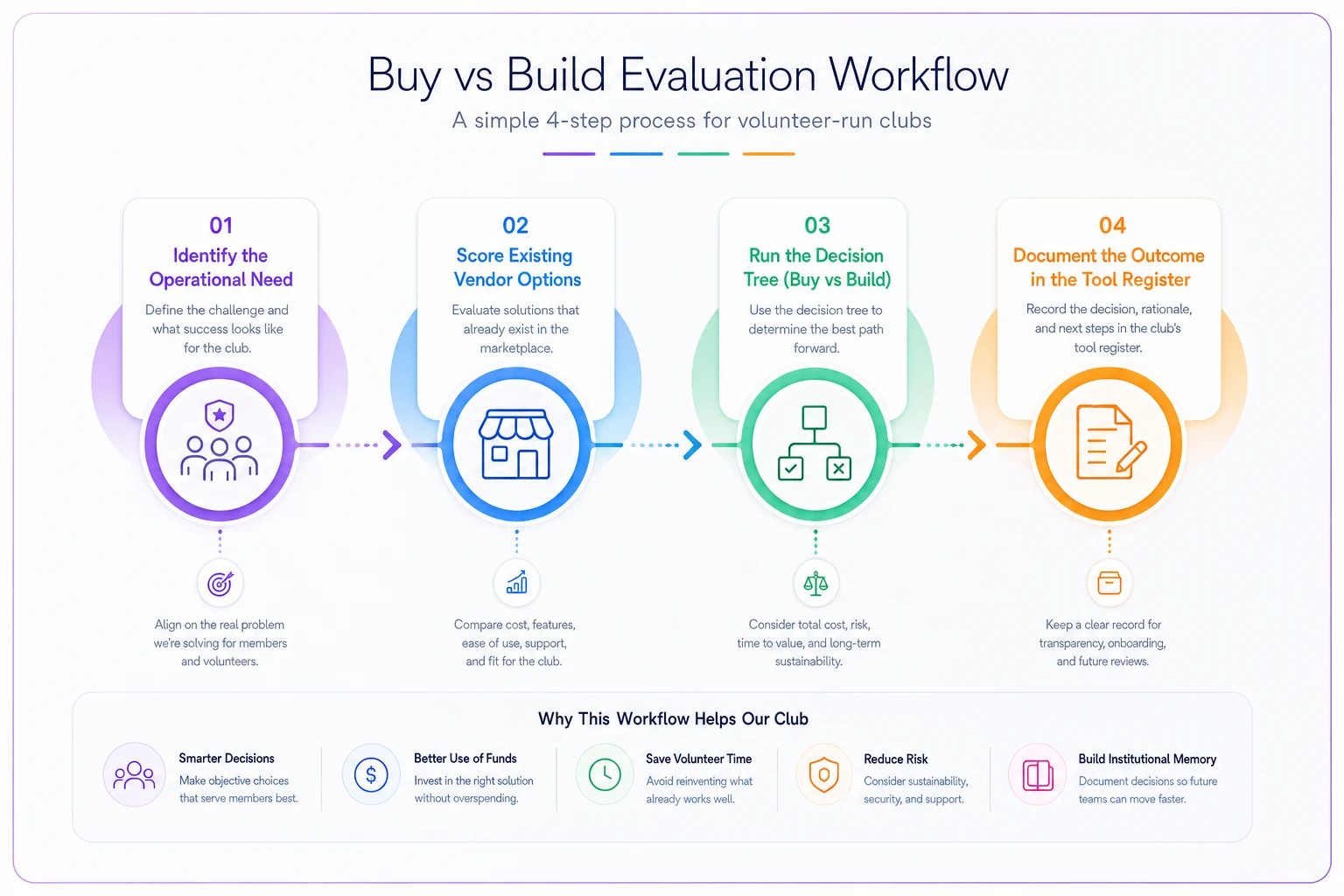
> Workflow note: A typical buy-vs-build evaluation moves from identifying the operational need → scoring existing vendor options → running the decision tree above → documenting the outcome in the tool register. The whole process, done properly, takes one focused meeting.
Here's a simple visual of that workflow you can use when explaining the process to volunteers:
When building actually makes sense
There's a narrow band where building is right: a simple, stable, low-stakes tool that solves something no vendor addresses and that would cost real money to buy. A custom scoring sheet for an annual awards program. A lightweight sign-in page for one recurring event. Small, contained, replaceable.
When building is a bad idea
Anything involving payments, personal member data, or something the whole club depends on weekly. The moment a homegrown tool touches money or PII, the risk profile changes completely. Buy something from a company that's legally responsible for keeping it running and secure.
Minimum integration clauses (the part nobody reads until it's too late)
The single most expensive procurement mistake clubs make is buying tools that don't talk to each other, then paying — in volunteer hours — to manually shuffle data between them indefinitely. Someone exports registrations from one system every Monday and re-uploads them to another. That's a job nobody agreed to take, and it lasts as long as the tools do.
-
Full data export on demand, in a standard format, without having to contact support.
-
A real, documented API or native connector to your core system of record — not a vague "integrations coming soon."
-
Webhook or automated sync for the one or two data flows you actually depend on (new member → your member database, payment → your records).
-
No data hostage clause
your data stays yours and remains exportable after cancellation for at least 30–60 days.
-
Clear ownership of the member relationship — the vendor doesn't get to market to your members or gate your own list behind their platform.
That last point bites multi-chapter organizations especially hard, where fragmented tools quietly re-centralize control in whoever holds the login. If you run chapters, it's worth reading through common centralization mistakes for multi-chapter clubs before committing to any platform that touches chapter-level data.
Clubs that skip these integration checks tend to discover the problem around month four, when the manual reconciliation work starts piling up and nobody wants to own it.
A low-cost TCO checklist
The sticker price is almost never the real price. The advertised monthly fee tends to represent somewhere around 40–60% of the true annual cost once everything gets counted — and that's before factoring in volunteer time.
-
Base subscription (annual, not the "per month billed annually" trick).
-
Per-seat or per-admin fees — how many logins do you actually need?
-
Per-member scaling — does cost jump at 500, 1,000, 2,000 members?
-
Payment processing fees if it handles dues (this is often the biggest hidden line).
-
Setup / onboarding / migration costs, including your volunteers' time.
-
Add-ons you'll inevitably need (email sends, extra storage, an events module).
-
Switching cost later — how painful is it to leave? A cheap tool you can't escape isn't cheap.
-
The shadow cost of manual work if it doesn't integrate with anything.
The one people consistently miss: volunteer time is a real cost even though it's unpaid. A tool that saves $200 a year but costs your treasurer four extra hours a month is a bad deal. Value those hours at even $20 — that's close to $1,000 in volunteer capacity you could have aimed at recruiting or programming instead. That math tends to change the conversation.
Governance guardrails sized for volunteer teams
Enterprise governance is overkill and nobody will follow it. But zero governance is how you end up with six subscriptions, three admins nobody can name, and a mystery $19 charge on the club card. The goal is the lightest set of rules that still prevents drift.
-
A single owner per tool. Every piece of software has one named person accountable for it — not "the tech committee." When they rotate off, the handoff is a documented item, not an afterthought.
-
A one-page tool register. A simple shared doc listing
tool name, what it does, owner, cost, renewal date, and who has admin access. That's it. This one document prevents most zombie-subscription problems.
-
A spend threshold that triggers a board conversation. Any new recurring tool over $X/month, or anything touching member data or payments, needs a quick board sign-off. Below that, an owner can act.
-
An annual "do we still use this?" review. Once a year, walk the tool register and cut anything nobody can justify. Clubs almost always find at least one thing to kill.
The register is the highest-leverage habit here. It costs ten minutes to start and saves you from the most common club-tech disaster: paying for and depending on things nobody remembers deciding to buy.
Who should NOT run a heavy procurement process
If you're a 60-member club evaluating a $15/month tool, don't build a full scorecard for it. Match the process to the stakes. The complete rubric earns its keep when you're choosing something that touches money, member data, or that the whole organization will depend on. For a low-cost, low-risk, easily-replaced tool, the decision tree alone is plenty — just make sure it lands on the register with an owner attached.
The mistake in the other direction is just as real: solo decision-makers who buy critical infrastructure on gut feel because "process is bureaucracy." That works right up until they leave and take all the context with them.
A real scenario
A regional hobbyist association, roughly 850 members, was running four disconnected tools: a form builder for events, a separate email platform, a spreadsheet for the member roster, and a payment link for dues. No integration between any of them. Their membership coordinator was spending somewhere around six to eight hours a month manually reconciling who'd paid, who'd registered, and who to email.
They almost bought a fifth tool to "fix communications." Instead they ran the buy-vs-build tree and the TCO checklist and realized the actual problem was fragmentation, not a missing feature. They consolidated onto one platform that handled records, dues, and email together, with a clean export guarantee and a documented owner.
The subscription cost went up by about $40 a month. But the reconciliation work dropped to under two hours, the coordinator stopped dreading the first week of every month, and when that coordinator later stepped down, the handoff took an afternoon instead of a crisis. That last outcome never shows up on a pricing page, and it's usually the one that matters most.
Pulling it together
Good procurement for a volunteer-run club isn't about finding the perfect vendor. It's about building a decision process that outlives any single volunteer. The scorecard forces the right questions, the buy-vs-build tree keeps you from creating fragile dependencies, the integration clauses prevent silent manual-labor traps, the TCO checklist stops sticker-price mistakes, and the governance guardrails keep the whole thing from drifting back into chaos.
Run it lightly. Match the effort to the stakes. And whatever you buy, write down who owns it and why — because the next person will thank you, and in a volunteer club, there is always a next person.
Run it lightly. Match the effort to the stakes. And whatever you buy, write down who owns it and why — because the next person will thank you, and in a volunteer club, there is always a next person.
Ready to streamline your club operations?
Join 500+ clubs using Clubyly to save time, boost member engagement, and grow their communities.