


Most clubs don't have a recruitment problem. They have a conversion problem disguised as one.
Why most club volunteer sign-up forms leak people before they ever start
You put out the call. Twelve people say they're interested. Two show up. Six weeks later one of those two has quietly gone dark. Then the board meeting turns into another round of "we just can't get volunteers" — which is the wrong diagnosis. The interest was there. The funnel just lost it.
Clubs tend to treat volunteer recruitment like a single event ("we need help — who's in?") instead of a series of small yes-or-no decisions a person makes on their way to actually doing something useful. Each step where you ask for too much, explain too little, or go silent is a hole in the bucket.
This post is about plugging those holes at the front of the process — sourcing and screening — with three practical tools: short role packs, micro-task trials, and conversion templates. The scheduling side (rotations, backfill, reminders) is already handled well in automating volunteer schedules, so I'm staying upstream of that and focusing on feeding clean, committed people into it.
The typical funnel, and where it actually breaks
Below is the shape of a normal small-club volunteer funnel and roughly what happens at each stage. The numbers reflect the kind of drop-off pattern you see in a club with an active membership of a few hundred:
Keep your membership organized and engaged.
Clubyly simplifies member management, event coordination, and payment collection—effortlessly.
- Unified member database
- Automated payment tracking
- Event scheduling & reminders
No credit card required
| Stage | People | What they're deciding | Where it leaks |
|---|---|---|---|
| Saw the ask (newsletter, group post) | ~200 reached | "Is this for me?" | Vague ask, no clear role |
| Expressed interest | ~15 | "What am I signing up for?" | No fast reply, huge intake form |
| Filled out intake / replied | ~9 | "Is this worth my time?" | Long onboarding, unclear next step |
| Did a first task | ~4 | "Do I want to keep doing this?" | Bad first experience, no follow-up |
| Became a repeat volunteer | ~2 | — | — |
Here's a simple workflow diagram of the volunteer funnel and common leak points.
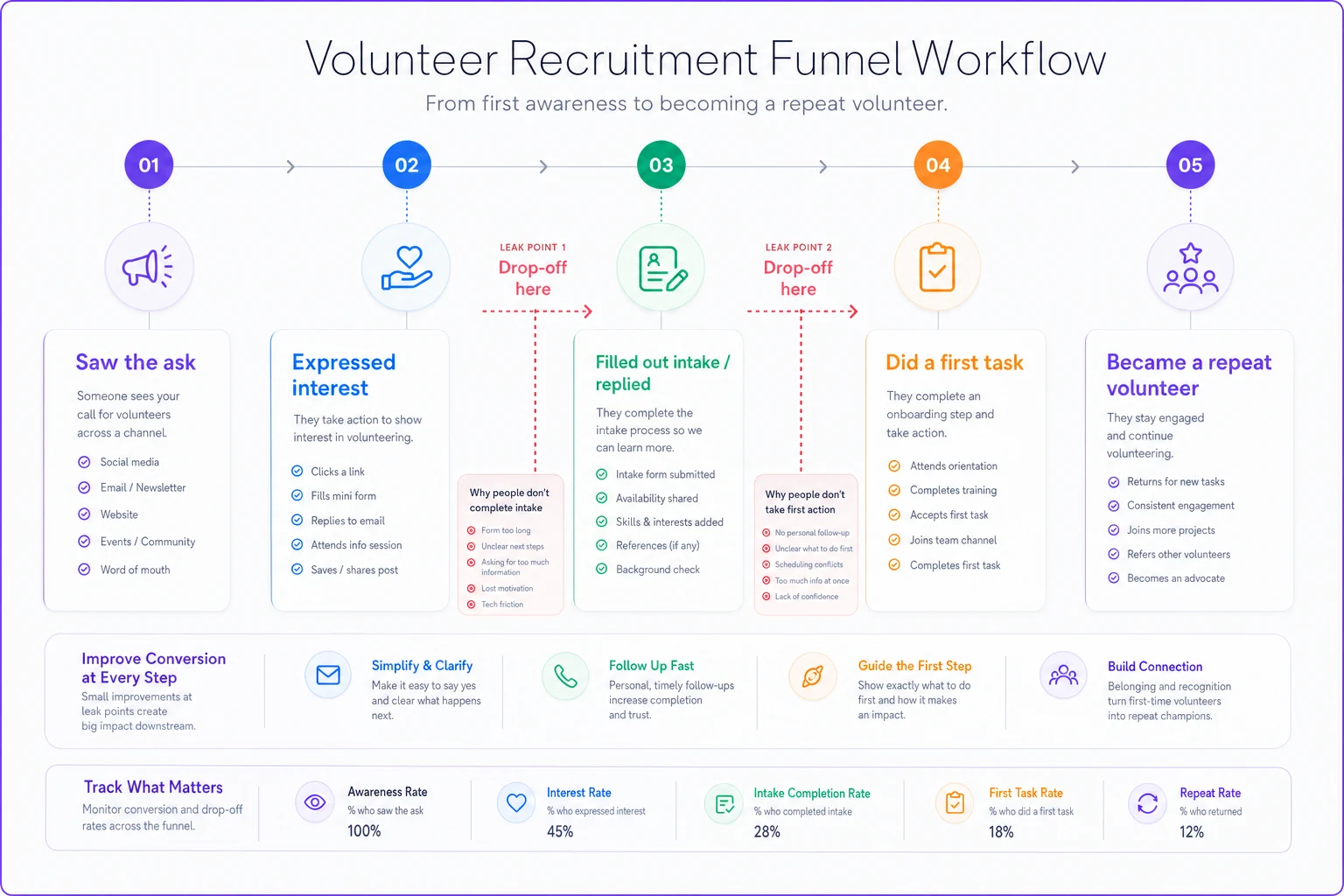
The interesting part is where the biggest drop is. It's almost never the top. Plenty of people express interest. The catastrophic leaks are between "expressed interest" and "did a first task." That's the stretch nobody designs. Clubs obsess over the flyer wording and then let a warm lead sit in an inbox for nine days.
Worth noticing: the volunteers who eventually become reliable are almost always the ones who did something small within the first week of raising their hand. Momentum is the whole game. Every day you wait to give someone a concrete task, the odds they'll ever do one drop.
Short role packs: the ask that gets a yes
The single biggest early-funnel fix is replacing "we need volunteers" with a short role pack — a one-screen description of a specific, bounded thing you need done.
Not a job description. Those scare people. A role pack is deliberately small and honest about scope. The whole point is to let someone read it in under 60 seconds and know exactly what they're signing up for, including how much time it actually takes.
A good role pack has five things and nothing else:
-
Title that's a real thing — "Saturday check-in desk (2 hrs)" not "Membership Engagement Coordinator"
-
Time budget — an honest number, per session or per month
-
What you'd actually do — three bullets max, plain verbs
-
What you don't have to do — this line converts better than anything else
-
How to start — a single next step, ideally a tiny first task
Keep the role pack scannable on one screen so someone can read it in under 60 seconds.
That "what you don't have to do" line matters more than people expect. Most volunteers hesitate because they imagine the role has some invisible tail of obligations. "You won't be running the event, handling money, or committing beyond this shift" removes the fear that saying yes once means saying yes forever.
> Weak ask: "We're looking for dedicated members to join our events committee and help make our club great. Lots of ways to get involved!" > > Role pack: "Event setup crew — ~90 min, morning of the fall social. You'll help arrange tables, put out signage, and greet early arrivals. You won't plan anything or clean up after. Reply 'setup' and I'll send the one-page rundown."
The second one converts because it's answerable. The first asks the reader to do the work of figuring out what they'd be committing to, and most people just... don't.
Build a small library of these. Five to eight role packs covering your recurring needs — front desk, setup, social media posts, new-member calls, gear checks — means you're never writing a recruitment ask from scratch, and you're never posting something vague because you ran out of time.
Time-budgeted templates: stop hiding the cost
Volunteers don't fear work. They fear unknown work. The number one thing that kills a warm lead is the suspicion that this is a bottomless commitment.
Every role pack and every follow-up message should carry a visible time budget, specific enough to feel slightly uncomfortable to write. "A few hours here and there" is a red flag to anyone who's been burned before. "About 2 hours, once a month, mostly on the second Saturday" is a green light.
The clubs that keep volunteers longest tend to undersell the time. Advertise two hours, let people leave when it's done. The volunteers who finish 15 minutes early feeling like they got off easy are the ones who come back. The ones who signed up for "a couple hours" and got stuck for four are the ones who ghost.
A simple template structure that works across almost every role:
-
The commitment in one line — "~2 hrs/month"
-
When it happens — specific and predictable beats flexible-but-vague
-
The out — how someone stops or takes a break without guilt
-
The floor — the smallest possible version of helping, so hesitant people have an entry point
That last point is where micro-task trials come in.
Micro-task trials: let people test the role before committing
The screening step most clubs skip is letting the volunteer screen you. Nobody wants to commit to a monthly role for a group whose vibe and workload they haven't experienced. So give them a trial that costs them almost nothing.
A micro-task trial is a single, real, useful task that takes 15–30 minutes and requires zero ongoing commitment. It does three things at once: gives the volunteer a low-risk taste of what helping actually looks like, gives you a read on reliability before you build a schedule around them, and creates early momentum — which predicts long-term involvement better than anything someone says in an intake form.
Good micro-tasks are real work, not busywork. People can tell the difference immediately, and fake tasks ("just come to a meeting and see") kill trust fast. Examples that actually work:
-
Make three welcome calls to new members from a script and log how they went
-
Write two social posts for the next event using a provided template
-
Do a supply count in the storage closet and flag what's low
-
Test the online sign-up form and note anything confusing
These are all things you genuinely need done. The trial isn't a hoop — it's a small piece of real work that also happens to be an audition in both directions.
The screening signal is quiet but reliable: did they finish it, and did they finish it roughly on time? Someone who completes a 20-minute task within a few days without being chased is your future backbone. Someone who needs three reminders for that same task is telling you something useful before you've handed them a recurring shift.
A real scenario
A regional hobby club — around 280 members, entirely volunteer-run — kept posting "volunteers needed" in their monthly newsletter and getting a trickle of replies that mostly evaporated. Their intake was a Google Form with 14 questions, including a paragraph on "why do you want to volunteer."
They changed three things over one season. They swapped the generic ask for four role packs with honest time budgets. They cut the intake to name, contact, and "which of these interests you." And they attached a micro-task to each role — a 20-minute first thing people could do the same week they raised their hand.
Expressed interest didn't really change — still around a dozen a cycle. But the number who completed a first task went from roughly 3–4 up to around 8–9, and repeat volunteers roughly doubled. Nothing dramatic at the top of the funnel. They just stopped losing people in the middle.
The board's takeaway was the useful part: they hadn't had a recruitment problem — they'd had a middle-of-the-funnel problem, and it was fixable with wording and one small task.
Conversion templates and nudges: the follow-ups that decide everything
The ugliest truth about volunteer recruitment in small clubs: most leads die of silence, not rejection.
Someone replies "I'm interested" and then waits. By the time the volunteer coordinator gets to the inbox on Sunday night, the moment has passed. This is the highest-leverage fix in the whole funnel, and it's almost entirely about speed and sequence, not persuasion.
You need a small set of conversion templates — pre-written, ready to send — so a reply never sits waiting for someone to find the words. At minimum:
-
Same-day acknowledgment — confirms you got their interest, sends the role pack, offers the micro-task. This one message, sent fast, saves more volunteers than anything else.
-
Micro-task hand-off — the actual task, clear instructions, a realistic due window ("sometime this week is perfect")
-
Post-task thank you + next step — acknowledges the task, and only now invites the ongoing role
-
Gentle re-engage — for the person who went quiet after expressing interest, a low-pressure single nudge a few days later
The nudges matter, but the discipline that makes them work is restraint. One well-timed re-engage message recovers a surprising share of quiet leads. Three of them make you the club that pesters people, and the person who might've come back now feels guilty and avoids you entirely. Nudge once, then let it go.
The sequencing point most clubs miss: don't invite someone into the ongoing role until after they've completed the micro-task. Asking for the commitment first and the trial second gets it backwards. Let them do the small real thing, feel good about it, and then the ask for more is landing on someone who already has momentum — not someone weighing an abstract commitment.
Where automation fits (and where it shouldn't)
The tedious part of all this is the timing. Same-day acknowledgments, hand-off messages, and single re-engage nudges are exactly the kind of thing that falls through the cracks when your coordinator is also a full-time-employed volunteer with a life. Setting up your intake so that an interested reply automatically triggers the acknowledgment and role pack — and queues the micro-task — is where operational software earns its place. It closes the silence gap without making anyone babysit an inbox.
But keep the human part human. The post-task thank you and the actual invitation into a role land better with a real name and a real sentence about how their calls went. Automate the plumbing — the reliable, time-sensitive, boring delivery. Keep the judgment and the warmth on a person. Once someone converts into an ongoing role, that's the clean hand-off point into your scheduling system, which is its own discipline covered in automating volunteer schedules.
When this approach fits — and when it doesn't
This funnel design earns its keep when you have recurring, predictable volunteer needs and a membership base big enough that a few people raising their hands each cycle is normal. Front desks, event crews, new-member outreach, content — anything you need filled again and again.
When it's a bad fit: if you're recruiting for a single high-trust, high-commitment role — treasurer, board chair, someone handling money or sensitive data — skip the micro-task funnel entirely. Those roles need real conversations, references, and a deliberate succession process. Funneling a treasurer candidate the same way you funnel a setup-crew volunteer is a mistake, and it signals to good candidates that you don't take the role seriously.
Who shouldn't over-engineer this: a club with fifty members and one recurring need doesn't need eight role packs and a full template library. Two role packs and one habit — reply the same day, always attach a small first task — will do almost everything. Build the machinery to match the volume, not to look impressive.
Pulling it together
The clubs that consistently fill their volunteer needs aren't the ones with the most members or the catchiest newsletters. They're the ones who made it easy to say a small yes, and then respected people's time enough that that yes never felt like a trap.
Short role packs answer "what am I signing up for." Honest time budgets answer "what will this cost me." Micro-task trials answer "do I even want to do this" — for both sides. And fast, restrained conversion templates make sure nobody who wanted to help gets lost in the gap between raising a hand and doing a thing.
Start with the cheapest fix that has nothing to do with wording: reply the same day. Then add one micro-task to your most common role. Most clubs find the volunteers were there all along — they were just quietly leaking out of a funnel nobody had bothered to design.
Ready to streamline your club operations?
Join 500+ clubs using Clubyly to save time, boost member engagement, and grow their communities.