
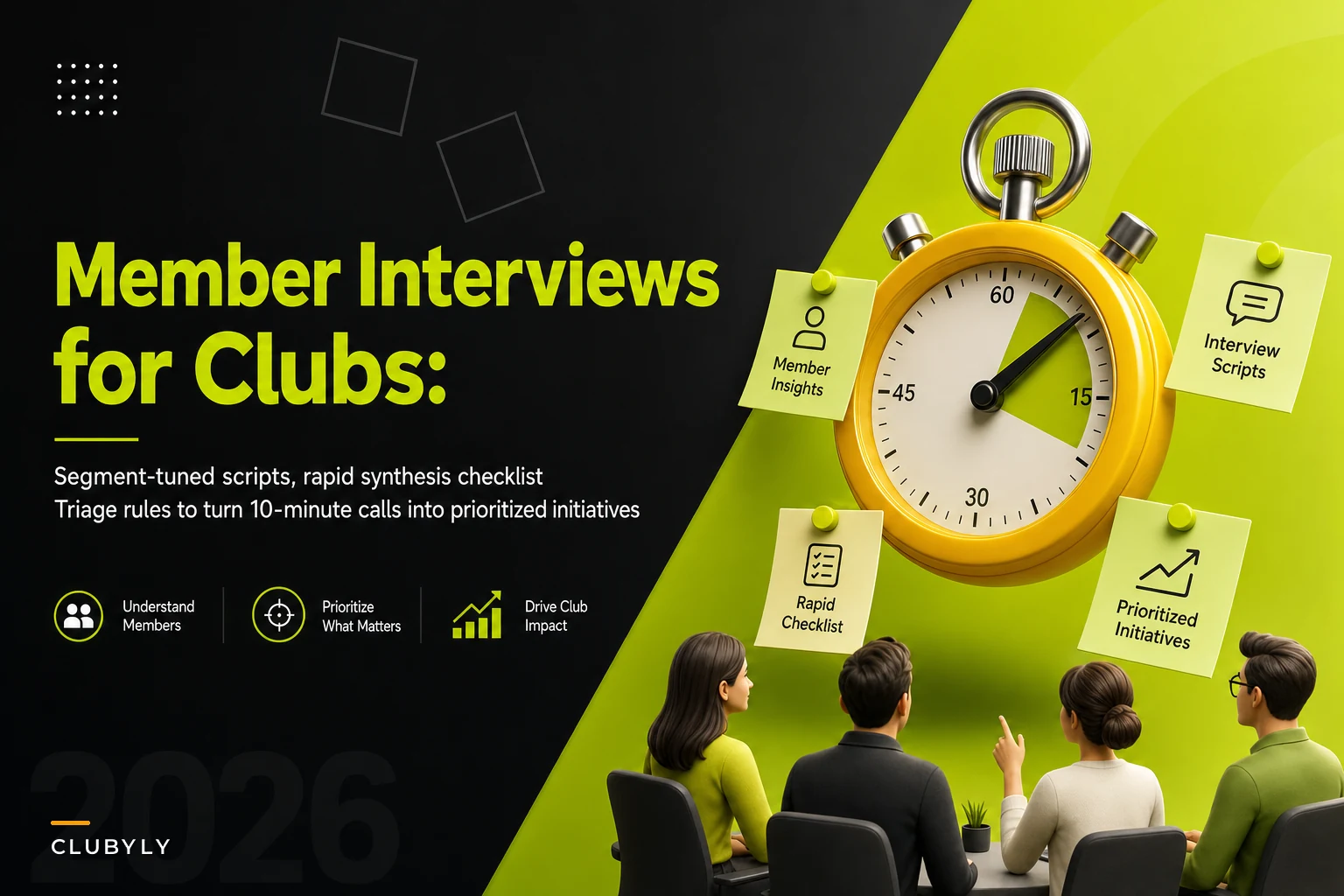

Most clubs know they should talk to members more. The problem isn't willingness — it's that a "member interview" sounds like a 45-minute production requiring a moderator, a note-taker, a scheduling headache, and a follow-up write-up nobody has time to finish. So it never happens. The board keeps guessing about why renewals dipped, why Tuesday events feel dead, why newer members disappear after month two.
Ten-minute interviews fix the time problem. But short interviews only work if they're built right — tight scripts tuned to who you're talking to, with a synthesis method that doesn't collapse into a folder of forgotten voice memos. Getting real signal out of quick conversations, then routing that signal somewhere it turns into action — that's the whole point.
Why 10 minutes actually works better than 45
There's a counterintuitive thing that happens when you cap an interview at ten minutes: people stop performing. Give someone 45 minutes and they'll fill it — they'll tell you what they think you want to hear, wander into pet grievances, soften real complaints into polite suggestions. A ten-minute window forces both of you to be economical. You get to the actual problem faster.
The bigger reason is volume. A club that runs one 45-minute interview a week does maybe 20 conversations a year and treats each one like an event. A club running 10-minute calls can do five in a single evening. Across a quarter, that's 40–60 members you've actually spoken to — enough that patterns start emerging instead of anecdotes. Patterns are what change decisions. One person hating the new venue is noise. Eleven people mentioning parking without being asked is a signal you can take to the board.
The trade-off is depth, obviously. You're not getting a deep dive in ten minutes. But that's usually not what clubs need anyway. They need to know where the friction is, quickly, across enough people to actually trust it. Depth interviews are a follow-up tool for the two or three problems you've already confirmed are real.
The recruitment script (the part everyone gets wrong)
Nearly every failed interview program dies at recruitment, not the interview itself. Someone sends a vague "can we chat about your experience?" email and gets a 4% response rate, mostly from members who already love everything. The "insights" end up useless because you only heard from fans.
Keep your membership organized and engaged.
Clubyly simplifies member management, event coordination, and payment collection—effortlessly.
- Unified member database
- Automated payment tracking
- Event scheduling & reminders
No credit card required
The fix is being specific and small in the ask. Compare these two:
> Weak: "We'd love to hear your feedback on your membership! Do you have some time to talk?" > Works: "We're making three changes to how Tuesday events run next quarter and want to get five members' reactions before we commit. It's a 10-minute call — I'll ask four questions, that's it. Are you free Thursday between 6 and 8?"
The second one works because it names the length, the number of questions, the reason, and a tight time window. It signals you respect their time and actually intend to do something with what they say. Vague requests read as busywork.
-
Recruit by segment, not at random. If you email the whole roster, whoever replies is your sample — and self-selected samples skew toward the happy and the furious. Pick who you want to hear from first, then invite them directly.
-
Cap the ask at "four questions, ten minutes" in the first sentence. Response rates roughly double when the time commitment is the first thing they read.
-
Offer a real window, not "whenever works." Open-ended scheduling creates three back-and-forth emails per person. Give two or three slots.
-
Recruit more than you need. Expect 30–40% of confirmed people to no-show or reschedule. If you want five conversations, line up eight.
Expect 30–40% of confirmed people to no-show or reschedule. If you want five conversations, line up eight.
Segment-tuned scripts
The single biggest upgrade to short interviews is refusing to use one script for everyone. A member who joined three weeks ago and one who's about to lapse after six years are living in completely different realities. Asking them the same questions wastes half your ten minutes.
Below is how to think about the main segments and what to actually ask each. Every script follows the same shape — one warm-up, two diagnostic questions, one forward-looking question — but the content shifts hard by segment.
| Segment | Primary thing you're trying to learn | Opening question | Core diagnostic | Forward-looking close |
|---|---|---|---|---|
| New members (0–60 days) | Where onboarding confused or lost them | "What made you finally sign up?" | "What's one thing that was harder to figure out than it should've been?" | "What would make you show up to your first event?" |
| Active/engaged | What keeps them coming and what's at risk | "What's the last club thing you told a friend about?" | "If we changed one thing and you'd consider leaving, what is it?" | "What would make you volunteer or take on more?" |
| Fading (declining activity) | The moment they started drifting | "When were you most involved — and what changed?" | "What stopped being worth the time?" | "What would have to be true for you to come back regularly?" |
| Lapsed/non-renewers | The actual reason, not the polite one | "No wrong answers here — what tipped you toward not renewing?" | "Was it the money, the schedule, or the value? Be blunt." | "Is there any version of this that would win you back?" |
| Long-tenure (3+ years) | Slow erosion they've stopped mentioning | "You've been around a while — what's quietly gotten worse?" | "What do you tolerate now that you wouldn't have when you joined?" | "If you ran it, what's the first thing you'd change?" |
A couple of things make these work. Notice the lapsed script gives explicit permission to be blunt and even offers the categories — money, schedule, value. Lapsed members are the hardest to get honest answers from because they feel awkward criticizing something they walked away from. Naming the categories out loud tends to break that.
The long-tenure script is hunting for erosion. Your most loyal members are the worst at complaining because they've mentally adjusted to every small decline. Asking what they've stopped mentioning surfaces problems that have been quietly compounding for years — the kind that eventually cause a wave of quiet departures.
Keep the warm-up question genuinely warm. It's not filler. People give better answers once they've said something positive first; jumping straight into "what's broken" tends to make them defensive.
The rapid synthesis checklist
This is where most programs actually fall apart. You do 15 good interviews, you have 15 sets of scribbled notes, and then nothing. Three weeks later the notes are stale and nobody can remember which member said what. The insight evaporated.
The fix is synthesizing immediately — ideally within an hour of each interview, definitely same-day. Not writing an essay. Just capturing the structured minimum while it's fresh.
-
One-line summary of what this person actually feels (not what they said — what they feel)
-
The single sharpest quote, verbatim, in their words
-
Which segment they belong to
-
A friction tag — one word or short phrase for the core problem (e.g. "parking," "onboarding confusion," "event timing," "no beginner track")
-
Intensity
1–3
— how strongly did this come up? 1 = mentioned in passing, 3 = clearly a live nerve
Do the one-line summary and tag immediately while the audio is fresh.
That's it. Sixty seconds of work while the conversation is fresh beats an hour of reconstruction a week later.
Then, once you've got a batch — say every 10 interviews — do the actual synthesis pass:
-
Sort every note by friction tag. Now you can literally count. Seven "onboarding confusion" tags is a pattern; one is a person.
-
Sum the intensity within each tag. Five people mentioning something in passing (intensity 1) is different from three people who are genuinely angry (intensity 3). Intensity-weighting stops loud minorities from dominating.
-
Flag anything that appears across multiple segments. A problem that shows up in new and fading and long-tenure members is structural, not situational. Those are your priorities.
-
Pull the two sharpest quotes per top friction tag. These are what you'll put in front of the board. A verbatim member quote moves decisions in a way a percentage never does.
-
Discard the long tail. Anything mentioned once, at low intensity, by one segment — park it. Don't let single voices set the agenda.
This is the same discipline behind a good membership survey program — the value isn't collecting feedback, it's the structured triage that turns raw input into a ranked, defensible list. Interviews just give you richer, more human material to run through that same process.
The synthesis step is also where AI-powered operational software is starting to genuinely earn its place. Platforms that can ingest friction tags, weight by intensity, and surface cross-segment patterns automatically cut what used to be a few hours of counting work down to twenty minutes or so. You still need a human to write the one-pager and assign the owner — but the ranking and tallying, which is honestly the most tedious part, doesn't have to be manual anymore.
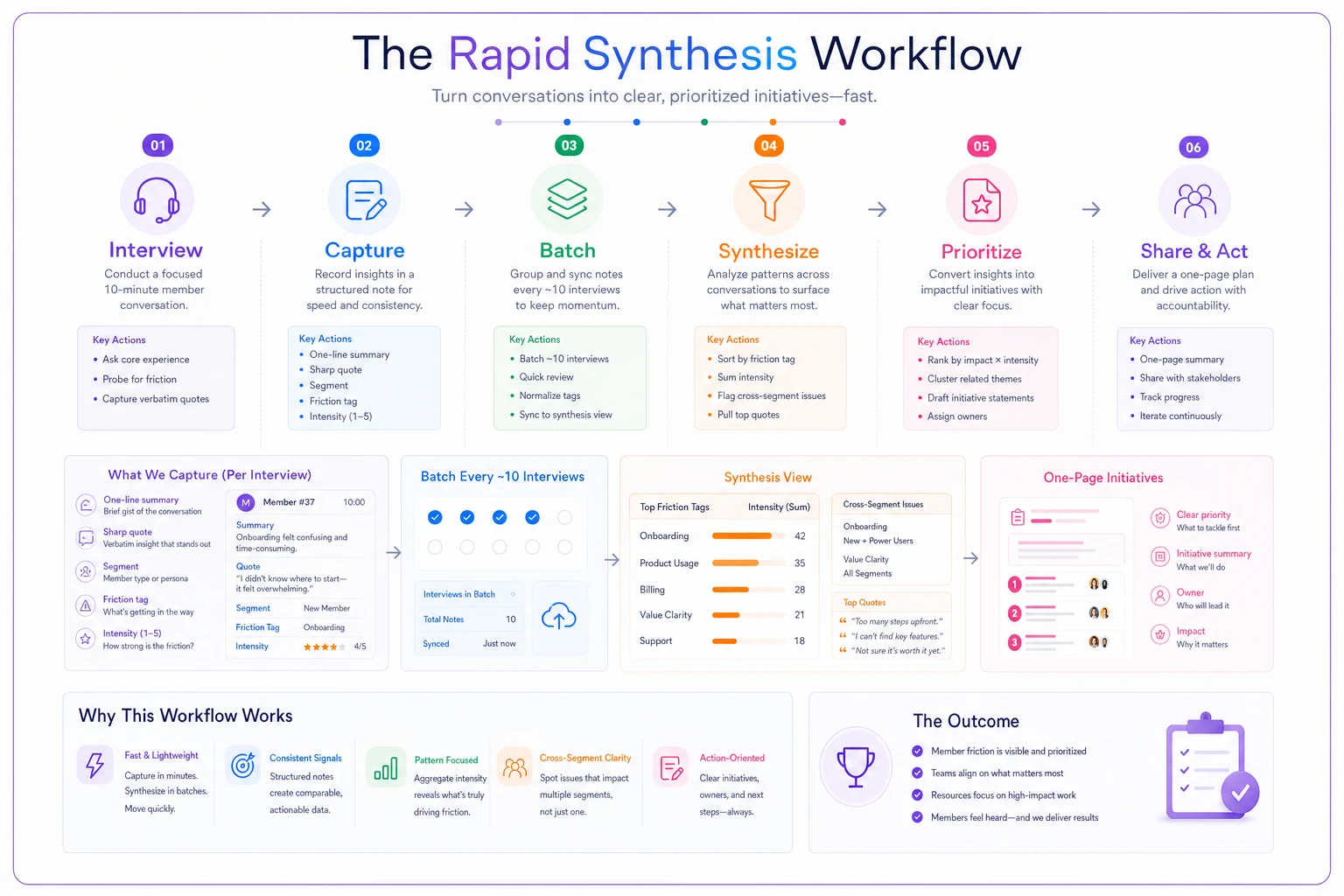
Here's a quick visual of that workflow.
Triage and assignment rules: turning a friction tag into a one-page initiative
A ranked list of problems still isn't action. The final step — the one that separates clubs that actually improve from clubs that just keep interviewing — is converting each top friction tag into a one-page initiative with a named owner.
Keep the one-pager brutally short. If it doesn't fit on a single page, it won't get done.
-
Problem the friction tag, in one sentence, with the intensity-weighted count ("9 members, weighted intensity 21, across new + fading segments")
-
Evidence two verbatim quotes
-
Proposed change one specific thing you'll try
-
Owner one name (not a committee)
-
Success signal what you'll watch to know if it worked
-
Review date when you check back
The assignment rules matter as much as the format. A few that hold up:
-
One owner per initiative, always. Shared ownership is no ownership. If a fix spans two people's areas, one of them owns it and the other is listed as support.
-
Cap active initiatives at three per quarter. A synthesis pass might surface eight problems. You can't fix eight. Rank by intensity-weighted count crossing segments, take the top three, park the rest for next quarter.
-
Match the fix to the right owner by segment. Onboarding friction goes to whoever runs new-member flow. Event-timing complaints go to the events lead. Value or pricing pushback goes to whoever owns tiers and renewals.
-
Every initiative gets a review date at creation. "We'll fix it eventually" is where initiatives go to die.
For choosing which signal to watch as your success measure, lean on metrics you already track rather than inventing new ones. If you've already defined which engagement metrics actually matter for your club, tie each initiative's success signal to one of those existing thresholds. It keeps everyone honest and stops "success" from being a vibe.
A real scenario
A mid-sized hobbyist club — around 240 members, volunteer-led, renewals sliding from the low 80s down to roughly 74% over two years — couldn't figure out why. Surveys came back mostly positive, which made the drop more baffling.
They ran 22 ten-minute interviews over three weeks, weighted toward fading and lapsed members instead of the usual survey crowd. Total talking time was under four hours, spread across two volunteers.
The synthesis pass turned up something surveys had completely missed. The top friction tag wasn't price or programming — it was "event timing." Eleven people, heavily concentrated in the fading and long-tenure segments, said the shift of the main monthly meetup from weekday evenings to Saturday afternoons (made two years earlier for venue reasons) had quietly pushed them out. Surveys never caught it because the people affected had simply stopped answering surveys.
The one-page initiative was small: pilot a return to weekday-evening timing for the main meetup for one quarter, owned by the events lead, success measured by fading-segment attendance. Attendance among previously-fading members climbed noticeably during the pilot, and the next renewal cycle stabilized in the high 70s. The fix cost almost nothing. The reason it had gone unfixed for two years is that nobody had asked the right segment the right short question.
When this makes sense — and when it doesn't
Short interviews shine when you have a specific decision coming up, or a metric moving in a direction you can't explain from your existing data. They're fast, cheap, and produce the kind of verbatim material that actually shifts a board discussion.
They're a bad idea when you're using them to avoid a decision you already have the data to make. If your renewal numbers, engagement metrics, and dunning data all point the same direction, don't run 20 interviews to feel more comfortable — act. Interviews are for genuine uncertainty, not procrastination dressed up as diligence.
And the whole approach breaks down if you can't commit to the synthesis and triage steps. Interviews without synthesis are just pleasant chats. Synthesis without assignment is just a nicer folder of complaints. The talking is the easy 20%. The counting, ranking, and one-page-initiative discipline is the 80% that produces actual change — and if nobody owns that part, don't start.
Member interviews fail for clubs almost never because the questions were wrong. They fail because recruitment pulls the wrong people, the notes never get synthesized, and insights never get an owner or a deadline. Fix those three failure points and ten minutes per member is genuinely enough to run a club on real signal instead of guesswork. Keep the scripts tuned to who's actually sitting across from you, count the friction tags honestly, and turn the top three into one-pagers with a name attached. That's the whole system — and it fits in the gaps between everything else you're already doing.
Ready to streamline your club operations?
Join 500+ clubs using Clubyly to save time, boost member engagement, and grow their communities.