
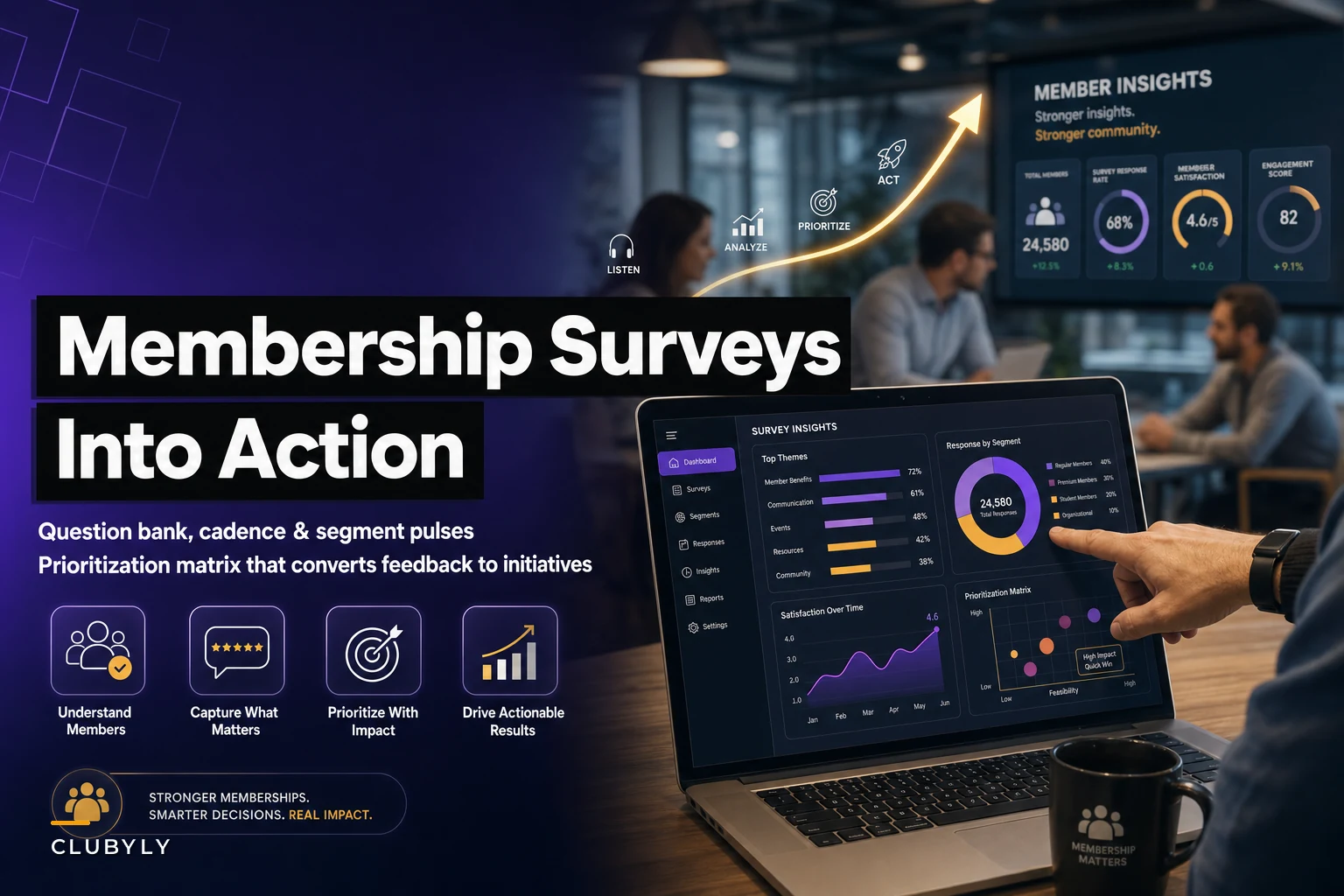

Running a country club near Phoenix taught me something uncomfortable about member surveys. We'd send quarterly satisfaction surveys, get maybe 80 responses from our 400 members, create beautiful reports with color-coded charts, present them at board meetings... and then watch absolutely nothing change.
The surveys themselves weren't the problem. We asked decent questions. Members gave thoughtful responses. The breakdown happened in that gap between collecting feedback and actually doing something meaningful with it.
After building operational software for clubs ranging from 50-member professional associations to 3,000-member athletic organizations, this same pattern destroys survey programs everywhere. Clubs spend thousands on survey tools, generate mountains of data, then let it all die in PowerPoint presentations that nobody acts on.
The operational breakdown that kills survey value
Your membership survey program probably follows a familiar cycle. Someone decides you need member feedback. Maybe retention dropped, or the board wants "data-driven decisions," or someone read that successful organizations survey regularly. You scramble to create questions, send them out, get responses back.
Then what?
Most clubs hit three specific operational failures that turn surveys into expensive theater.
First, the questions create noise instead of clarity. I worked with a professional association in Austin that sent 47-question surveys twice a year. They measured everything — event satisfaction, newsletter preferences, website usability, networking value, educational content quality. The resulting data looked comprehensive but gave zero direction. When every metric gets measured equally, nothing feels urgent enough to fix.
Second, timing destroys response quality. A yacht club sent annual surveys every January. Members who joined in February got surveyed after 11 months of membership. Those who joined in December got surveyed after three weeks. The feedback mixed completely different member experiences into one meaningless average.
Third — survey results live in a different universe from actual operations. The survey data sits in one system. Member records live in another. Event attendance lives somewhere else. Financial data stays with accounting. Without connecting feedback to operational reality, you can't prioritize what actually needs fixing.
Building a measurement-to-action framework
A working membership survey program starts with validated question banks that measure what drives actual member behavior, not what sounds important in meetings.
Keep your membership organized and engaged.
Clubyly simplifies member management, event coordination, and payment collection—effortlessly.
- Unified member database
- Automated payment tracking
- Event scheduling & reminders
No credit card required
Traditional satisfaction scales tell you nothing actionable. A member rating your events as "7 out of 10" doesn't explain whether they'll renew, refer friends, or increase participation. The questions that matter connect directly to member actions.
Instead of "How satisfied are you with our events?" ask "How likely are you to attend our next quarterly mixer?" Instead of "Rate our communication effectiveness," ask "Which of these three communication changes would most improve your membership experience?"
Here's a question framework that generates actionable data:
Behavioral anchors (not satisfaction scores):
-
"In the last 30 days, how many times did you [specific action]?"
-
"What prevented you from [desired behavior] last month?"
-
"Which single change would make you [target action] more often?"
Trade-off questions (forces prioritization):
-
"If we could only improve ONE of these three areas, which matters most?"
-
"Would you prefer [Option A with specific details] or [Option B with specific details]?"
Effort/value mapping:
-
"How much time does [specific task] take you currently?"
-
"How much would you value saving [X minutes] on [specific task]?"
A professional society with roughly 850 members switched from generic satisfaction surveys to this behavioral model. Their survey response rate dropped from 31% to 24%, but the quality of insights exploded. They identified that 65% of lapsed members cited one specific pain point — difficulty claiming continuing education credits. Fixing that single workflow issue reduced churn by almost 20% over six months.
Cadence templates that match member lifecycles
Survey timing matters more than survey design. Most clubs default to annual or quarterly surveys without considering member lifecycle stages or engagement patterns.
Your cadence should map to decision points and engagement cycles, not calendar quarters.
New member pulse (Day 7, 30, 90): Short, focused surveys that track onboarding success. Three questions max. Are they accessing resources? Have they attended an event? What's blocking full participation?
Engagement checkpoint (Every participation milestone): Trigger surveys based on behavior, not time. After someone attends their third event. After they use a member benefit for the first time. After they refer their first new member. These contextual surveys capture feedback when experiences are fresh and actionable.
Renewal reconnaissance (60 days before renewal): Don't wait until someone cancels to understand why they might leave. Survey members before renewal decisions, focusing on value perception and specific barriers to continuation.
Lapsed member autopsy (14 days after non-renewal): Most clubs never systematically capture why members actually leave. A two-question exit survey ("Primary reason for not renewing?" and "What change would have kept you as a member?") provides more actionable data than any satisfaction survey.
A 200-member trade association implemented this lifecycle-based cadence. Instead of sending four identical surveys annually to everyone, they sent targeted micro-surveys at specific moments. Response rates jumped to 45% average, and they could act on feedback immediately rather than waiting for quarterly reports.
Segment-specific pulses that acknowledge different member needs
Treating all members identically in surveys guarantees mediocre insights. A founding member with 10 years of history has fundamentally different perspectives than someone who joined last month. A power user attending weekly has different needs than someone who engages purely online.
Segmentation isn't about creating 50 different survey versions. It's about acknowledging that different member groups have different relationships with your organization.
Engagement-based segments:
-
Highly active (top 20% by participation)
-
Moderately engaged (middle 50%)
-
Low-touch members (bottom 30%)
Each segment gets different questions. Highly active members might evaluate advanced benefits and community features. Low-touch members might explain barriers to participation. Same survey cycle, completely different insights.
Tenure-based modifications: Questions evolve based on membership duration. New members can't evaluate your leadership or long-term value. Veteran members shouldn't answer onboarding questions. The system should know who's who and adjust accordingly.
Value-perception grouping: Members who use different benefits need different questions. If someone never attends events but uses online resources heavily, don't waste survey real estate asking about event venues. Focus on what they actually use and value.
An alumni association with 1,200 members started segmenting surveys based on engagement patterns. They discovered their low-engagement segment (around 400 members) wasn't actually disengaged — they were international members who couldn't attend U.S. events but highly valued online resources. This insight led to launching virtual programming that increased international member retention by 30%.
The prioritization matrix that turns data into one-page action plans
Most survey programs completely fall apart here. You've collected feedback. You've identified issues. You have dozens of potential improvements. Now what?
Without a prioritization framework, survey results become wish lists that overwhelm operations instead of improving them. You need a systematic way to convert feedback into specific, owned, executable initiatives.
The matrix considers three factors:
-
Impact scope
How many members does this affect?
-
Effort required
What resources would fixing this consume?
-
Strategic alignment
Does this connect to core objectives?
You also need to factor in current capacity, technical dependencies, and political feasibility. The theoretically perfect improvement that requires board approval, system changes, and three months of work won't happen. The good-enough fix you can implement next week will.
| Issue Identified | Members Affected | Implementation Effort | Strategic Value | Action Decision |
|---|---|---|---|---|
| Event registration confusing | 65% attempting | 2 weeks, internal | Medium - retention | Fix immediately |
| Want more networking events | 25% surveyed | Ongoing programming | High - engagement | Pilot one event |
| Newsletter too long | 40% of readers | 1 day fix | Low - communication | Quick fix |
| Certification process unclear | 100% of applicants | Major system overhaul | Critical - core service | Phase over 3 months |
Convert the matrix into one-page action plans with specific owners and 30-day milestones so items actually get done.
The magic happens when you convert this matrix into one-page action plans with specific owners and deadlines. Not vague "improve communication" goals, but "Sarah will redesign the event registration flow by March 15, reducing steps from 8 to 4."
A chamber of commerce with 300 business members used this prioritization approach after their annual survey. Instead of the usual 20-page report with 50 recommendations, they produced a single page with five specific initiatives, each with an owner and 30-day milestone. Four of the five were implemented within 60 days — compared to previous years where survey results generated discussion but zero visible changes.
Converting insights into operational workflows
The gap between survey insights and operational changes isn't just about prioritization — it's about integration with actual workflows. Most clubs treat surveys as special projects disconnected from daily operations. The insights live in reports. The work happens in completely different systems.
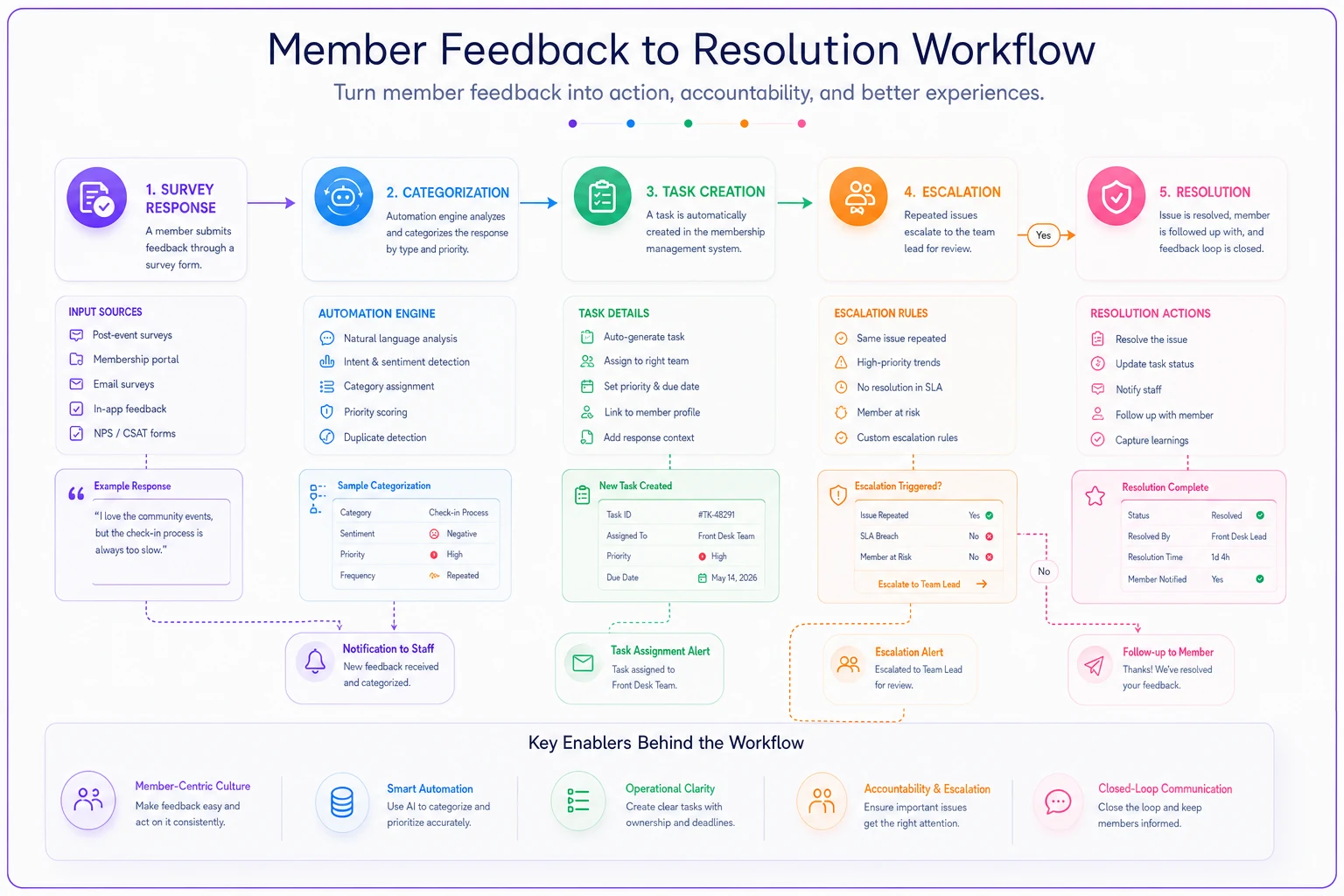
Real measurement-to-action programs embed survey insights directly into operational workflows. When a member flags an issue in a survey, it should automatically create a task in your management system. When multiple members identify the same problem, it should trigger an escalation workflow. When satisfaction drops below thresholds, it should alert relevant staff immediately.
Start with simple connections:
-
When someone rates something critically low, don't wait for the quarterly report. Set up alerts for responses that need immediate attention. A member saying they're "very likely to not renew" should trigger outreach within 48 hours, not get buried in aggregated data.
-
Survey identifies confusion about a specific benefit? That automatically creates a task to update documentation and notify members who might be affected. No meetings needed to decide if it's worth fixing.
-
Members hate giving feedback that disappears into the void. When you fix something based on survey input, tell the members who flagged it. "You mentioned event registration was confusing. We simplified it — here's what changed."
This workflow illustration shows how responses can flow from surveys into categorization, task creation, escalation, and member follow-up.
This one practice alone can double future response rates.
The measurement rhythm that sustains itself
Building a membership survey program that drives action requires aligning several moving parts — question design, timing, segmentation, prioritization, and workflow integration. The real test is sustainability. Can this system run month after month without becoming another burden on already stretched operations?
The clubs that succeed with measurement-to-action programs share three characteristics:
They keep surveys short and focused. No survey takes more than three minutes. Questions directly connect to decisions the organization can make. If you can't act on the answer, don't ask the question.
They maintain consistent rhythm without survey fatigue. Members know when to expect surveys and why they matter. The cadence feels natural, not intrusive. A professional group sends exactly four touches per year to each member, but because they're timed to natural interaction points, members don't experience survey exhaustion.
They demonstrate that feedback creates change. Nothing kills survey participation faster than members feeling their input goes nowhere. When you make changes based on feedback, tell members explicitly: "Based on your survey feedback, we've made these three changes." This creates a virtuous cycle where response rates and quality both improve over time.
Making measurement operational, not aspirational
The gap between collecting feedback and driving change isn't technical — it's operational. Clubs don't need better survey tools or more sophisticated analytics. They need systems that connect member insights directly to daily workflows and decision-making processes.
AI-powered operational software becomes genuinely valuable here, not as survey tools but as platforms that connect feedback to actual metrics and workflows. When survey responses automatically update member profiles, trigger retention workflows, and create prioritized task lists, the measurement-to-action loop closes naturally. The AI handles the routine work of categorizing feedback, identifying patterns, and routing issues to the right people, letting staff focus on solving member problems rather than analyzing survey data.
A 500-member industry association implemented this connected approach. Survey responses flow directly into their operational platform, where AI automation categorizes issues, assigns priority scores based on impact and frequency, and creates specific tasks with owners and deadlines. Their survey-to-action time dropped from six weeks to three days. More importantly, members started seeing their feedback create visible changes, driving response rates from 20% to over 45% in eight months.
The best membership survey program isn't the one with the most sophisticated questions or the highest response rates. It's the one that consistently turns member feedback into operational improvements that members notice and value. Everything else is expensive data collection that makes everyone feel busy without making anything better.
Stop treating surveys as special projects. Start treating them as operational inputs that drive daily decisions. Build the workflows that connect feedback to action. Make measurement part of operations, not separate from it.
That's when surveys stop being paperwork and start being powerful.
Ready to streamline your club operations?
Join 500+ clubs using Clubyly to save time, boost member engagement, and grow their communities.