



Most club finances don't fall apart because someone did something wrong. They fall apart because the person who understood the system left, and nobody could rebuild it from the pile of receipts, PayPal exports, and one increasingly haunted spreadsheet they inherited.
That's the real constraint volunteer treasurers work under. You're not managing complexity — you're managing turnover. The finance model has to survive a handoff to someone who's never done bookkeeping in their life and has maybe two hours a week to spare. If your system requires accounting knowledge to operate, it will quietly degrade the moment your competent treasurer steps down.
This isn't about being more sophisticated. It's the opposite. The goal is a finance operating model simple enough that a nervous newcomer can keep it clean, and structured enough that the board can actually trust the numbers. Getting your financial operations for clubs right is less about better software and more about fewer categories, tighter templates, and rules that don't need interpretation.
This covers the whole thing — chart of accounts, event margins, reserves, sponsor money, and the one page the board should actually see.
The chart of accounts is where most clubs already went wrong
A pattern that shows up constantly: a club with an annual budget of maybe $40k–$60k running a chart of accounts with 70+ line items. Someone, years ago, added a category every time a new type of expense showed up. "Pizza for volunteers" became its own line. So did "banner reprint." Now every treasurer inherits a taxonomy that only made sense to the person who built it.
The problem with a bloated chart of accounts isn't that it's messy. It's that categorization becomes a judgment call. When a new treasurer sees an $80 charge, they have to guess which of five overlapping categories it belongs to. Two treasurers make different guesses. Now your year-over-year comparisons are garbage, and nobody notices until the board asks why "supplies" tripled.
For a club, you almost never need more than 15–20 active accounts. A workable structure looks like this:
Income
-
Membership dues
-
Event revenue (registration/tickets)
-
Sponsorships
-
Merchandise / concessions
-
Grants & donations
-
Other income
Expenses
-
Event direct costs
-
Facilities / venue
-
Insurance
-
Software & subscriptions
-
Marketing & printing
-
Volunteer & operations (food, supplies, travel)
-
Bank & payment processing fees
-
Professional fees (filing, accountant)
-
Miscellaneous
Write a one-line definition next to every account to remove guesswork when categorizing transactions.
That's it. Resist the urge to split. If you want detail on which event drove costs, that's not a chart-of-accounts job — that's what the event template handles. The chart of accounts should answer "what kind of money is this," not "which specific thing did we spend it on."
One rule that saves future treasurers real pain: write a one-line definition next to every account. "Event direct costs = anything we wouldn't have spent if the event were cancelled." Now categorization stops being a guess. That single sentence is worth more than any accounting course.
Event margins: the number your board never actually knows
Ask most club leaders whether their spring fundraiser made money and you'll get a confident "yeah, definitely." Ask them by how much and they go quiet. Event finances are almost always tracked as a jumble — some costs went on a personal card, some registration came through the payment platform, some cash never got logged properly.
Keep your membership organized and engaged.
Clubyly simplifies member management, event coordination, and payment collection—effortlessly.
- Unified member database
- Automated payment tracking
- Event scheduling & reminders
No credit card required
The fix is boring and it works: a single event-margin template, filled out the same way every time. Not per-event custom spreadsheets. One template. Every event.
Here's the structure that actually surfaces the truth:
| Line | Example: Summer Social |
|---|---|
| Gross registration revenue | $4,200 |
| Sponsor contribution (event-specific) | $1,500 |
| Merchandise / concessions | $610 |
| Total revenue | $6,310 |
| Venue rental | $1,800 |
| Food & beverage | $2,150 |
| Payment processing fees | $190 |
| Printing & signage | $240 |
| Volunteer meals / supplies | $180 |
| Total direct costs | $4,560 |
| Event margin | $1,750 |
| Margin % | ~28% |
A simple workflow for filling the event-margin template:
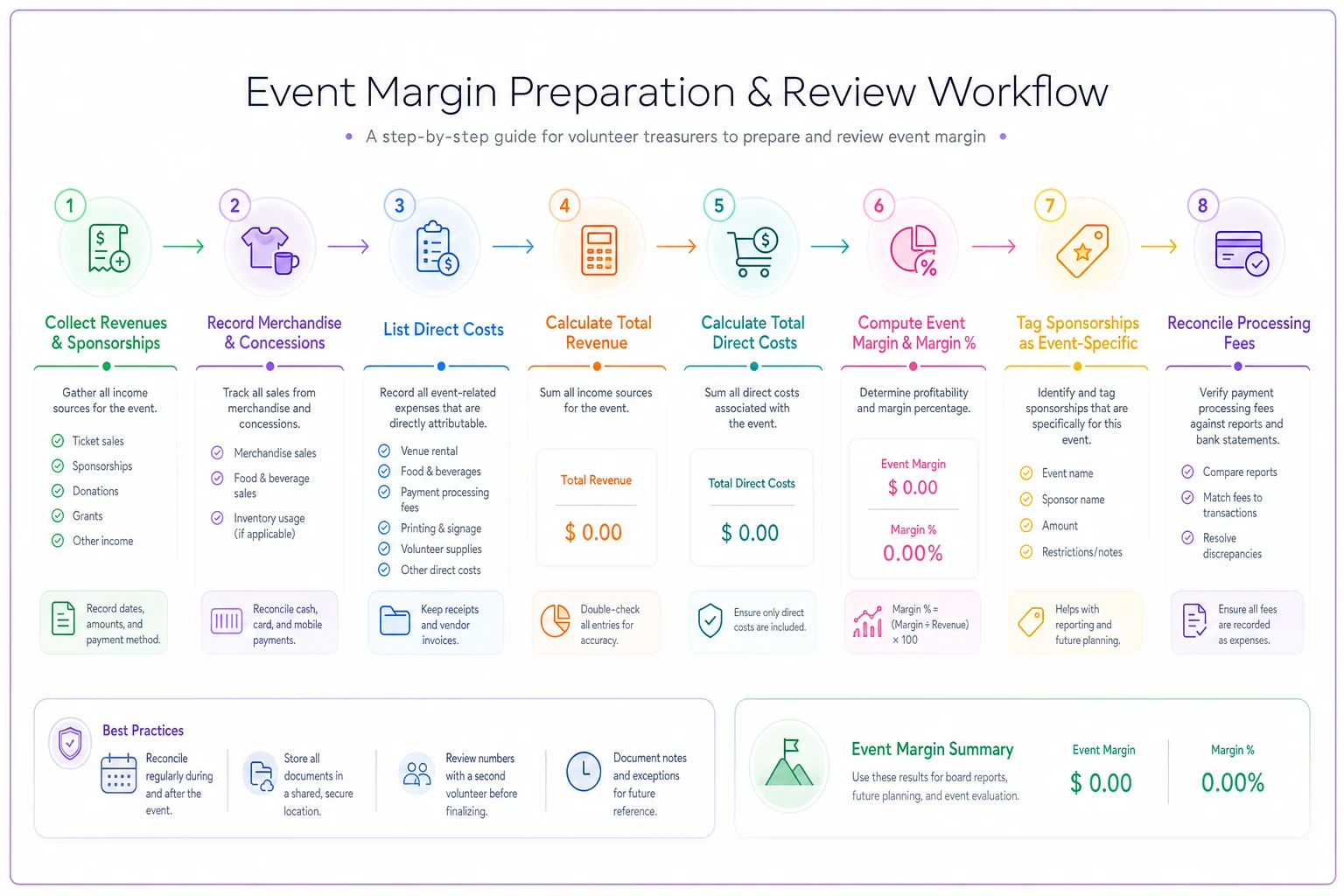
The reveal here isn't the profit — it's what the template forces you to confront. In this example, food ate roughly a third of gross revenue. A lot of clubs discover their signature event has been running at a 5–10% margin for years while everyone assumed it was a big earner. The event felt busy, so it felt profitable. Those aren't the same thing.
A few things this template does that loose tracking never will:
-
It separates event-specific sponsorship from general sponsorship, so you're not double-counting the same sponsor dollar across your annual budget and your event report.
-
It catches the costs people forget — processing fees and volunteer supplies are almost always missing from the mental math.
-
It makes events comparable. When every event uses the same rows, you can finally see that your quiet workshop series out-earns your flashy gala per volunteer hour.
That last point matters more as you grow. A club running three events a year can keep it in their head. A club running twelve can't — and without a standard template, the twelve-event club is essentially flying blind, pouring energy into whichever event has the loudest champion rather than the best return.
The reserve policy nobody wants to write
Reserves are where volunteer boards get squeamish, because holding cash back feels like admitting you might not spend it on the mission. But a club with no reserve policy isn't more mission-focused — it's one bad event or one late grant away from not making payroll on its insurance.
The practical version doesn't need a finance committee or a formal investment policy. It needs three decisions written down:
-
Target reserve size. A common, defensible target is 3–6 months of operating expenses. If your club spends roughly $4k a month to exist (insurance, software, storage, baseline costs), your reserve target sits somewhere around $12k–$24k.
-
What the reserve is for. Name it. "Covers operating costs if a major event is cancelled or a grant is delayed." A reserve without a stated purpose gets raided for whatever feels urgent in the moment.
-
Who can authorize using it, and how much. Below $500, the treasurer decides. Above that, the board votes. Simple thresholds prevent both paralysis and quiet draining.
The failure mode to watch for is the invisible reserve — money that's technically sitting in the account but has already been mentally spent by three different people for three different things. On paper you have $18k. In reality, someone's counting on $8k for the fall event, someone else assumed $5k was going toward new equipment, and the treasurer thinks it's untouched. Everyone's right, which means everyone's wrong.
Treating "reserve" as a named, protected number — not just a bank balance — is where this earns its keep. The balance in the account and your available-to-spend figure are two different things, and confusing them is how clubs end up surprised.
Sponsor accounting: the messiest money you handle
Sponsorship is the category that breaks the most books, because sponsor money doesn't behave like other income. It arrives on strange timelines, often carries obligations, and sometimes isn't cash at all.
The core problem: when do you recognize a sponsorship? A sponsor commits $3,000 in January for an event in September. Do you count it as January income? September income? For a small club, the honest answer is to track it against the thing it's paying for — which means sponsor money should live in two places conceptually: the annual budget and the specific event or program it funds.
There's also the in-kind trap. A local print shop "sponsors" you by donating $800 worth of banners. That's real value and often a real tax consideration, but it never touches your bank account. Clubs either ignore it entirely — understating what sponsors actually gave, which hurts at renewal time — or record it clumsily and inflate their cash position.
A clean approach for volunteer treasurers:
-
Cash sponsorships go into the sponsorship income account, tagged to the event or program they fund.
-
In-kind sponsorships get logged in a separate in-kind register with an estimated fair value — recorded for the record and for sponsor relationships, but kept out of your cash books so they don't distort your actual balance.
-
Multi-year or installment deals get a simple schedule so the next treasurer knows $1,500 is expected in Q3 and isn't surprised when it doesn't show up in Q1.
If you're still building your sponsor pipeline in the first place, the accounting side gets a lot easier once the relationship side is systematized — there's a full breakdown in the prospect-to-renewal playbook for local sponsors. And if you're leaning on sponsorship because dues alone aren't cutting it, it's worth pressure-testing the whole revenue mix using a proper evaluation framework for diversifying beyond dues rather than just chasing the next check.
The insight most clubs miss: sponsor accounting isn't really a finance task, it's a retention task. When renewal season comes and a sponsor asks "what did we actually get for our $3,000 last year," a club that tracked the money against real events and logged the in-kind value can answer in thirty seconds. A club that dumped it all into one "sponsorship" bucket has to reconstruct the story from memory, and it shows.
The one-page board dashboard
Boards don't need your full ledger. They need enough to make decisions and to know if something's on fire. Hand a board a 12-tab spreadsheet and they either rubber-stamp it without reading (bad) or one detail-obsessed member rabbit-holes on a $40 discrepancy while the $6k reserve gap goes unmentioned (worse).
One page. Updated monthly. Roughly this:
-
Cash position total in accounts, and — separately — reserve vs. available-to-spend
-
Year-to-date income vs. budget (three or four big categories, not twenty)
-
Year-to-date expenses vs. budget
-
Reserve status current vs. target, as a simple number and a "on track / below target" flag
-
Event margins to date one line per event, revenue / cost / margin
-
Sponsor commitments received, pending, at-risk
-
One flag box anything the treasurer actually wants the board to look at
The discipline here is subtraction. Every time you're tempted to add a metric, ask whether the board would make a different decision because of it. If not, leave it off. A dashboard that fits on one page gets read. One that doesn't, doesn't.
A real scenario
A regional hobbyist club — around 220 members, annual budget in the low $50k range — ran into the classic wall when their treasurer of six years moved away. The incoming treasurer inherited a chart of accounts with 60-something categories, event finances scattered across three payment tools and a personal credit card, and a bank balance nobody could explain.
The first quarter was rough. They couldn't say whether their biggest event had made money. It turned out it had cleared roughly $400 on about $7k of revenue — a margin so thin that one rained-out afternoon would have flipped it to a loss.
They rebuilt around the model above: chart of accounts cut to 17 lines, one event template used for every event going forward, a written reserve target of about $15k, and a one-page dashboard for the board. Nothing fancy. The change wasn't a bigger surplus overnight — it was that within two quarters, the board could look at a single page and actually understand where the money was. The next handoff, when it came, took an afternoon instead of a season.
Where tools fit (and where they don't)
You can run all of this in a spreadsheet, and plenty of clubs should. The model matters more than the software. That said, the manual version has a real cost: someone has to remember to tag every sponsor payment to the right event, reconcile the payment platform against the bank, and rebuild the dashboard by hand each month. That work quietly falls apart under turnover — which is exactly what this model is trying to prevent.
An operational platform that ties membership, events, and finances together starts to pull its weight here — not because it does anything you couldn't do manually, but because it removes the steps most likely to get skipped by a busy volunteer. When dues, event registrations, and sponsor payments already flow into categorized records, the treasurer isn't rebuilding the picture from exports.
AI-assisted categorization can flag a transaction that doesn't match your defined accounts, and the dashboard updates without waiting for someone to find two free hours. The point isn't automation for its own sake — it's that the system keeps running when the most capable person on the board is on vacation.
When this level of structure makes sense — and when it doesn't
A club running one event a year on a $10k budget probably doesn't need a formal reserve policy or an event-margin template. Three envelopes and a shared spreadsheet is genuinely fine. Adding structure to a club that small just creates work nobody will maintain.
This model starts earning its keep when you hit a few thresholds:
-
more than a handful of events a year
-
sponsorship income that's material to the budget
-
a board that expects real reporting
-
treasurer turnover on the horizon
If any of those are true, the cost of doing it loosely is a painful handoff and books nobody trusts.
Where it goes wrong is over-engineering. Don't build a 40-line chart of accounts because a "real" nonprofit would have one. Don't add a metric to the dashboard because it looks thorough. Every bit of complexity is something the next volunteer has to understand and maintain, and they won't have the context you do.
Good financial operations for clubs aren't measured by sophistication. They're measured by how cleanly the whole thing survives the day you hand it to someone new — and whether, six months later, they're still keeping it as clean as you did.
Ready to streamline your club operations?
Join 500+ clubs using Clubyly to save time, boost member engagement, and grow their communities.