

Most clubs are decent at closing a sponsor. Someone knows a guy who owns the hardware store, they grab coffee, the guy agrees to $500 for a banner at the tournament, and everyone feels good. Then the season ends. The banner comes down. Nobody follows up. Next year the same volunteer starts from zero, hoping the guy is still in a decent mood.
That's the actual problem with local sponsorship management. It's not a sales problem — it's an operations problem wearing a sales costume. The money left on the table isn't in finding new sponsors. It's in the ones you already had and quietly lost because nobody tracked what you promised, whether you delivered, and when to ask again.
This playbook covers the full lifecycle: prospecting, agreements, fulfillment, invoicing, and renewal. Trackers and scripts included. The goal is turning a sponsor into a budget line you can count on year after year, not a scramble every spring.
Why local sponsorships leak revenue
A youth soccer club had roughly 14 "sponsors" on their books over three years. When we mapped it out, only 4 had ever renewed for a second year. Nobody had done anything obviously wrong — there was just no institutional memory. Every sponsor relationship lived inside one volunteer's inbox and phone. When that volunteer stepped down after two seasons, the relationships walked out the door with them.
The pattern that shows up repeatedly:
-
No record of what was promised. A sponsor was told they'd get a social shoutout, a banner, and a newsletter mention. They got the banner. They probably didn't track the missing pieces consciously — but they noticed, and it killed the renewal.
-
Invoicing happens whenever someone remembers. A sponsor verbally commits in March, gets invoiced in July, and by then the whole thing has gone cold.
-
No renewal trigger. The season ends and there's no date on any calendar that says "reach out to Miller's Auto about next year."
-
Everything lives in one head. Fine, until that person burns out or moves on.
The result is clubs treating sponsorship as found money — nice when it shows up, impossible to budget around. But a club with 8–10 stable local sponsors at $400–$800 each is looking at somewhere in the $4k–$7k range annually, renewing with maybe a fifth of the effort of new sales. That's the actual prize. Reliability, not size.
Stage 1: Prospecting that doesn't feel like begging
The prospecting problem is usually that the ask is vague. "Would you like to sponsor us?" puts all the work on the business owner to figure out what they're buying. Most say "let me think about it," which means no.
Keep your membership organized and engaged.
Clubyly simplifies member management, event coordination, and payment collection—effortlessly.
- Unified member database
- Automated payment tracking
- Event scheduling & reminders
No credit card required
Walk in with a specific offer at a specific price tied to a specific audience. Local businesses don't sponsor clubs out of charity — they do it because your members are their customers. The parents at your swim club buy groceries, hire plumbers, go out to eat. Say that out loud.
Two scripts that work better than the generic ask:
Cold outreach (email or in-person), first contact: > "Hi [Name], I run [Club]. We've got about [X] active member families in [town], and a lot of them already shop local. We're putting together our sponsor lineup for the [season/year] and thought of [Business] because [specific reason — you're right by the field, members already go there, etc.]. Our most popular package is $[X] and gets you [2–3 concrete things]. Worth 15 minutes to see if it's a fit?"
Warm follow-up after interest: > "Thanks for the chat. To make it easy — here's the one-pager with what's included and the cost. If it looks good, I'll send a short agreement and an invoice, and we'll get your logo up by [date]. No pressure either way, just let me know by [date] so I can plan the season."
The follow-up already sets a timeline and a paper trail. That's deliberate. The most common prospecting mistake is being so relieved someone said yes that you don't nail down the details while they're warm. Two weeks later you're both fuzzy on what was actually agreed.
When cold prospecting is a bad idea: if you haven't defined your packages yet. Don't go out asking for money with a blank menu. Build the tiers first.
Stage 2: The one-page agreement (keep it that way)
Clubs make one of two mistakes here. Either they use nothing — a handshake and a Venmo — or someone's lawyer cousin sends over a four-page contract that scares off a $500 sponsor. Both are wrong.
One page. It exists to create shared memory, not legal armor. Its real job is fulfillment: it's the list you'll check against later.
A workable template:
| Field | Example entry |
|---|---|
| Sponsor name & contact | Miller's Auto, Dave Miller, dave@... , (555) 018-2231 |
| Sponsorship tier & fee | Gold — $650, one season |
| What's included | Field banner (4x6), logo on jerseys, 3 social posts, newsletter mention |
| Fulfillment deadlines | Banner up by Apr 15, posts spread Apr–Jun, newsletter May |
| Payment terms | Due within 30 days of signing, invoice attached |
| Renewal date | Contact by Feb 1 next year |
| Signed by | (club) / (sponsor) |
The most valuable line on that sheet is "What's included" written as a checklist. That's what you'll pull from when building your fulfillment tracker, and it's what protects you when a sponsor half-remembers being promised something you never offered.
If you're already rethinking what your tiers should contain, the same logic behind auditing and testing membership tiers and benefits applies cleanly here — figure out which perks actually get noticed and which are just noise nobody values.
Stage 3: The fulfillment tracker (this is where renewals are won)
Almost every small club skips this part, and it's the single biggest reason sponsors don't come back. If you deliver 60% of what you promised and never document it, the sponsor experiences it as "we paid and nothing happened."
The tracker turns promises into checkable tasks with owners and dates. Simplest version is a shared sheet, one row per deliverable:
| Sponsor | Deliverable | Due | Owner | Status | Proof link |
|---|---|---|---|---|---|
| Miller's Auto | Banner installed | Apr 15 | Jen | Done | photo |
| Miller's Auto | Social post #1 | Apr 20 | Marco | Done | link |
| Miller's Auto | Social post #2 | May 15 | Marco | Pending | — |
| Miller's Auto | Newsletter mention | May | Jen | Done | link |
| Riverside Cafe | Banner installed | Apr 15 | Jen | Overdue | — |
Two things make this actually work:
-
One row per deliverable. If you track by sponsor, "half done" hides in a single cell and nobody notices the missing pieces. Row-per-deliverable makes gaps hard to ignore.
-
A "proof link" column. Screenshots of the social post, a photo of the banner on the fence, the newsletter PDF. This isn't busywork — it becomes your renewal packet.
Quick visual of the fulfillment tracker workflow.
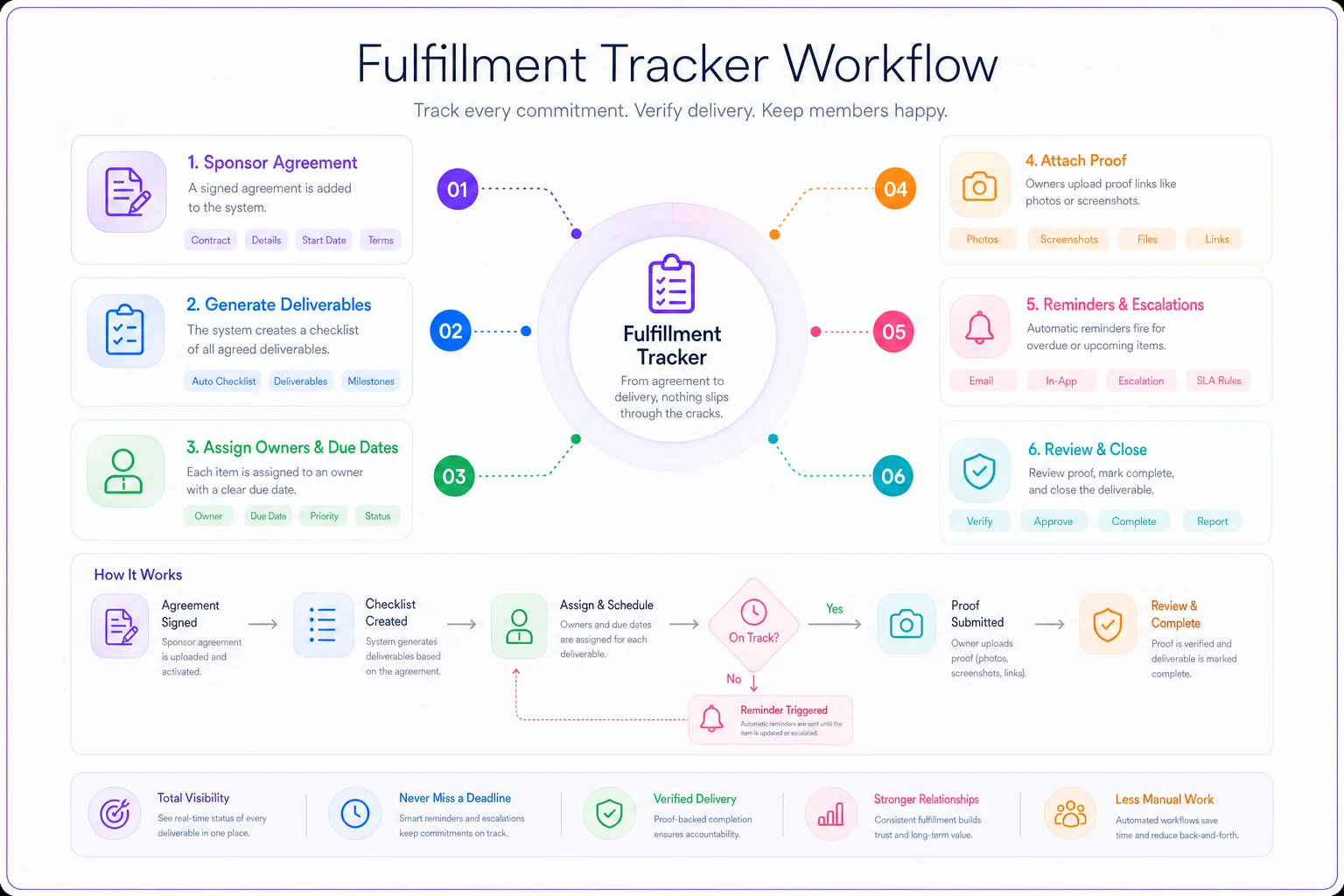
The proof link habit is where the tools you're already using start earning their keep. If your club runs on an operational platform rather than scattered spreadsheets, deadlines on this tracker can fire automatic reminders to the assigned owner, and overdue deliverables surface without waiting for someone to scroll a sheet. Not fancy automation for its own sake — just making sure "social post #2" doesn't quietly slip because a volunteer got busy in May.
Stage 4: Invoicing cadence that actually gets paid
Late and inconsistent invoicing does two bad things: it delays your cash, and it signals to the sponsor that you're disorganized — which quietly makes them less likely to renew.
A clean cadence:
-
Invoice within 48 hours of a signed agreement. Not after the season, not whenever you get around to it. Signature is the trigger.
-
Net-30 terms, stated on the invoice. Local businesses know net-30. It's normal and gives you a clean follow-up date.
-
Day 31
soft nudge
if unpaid. "Hi Dave, just circling back on the sponsorship invoice — let me know if you need anything to process it." -
Day 45
direct follow-up,
ideally from whoever has the relationship.
If payment genuinely stalls, don't let it drift. The same discipline that recovers unpaid member dues applies here — the structured, non-awkward follow-up sequence in this operational dunning playbook maps almost directly onto sponsor invoices. The mechanics of recovering money someone already agreed to pay don't really change whether it's a member or a business.
One pattern worth naming: clubs that invoice fast and clean get treated like a real vendor. Clubs that invoice late get treated like a favor. Vendors get renewed. Favors get forgotten.
Stage 5: Renewals — the part with the highest return
The math here should change how you spend your time. Closing a new local sponsor might take five touchpoints, a meeting, and a lot of chasing. Renewing an existing one who had a good experience takes one well-timed email. Yet most clubs pour energy into the first and almost none into the second.
Set the renewal reminder the day the agreement is signed — not at season's end. A date on the calendar, usually 6–8 weeks before your prospecting window opens, that says "start renewal conversation with [sponsor]."
The renewal email is where your fulfillment tracker pays off. Compare:
Weak renewal ask: "Would you like to sponsor us again this year?"
Strong renewal ask: "Hi Dave — before the season kicks off I wanted to say thanks. Last year your banner was up all season, we ran three posts featuring Miller's Auto (links below — one got around 40 shares), and you were in our May newsletter that went to about 180 families. We'd love to have you back at the same tier. Can I send the agreement?"
A quick sequence for the renewal window:
-
8 weeks out send the recap-and-renew email above.
-
No reply in 10 days short personal follow-up, mention a spot is opening at their tier.
-
Still nothing one phone call. Local sponsorship is a relationship; a call closes what email won't.
-
Yes new one-pager, invoice within 48 hours, reset the tracker.
Yes: new one-pager, invoice within 48 hours, reset the tracker.
A real scenario
A small rec-league baseball club — around 220 member families, run almost entirely by volunteers — had bounced between roughly $2k and $6k in sponsorship income with no real pattern. Some years a board member happened to have good local connections. Other years, almost nothing.
They didn't change pricing or add tiers. They just added memory: a one-page agreement for every sponsor, a fulfillment tracker with a proof-link column, invoicing within two days of signing, and a renewal date set at signature.
The first year mostly cleaned up chaos. The real change showed year two. Of their 9 sponsors, 7 renewed — because for the first time the renewal email included screenshots of social posts and a photo of the banner on the outfield fence. Two sponsors actually bumped up a tier when they saw what the higher package would've included. Sponsorship revenue settled into a stable range just north of $6k and, more importantly, became something the treasurer could actually put in the budget.
No viral campaign, no big new names. Just a lifecycle that remembered what was promised and asked again at the right time.
When this playbook isn't worth it
A few honest caveats.
If you have one or two sponsors total, you don't need trackers and cadences — you need a calendar reminder and a decent memory. Don't build a system for a problem you don't have yet.
If your club's leadership turns over every season with no overlap, fix that first. The best sponsor tracker still dies if nobody's around who knows what it's for. The system helps because it survives handoffs, but someone has to actually hand it off.
If you haven't defined what you're selling, stop and do that before anything else. A tracker for undefined packages is just a neatly organized mess.
The takeaway
Sponsorship stops being lucky money and starts being real revenue the moment your club has a memory outside of one volunteer's head. The agreement remembers what you promised. The tracker remembers whether you delivered. The invoice cadence remembers to collect. And the renewal date remembers to ask again — with proof that last year was worth it.
Most clubs already close sponsors just fine. The revenue being missed is sitting in the sponsors from last year who never got a proper follow-up. Build the lifecycle once, and next spring you're not starting from zero — you're sending recap emails to people who already said yes.
Sponsorship stops being lucky money and starts being real revenue the moment your club has a memory outside of one volunteer's head. The agreement remembers what you promised. The tracker remembers whether you delivered. The invoice cadence remembers to collect. And the renewal date remembers to ask again — with proof that last year was worth it.
Most clubs already close sponsors just fine. The revenue being missed is sitting in the sponsors from last year who never got a proper follow-up. Build the lifecycle once, and next spring you're not starting from zero — you're sending recap emails to people who already said yes.
Ready to streamline your club operations?
Join 500+ clubs using Clubyly to save time, boost member engagement, and grow their communities.