


Most clubs don't have a moderation problem until the night they suddenly have one. A heated thread in the member forum spirals at 11pm, two long-time members start trading insults, someone screenshots it, and the volunteer moderator on duty — who normally just approves new member posts — has no idea whether to delete, warn, suspend, or wake up the president.
That gap between "nothing happening" and "full-blown conflict with no playbook" is where small clubs get hurt. The damage isn't usually the incident itself. It's the inconsistent, improvised response that follows. One member gets banned for something another member got a gentle warning for last month. Nobody remembers why. The moderator who made the call burns out and quits.
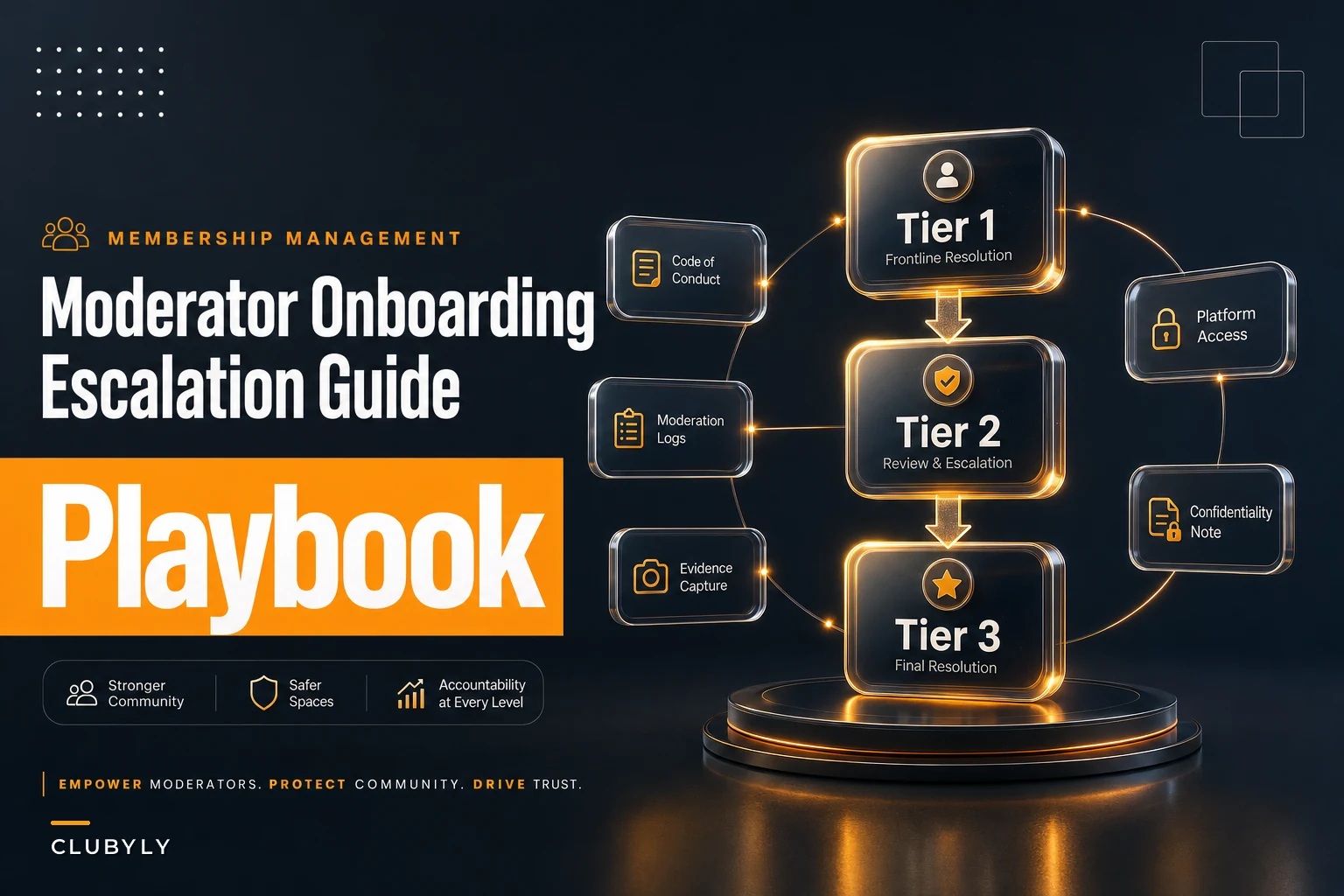
This handbook addresses that with four concrete things: a three-tier escalation tree, a moderator onboarding checklist, templated warnings and removals, and evidence-collection templates — plus a lightweight transparency report so members can see the rules are applied evenly. It's built specifically for volunteer moderators and small-club communities, not enterprise trust-and-safety teams.
Why moderation falls apart in volunteer-run communities
The failure pattern is almost always the same, and it has nothing to do with bad people. It's structural.
Volunteer moderators rotate. The person who handled a dispute in March isn't the person handling a similar one in September, and there's no shared memory of what was decided or why. Decisions live in someone's head, in a DM thread, or in a Facebook comment that got buried.
Second, moderators are usually also members. They know the people involved. That makes neutral judgment genuinely hard — not because anyone's corrupt, but because it's awkward to warn someone you'll see at the next meetup. So borderline stuff gets ignored until it's no longer borderline.
Third, there's no definition of what actually crosses a line. "Be respectful" is not an enforceable standard. When a member asks "what rule did I break?", a vague code of conduct leaves the moderator defending a gut call, which is exactly when things get personal and escalate to the board.
Clubs that run smooth communities aren't running stricter rules — they're running predictable ones. Members tolerate enforcement when it's consistent. They revolt when it feels arbitrary.
The three-tier escalation tree
This is the backbone. The point of a tier system is to match the response to the severity, and — just as important — to make clear who decides at each level so a single volunteer isn't carrying the whole thing alone.
Keep your membership organized and engaged.
Clubyly simplifies member management, event coordination, and payment collection—effortlessly.
- Unified member database
- Automated payment tracking
- Event scheduling & reminders
No credit card required
| Tier | What it covers | Who handles it | Typical response | Response window |
|---|---|---|---|---|
| Tier 1 – Minor | Off-topic posts, mild rudeness, first-time rule slips, spam | On-duty moderator alone | Friendly nudge, post edit/removal, or a logged soft warning | Same day |
| Tier 2 – Serious | Repeat Tier 1 after warning, personal attacks, harassment of one member, sharing someone's private info | Moderator + one other moderator or lead | Formal warning, temporary mute (e.g. 7 days), content removal | Within 24 hours |
| Tier 3 – Severe | Threats, hate speech, doxxing, safety risk, anything legal-adjacent | Escalated to board/president, two-person review required | Suspension or removal, possible external reporting | Immediate; interim action allowed before full review |
Tier 1 is deliberately low-stakes. The on-duty moderator can act alone and doesn't need to convene anyone. This keeps the forum moving and prevents tiny issues from waiting three days for a committee.
Tier 2 requires a second set of eyes — but only one. The two-person rule at this level isn't bureaucracy; it's the thing that protects moderators from the "you're picking on me" accusation. When two people signed off on a mute, it stops being personal.
Tier 3 interim action matters. The biggest mistake clubs make here is freezing because "we need to discuss it first." If someone is posting threats, the on-duty moderator should be explicitly authorized to remove the content and temporarily suspend the account immediately, then trigger the full review. Give them that authority in writing or they'll hesitate when it counts.
One pattern worth flagging: clubs that skip the tier definitions tend to treat everything as either Tier 1 (ignore it) or Tier 3 (nuclear). The middle tier is where most real moderation lives, and it's the one people forget to build.
Moderator onboarding checklist
New volunteer moderators are usually handed a password and told "you'll figure it out." Then they make an inconsistent call in week two and either over-correct or quit. A short onboarding checklist prevents both.
-
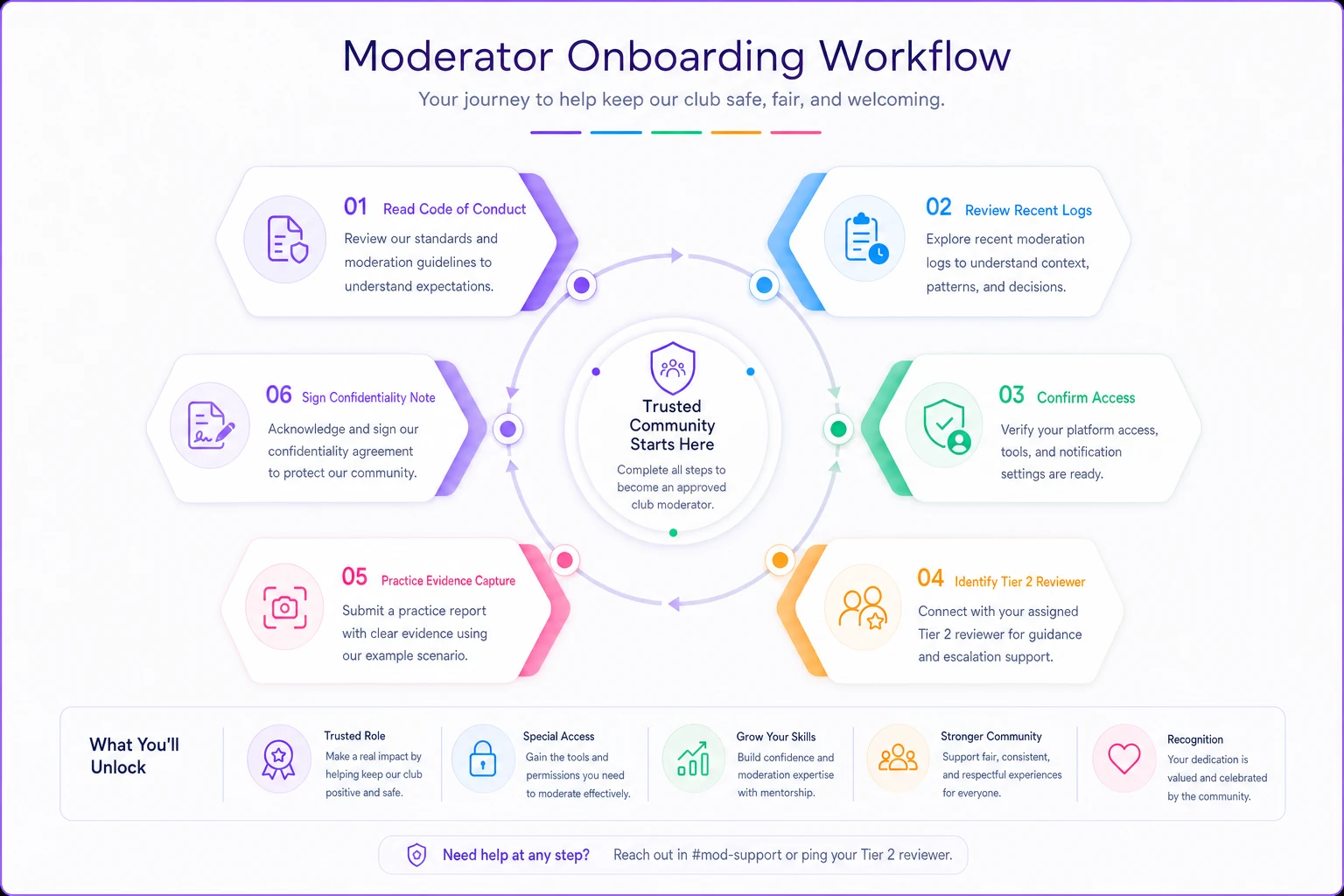
- [ ] Read the code of conduct and the three-tier escalation tree
-
- [ ] Review the last 5–10 logged moderation decisions to see how tiers are applied in reality
-
- [ ] Confirm access
forum/platform admin, the decision log, and the warning templates
-
- [ ] Know who their Tier 2 "second reviewer" is and how to reach them fast
-
- [ ] Know who the Tier 3 escalation contact is (name, not a role) and the after-hours method
-
- [ ] Understand the recusal rule
if the dispute involves a friend, close contact, or themselves, they hand it to another moderator
-
- [ ] Practice one evidence-collection capture on a dummy post
-
- [ ] Agree on shift coverage and how to log "nothing happened" vs. actions taken
-
- [ ] Sign a short confidentiality note — moderators see private reports and complaints
The recusal rule deserves emphasis. It's the single most protective habit a volunteer moderation team can build. In small clubs where everyone knows everyone, "I'm too close to this one, can you take it?" should be normal and praised, not treated as dodging work.
A simple onboarding flow helps new moderators ramp up quickly.
The recusal rule deserves emphasis. It's the single most protective habit a volunteer moderation team can build. In small clubs where everyone knows everyone, "I'm too close to this one, can you take it?" should be normal and praised, not treated as dodging work.
Templated warnings and removals
Improvised warnings are where tone goes wrong. A tired moderator at midnight writes something sharper than intended, the member reacts to the tone rather than the rule, and now there's a second conflict on top of the first.
Templates fix the tone problem and the consistency problem at once. Keep them neutral, specific, and short. Here are the core three.
Tier 1 — Soft warning (friendly nudge): > Hi [name], quick note from the mod team — your post in [thread] got edited/removed because [specific reason, e.g. it drifted off-topic / included a personal jab]. No big deal and nothing's logged against you formally. Just keeping threads useful for everyone. Thanks!
Tier 2 — Formal warning: > Hi [name], this is a formal warning from the moderation team regarding [specific behavior] in [location], which breaks [specific rule in the code of conduct]. This has been logged. A repeat may lead to a temporary mute or suspension under our escalation policy. If you'd like to discuss this, reply here or contact [contact].
Tier 2/3 — Temporary mute or suspension notice: > Hi [name], your account has been [muted for 7 days / suspended] as of [date] due to [specific behavior], which falls under [tier/rule]. This decision was reviewed by two members of the moderation team. It will be reviewed for reinstatement on [date]. You can appeal by contacting [appeal contact].
Notice what these templates do: they name the specific behavior, cite the specific rule, and — at Tier 2 and up — state that a second person reviewed it. That one sentence ("reviewed by two members") defuses an enormous amount of "you singled me out" energy.
The fill-in brackets are intentional. The moderator has to type the specific reason, which forces them to actually identify the rule that was broken before they act. If they can't fill the bracket, they probably shouldn't be sending the warning yet.
Evidence-collection templates
The quiet failure that bites clubs months later: someone appeals a removal to the board, and there's no record of what they actually did. The post was deleted. The screenshot is gone. The moderator "remembers" but can't prove it. Now it's one person's word against another's, and the board can't defend the decision.
Collect evidence at the moment of action, every time, even for small stuff. It takes about 90 seconds and saves hours later.
-
Date and time of the incident and of the action taken
-
Who was involved (member IDs/names)
-
Where it happened (thread link, channel, event)
-
What happened — a factual one-line description, no editorializing
-
Screenshot or copy of the original content before removal
-
Tier assigned and the rule cited
-
Action taken (warning sent, muted, removed, escalated)
-
Who decided (and the second reviewer, if Tier 2+)
Capture the content before you delete it.
The discipline that matters most: capture the content before you delete it. The number of moderators who remove a post first and realize afterward they have no copy is surprisingly high. Screenshot, then act.
Factual description is the other habit worth drilling. "Member posted a comment calling another member an idiot, link attached" is usable. "Member was being toxic and horrible" is not — it's an opinion, and it won't hold up in an appeal.
This evidence log and your broader communications governance system should live in the same operational world. Moderation decisions often touch member contact rules, consent, and privacy — keeping records consistent across both prevents contradictory handling.
A simple transparency report members can trust
Members don't need to know who got moderated. They need to know the rules are applied evenly. A short quarterly transparency report does that, and it's the thing that quietly earns the moderation team legitimacy over time.
Keep it anonymized and short. A format that works:
-
Total actions taken this quarter, by tier (e.g. "14 Tier 1, 3 Tier 2, 1 Tier 3")
-
Most common reasons (e.g. off-topic posts, personal attacks)
-
Number of appeals and how they were resolved
-
Any rule changes made as a result
-
A one-line reminder of where the code of conduct lives
A club with an active forum might report something like: roughly 18 actions over three months, the vast majority Tier 1 nudges, one suspension, two appeals of which one was overturned. That last detail — "one was overturned" — is actually valuable. It shows the system self-corrects, which makes members trust it more, not less.
That overturned-appeal honesty is counterintuitive but real. Communities that admit they occasionally get it wrong and fix it generate far less resentment than communities that project infallibility. Worth leaning into.
A short real scenario
A regional hobby club with around 600 members ran its community through a Facebook group and a small forum. Moderation was two volunteers making calls from memory. Over about six months they had three public blowups where a removed member accused the mods of bias — and because there were no records and no tier system, the board couldn't tell whether the complaints were fair. Two moderators quit, citing stress.
They put in the four pieces above: a three-tier tree, templated warnings, an evidence log in a shared doc, and a quarterly transparency note. The change over the following couple of quarters wasn't that fewer incidents happened — it was that incidents stopped escalating to the board. Most resolved at Tier 1 or 2 with a logged, templated response. Appeals dropped to a handful, and those were settled by pointing to the record rather than arguing from memory. Recruiting new moderators also got easier, because the role now had a clear playbook instead of "deal with angry people and hope."
No dramatic numbers. Just a noticeable drop in drama and a team that stopped burning out.
When this full system makes sense — and when it's overkill
When to build all of it: You have an active online community (forum, group chat, Discord, Facebook group) with more than a couple hundred members, multiple volunteer moderators, or a history of conflicts reaching the board. At that scale, inconsistency is inevitable without structure.
When to go lighter: A 40-member club with a quiet mailing list doesn't need a three-tier tree and quarterly transparency reports. Start with just the evidence habit (capture before you delete) and one simple warning template. Add tiers only when a second moderator comes on, because that's when consistency between people becomes the real problem.
Who should NOT roll this out all at once: Clubs mid-conflict. If you're currently in a dispute, don't invent a brand-new policy to apply to the person you're fighting with — it reads as a weapon aimed at them. Resolve the active issue under whatever rules existed, then introduce the system for next time, communicated as a general improvement.
Where tooling quietly helps
None of this requires software. A shared document and a bit of discipline cover a small club fine. But the part that breaks down manually is the logging — moderators forget, records get inconsistent, and the transparency report becomes a scramble to reconstruct the quarter.
Clubs that run their membership on an operational platform tend to fold moderation records into the same system where member profiles, communication rules, and privacy settings already live. That matters because a moderation action is rarely isolated — it can intersect with contact preferences, directory visibility, and consent. Keeping those connected prevents the awkward situation where someone is suspended from the forum but still showing up in the public member directory with full contact details. AI-assisted logging can also flag repeat offenders across time — surfacing "this is the third Tier 1 from the same member" so the tier escalation actually triggers instead of resetting every time a new moderator takes a shift.
The tools are a convenience layer on top of the real work, though. The handbook is the thing that matters.
The one habit to start with today
If you do nothing else from this handbook, do this: never delete content without capturing it first, and log every action in one shared place.
That single discipline turns "he said / she said" disputes into closed cases, protects your volunteer moderators from accusations, and gives the board something concrete when an appeal lands. Everything else — the tiers, the templates, the transparency report — builds naturally on top of a team that's already keeping records.
Start there, add the rest as your community grows, and you'll never again have a moderator staring at a spiraling thread at 11pm with no idea what they're actually allowed to do.
If you do nothing else from this handbook, do this: never delete content without capturing it first, and log every action in one shared place.
Start there, add the rest as your community grows, and you'll never again have a moderator staring at a spiraling thread at 11pm with no idea what they're actually allowed to do.
Ready to streamline your club operations?
Join 500+ clubs using Clubyly to save time, boost member engagement, and grow their communities.