
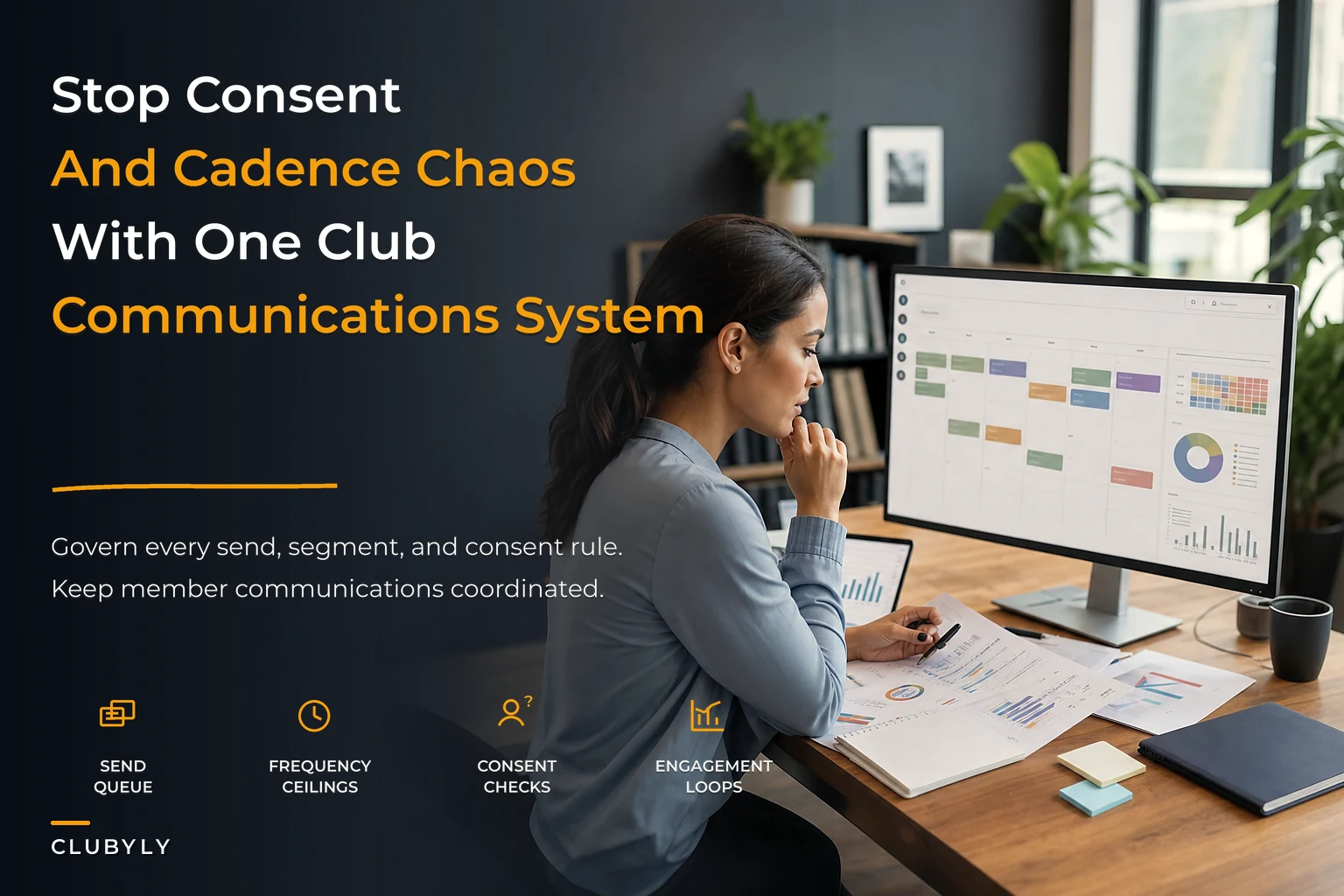

Most clubs don't realize their communications are broken until something embarrassing happens. A member who unsubscribed two years ago gets a fundraising blast. The events team and the membership team both email the same 40 people about renewals in the same week. Someone forwards a "confidential" board update to the general list. None of these are technology failures. They're governance failures — nobody agreed on who can send what, to whom, how often, and with what permission.
The word "cadence" gets thrown around like it's just a scheduling question. It isn't. Your member communications cadence is the visible output of four separate systems working together: consent, channel governance, segmentation, and templates. When any one of those drifts, the whole thing starts producing the low-grade chaos that most club managers just accept as normal.
This is a systems article, not a tips list. The goal is to show you how these four pieces connect, where they quietly break as your club grows, and what a functional communications system actually looks like when it's working.
## The four systems that quietly run your communications
Think of your communications as a pipeline. Something enters at one end (a decision to send), and a message exits at the other end (into an inbox, a text thread, an app notification). Between those two points sit four control layers. Most clubs have all four, but they live in different people's heads and different tools, which is exactly why they conflict.
| Layer | What it controls | Where it usually lives | How it fails |
|---|---|---|---|
| Consent | Who has agreed to hear what, on which channel | Signup form + someone's memory | Preferences captured once, never updated |
| Channel governance | Which channels are official, who owns each | Nowhere / informal | Random volunteers start a WhatsApp group |
| Segmentation | Who gets which message | Spreadsheet filters | Overlapping lists, stale tags |
| Cadence templates | Timing, frequency, sequence | Individual habits | Everyone sends "when they feel like it" |
These four fail in a specific order. Consent problems show up first because they're the most visible — someone complains. Channel sprawl comes next as the club grows and different teams want their own turf. Segmentation rot follows quietly. And cadence chaos is usually the last symptom. By the time your sends feel messy, all three upstream layers are already leaking.
## Consent: the layer everyone captures once and never maintains
Here's the pattern that keeps showing up. A club builds a nice signup form with checkboxes: "newsletter," "event invites," "partner offers." A member ticks two of three. That preference gets stored. And then it's frozen in time forever.
Keep your membership organized and engaged.
Clubyly simplifies member management, event coordination, and payment collection—effortlessly.
- Unified member database
- Automated payment tracking
- Event scheduling & reminders
No credit card required
Two years later that same member has attended 15 events, changed their email, told a volunteer verbally they "don't want the weekly stuff anymore," and still gets the weekly stuff — because the verbal preference never made it back into the system. Consent isn't a one-time capture. It's a living record that needs update paths from every direction: the member's account, the unsubscribe link, and staff-side edits when someone tells you in person.
A practical consent model for a club looks like this:
-
Granular topics, not one big list. At minimum
operational (renewals, safety, closures), community (newsletters, event invites), and promotional (sponsor offers, upsells).
-
Channel-specific consent. Agreeing to email is not agreeing to SMS. Texting people who only opted into email is how clubs end up in genuinely uncomfortable territory.
-
A visible last-updated date on each member's preferences so you can spot records that are years stale.
-
A single unsubscribe that respects granularity — people should be able to leave the newsletter without losing renewal reminders they actually need.
The thing most people miss: operational messages and promotional messages need completely different consent rules. A member should almost never be able to opt out of "your membership expires Friday" the same way they opt out of "check out our sponsor's sale."
Blurring those two is what forces clubs into all-or-nothing lists, which then create the cadence problems later.
## Channel governance: the layer that grows without permission
No club decides to run communications across six channels. It just happens. Email was first. Then someone made a Facebook group. Then the events crew wanted a Discord. Then a chapter lead started texting the "core members." Then Instagram. Nobody owns the map, so nobody can see that a single member might be getting the same announcement four times across four channels — or, worse, that critical info lives only in a channel half the members never check.
-
Purpose — what this channel is for (and what it's explicitly not for).
-
Owner — one named person accountable for it.
-
Audience — which segment actually lives here.
A typical example of what this fixes: a club with roughly 400 members had "urgent closures" posted only to Instagram Stories. Attendance at a rained-out event was a mess because maybe a third of members ever saw Stories. Once they designated email and SMS as the only official operational channels and demoted social to community and marketing use, the confusion basically disappeared. Same members, same tools, different governance.
The mistake to avoid is trying to kill channels to "simplify." You don't need fewer channels — you need each channel to have a clear job. A vibrant club Discord is great. It just shouldn't be where you announce dues deadlines.
## Segmentation: the layer that rots silently
Segmentation is where consent and channel governance turn into actual targeting. And it's the layer that decays without anyone noticing, because a stale segment still sends — it just sends to the wrong people.
-
Over-segmentation 22 different tags, half of which nobody remembers the meaning of, overlapping so that some members sit in five segments and get five copies of everything.
-
Under-segmentation one giant "all members" list, so every message goes to everyone, which trains people to ignore all of it.
Both produce the same result — members tuning out — but the fixes are different. Over-segmented clubs need to consolidate and document. Under-segmented clubs need to split by behavior and lifecycle stage.
A lean segmentation model that holds up as a club grows usually has just a handful of axes:
-
Lifecycle stage (prospect, new, active, lapsing, lapsed) — this is the big one, and it ties directly into your signup-to-active-member activation sequence, since new members need a fundamentally different cadence than five-year veterans.
-
Engagement level (regular, occasional, dormant) — defined off real metrics, not gut feel. If you haven't nailed down what "engaged" even means for your club, sort out which engagement metrics actually matter first, because segmentation built on vague definitions rots fastest.
-
Interest topics — pulled directly from consent, not invented separately.
Keep a single document defining each tag and its inclusion rules to prevent accidental overlap and duplicate sends.
The point worth holding onto: your segments should map to your consent topics and your lifecycle stages, not exist as a third independent system. When segmentation is derived from data you already collect, it stays current. When it's a separate pile of manual tags, it rots.
## Cadence: the layer everyone blames, that's usually just downstream
By the time cadence "feels wrong," the real problem is almost always upstream. But cadence templates are still worth building deliberately, because a good template layer protects members from the number-one club communications sin: collision.
Collision is when multiple teams send to overlapping audiences in the same window. The events team, the membership team, the fundraising team, and the newsletter all operate independently, each convinced their message is the important one. From the member's side it's just noise — and noise causes unsubscribes, which corrupts your consent layer, shrinks your reachable audience, and makes the next campaign underperform. The whole thing feeds back on itself.
A cadence template system needs two things working together:
A frequency ceiling per segment. Decide the maximum touches per member per week, by segment. New members can tolerate more — they're expecting onboarding. Long-term dormant members should get very little. A rough starting point many clubs land on:
-
New members (first 30 days)
up to 3–4 touches/week, mostly operational and onboarding
-
Active members
1–2 touches/week
-
Occasional members
about 1 touch/week
-
Dormant members
1–2 touches/month, reactivation-focused
A shared send calendar with priority rules. When two teams want the same window, operational always wins, and the lower-priority message moves. This single rule prevents most collisions. Without it, whoever hits "send" first wins by accident.
A simple weekly cadence workflow
-
Every team drafts sends into a shared calendar a week ahead, tagged with target segment and message type (operational / community / promotional).
-
A single coordinator reviews the week for collisions — any segment exceeding its frequency ceiling gets flagged.
-
Conflicts resolve by priority
operational > community > promotional. Lower-priority sends shift days.
-
Before send, each message checks against consent — does this segment actually accept this topic on this channel?
-
After send, engagement and unsubscribe data flow back to update segments and flag stale consent.
Here's a quick visual of that workflow:
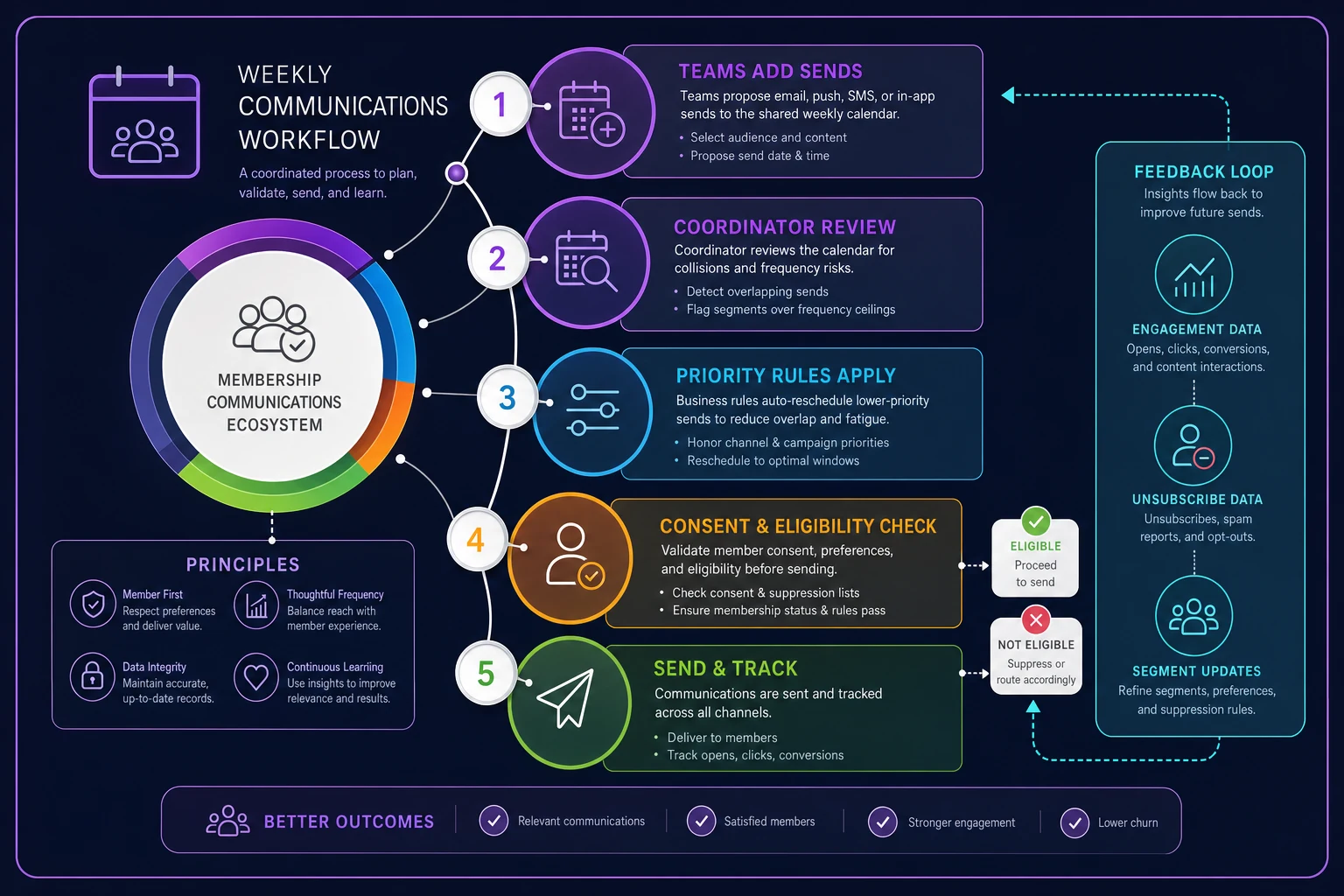
Step 5 is the one clubs skip, and it's the one that keeps the whole system from rotting. Communications governance isn't a set-and-forget policy — it's a loop.
## What breaks at scale
Everything above is manageable when your club is small enough that one person mentally holds the whole picture. The failure point is predictable: it's the moment you cross from one person coordinating to multiple teams sending independently. For most clubs that's somewhere around a few hundred members plus a second or third active committee.
Before that threshold, informal coordination works — you all sit in the same room, or the same group chat. After it, informal coordination silently fails, because no single person can see all the sends anymore. Consent records drift, channels multiply, segments overlap, and cadence collisions become weekly instead of rare.
Modern club management platforms with AI-assisted automation help here in an unglamorous but genuinely useful way: they enforce the loop you'd otherwise have to police by hand. Consent gets checked automatically before every send, so a promotional message can't go to someone who only opted into operational updates. Frequency ceilings get enforced across teams, so collisions get caught before they hit inboxes. Segments update from behavior instead of relying on someone remembering to re-tag people. The point isn't fancy — it's that the rules keep running even when the volunteer who set them up steps back.
## A real scenario
A regional hobby club with about 520 members and four volunteer committees was quietly bleeding members through communication fatigue. Each committee ran its own list. In one particularly bad week, active members received nine separate emails, three of them nearly duplicate event reminders. Unsubscribes that quarter ran roughly double their normal rate — and the part that really stings — some of those unsubscribes took people off renewal reminders too, because everything was one big list.
They didn't buy anything new at first. They just did the governance work: mapped their channels, split consent into operational vs. community vs. promotional, collapsed 18 messy tags down to lifecycle-plus-engagement segments, and set a shared calendar with a frequency ceiling. Within about two months, weekly email volume to active members dropped to two or three, unsubscribes settled back to normal, and open rates went up — because members stopped ignoring the club by default.
The renewal impact was the quiet win. By separating operational reminders from promotional noise, their renewal emails actually got seen again. They didn't measure it perfectly, but retention that cycle came in noticeably better than the previous year.
## When this level of governance actually makes sense
Build the full system when:
-
You have more than one team or committee sending independently
-
You're running more than two active channels
-
You've had at least one consent-related complaint or a duplicate-send incident
-
Renewals or safety messages are getting buried under promotional traffic
Keep it lightweight when:
-
You're under ~150 members with one person handling all comms
-
You have a single channel (email only)
-
Nobody's ever complained about frequency
Who should NOT overbuild this: a brand-new club with 30 members and one newsletter. Setting up frequency ceilings and priority resolution for a list that gets one email a month is pure overhead. Governance should match your actual coordination load. The whole point is to add structure exactly when informal coordination stops working — not before.
## A quick governance readiness checklist
Run through this to see where your leaks are:
-
- [ ] Consent is captured by topic and channel, not one global checkbox
-
- [ ] Staff can update a member's preferences when told in person
-
- [ ] Every channel has a written purpose, owner, and audience
-
- [ ] Operational messages are separated from promotional ones at the consent level
-
- [ ] Segments derive from lifecycle and engagement data, not manual guesswork
-
- [ ] There's a frequency ceiling per segment
-
- [ ] All teams draft into one shared send calendar
-
- [ ] Collisions resolve by a documented priority rule
-
- [ ] Unsubscribe and engagement data flow back to update segments
If you're checking fewer than half of these, your cadence problems aren't really cadence problems — they're upstream governance leaks showing up in the last layer.
## Tie it back to feedback, don't just broadcast
One last thing worth saying: communications governance isn't only about sending. The same segmented, consent-aware structure you build for outbound messages is exactly what makes inbound feedback usable. When you know which segment a member sits in and what they've consented to hear, you can also run a properly targeted membership survey program instead of blasting one generic survey at everyone and getting mush back.
Communications, in a well-run club, is a two-way loop — the cadence going out and the feedback coming back share the same plumbing. Get the governance right once, and both directions get easier.
The clubs that handle this well aren't the ones with the fanciest tools or the most channels. They're the ones who decided, on purpose, who can say what to whom and how often — and then built something that keeps enforcing that decision even as the club grows past the point where any single person can hold it all in their head.
Ready to streamline your club operations?
Join 500+ clubs using Clubyly to save time, boost member engagement, and grow their communities.