
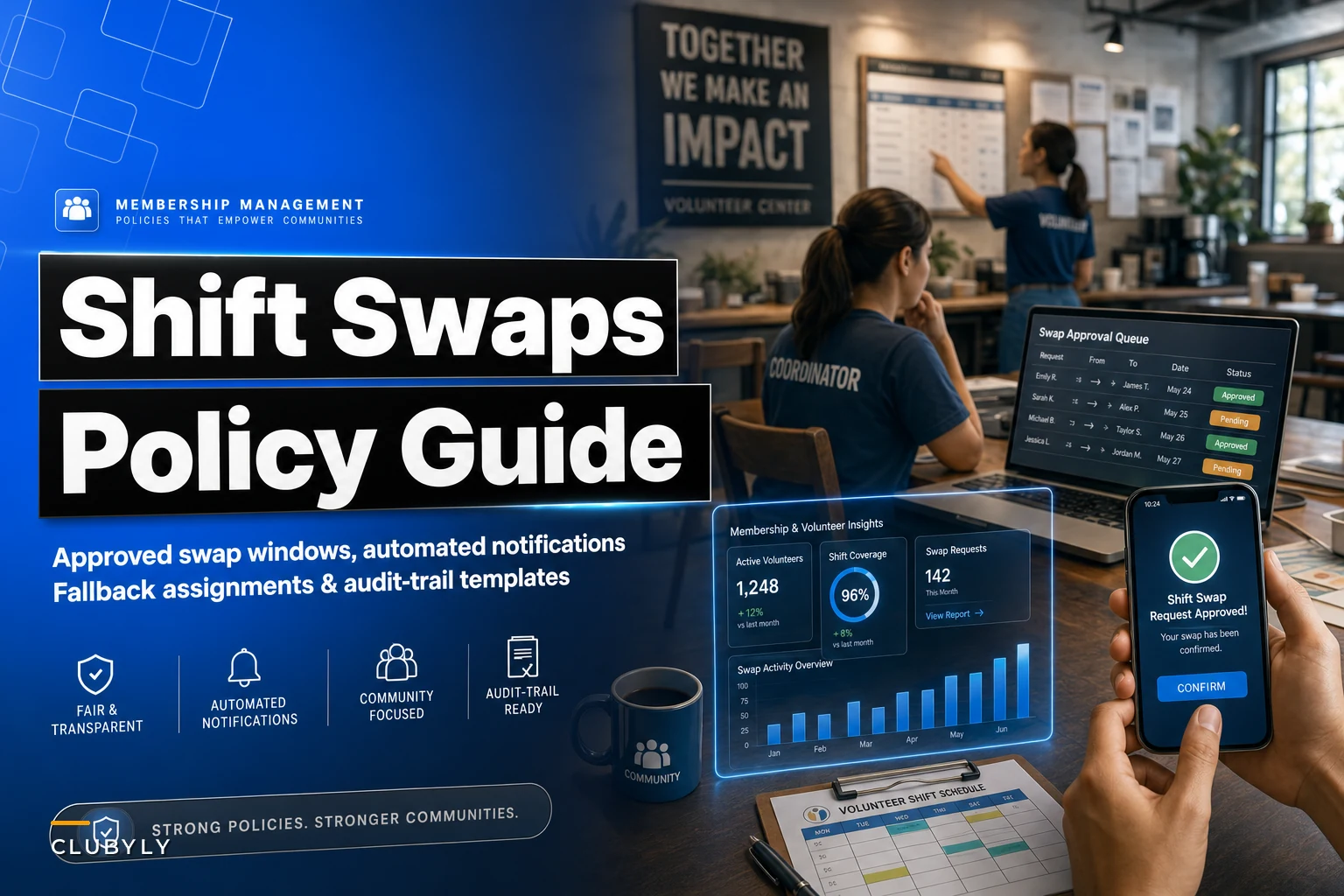

The problem almost never shows up on the schedule itself. The schedule looks fine. Everyone's slotted in. Then Thursday night a volunteer texts the coordinator: "Hey, something came up Saturday, can someone cover my 9am?" And that one message quietly kicks off the thing that eats a coordinator's entire weekend.
Because it doesn't stay one message. The coordinator forwards it to the group chat. Three people say "maybe." One person volunteers but doesn't actually confirm. Someone else already swapped that same slot two weeks ago and assumes the rule is different now. By Saturday morning nobody's fully sure who's supposed to be at the door, and the coordinator is standing there with a clipboard doing headcount math they should've never had to do.
That's not a scheduling problem. That's a volunteer shift swap policy problem — or more accurately, the absence of one. Most clubs have a rotation and reminders figured out. What they don't have is a clear, enforced process for what happens when someone needs out of their assigned shift.
Why swaps break down (it's rarely the volunteers' fault)
The instinct is to blame flaky volunteers. That's almost always wrong. What we've seen across a lot of volunteer-run organizations is that the swap process fails for structural reasons, not attitude reasons.
Here's what actually goes wrong:
Swaps happen in the wrong channel. A group text or a Facebook comment thread is where most swap requests live and die. There's no record, no confirmation step, and no single person who "owns" the outcome. The request floats around until it either resolves by luck or falls apart.
There's no deadline on the request. When someone can drop a swap request at any time — including two hours before a shift — the coordinator becomes the emergency backstop by default. Without an approved window, every swap is potentially a fire drill.
"Covered" and "confirmed" get conflated. Someone saying "I can probably do it" is treated as a solved problem. It isn't. The gap between a soft maybe and a locked-in yes is where the no-shows come from.
Nobody knows the fallback. If no one volunteers to cover, then what? Most clubs have no defined answer, so the answer becomes "the coordinator does it or begs someone." That's the single biggest source of coordinator burnout in shift-based volunteering.
The pattern underneath all of this: swaps are treated as informal favors instead of a defined operational process. Favors don't scale. A membership org running weekly events might handle 15–20 swap requests a month once you're past a certain size, and informal favor-trading collapses under that volume.
What a real swap policy actually needs to define
A swap policy isn't a paragraph in your volunteer handbook that says "please give advance notice." That does nothing. A functional policy answers four specific questions, and each one needs an actual rule, not a vibe.
Keep your membership organized and engaged.
Clubyly simplifies member management, event coordination, and payment collection—effortlessly.
- Unified member database
- Automated payment tracking
- Event scheduling & reminders
No credit card required
| Policy element | The vague version (fails) | The functional version (works) |
|---|---|---|
| Timing | "Give as much notice as you can" | Swap requests must be submitted at least 48 hours before the shift |
| Approval | "Let the coordinator know" | Coordinator approves within a set window; auto-approved if standard swap |
| Confirmation | "Find someone to cover" | Swap isn't valid until the covering volunteer explicitly confirms |
| Fallback | Undefined / coordinator problem | If no one confirms by the cutoff, a pre-defined fallback rule triggers |
The magic isn't in any single row. It's that all four are defined before a swap ever happens, so nobody's improvising under pressure.
The approved swap window
Pick a cutoff and hold it. Forty-eight hours is a reasonable default for most club events — enough time for someone to actually pick up the slot, short enough that you're not making people plan a month out.
Inside the window, swaps follow the normal process. Outside the window — meaning under 48 hours — it's no longer a "swap," it's an "emergency," and it routes differently. Separating these two categories is honestly half the battle. A planned swap and a two-hour emergency are completely different problems, and treating them the same is why coordinators feel like everything is a crisis.
Fallback rules that don't land on the coordinator
This is the part almost every club skips, and it's the most important. A fallback rule says: if the swap doesn't get covered by X time, here's exactly what happens. Options that work:
-
- Standby list. A short list of volunteers who've agreed to be "on call" for a given event, in priority order. First person gets pinged, then the next if no response in an hour.
-
- Role collapse. For non-critical roles, define which shifts can simply be merged or dropped without breaking the event. Not every slot needs backfilling.
-
- Cross-role coverage. Pre-approve which roles can cover for which. Your greeter can cover check-in; your setup crew can't cover cash handling. Define it once.
The point of a fallback is that the answer exists before you need it. The coordinator shouldn't be inventing a solution at 8pm Friday.
The workflow, start to finish
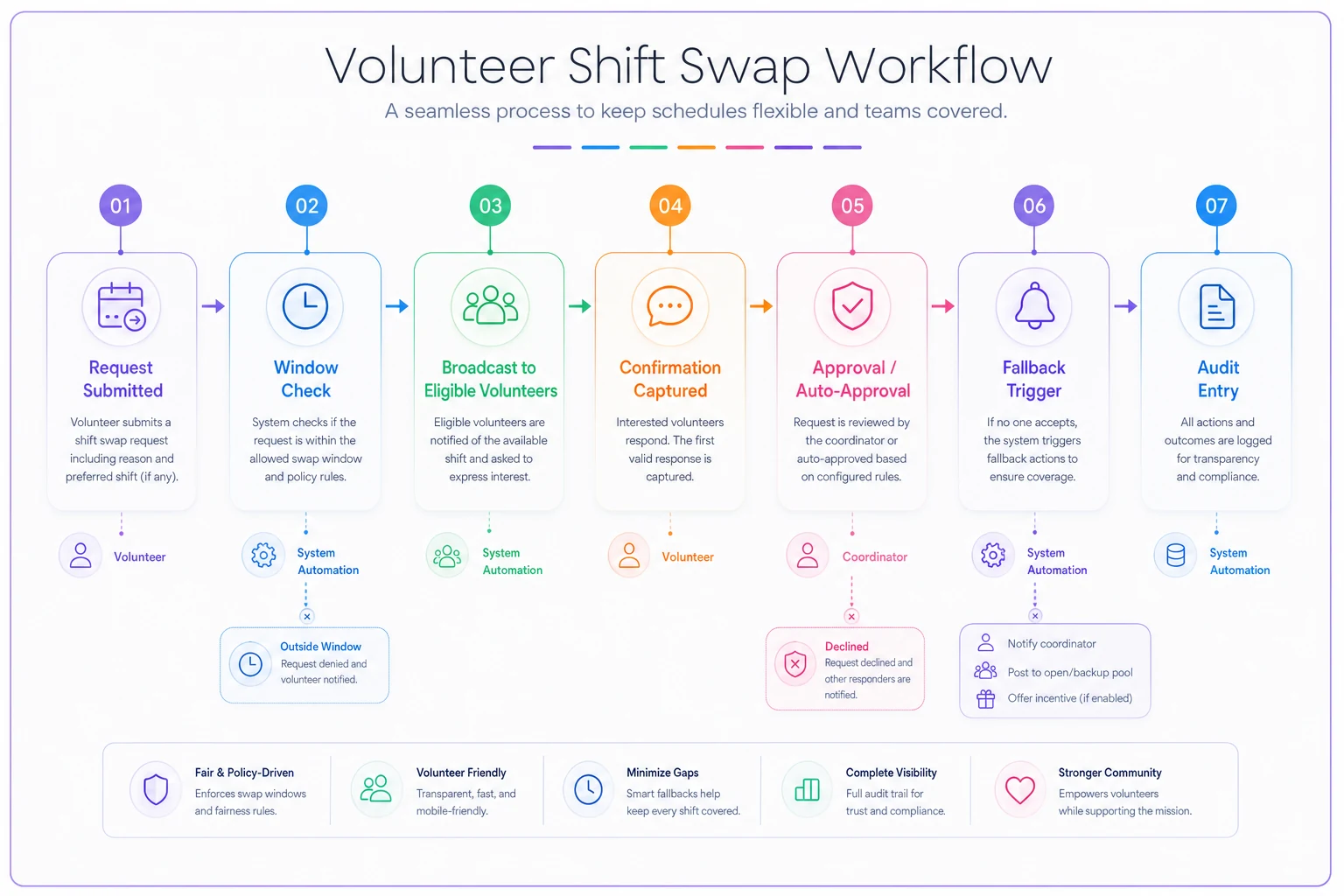
Here's how a clean swap actually moves, step by step. This is the sequence you're trying to make automatic:
-
1. Request submitted. Volunteer submits a swap request through one defined channel — not a text, not a hallway conversation — with the shift date and reason.
-
2. Window check. System or coordinator checks
is this inside the approved window? If yes, continue. If no, it flags as an emergency and routes accordingly.
-
3. Broadcast to eligible volunteers. The open slot goes only to people qualified for that role, not the whole roster. This alone cuts noise dramatically.
-
4. Confirmation captured. A covering volunteer accepts. Hard confirmation, logged — not a "maybe" in a chat.
-
5. Approval. Coordinator approves, or it auto-approves if it's a standard like-for-like swap. Original volunteer is released.
-
6. Fallback trigger if needed. If no confirmation by the cutoff, the fallback rule fires — standby list, role collapse, or cross-role coverage.
-
7. Audit entry created. Who requested, who covered, when, approved by whom. Logged and done.
When you write it out like this, the informal group-chat version looks insane by comparison. And it is — it's just familiar, which makes it feel normal.
Here's a quick visual of that workflow.
When you write it out like this, the informal group-chat version looks insane by comparison. And it is — it's just familiar, which makes it feel normal.
Where automation quietly earns its keep
You can run this whole process manually with a form and a spreadsheet, and plenty of clubs do. But the friction points — window checks, broadcasting to only eligible people, triggering fallback rules, logging every step — are exactly the repetitive tasks that pile up on one overworked coordinator.
Operational software with some automation built in starts to matter here, not as a shiny feature, but as a way to remove the coordinator from the middle of every single swap. When a request comes in, the system can check the timing window, notify only qualified volunteers, capture the confirmation, and fire the fallback if nobody responds by the cutoff — without anyone manually forwarding messages or chasing maybes.
Automate timing checks and eligible-volunteer broadcasts so swap handling requires no manual triage.
The same logic that powers good rotation, backfill and reminder rules for volunteer schedules applies to swaps: define the rule once, and let the workflow enforce it consistently so the coordinator isn't the enforcement mechanism. The audit trail matters too — when every swap is automatically logged, you stop having "wait, who was supposed to cover that?" conversations entirely.
The goal isn't to remove humans from the process. It's to make sure a human only gets pulled in when there's an actual judgment call — an emergency, a conflict, a role that genuinely needs a decision. Everything else should just run.
A real scenario
A mid-sized community sports club running weekend youth matches had roughly 40 volunteers cycling through check-in, field setup, and concessions across a season. Swaps were handled entirely in a WhatsApp group of about 55 people.
The pattern was predictable. Around 12–18 swap requests a month, most resolved through a chaotic thread. The coordinator estimated she spent five or six hours a week just managing swaps — reading through messages, confirming who was actually covering, and personally filling gaps when nobody stepped up. On two Saturdays that spring, a role went completely uncovered because a "maybe" evaporated overnight.
They made three changes: a 48-hour swap window, a single request form instead of the group chat, and a standby list of six volunteers who agreed to be first-call fallbacks. Within a couple months, the coordinator's swap-related time dropped to under two hours a week. The uncovered-shift problem basically disappeared — not because volunteers got more reliable, but because the fallback rule caught the gaps the old process let slip through.
Nothing dramatic. Just a defined process replacing an undefined one.
When a formal swap policy makes sense — and when it doesn't
It makes sense when: you're running regular, recurring shifts with more than about 15 active volunteers, and swaps are frequent enough that they're consuming coordinator time. If you're handling 10+ swap requests a month, you're past the point where informal works.
It's overkill when: you run occasional events with a small, tight crew who all know each other and text directly. If you have eight volunteers and two events a quarter, a formal window and fallback list is more process than you need. Don't build machinery for a problem you don't have.
Who should not do this: clubs where the real issue is a volunteer shortage, not a swap process. If shifts keep going uncovered because you simply don't have enough people, no policy fixes that — you have a recruitment problem, and you'd get more from tightening your volunteer recruitment funnel than from swap rules. A swap policy manages an adequate volunteer pool. It can't manufacture volunteers you don't have.
The quick checklist
Before your next event season, make sure you can answer yes to each:
-
[ ] There's one channel for swap requests — not a group chat
-
[ ] There's a defined swap window (e.g., 48 hours out)
-
[ ] "Emergency" swaps (inside the window) are treated differently from planned ones
-
[ ] A swap is only valid after an explicit confirmation, not a maybe
-
[ ] There's a written fallback rule for when nobody covers
-
[ ] Someone specific owns approval — or standard swaps auto-approve
-
[ ] Every swap gets logged so you can see patterns over time
If you can't check the fallback box, start there. It's the one that determines whether the coordinator ends up covering shifts personally.
The real takeaway
Swap chaos isn't a sign your volunteers are unreliable. It's a sign that the moment someone needs out of a shift, your club has no defined path for what happens next — so the path becomes "whatever the coordinator can pull together." That works right up until it doesn't, usually on the busiest weekend of your calendar.
Define the window. Define the confirmation. Define the fallback. Log the results. Do that, and swaps stop being weekend emergencies and go back to being what they should've always been — a routine, boring, handled part of running the schedule.
Ready to streamline your club operations?
Join 500+ clubs using Clubyly to save time, boost member engagement, and grow their communities.