
Cash sponsorships are easy to track. Money hits the account, the treasurer logs it, done. In-kind sponsorships are where clubs quietly lose the plot. A local printer donates "banners and flyers." A restaurant commits to catering "the fall mixer." A hardware store offers "whatever tools you need for the build day." Three months later nobody can remember what was promised, who received it, whether the logo ended up on the banner, or if anyone thanked the printer.
That gap is expensive in ways that don't show up on a ledger. The sponsor remembers they gave you something. You don't remember exactly what, and you definitely can't prove you delivered the recognition you promised. The renewal conversation gets awkward. Sometimes it just doesn't happen.
This post is narrowly about the operational spine for in-kind gifts: an intake form that captures the right fields, a fulfillment checklist so nothing slips, proof-of-delivery templates volunteers can actually fill out, and a follow-up flow that keeps the sponsor warm. If you've already built a good pipeline for turning local sponsors into reliable revenue, this is the part that keeps those relationships from leaking after the handshake.
Why in-kind gifts fall through the cracks
Cash has a built-in paper trail. In-kind doesn't. The gift arrives as a verbal commitment, gets handled by whoever happened to be on that committee, and never enters a system that anyone checks later.
-
The commitment lives in one person's inbox. The membership chair negotiated the donation over email. She's the only one who knows the details, and she's rotating off the board in June.
-
No agreed value. A sponsor donates "printing." Is that worth $150 or $1,400? Nobody assigned a number, so your treasurer can't acknowledge it properly and your sponsor's accountant can't either.
-
Delivery is assumed, never confirmed. You promised the sponsor a logo on the event signage and a shoutout from the stage. Did both happen? Probably. Can you prove it? No.
-
The thank-you is informal or missing. Someone said thanks in person at the event. There's no record, no photo, nothing the sponsor can forward to their own boss to justify the donation.
The underlying issue is that in-kind sponsorship touches three different people — whoever secured it, whoever used it at the event, and whoever maintains the relationship — and those handoffs happen in hallways and group chats instead of a shared record.
The intake form: capture it the moment it's promised
The intake form is the single highest-leverage fix here. Not because forms are exciting, but because capturing the gift at the moment of commitment stops most of the downstream mess. If the details get written down once, the rest of the chain has something to work from.
Keep your membership organized and engaged.
Clubyly simplifies member management, event coordination, and payment collection—effortlessly.
- Unified member database
- Automated payment tracking
- Event scheduling & reminders
No credit card required
-
Sponsor name and primary contact (person, not just company)
-
What was committed — specific items, quantities, dates
-
Estimated fair market value — and who estimated it
-
What we promised in return — logo placement, verbal recognition, social posts, booth space, etc.
-
Delivery date / event it's tied to
-
Who secured it (so there's an owner)
-
Any conditions — "logo must appear at least this size," "they want photos of their donation in use"
That "what we promised in return" field is the one people skip and the one that causes the most pain. The sponsor's whole reason for giving is that return. If it's not written down, it's the first thing to get forgotten when the event gets chaotic.
A quick note on valuation: you don't need a professional appraisal. For most donated goods, the sponsor's own invoice or a reasonable retail estimate is fine. Write down how you arrived at the number so the treasurer isn't guessing later. This also matters for your books — in-kind contributions often need to be recorded for accurate financials, which ties directly into how you handle sponsor accounting and diversified revenue.
The fulfillment checklist: making sure your side happens
Here's the asymmetry clubs miss. You track whether the sponsor delivered their gift. You rarely track whether you delivered what you promised in return. But the return is what gets you the renewal.
A fulfillment checklist runs per sponsor, per event. It's the bridge between "we got the donation" and "we honored the deal."
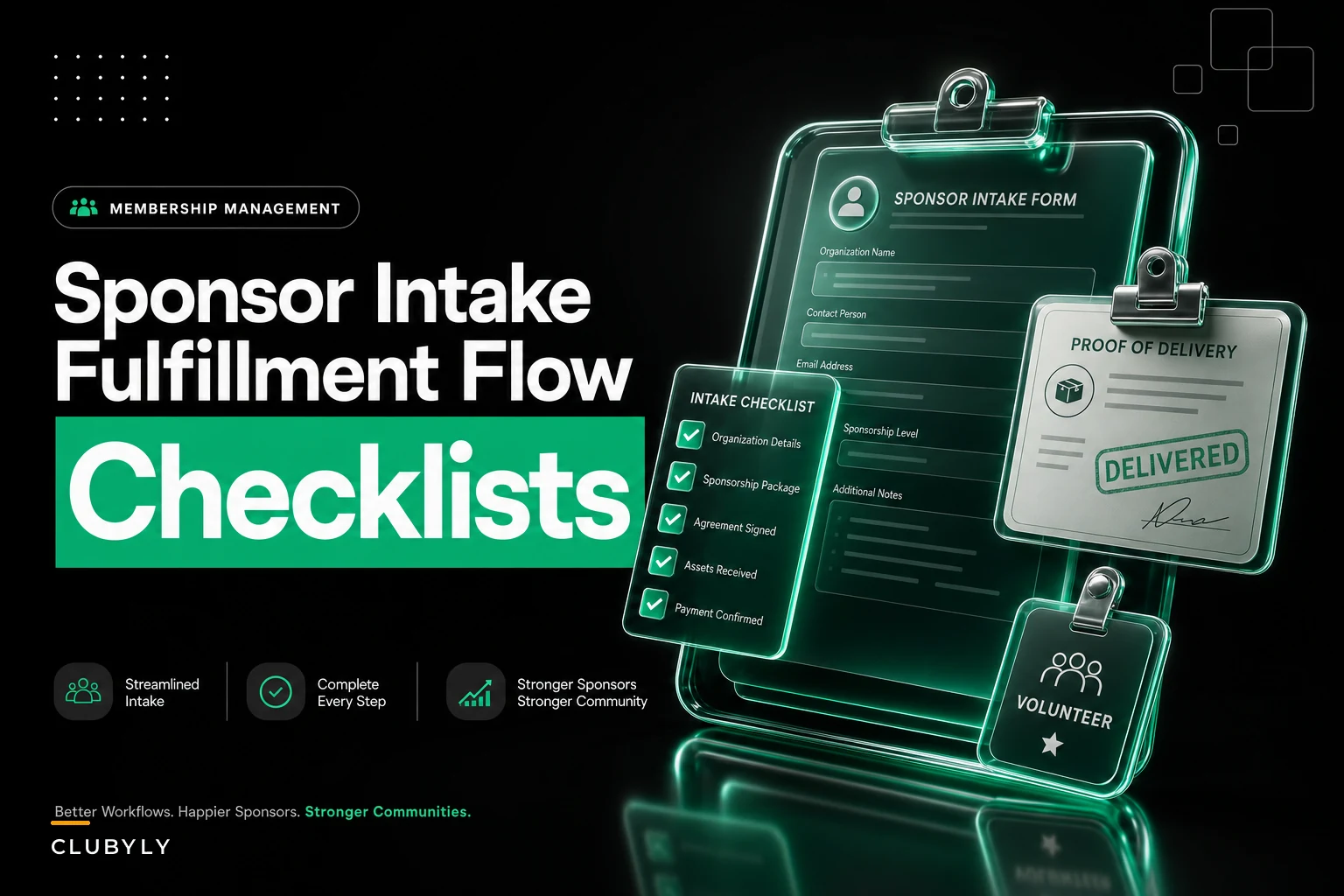
A workable fulfillment checklist looks like this:
-
[ ] Gift received and matches intake form (quantity, condition, timing)
-
[ ] Logo/branding assets collected from sponsor (correct format, resolution)
-
[ ] Recognition placements confirmed built — signage, program, website
-
[ ] Verbal recognition added to event run-of-show (so the MC actually says it)
-
[ ] Social post scheduled or published, sponsor tagged
-
[ ] Photos captured of the gift in use and the recognition in place
-
[ ] Proof-of-delivery packet assembled
-
[ ] Thank-you sent within the agreed window
Here's a simple workflow from intake to proof and follow-up.
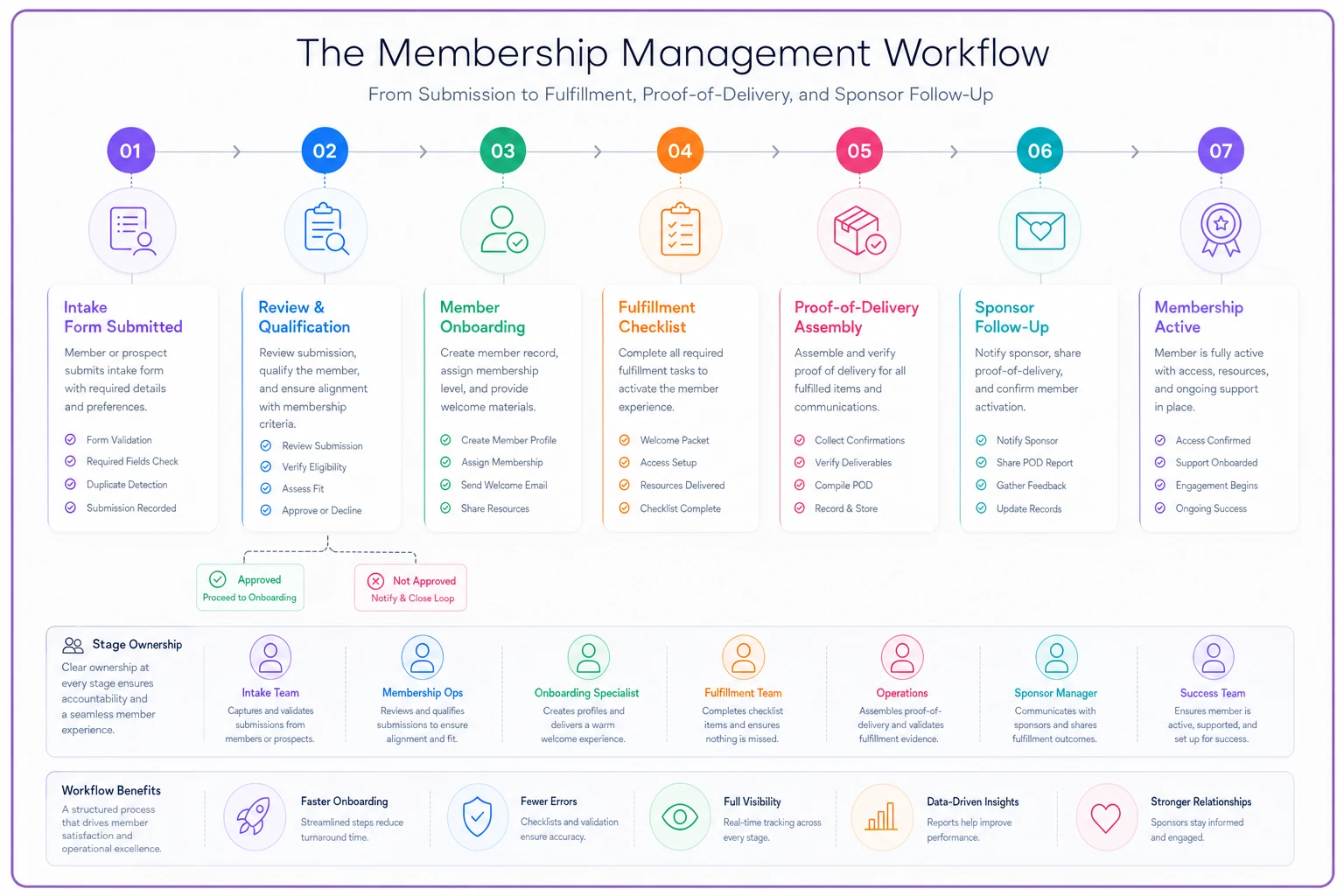
The sneaky failure point is the verbal recognition. "Thank our friends at Riverside Hardware" needs to be in the script the MC is holding, not in someone's memory. Events are loud and rushed. If it's not on the run-of-show, it gets skipped more often than you'd expect — and the sponsor who was standing in the audience noticed.
Proof-of-delivery templates volunteers will actually use
Proof-of-delivery is the part that separates clubs that keep sponsors from clubs that constantly re-pitch cold. It's a simple packet you hand the sponsor that says, without much ceremony: here's exactly what your donation did and here's how we recognized you.
Keep it visual and short. A one-page proof-of-delivery packet per sponsor should include:
| Element | What it proves | Format |
|---|---|---|
| Photo of gift in use | Their donation was actually used | 1–2 images |
| Photo of recognition | Logo/signage appeared as promised | 1 image |
| Attendance / reach numbers | How many people saw it | One line: "~140 attendees, 3 social posts, ~900 impressions" |
| Recognition recap | Everything you delivered on your side | Short bulleted list |
| Thank-you note | The relationship touch | 2–3 sentences, signed by a named person |
The reach numbers don't need to be impressive or precise. "Around 140 attendees and three social posts" is honest and useful. Sponsors aren't expecting stadium crowds from a club mixer — they want evidence their goods did something and that someone noticed.
The template should be fill-in-the-blank so a volunteer can assemble it in ten minutes by dropping in two photos and a few numbers. The second someone has to design a document from scratch, it won't get made.
The follow-up flow: turning one gift into a repeat gift
Most clubs treat the thank-you as the end. It's actually the start of the renewal. A light follow-up flow keeps the sponsor engaged without turning into a burden for your volunteers.
A reasonable sequence after an in-kind gift is delivered:
-
Within 72 hours — send the proof-of-delivery packet with a short, warm thank-you. Timing matters more than polish. A fast, imperfect thank-you beats a beautiful one three weeks late.
-
Two to three weeks later — a brief personal check-in. Not a pitch. "Hope the photos were useful — happy to send higher-res versions if your team wants them for anything."
-
Mid-cycle, around the next event planning window — soft re-engagement. "We're starting to plan the spring build day and immediately thought of you."
-
Before the next ask — a two-question note works
Was the recognition what you expected? Anything we could do better next time?
That satisfaction check is underused. It surfaces problems while they're still fixable — "honestly our logo was pretty small on the banner" — instead of letting a quietly annoyed sponsor ghost your next email. A sponsor who tells you what went wrong is a sponsor who's still in the relationship.
A real scenario
A regional hobbyist club — around 180 members, roughly six events a year — ran almost entirely on cash sponsorships plus a loose collection of in-kind donations nobody tracked well. They estimated in-kind gifts (printing, venue discounts, donated raffle prizes) at somewhere around $4k–$6k of annual value, but couldn't say for sure.
Their problem wasn't getting donations. It was that two of their reliable in-kind sponsors quietly stopped responding. When the board dug in, the pattern was the same for both: the sponsors had donated, received a quick verbal thanks at the event, and heard nothing after. One of them later mentioned they weren't even sure their logo had made it onto the signage — and it hadn't, because the design file was finalized before the donation was confirmed and nobody updated it.
They put in a basic intake form, a per-sponsor fulfillment checklist, and a one-page proof-of-delivery template. Nothing fancy — a shared folder and a form.
The shift over the following year was mostly qualitative but real. Fulfillment stopped being a scramble because the "what we promised" field made the recognition obligations visible weeks ahead. Both lapsed sponsors came back once they got an actual proof packet showing their donation in use. And the club stopped under-reporting in-kind value on its books, which gave the treasurer a cleaner picture of true event margins. The number of in-kind sponsors renewing went from roughly half to most of them.
When a formal in-kind sponsorship system makes sense (and when it doesn't)
This is worth building if in-kind gifts are a meaningful part of how your events run, if more than one or two people handle sponsor relationships, or if board turnover means institutional memory keeps walking out the door.
It's probably overkill if you take one small donation a year from the same person who's been doing it for a decade. Don't build a tracking system heavier than the thing it tracks. For a single recurring gift, a shared note works fine.
Where it stops being optional is multi-chapter or multi-committee clubs. The moment two different people can accept an in-kind gift from the same business without knowing about each other, you need a central record — otherwise you'll double-ask a sponsor, or thank them for one gift while forgetting another.
Where lightweight tooling helps
You can run all of this in a form tool and a shared folder, and plenty of clubs should start exactly there. The friction shows up at the handoffs — someone has to remember to assign the fulfillment owner, to nudge whoever's assembling the proof packet, to trigger the follow-up at the right interval.
Assign the fulfillment owner at intake submission so the handoff isn't left to someone's memory.
That's where a shared operations platform earns its keep: intake feeding directly into a fulfillment checklist with an owner attached, automatic reminders when a proof packet is due or a follow-up window opens, and a single sponsor record anyone on the board can pull up instead of details trapped in one person's inbox. The goal isn't to automate the relationship — it's to stop the reminders and handoffs from depending on one volunteer's memory, so the human part (the thank-you, the check-in) actually happens on time.
Pulling it together
In-kind sponsorship isn't hard because the gifts are complicated. It's hard because the information scatters across people and the delivery of your side goes unverified. An intake form captures the deal before anyone forgets it. A fulfillment checklist makes sure you hold up your end. Proof-of-delivery shows the sponsor it mattered. A follow-up flow turns a one-time favor into a sponsor who expects to help again next year.
Start with the intake form. It's the cheapest fix and it stops the most bleeding. Everything downstream gets easier once the gift and the promise are written down somewhere that outlives whoever secured it.
Start with the intake form. It's the cheapest fix and it stops the most bleeding. Everything downstream gets easier once the gift and the promise are written down somewhere that outlives whoever secured it.
Ready to streamline your club operations?
Join 500+ clubs using Clubyly to save time, boost member engagement, and grow their communities.