


Most multi-chapter clubs eventually hit the same wall. The national office — or the biggest chapter — pays for something everyone uses: a shared email platform, a paid Zoom account, a graphic designer who builds event flyers, a member database license. Then someone has to figure out who owes what. That's when the politics start.
The small chapter's treasurer feels like they're subsidizing the big chapter's activity. The big chapter feels like they're carrying everyone else. Nobody agreed on the math up front, so every invoice becomes a negotiation. And because these are volunteer finance teams, half the people involved have day jobs and zero patience for a two-hour call about a $340 line item.
This post is narrow on purpose. It's about one thing: setting up inter-chapter chargebacks for genuinely shared services in a way that's fast to run, hard to argue with, and doesn't require a professional accountant. You'll get a decision flow for what to centralize, plain-language SLA wording, a chargeback calculator you can rebuild in a spreadsheet, and an invoice template sized for volunteer treasurers.
First: not everything shared should be charged back
The instinct when a shared cost appears is to immediately split it. That's usually the wrong first move. Some things are cheaper to absorb centrally than to bill, because the billing itself — in volunteer hours and goodwill — costs more than what you recover.
A rough rule that holds up: if a shared cost is under about $200–$300 a year per chapter, don't build a chargeback for it. Fold it into national dues or absorb it. The moment you send a $47 invoice to three chapters, you've created three payments to chase, three treasurers who don't know what the line item is, and probably one who disputes it. Not worth it.
A quick decision flow for what to centralize vs. charge back
-
Is the total annual cost above roughly $1,000? If no, strongly consider absorbing it centrally. Below that threshold, the chargeback overhead usually eats the benefit.
-
Does usage vary a lot between chapters? If everyone uses it about equally, split it as a flat per-chapter fee or fold it into dues. Don't build a usage meter for something that's basically uniform.
-
Can you measure usage without manual counting every month? If measuring usage means someone hand-tallies logins or events, the measurement will quietly rot within two quarters. Only meter what the system reports automatically.
-
Would a chapter reasonably want to opt out? If yes, you need a real chargeback so opting out actually saves them money. If opting out isn't possible — shared insurance, core database — just centralize and allocate.
If something clears all four — big cost, uneven usage, auto-measurable, opt-out-able — that's your chargeback candidate. Almost everything else should be centralized and funded from dues. We've covered the broader trap of over-centralizing in this breakdown of centralization mistakes multi-chapter clubs make, and the same warning applies here: charging back too many small items is its own kind of over-centralization.
The SLA: keep it to one page, in language a volunteer can read
This is the part clubs skip, then regret. When a chapter pays into a shared service, they're implicitly buying a service level. If the shared designer takes three weeks to turn around a flyer, or the "shared" member database is down during a renewal push, the paying chapter feels ripped off — and now the chargeback dispute is really a service dispute wearing a costume.
Keep your membership organized and engaged.
Clubyly simplifies member management, event coordination, and payment collection—effortlessly.
- Unified member database
- Automated payment tracking
- Event scheduling & reminders
No credit card required
You don't need a corporate SLA with penalty clauses. You need a plain paragraph that answers three questions: what's included, how fast, and what happens when it breaks.
> Chapters that pay into the shared design fund can submit up to 4 design requests per quarter. Standard turnaround is 5 business days from a complete request (text, images, and event date provided). Rush requests under 5 days aren't guaranteed. If turnaround exceeds 10 business days on a standard request, that request doesn't count against the chapter's quarterly total and is credited on the next invoice.
That's it. It sets expectations, defines "complete request" so nobody games the system, and builds in a self-correcting credit so you're not arguing after the fact. The credit clause matters more than people think — it converts "you failed us, we're not paying" into an automatic, pre-agreed adjustment. No meeting required.
Write one of these for every service you charge back. If you can't write a one-paragraph SLA for something, that's a signal the service is too vague to bill fairly. Centralize it instead.
The chargeback calculator: three ways to split, pick the least controversial
Almost every shared-cost dispute comes down to which allocation method you're using. There are really only three that work for volunteer teams, and the trick is picking the one people find hardest to argue with for that specific cost.
| Method | How it works | Best for | Where it causes fights |
|---|---|---|---|
| Flat per-chapter | Total cost ÷ number of chapters | Costs that don't scale with size (base platform fee, shared insurance) | Small chapters feel it's unfair they pay the same as a chapter 5x their size |
| Per-member | Cost allocated by each chapter's member count | Costs tied to membership (database seats, member communications) | Chapters with lots of inactive members overpay; needs a clean member count date |
| Per-usage | Cost split by actual usage (events run, tickets sold, requests submitted) | Costs that clearly scale with activity (event platform, design requests) | Requires reliable usage data; a quiet quarter can spike another chapter's share |
The mistake clubs make constantly: picking one method and applying it to everything. Then the flat-fee people are upset about the usage-heavy service, and the usage people are upset about the flat one. Mix methods per service. Insurance gets split flat, the event platform gets split by usage, the database gets split per-member. Each split matches how the cost actually behaves.
Building the calculator
-
Column A Service name
-
Column B Total annual (or quarterly) cost
-
Column C Allocation method (flat / per-member / per-usage)
-
Columns D onward one column per chapter, holding the driver value (member count, event count, or just "1" for flat)
-
A summary block that outputs each chapter's dollar share per service, then totals down each chapter's column
Freeze the driver values on a fixed date to avoid mid-quarter disputes.
One design rule that saves you headaches: freeze the driver values on a fixed date. For per-member splits, use member counts as of the first of the billing quarter, for example. Otherwise a chapter that recruited 15 people mid-quarter argues they shouldn't be charged for them yet, and you're back in a debate. A stated count date ends that conversation before it starts.
A worked example so the math is concrete
Say a regional club has four chapters sharing three things: a member database ($2,400/year), an events platform ($1,800/year), and a design fund ($1,200/year). Chapter sizes and activity look like this:
-
Chapter North 210 members, ran 14 events, submitted 9 design requests
-
Chapter East 95 members, ran 4 events, submitted 3 requests
-
Chapter South 140 members, ran 9 events, submitted 6 requests
-
Chapter West 55 members, ran 2 events, submitted 2 requests
The database ($2,400) splits per-member across 500 total members — roughly $4.80 per member. North pays about $1,008, East about $456, South about $672, West about $264.
The events platform ($1,800) splits per event across 29 total events — roughly $62 per event. North pays about $868, East $248, South $558, West $124.
The design fund ($1,200) splits per request across 20 total requests — $60 each. North $540, East $180, South $360, West $120.
North's total lands around $2,416 for the year, West's around $508. Nobody can seriously argue North should pay the same as West — North used the shared services roughly four to five times as heavily. That's the point: the numbers do the arguing for you, so the treasurers don't have to.
No chapter got charged for the whole of any service, and each split matched the cost's nature. That combination is what kills the "we're subsidizing them" resentment.
The invoice: build it for a volunteer, not an accountant
The billing document itself is where a lot of goodwill quietly dies. If the invoice just says "Chapter East owes $884," the treasurer has nothing to check against and either pays blindly — bad for trust — or comes back with questions, which is bad for your time. The invoice needs to show its work.
-
Chapter name and billing period (make the period unmistakable — "Q2 2026, April–June")
-
Each shared service on its own line, with
the service, the allocation method used, this chapter's driver value, the total pool, and the resulting amount
-
The count/measurement date for anything usage- or member-based
-
Any SLA credits applied, itemized, so a service failure shows up as a visible reduction
-
The total due, a due date, and exactly how to pay
-
A single named contact for questions — one person, not "the finance committee"
That "show the driver value and the pool" line is the trust-builder. When East's treasurer sees "Events platform — per-usage — your events: 4 of 29 total — $248," there's nothing to dispute. They can verify their own event count in thirty seconds. Disputes drop toward zero not because people get nicer, but because there's nothing left to argue about.
Who runs this, and how often
Keep the cadence quarterly, not monthly. Monthly chargebacks for a volunteer club generate twelve rounds of small invoices and twelve opportunities for something to slip. Quarterly gives you four clean cycles, enough usage data to be fair, and amounts small enough that no single invoice is a shock.
The workflow, start to finish:
-
On the first business day of the quarter, pull the driver values (member counts, event counts, request logs) as of the count date.
-
Drop them into the calculator tab. Per-chapter amounts populate automatically.
-
Apply any SLA credits from the prior quarter.
-
Generate one invoice per chapter from the template, each showing its own driver values.
-
Send, with a two-week payment window and one named contact.
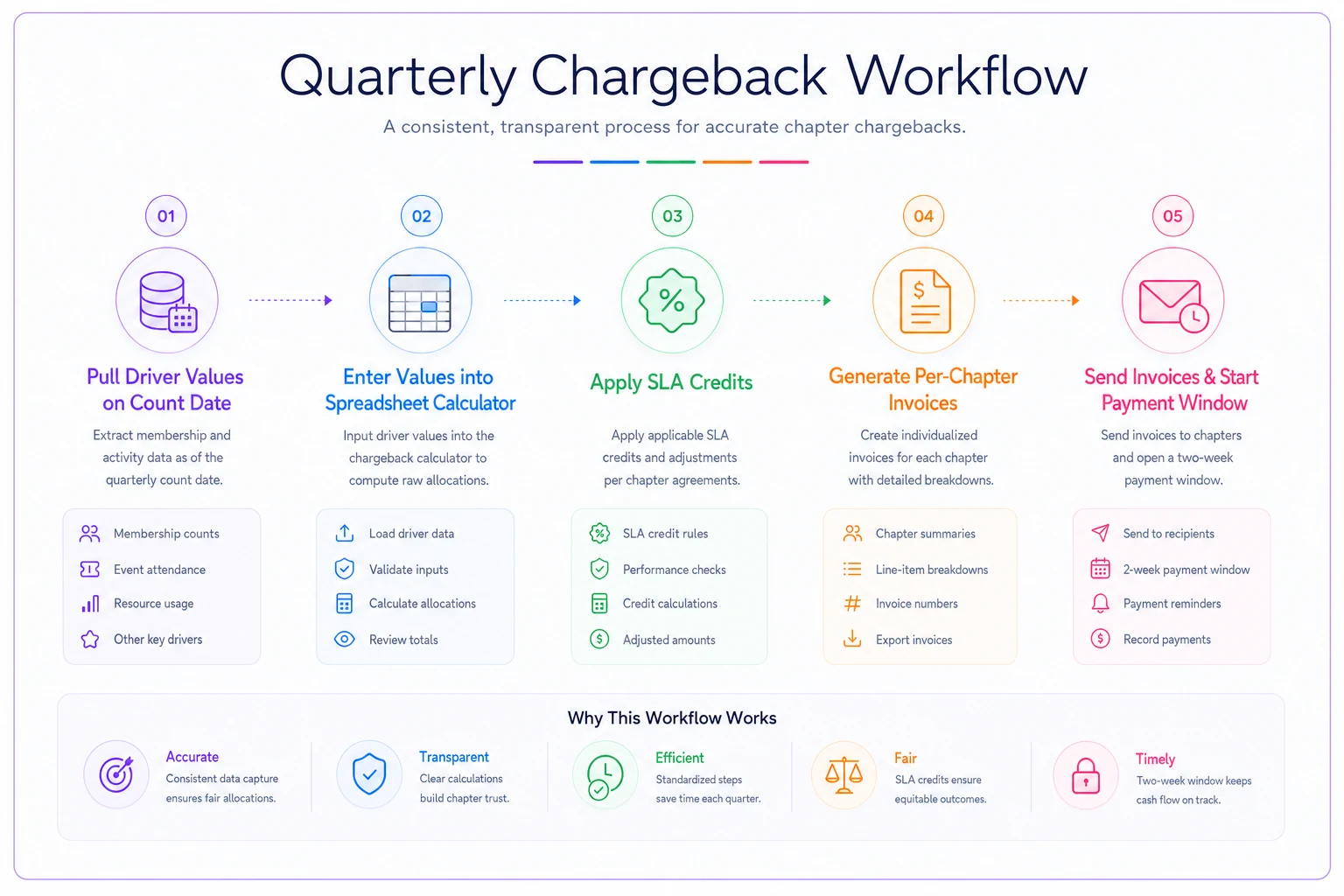
A concise visual of the five steps helps new volunteers run the quarter without asking for a walkthrough.
The friction point is almost always step one — gathering usage data. If someone has to log into three systems and manually count events and design tickets, that step gets skipped when things get busy, and the whole system stalls. Worth solving before you launch, not after. When clubs choose the tools that sit underneath this process, the ability to export usage cleanly matters more than fancy features — a point that fits the broader vendor scorecard approach for volunteer-run clubs. A platform that centralizes member counts and event activity, and lets you pull those numbers in one export, is what makes the quarterly run take an hour instead of an afternoon.
When inter-chapter chargebacks are a bad idea
This whole system is overhead. It's worth it when shared costs are real and lopsided. It's a mistake in a few situations:
-
You have two or three chapters that are roughly the same size and activity. Just split flat or fold into dues. The precision isn't worth the machinery.
-
Total shared spend is under a couple thousand dollars a year. The volunteer hours to run quarterly chargebacks can exceed what you're actually reallocating.
-
Your chapters don't have functioning treasurers. If invoices already go unpaid and unanswered, adding inter-chapter billing just creates more unpaid invoices with more hurt feelings. Fix basic payment discipline first.
-
The "shared service" is really one chapter's project that others tolerate. That's not shared infrastructure — that's a favor, and billing for it will feel like a bait-and-switch.
If none of those apply — you've got several chapters of uneven size, meaningful shared spend, and treasurers who actually reconcile — the setup pays for itself in reduced arguments alone.
The real reason this works
The politics around shared costs almost never come from people being cheap. They come from ambiguity. When nobody knows the rule, everyone assumes it favors someone else. A small chapter assumes it's subsidizing the big one; the big one assumes it's carrying everyone. Both can be simultaneously convinced they're getting a raw deal, because there's no shared reference point.
A written allocation method, a one-paragraph SLA, and an invoice that shows its math replace all of that assumed unfairness with a visible, checkable number. Treasurers stop debating fairness in the abstract and start verifying arithmetic — a much shorter and less emotional conversation.
Set it up once, keep it quarterly, and match each split to how the cost actually behaves. The goal isn't perfect cost accounting — it's a system boring enough that nobody wants to fight about it anymore.
Ready to streamline your club operations?
Join 500+ clubs using Clubyly to save time, boost member engagement, and grow their communities.