


Most clubs don't decide to outsource. They drift into it. The newsletter gets late one too many times, someone's cousin does web design, a bookkeeper gets hired "just for tax season," and suddenly the club has four vendors nobody formally chose, no contracts anyone can find, and a treasurer who can't tell you what any of it actually costs per member.
So before you sign anything, the question isn't "should we outsource?" It's "what does this function actually cost us to run today, and would handing it off make that number better or worse?" That's a costing question first, a staffing question second, and a contract question third. Most clubs do it in reverse — they pick a vendor, then rationalize the decision. This playbook flips it. Scope here is tight: how to decide what to outsource, how to hold a vendor to a real standard without a legal budget, and a simple model any volunteer can run in a spreadsheet to compare options honestly.
The buy-vs-outsource rubric (score it before you shop)
The mistake clubs make is treating "outsource" as a yes/no. It's actually four separate questions, and a function only clears the bar if it passes all four. Score each function 1–5 on these dimensions, then look at the total.
| Dimension | Score low (keep in-house) | Score high (outsource) |
|---|---|---|
| Volunteer availability | You have a reliable person who wants it | Nobody's touched it in months; it's orphaned |
| Specialization needed | Any competent member can do it | Needs a credential or real expertise (books, legal, accessibility compliance) |
| Failure cost | A mistake is annoying, not dangerous | A mistake means fines, lost members, or safety risk |
| Frequency / load | A few hours a month, predictable | Heavy, spiky, or constant — burns people out |
Add it up. A function scoring 16–20 is a strong outsource candidate. Below 10, you're probably better off keeping it internal and supporting the volunteer. The messy middle (11–15) is where judgment comes in — and where most clubs guess wrong.
There's a pattern worth noticing: the functions clubs most want to outsource (event planning, social media) usually score low, because they're enjoyable and people actually volunteer for them. The functions clubs should outsource (bookkeeping, accessibility audits, payroll if you have staff) score high but feel tedious, so they get ignored until something breaks. The rubric exists to override that emotional bias.
One more thing the rubric catches: a function can score high on specialization and failure cost but still be a bad outsource candidate if the volume is tiny. Paying a $200/month minimum for a vendor to do two hours of work isn't buying expertise — it's buying a retainer you'll resent. Keep an eye on the frequency column.
A small costing model your volunteers can run
You can't compare in-house versus outsourced until you know what in-house actually costs — and "it's free, volunteers do it" is almost never true. Volunteer time has a replacement cost, and ignoring it is how clubs convince themselves they're saving money while quietly burning out the three people holding everything together.
Keep your membership organized and engaged.
Clubyly simplifies member management, event coordination, and payment collection—effortlessly.
- Unified member database
- Automated payment tracking
- Event scheduling & reminders
No credit card required
This model fits on one spreadsheet tab. Build it per function, not for the whole club at once.
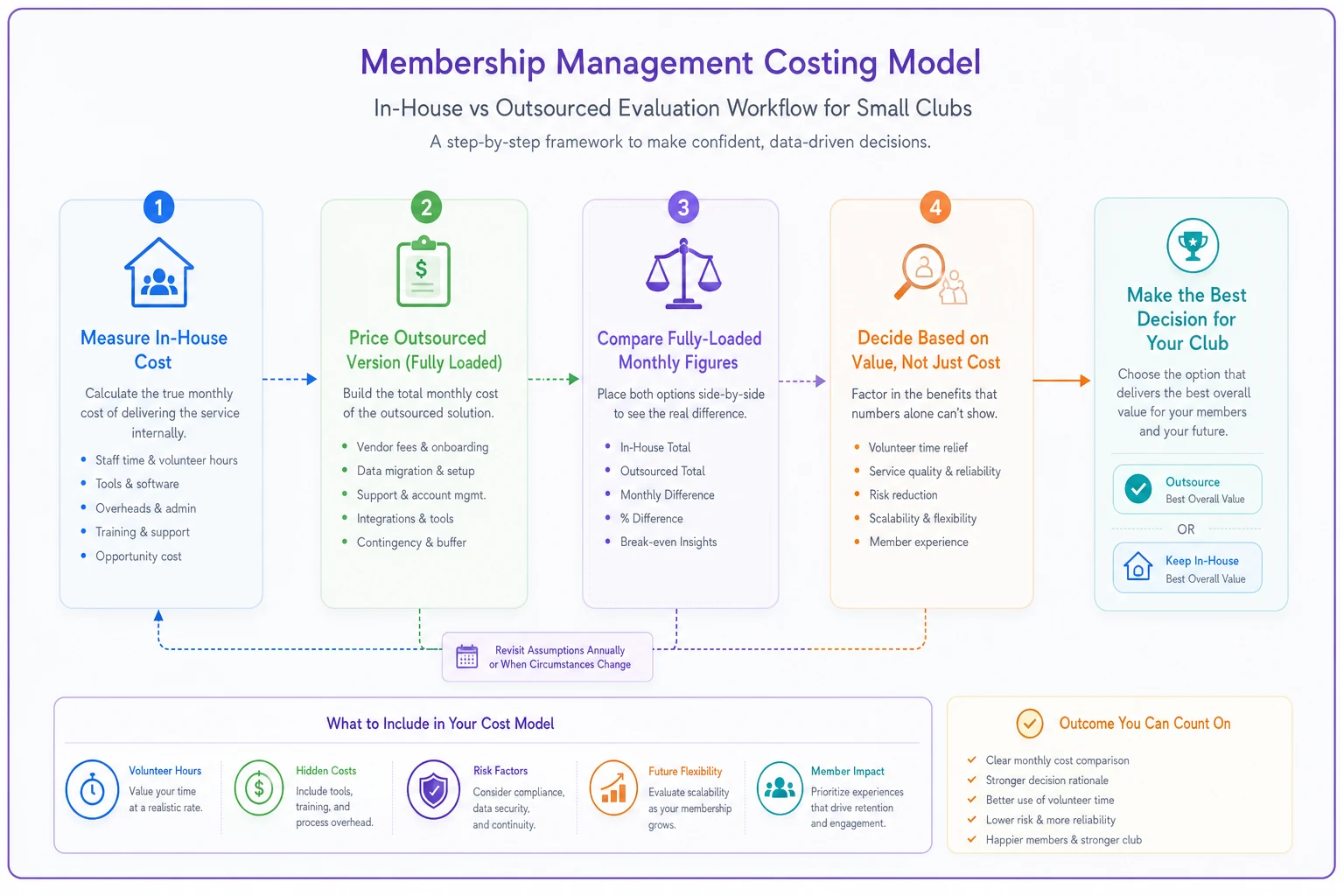
Step 1 — Measure in-house cost-to-serve.
-
Estimate monthly hours the function takes (track it for one real month if you can — people always underestimate).
-
Assign an hourly replacement value. For skilled volunteer work, somewhere around $25–$40/hour is a defensible placeholder — roughly what you'd pay a part-timer to do the same thing.
-
Add any tools, subscriptions, or software the function already eats.
-
Add a "fragility factor" — a rough dollar estimate of what a screw-up costs, multiplied by how often it happens. Late dues invoices that lose two members a year at ~$80 each is a ~$160 line, not zero.
So a bookkeeping function might look like: 6 hours/month × $30 = $180, plus $25 in software, plus a $100 fragility estimate for reconciliation errors = roughly $305/month, or about $3,600/year to serve in-house.
Step 2 — Price the outsourced version fully loaded.
-
The vendor fee itself
-
Oversight time (someone still has to review their work — usually 1–3 hours/month)
-
Onboarding/transition cost, spread over the first year
-
Any tools you still pay for because they're not included in the engagement
A bookkeeper quoting $250/month looks cheaper than $305 — until you add 2 hours of treasurer oversight at $30 (=$60) and you're actually at $310. Now it's essentially a wash on cost, and the decision comes down to quality and volunteer relief, which is a much clearer conversation to have.
Step 3 — Compare the honest numbers, not the sticker price.
The output you want is a per-month, fully-loaded figure for each option, plus a one-line note on what you gain beyond cost — volunteer hours freed, risk reduced. When the numbers are close, the tiebreaker is almost always "which option stops a specific person from quitting." That's a legitimate factor. Put it in writing.
What tends to happen when clubs actually run this: about a third of their "obvious outsourcing wins" turn out to be cost-neutral, and the real justification becomes volunteer sustainability. That's fine — just name it honestly instead of dressing it up as a savings play.
The SLA checklist (what "they'll handle it" actually needs to mean)
"They'll handle the newsletter" is not an agreement. It's a hope. The gap between the two is where clubs get burned — the vendor technically did the work, just three days late, in the wrong format, after you'd already chased them twice. An SLA for a small club doesn't need to be a 12-page document. It needs to answer these questions, in writing, in plain language:
-
Scope boundary — exactly what's included, and one explicit line on what's not (so "can you also just quickly..." requests have somewhere to land).
-
Turnaround time — "newsletter draft delivered by the 25th, final by the 28th," not "monthly."
-
Response time — how fast they reply when you flag a problem (e.g., within one business day).
-
Quality standard — what "done right" looks like, even if it's just "zero broken links, correct event dates, approved sender name."
-
Revision rounds — how many edits are included before it costs extra.
-
Who owns the accounts — the club owns the logins, the mailing list, the domain. Always. This is the one people forget until a vendor relationship goes sour and they're locked out of their own member list.
-
Reporting — what they send you monthly so you're not guessing whether the work happened.
-
Escalation path — who you call when the main contact goes quiet.
Notice what's missing: penalty clauses, uptime percentages, enterprise jargon. A volunteer-run club trying to enforce a 99.9% uptime guarantee against a $300/month vendor is theater. What you actually enforce is the turnaround date and the account ownership. Keep the SLA to what you'll realistically hold someone to.
This mirrors the discipline covered in the lightweight SLA and chargeback approach for inter-chapter shared services — the same "name the standard, name the owner, keep it enforceable" logic applies whether you're paying an outside vendor or coordinating with another chapter.
Sample contract clauses (steal these, adjust the names)
You don't need a lawyer to draft a small services agreement, but you do need a few clauses that protect the club when things go sideways. Four matter most.
1. Termination for convenience.
> "Either party may terminate this agreement with 30 days' written notice, with no penalty beyond fees for work completed."
Clubs get trapped in auto-renewing annual contracts they can't exit. A 30-day out is your single most important protection. If a vendor won't offer one, pay attention to that.
2. Data and account ownership.
> "All member data, account credentials, domain names, and content created under this agreement remain the sole property of [Club]. Upon termination, [Vendor] will transfer all credentials and export all data within 10 business days and delete their copies."
Without this clause, you can lose your member list, your social accounts, or your website in a dispute. This one has saved more clubs than any other.
3. Confidentiality.
> "[Vendor] will not share, sell, or use member personal data for any purpose outside the scope of this agreement."
If you handle member contact info — and you do — this isn't optional.
4. Scope and change control.
> "Work outside the defined scope requires written approval and a separate quote before it begins."
This kills scope creep and the awkward surprise invoice.
Keep the whole thing to two pages. A long contract a volunteer board can't follow is worse than a short one everyone actually reads.
A real scenario: a 220-member hobbyist club
A regional hobbyist club with around 220 members had drifted into three outsourced relationships with zero contracts: a web person ($90/month), a social media volunteer-turned-freelancer ($150/month), and an informal bookkeeper ($200/month at tax time only).
When the treasurer finally ran the costing model, two things came up. The web person was handling roughly 45 minutes of actual work a month — essentially paying $90 for availability they almost never used. And the bookkeeping, scored against the rubric, came out at 19: high specialization, high failure cost, no reliable volunteer. It was being under-outsourced, not over.
The fix wasn't dramatic. They dropped the web retainer and moved to an as-needed arrangement — roughly $120 total most quarters, versus ~$1,080/year. They moved the bookkeeper to a proper monthly engagement with a real SLA and the account-ownership clause. Net annual cost barely moved, maybe $200 higher, but the treasurer stopped spending evenings untangling shoebox receipts, and the club's biggest financial risk finally had proper coverage. The money was roughly flat; the risk and volunteer burnout picture got noticeably better.
That's the realistic outcome. Outsourcing done well often isn't cheaper on paper — it's more survivable.
When outsourcing is actually a bad idea
A few situations where the rubric will tempt you but you should hold back:
-
The function is your club's identity. Outsource newsletter production and you can lose the voice members actually joined for. Keep the voice in-house even if the formatting goes out.
-
It's tiny and healthy. If one happy volunteer handles it in two hours a month, outsourcing just adds oversight overhead and a vendor relationship to manage.
-
You can't define "done." If you can't write a two-line quality standard, you can't hold a vendor to one, and you'll end up redoing the work anyway.
-
The real problem is a missing process, not missing hands. Paying someone to run a broken workflow just means you're paying for the chaos. Fix the process first, then decide who runs it.
The last one is the sneaky one. Clubs often reach for a vendor when what they actually have is an undefined, undocumented mess. A vendor can't fix that — they'll just inherit it. The procurement discipline in this lightweight vendor scorecard and buy-vs-build rubric for volunteer-run clubs pairs well here: get clear on what you're buying before you decide whether to buy it at all.
Who should run this, and how often
This isn't a one-time exercise. Vendor costs creep, volunteer availability shifts, and a function that scored "keep in-house" last year can flip when its one reliable person steps down.
The treasurer or ops lead should re-run the costing model for each outsourced function once a year — ideally at budget time, when the numbers are already open. Keep the rubric scores, the costing spreadsheet, and the signed agreements somewhere the next board can actually find them. Half the reason clubs end up with phantom vendors is that the person who hired them left and nobody inherited the context.
Do this review at budget time so the numbers are already open.
A single shared folder with vendor name, monthly cost, SLA summary, renewal date, and account owner for each relationship prevents most of that. It's boring to set up, which is exactly why it never gets done until a vendor goes dark and nobody can remember the login.
Pulling it together
Good outsourcing decisions for small clubs come down to three honest documents: a rubric score that overrides the "this is fun, let's keep it / this is boring, let's dump it" bias; a costing model that counts volunteer time and risk instead of pretending they're free;
and a two-page agreement that protects your data and gives you a clean exit.
Run those three before you sign anything. You'll find some things you wanted to outsource should stay, some things you've been limping through should go, and a few relationships you already have need contracts you never wrote. Fix those, and "they'll handle it" finally starts meaning something you can count on.
Ready to streamline your club operations?
Join 500+ clubs using Clubyly to save time, boost member engagement, and grow their communities.