

There's a specific failure that shows up in almost every club eventually, usually at the worst possible time. Someone on the marketing team grabs a great group photo from the 2022 holiday mixer, drops it into the next membership brochure, and three days later a member emails asking why their face is on a flyer they never agreed to appear on.
Now you're scrambling. Was there a consent form at that event? Who collected it? Is it in someone's email, a Google Drive folder, or a filing cabinet nobody's opened since the treasurer changed? And did that member's consent even cover brochures, or just the event recap post?
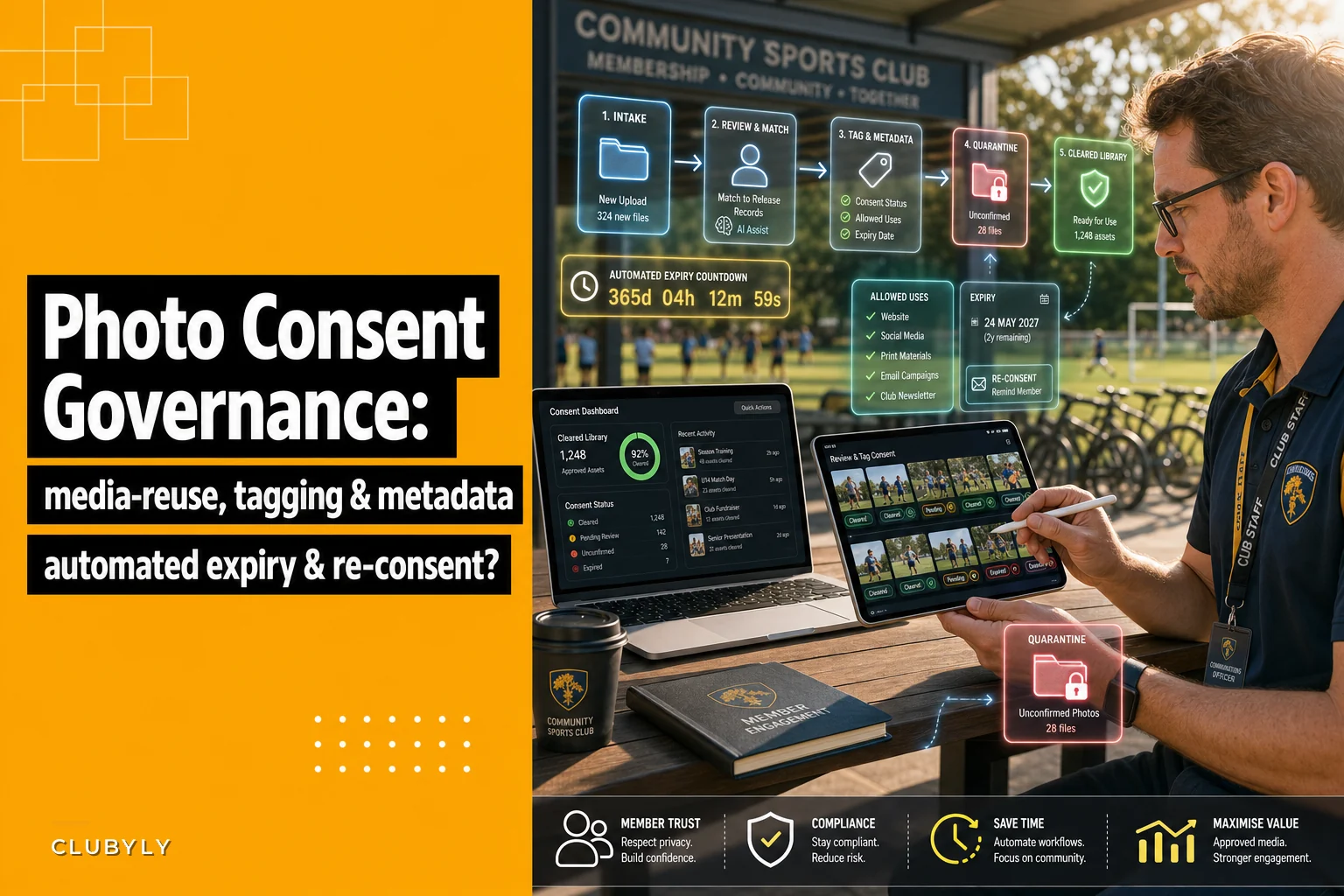
That scramble is exactly what this article is about. Not consent in the abstract — most clubs know they're supposed to get it. The actual operational gap is that photo consent gets collected once, stored badly, and then reused indefinitely with no record of what was actually permitted or when it expired. This is photo consent governance for clubs, and it's one of the most neglected parts of club marketing.
Why this breaks so predictably
Clubs don't fail at photo consent because they're careless. They fail because the consent lives in a completely different place than the images.
The usual shape of it goes like this. At an event, a volunteer has people sign a paper release or check a box on a registration form. Those forms go into a folder somewhere. Meanwhile, the photos go onto someone's phone, then into a shared drive, then into Canva, then into an email newsletter. The two streams never connect. Six months later nobody can look at a photo and answer the only question that matters: do we have permission to use this, for this purpose, right now?
-
Volunteers rotate. The person who collected consent at the spring gala is gone by fall, and so is their mental map of who agreed to what.
-
Photos outlive the consent. A release signed for "the 2023 member directory" quietly gets reused in 2025 ad campaigns because nobody flagged the original scope.
-
Minors and guests. Youth programs, bring-a-friend events, and family days create images where the person photographed never signed anything at all.
-
No expiry mindset. Clubs treat consent as permanent. Members don't. Someone who happily appeared in a 2021 photo might have left on bad terms, started a job where visibility is a problem, or simply changed their mind.
We've written before about how consent workflows and opt-in defaults go wrong across member communications, and image consent is the same disease in a different organ. The data exists somewhere. It's just not attached to the thing it's supposed to govern.
What it actually costs you
The obvious cost is the angry member email. That's annoying but survivable. The real costs are quieter and bigger.
Keep your membership organized and engaged.
Clubyly simplifies member management, event coordination, and payment collection—effortlessly.
- Unified member database
- Automated payment tracking
- Event scheduling & reminders
No credit card required
Reputational drip. A club that reuses a former member's image after they've left looks careless, and in tight-knit membership communities word travels fast. One mishandled photo can sour a dozen relationships.
Legal exposure that scales with your reach. The moment a photo moves from a private recap email to a public ad, a sponsor's materials, or a recruitment campaign, the consent bar rises. Clubs rarely re-check consent when the use changes — and that's exactly where liability sits.
Wasted marketing time. When nobody trusts the archive, every design project starts with a detective phase. A volunteer spends 40 minutes trying to confirm whether five photos are safe to use, gives up, and either uses them anyway (risk) or shoots new ones (cost and delay).
The stock-photo tax. Clubs that get burned once often overcorrect and stop using real member photos entirely. That's a genuine loss — authentic images convert far better in recruitment than generic stock. Bad governance doesn't just create risk, it strips away your best marketing asset.
The core idea: consent has to live *with* the image
The fix isn't a better signature form. It's connecting three things that clubs usually keep apart:
-
The release (what the person agreed to)
-
The image (the actual file)
-
The usage record (where and how you've used it, and until when)
When those three are linked, the detective phase disappears. Anyone on the team can look at a photo and see a plain-language answer: approved for recruitment and social until March 2026, signed consent on file, re-consent reminder set.
Here's how the pieces fit together.
1. Release templates that specify scope and duration
Most club releases are too vague to be useful. "I consent to the use of my likeness" tells you nothing about where or how long. A usable release names the channels and sets a clock.
-
Who signed (name, member ID if applicable)
-
What event or shoot the images came from
-
Allowed uses — pick from a checklist
internal recap, newsletter, public social, website, print brochure, sponsor materials, paid ads
-
Duration — an explicit expiry (e.g. 2 years) rather than "forever"
-
Guardian signature for anyone under 18
-
Withdrawal method — a clear line on how to revoke
The checklist of uses matters more than people expect. A member might happily agree to appear in your newsletter but not in a paid recruitment ad running on Facebook. If your release doesn't distinguish those, you've collected consent that doesn't actually protect you when the use escalates.
2. Metadata and tagging standards so photos are findable and governed
This is the step clubs skip, and it's the one that makes everything else work. Every image in your archive should carry a small set of tags that answer governance questions at a glance.
| Tag field | Example value | Why it matters |
|---|---|---|
| Event / source | "2024 Spring Gala" | Links the image back to the right consent batch |
| Consent status | Confirmed / Pending / None / Withdrawn | The single most important field |
| Allowed uses | Social, Newsletter, Print | Prevents use-creep into channels you didn't clear |
| Expiry date | 2026-05-01 | Triggers re-consent before you're exposed |
| Subjects identifiable | Yes / No / Crowd only | Crowd shots often need less scrutiny |
| Minors present | Yes / No | Flags the highest-risk images |
Even a basic version of this — four tags instead of six — transforms your archive from a liability into something your team can actually trust. The goal is that no one ever has to guess whether a photo is safe.
Make consent status and expiry searchable fields in your archive so reviewers can filter risky images quickly.
3. Archive workflow: one intake path, no side doors
The archive only stays clean if there's exactly one way photos get in. The failure mode is volunteers emailing images directly to each other or dropping them in random folders, where they enter the marketing supply chain untagged.
-
Photos land in one intake folder, not scattered across phones and inboxes.
-
A single reviewer (or small rotating role) matches each batch to its event's consent records.
-
Images get tagged with consent status, allowed uses, and expiry before they're moved to the "cleared" library.
-
Anything without matching consent goes to a quarantine folder — usable only as crowd shots or not at all, clearly labeled.
-
Only the cleared library feeds your newsletters, website, and campaigns.
A simple diagram helps show the intake path.
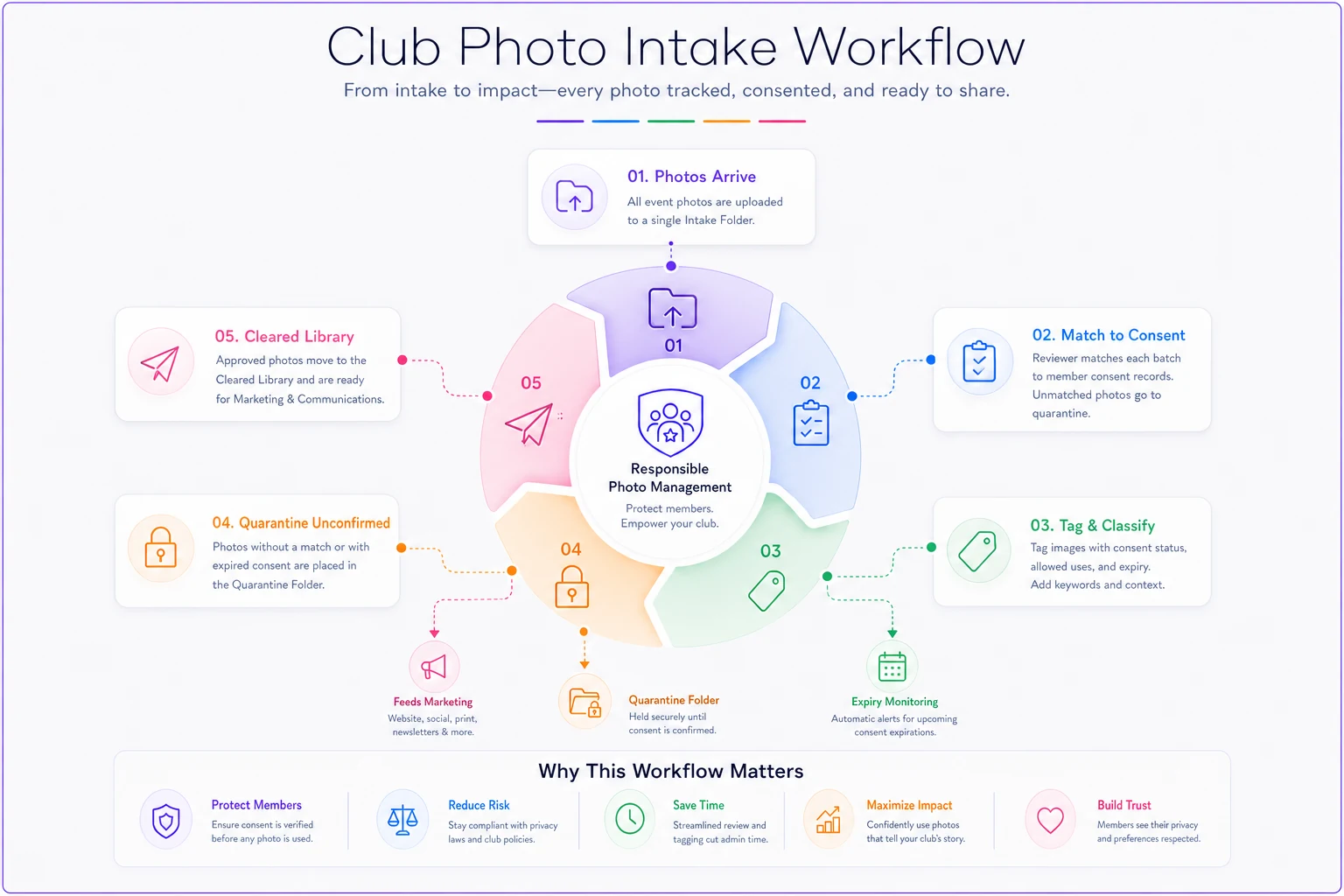
That quarantine step is the unsung hero. It gives you somewhere to put the great photo you can't confirm yet, instead of forcing a yes/no decision in the moment that usually ends with "eh, just use it."
4. Automated expiry and re-consent reminders
Even perfect consent decays. A two-year release signed in May 2024 is worthless in June 2026, and nobody remembers to check. This is exactly the kind of boring, time-based task that gets dropped in a volunteer-run club — and exactly where light automation earns its keep.
The pattern that works: each image's expiry date drives a reminder. Thirty to sixty days before consent lapses, the system flags it and either prompts you to pull the image or triggers a re-consent request to the member. Images that pass their expiry without renewal get moved out of the cleared library automatically.
This is where operational software earns its place in the workflow — not as a flashy feature, but as a reliable clock. Marketing platforms that handle consent tracking can watch expiry dates across your whole archive and surface the ones about to go stale, so a volunteer isn't manually auditing hundreds of photos. The automation isn't doing anything clever. It's just never forgetting, which is precisely the thing humans in rotating volunteer roles are worst at. The same logic applies to broader member data governance that prevents consent headaches — consent is only as good as your ability to track when it runs out.
A real-world example with numbers
Consider a mid-sized hobby club — around 400 members, a handful of signature events a year, run almost entirely by volunteers.
Before any governance system, their process was: photos dumped into a shared Drive after each event, consent forms (when collected) living in a different folder sorted by date, and no link between them. When the membership committee built a recruitment brochure, a volunteer spent the better part of two evenings trying to verify that the 30-odd photos they wanted to use were cleared. They confirmed maybe half, gave up on the rest, and quietly used three photos they weren't sure about. One of those surfaced a complaint from a member who'd left the club months earlier.
After they tightened things up — a scoped release template, six tag fields, a single intake folder, and expiry reminders — the next brochure took one volunteer about an hour to pull cleared images. No detective work. The quarantine folder caught roughly a dozen untagged shots before they ever reached a designer. And because expiry dates were tracked, they proactively pulled around 15 older images whose consent had lapsed, instead of finding out through a complaint.
The headline isn't a huge revenue number. It's that marketing stopped being nervous about its own photo library, and the time cost of every campaign dropped from "a weekend of dread" to "an hour of pulling files."
When this level of rigor makes sense — and when it doesn't
Not every club needs the full system. Be honest about your risk profile.
Worth building if:
-
You run public recruitment or paid ad campaigns using member photos
-
You photograph minors at any events
-
Your images appear in sponsor-facing or print materials
-
You have a growing archive you reuse frequently
You can keep it light if:
-
Your photos only ever appear in internal, members-only recaps
-
You shoot mostly crowd and wide shots with few identifiable individuals
-
Your archive is small and recent enough to hold in one person's head
A brand-new club with 30 members and two events a year doesn't need six metadata fields and automated workflows. Start with a decent release template and one clean folder. Add tagging and expiry tracking when the archive gets big enough that nobody remembers what's in it — which happens faster than most clubs expect.
A quick checklist to put this in place
A quick checklist to put this in place
-
[ ] Replace your vague release with a scoped template (uses + duration + withdrawal method)
-
[ ] Add a separate guardian-signature path for minors
-
[ ] Define 4–6 metadata tags, with consent status and expiry date as non-negotiable
-
[ ] Create one intake folder and one quarantine folder
-
[ ] Assign a single reviewer role to match photos to consent before tagging
-
[ ] Only let the cleared library feed public marketing
-
[ ] Set re-consent reminders 30–60 days before any consent expires
-
[ ] Audit the existing archive once, tagging what you can and quarantining what you can't
Only let the cleared library feed public marketing
The part most clubs get wrong
If there's one thing to fix first, it's the link between the release and the file. Everything else — tagging, workflows, reminders — is downstream of that single connection. A club can have beautifully signed consent forms and still be exposed, simply because no one can look at a given photo and tell you whether it's covered.
Photo consent isn't a legal checkbox you clear once. It's a standing relationship between what your members agreed to and what your marketing actually does with their faces — and that relationship changes every time a member leaves, a consent expires, or a photo jumps from a recap email into an ad. Build the system so that relationship is visible on every image, and the panicked scramble stops happening.
Photo consent isn't a legal checkbox you clear once. It's a standing relationship between what your members agreed to and what your marketing actually does with their faces — and that relationship changes every time a member leaves, a consent expires, or a photo jumps from a recap email into an ad. Build the system so that relationship is visible on every image, and the panicked scramble stops happening.
Ready to streamline your club operations?
Join 500+ clubs using Clubyly to save time, boost member engagement, and grow their communities.