


The treasurer who vanishes mid-fiscal year with all the QuickBooks passwords. The event coordinator who quits three weeks before your biggest fundraiser, leaving behind a folder of vendor receipts and zero context. The board president whose "transition meeting" consists of handing over a USB drive with files from 2018.
This is the reality of volunteer leadership succession in membership organizations—and it's completely preventable with the right operational framework.
Most clubs treat leadership transitions like moving day: throw everything in boxes, hope nothing breaks, figure it out when you get there. Organizations that actually maintain strong operations through leadership changes don't rely on heroic handoffs or institutional memory. They build succession systems that assume people will leave at the worst possible moment.
Why traditional handover approaches fail in volunteer organizations
The standard corporate succession planning model breaks down completely in volunteer-run clubs. You can't promise a six-month transition period when your treasurer has a day job and coaches Little League. You can't require extensive documentation from someone who's already giving you 15 unpaid hours a week. And you definitely can't count on overlap periods when new board members are elected in November but don't start until January.
What usually happens: Sarah runs membership renewals for three years, develops her own spreadsheet system, keeps vendor relationships in her personal email, and stores event photos on her home computer. When she steps down, the new membership chair inherits a Gmail account with thousands of unorganized emails and instructions that say "just ask Sarah if you have questions." Six months later, renewal rates drop 30% because nobody knows which members get the legacy discount or why certain long-time members have special payment arrangements.
The structural problem runs deeper than poor documentation. Volunteer organizations face unique succession challenges:
-
Compressed timelines
Board terms often run just one or two years. By the time someone figures out their role, they're already training their replacement.
-
Skill gaps
Unlike hiring for specific expertise, you work with whoever volunteers. Your next treasurer might be an accountant or might be someone who "is pretty good with Excel."
-
Parallel transitions
Corporate succession usually handles one role at a time. Volunteer boards often see 40–60% turnover simultaneously, creating cascading knowledge loss.
-
Informal knowledge networks
Critical information lives in WhatsApp threads, personal relationships with vendors, and undocumented agreements made three boards ago.
A youth soccer league ran into this head-on. Their entire board turned over after a contentious election. The new team inherited 400 player registrations with no context about which kids had scholarships, which parents were problem cases, and which fields required special insurance riders. They spent the entire spring season in crisis mode, lost two major sponsors, and saw participation drop 25% the following year.
Building role-level SOPs that actually get used
Standard operating procedures for volunteer roles need to look very different from corporate SOPs. Nobody's reading a 40-page manual for a volunteer position. But they will follow a two-page checklist if it keeps them from looking incompetent at their first board meeting.
Keep your membership organized and engaged.
Clubyly simplifies member management, event coordination, and payment collection—effortlessly.
- Unified member database
- Automated payment tracking
- Event scheduling & reminders
No credit card required
Effective volunteer SOPs focus on three things: critical recurring tasks, external relationships, and decision boundaries. Everything else becomes reference material.
Start with the calendar, not the role description. Map every task that happens on a schedule—monthly financial reports, quarterly newsletter deadlines, annual audit prep. For each task, document the minimum: where to find the information, who needs to receive it, what "done" looks like.
A community theater group restructured their treasurer SOP around eight recurring workflows:
-
Monthly venue payment (including the weird prorated calculation for shared spaces)
-
Ticket revenue reconciliation after each show
-
Quarterly tax filings with the specific forms for 501(c)(3) organizations
-
Annual budget presentation to the membership
-
Grant reporting deadlines with required metrics
-
Vendor payment approval process
-
Donation acknowledgment letters for tax purposes
-
Year-end financial audit preparation
Each workflow became a one-page guide with screenshots, not paragraphs. The new treasurer could handle month one without training because the SOP showed exactly which buttons to click.
Make each workflow a one-page guide with screenshots so new volunteers can handle month one without training.
What most organizations miss: SOPs need escape hatches for when things go wrong. Your documentation should explicitly state when to escalate, who can approve exceptions, and what requires board involvement versus individual discretion. Governance mistakes often stem from unclear authority boundaries, and succession planning makes these gaps worse when new leaders don't know their limits.
For external relationships, document the human details that matter. Don't just list "City Parks Department Contact." Explain that Jennifer prefers calls before 10am, that permit applications need two weeks minimum, and that she'll waive the damage deposit if you mention the youth programs. Those details make the difference between smooth operations and constant friction.
Creating handover artifacts that preserve institutional memory
The best handover artifact isn't a binder or a shared drive. It's a living operational record that captures decisions, context, and relationships throughout the year—more like a ship's log than an instruction manual.
Most handover documents fail because they're created at the worst possible time: when someone's already halfway out the door. Build handover artifacts continuously as part of regular operations instead. Every significant decision, vendor interaction, and member issue becomes part of the permanent record.
A rowing club developed what they call "role journals"—running documents where leaders record decisions and context in real-time. Their membership chair's journal includes entries like:
March 15: Waived John Smith's late fee—his wife is undergoing chemo. Board approved via email.
April 2: Negotiated 20% discount with new insurance broker by bundling general liability with D&O coverage. Contact is Mike at 555-0123, best reached Tuesday mornings.
May 8: Three families complained about Sunday morning practice times conflicting with church. Tabled until fall schedule planning.
These aren't polished documents. They're operational notes that preserve the "why" behind decisions. When the new membership chair takes over, they understand not just what was done, but the reasoning and relationships behind it.
The technical setup matters less than the habit. Some organizations use shared Google Docs with commenting enabled. Others use project management tools where decisions get logged as completed tasks with notes. The key is making documentation part of the workflow, not a separate burden piled on top.
Beyond written artifacts, create structural handovers that don't depend on individual availability:
-
Vendor contracts in the organization's name, not individuals'
-
Shared email accounts for each role (treasurer@club.org) that persist across transitions
-
Cloud storage owned by the organization with proper permission inheritance
-
Password managers with role-based vaults that transfer cleanly
One tennis club learned this the hard way after their tournament director kept all sponsor contacts in his personal phone. When he moved out of state unexpectedly, they lost relationships worth around $15,000 in annual funding. Every board role now includes a contact database export as a monthly deliverable, stored centrally.
Designing mentoring overlaps for compressed timelines
The traditional mentoring model assumes months of gradual responsibility transfer. Volunteer organizations rarely get that. You need overlap systems that deliver knowledge transfer in days or weeks, not months.
The most practical approach treats overlap as a series of escalating handoffs rather than a long apprenticeship. New leaders take on specific responsibilities immediately while maintaining access to their predecessor for a defined period.
A practical framework that accommodates volunteer schedules:
-
Week 1–2
Shadow and Access
The incoming leader shadows key meetings and gets system access. This isn't passive observation—they're taking notes, asking questions, and identifying knowledge gaps. The outgoing leader stays fully responsible but narrates their decision-making. -
Week 3–4
Supervised Execution
New leader handles routine tasks with review. They draft the monthly report, but the outgoing leader reviews before sending. They run the committee meeting, but their predecessor sits in to handle unexpected questions. -
Week 5–6
Support on Demand
New leader operates independently with on-call support. The predecessor stays available for specific questions but isn't involved in daily operations. Usually via text or quick calls, not lengthy meetings.
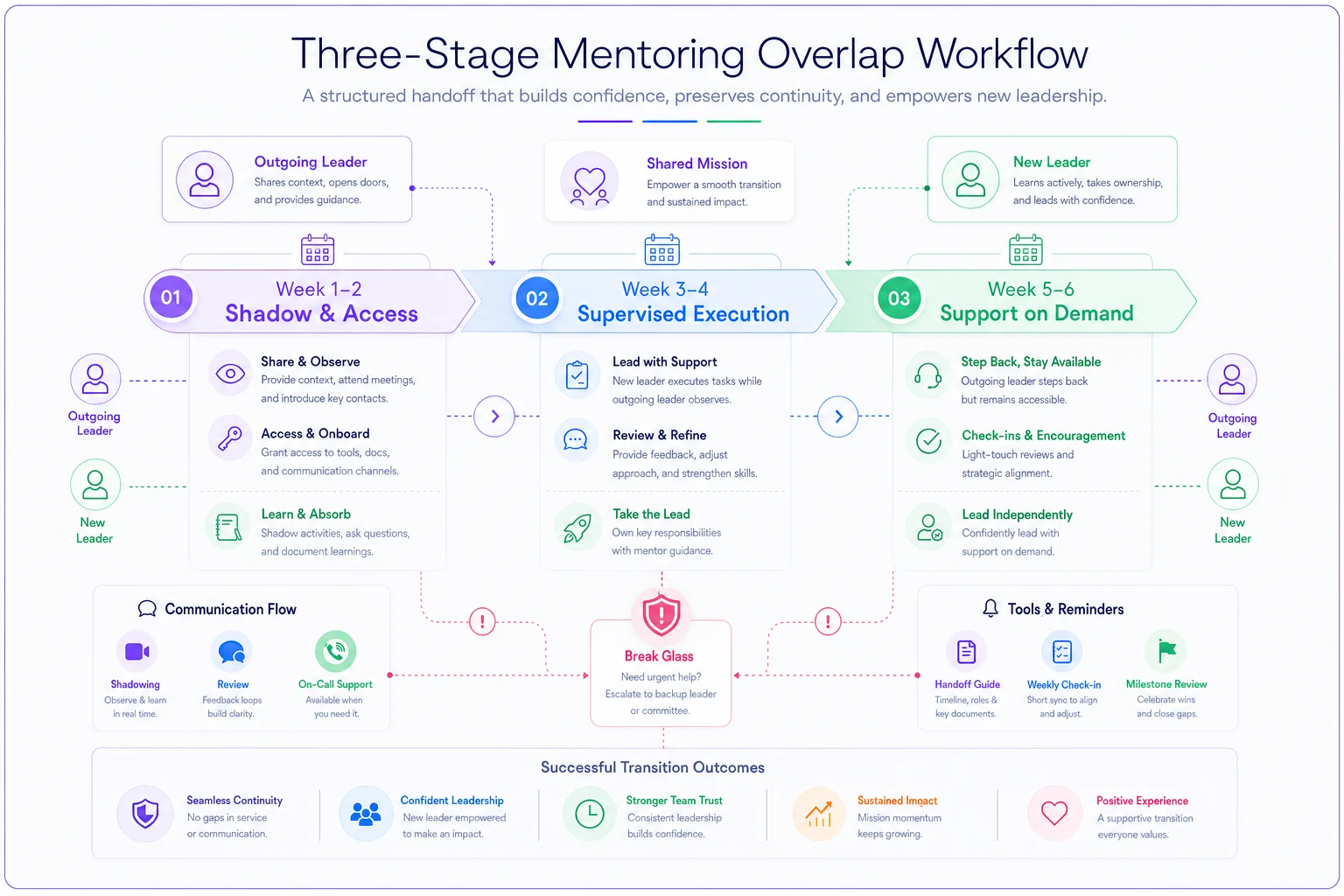
This flow shows the escalating handoffs across the six-week overlap.
A Rotary chapter formalized this with what they call "transition months." November is shadow month for all incoming board members. December is shared responsibility. January starts the new term, but outgoing leaders remain available as advisors through February.
The critical piece: bounded availability. Outgoing volunteers can't be on-call forever, and new leaders need to develop confidence. Set explicit end dates for mentoring support and stick to them.
For sudden transitions, create a "break glass" succession plan. Pre-identify backup contacts for each role—not necessarily successors, but people who understand enough to provide emergency coverage. Your membership chair quits unexpectedly? The designated backup knows enough about the renewal process to keep things running for 30 days while you find a replacement.
Documentation templates designed for 15-minute updates
Nobody maintains documentation that takes hours to update. The most successful succession plans use templates that can be refreshed in the time it takes to drink a cup of coffee.
Start with a role dashboard—a single page capturing the current state of responsibilities. Not a job description. A living snapshot:
-
Treasury Dashboard Example
-
- Current bank balance
$34,560
-
- Outstanding invoices
3 ($2,400 total)
-
- Upcoming payments this month
Rent ($1,200), Insurance ($450)
-
- Key deadlines
Quarterly 990 filing due April 15
-
- Active issues
Investigating $300 discrepancy in March deposits
-
- Waiting on
Board approval for new credit card
-
- Last updated
March 28
This takes five minutes to update during monthly board report prep. It gives an incoming treasurer immediate situational awareness without reading through six months of meeting minutes.
For recurring tasks, use checklist templates that combine instruction with confirmation. Merge the SOP and task tracker into one:
-
Monthly Newsletter Checklist
-
- [ ] Export member email list from database (Members > Reports > Active Emails)
-
- [ ] Upload to MailChimp (Lists > Import > CSV Upload)
-
- [ ] Copy previous month's template (Campaigns > Replicate)
-
- [ ] Update feature article (aim for 300–400 words)
-
- [ ] Add event calendar for next month (Events tab in database)
-
- [ ] Schedule send for first Tuesday, 9am (Campaign Settings > Schedule)
-
- [ ] Post PDF version to website (Newsletter Archive folder)
New volunteers can follow this without training, and completed checklists become audit trails of what got done.
The relationship map might be the most underrated template. A simple spreadsheet with five columns: Contact Name, Organization, Role/Purpose, Best Contact Method, and Notes. Takes minutes to update when you add a new vendor or partner. Saves hours when your successor needs to know who handles permit applications at City Hall.
Critical relationship tracking template:
| Contact | Organization | Purpose | Preferred Contact | Notes |
|---|---|---|---|---|
| Jennifer Wu | Parks Dept | Field permits | Call before 10am | Waives deposit for youth programs |
| Tony's Pizza | Local vendor | Event catering | Text: 555-0111 | 20% nonprofit discount, needs 72hr notice |
| Mark Stevens | Insurance broker | Annual renewal | Email best | Handles claims directly, very responsive |
These templates work because they're operational tools, not compliance documents. People update them because it makes their job easier.
Annual leadership calendars that prevent knowledge gaps
Most succession failures happen around time-sensitive tasks that only come up once a year. The new treasurer doesn't know about the special audit requirements until two weeks before deadline. The membership chair discovers the early-bird renewal campaign after members start complaining about missing discounts.
An annual leadership calendar solves this by mapping every significant deadline, decision point, and recurring task across the full year. Unlike a standard organizational calendar, this one explicitly connects tasks to roles and includes the context needed to execute them.
Month-by-month operational view: Break down each month into role-specific responsibilities. January isn't just "membership renewals"—it's "Membership Chair sends three-email renewal sequence (templates in shared drive), Treasurer processes early-bird discounts (20% off code: EARLY2024), Communications posts renewal reminders on social media weekly."
Decision gates and board approvals: Mark when specific decisions need board input versus individual discretion. "March: Review and approve next year's budget (requires 2/3 board vote), April: Confirm annual meeting date (President decides with input), May: Select audit firm (Treasurer recommends, board approves)."
External deadlines with buffer time: Don't just list when things are due—show when work needs to start. "Tax filing due May 15, prep starts April 1, draft to board by April 20." This prevents the scramble when new leaders discover deadlines too late.
A sailing club built their succession calendar after the commodore position had four turnovers in two years. Each person kept discovering new critical tasks months into their term. Their calendar now includes:
-
January
Insurance renewal negotiation (start November to compare quotes), slip assignment lottery for new members
-
March
Coast Guard safety inspection scheduling, summer instructor hiring
-
June
Municipal dock permit renewal (requires attendance at city council)
-
September
Haul-out schedule coordination with marina, winter storage contracts
-
November
Officer nominations open, budget planning begins
They also added relationship timing. "February: Schedule lunch with Harbor Master (builds goodwill for summer conflicts)." "October: Send thank-you notes to summer sponsors (influences next year's support)."
The calendar doubles as a succession readiness tool. Color-code tasks by complexity: green for anyone can do it, yellow for needs training, red for requires specific expertise. When recruiting new board members, you can honestly show them the commitment level and identify where they'll need support.
Building systems that survive 100% board turnover
The ultimate test of any succession plan: could your organization survive if the entire board resigned tomorrow? Most can't. But organizations with strong operational systems can weather even complete turnover.
This isn't paranoia—it's about building resilient operations that don't depend on individual knowledge. A community garden nonprofit had to learn this after a bitter dispute led to mass resignation. Seven board members quit on the same day, taking with them all knowledge of plot assignments, vendor relationships, and grant obligations.
The solution isn't more documentation. It's operational structure that enforces knowledge sharing. Start by eliminating single points of failure. Every critical system needs at least two people with access and understanding.
Mandatory redundancy in key functions: The treasurer role splits into treasury operations (day-to-day transactions) and financial oversight (reporting and compliance). Both people have full system access but divide regular duties. When one leaves, operations continue without interruption.
Rotating responsibility for recurring tasks: Instead of the same person running every monthly meeting, rotate facilitation. Instead of one person managing all vendor relationships, assign relationship owners with documented backups. This spreads institutional knowledge naturally through normal operations.
Centralized decision logging: Every significant decision gets recorded with three elements: what was decided, why it was decided, and what might trigger a revisit. "Moved monthly meetings to Wednesdays because of facility availability. Revisit if we lose access to community center."
A particularly effective approach is the "shadow board" system—recruit next year's likely leaders to attend this year's meetings as non-voting observers. They see the full cycle of decisions and challenges before taking responsibility. One arts organization requires all board candidates to shadow for at least three months before election. Their succession success rate went from around 60% to 90% after implementing it.
Automating volunteer schedules and rotations becomes critical when building turnover-resistant systems. AI-powered operational platforms can maintain scheduling logic that persists regardless of who's in charge—knowing that facilities need booking six weeks out, that certain volunteers can't work together, and that major events require specific coverage ratios. That operational intelligence survives even complete leadership changes.
The documentation requirements shift too. Instead of comprehensive manuals, focus on decision rules and escalation triggers.
-
Expenses under $500
Treasurer approves independently
-
$500–$2,000
Requires second officer approval
-
Over $2,000
Full board vote required
-
Emergency expenses
President and Treasurer can approve up to $5,000, must report at next meeting
-
Contractual commitments
Always require board vote regardless of amount
This framework operates regardless of who holds each position. New leaders know their authority immediately without studying precedent.
Common succession failure points across organizations
The patterns are remarkably consistent across volunteer organizations.
The knowledge hoarder problem: Usually unintentional, but devastating. One person becomes the go-to for everything—passwords, vendor relationships, historical context. They're helpful, always available, and completely irreplaceable. Until they're not available anymore. The fix isn't replacing them but systematically extracting their knowledge into operational systems before crisis hits.
The relationship dependency trap: Your biggest sponsor only works with Susan. The city permit office fast-tracks requests from Bob. The printer gives discounts because of a personal friendship with the treasurer. Document the value, formalize the arrangements, and introduce successors before transitions happen.
The technology ownership maze: The website domain registered to someone's personal credit card. The membership database in the past president's Google account. Social media pages created with individual profiles instead of business accounts. One tennis club lost their entire member database when a board member's personal Google account got suspended for unrelated reasons.
The compliance knowledge gap: Specific regulatory requirements known only to long-serving board members. The special reporting required for a gaming license. The unusual tax filing triggered by thrift shop revenue. The grandfather clause that exempts the organization from certain municipal requirements. These details vanish with leadership changes, often discovered only after penalties arrive.
The informal agreement amnesia: Handshake deals with venues, verbal commitments to sponsors, understood arrangements with partner organizations. A sailing club discovered they'd been violating a decade-old agreement about beach access hours. The original board knew the restrictions but never documented them. New leaders scheduled early morning events, triggering neighbor complaints and nearly costing the club their lease.
When volunteer leadership succession plans actually work
Success isn't about perfect documentation or lengthy transitions. It's about operational systems that maintain continuity regardless of who's in charge.
A community choir is a clear example. Five years ago, they faced catastrophic turnover when their long-serving music director, board president, and treasurer all left within three months. The organization nearly folded. Today, they're thriving despite continuing to see roughly 40% annual board turnover.
What changed? They stopped trying to transfer knowledge between individuals and started embedding it in operations. Membership renewals run through automated workflows that any volunteer can monitor. Financial reporting generates from templates that enforce consistent formatting. Event planning follows documented decision trees that prevent common mistakes.
They stopped asking "how do we train the next person?" and started asking "how do we make this role trainable in one week?" That constraint forced them to simplify processes, document decisions, and build systematic operations.
Their succession plan now includes:
-
Role handbooks that fit on two pages
-
Monthly documentation updates that take 15 minutes
-
Overlap periods compressed to two weeks
-
Shadow participation three months before election
-
Automated capture of operational decisions
-
Centralized storage of all organizational assets
-
Clear escalation paths for every role
-
Annual calendar with role-specific views
The measurable result: zero service disruptions during leadership transitions, around 30% less time spent on training, and more volunteers willing to take leadership roles because the commitment feels manageable.
Implementing succession systems without overwhelming volunteers
The biggest mistake organizations make: trying to implement everything at once. Volunteers already feel stretched. Adding a complex succession planning system on top of existing responsibilities guarantees failure.
Start with the highest-risk single point of failure in your organization. Usually it's either treasury or membership. Build a minimal succession system for that one role:
-
Two-page SOP for critical tasks
-
Monthly 15-minute documentation update
-
Shared system access with one backup person
-
Quarterly knowledge verification (backup person performs one key task)
Once this works for one role, expand gradually. Add one new role per quarter. By year-end, you've covered key positions without overwhelming anyone.
The implementation sequence matters too. Begin with operational documentation (the "what" and "how"), then add relationship mapping (the "who"), and finally capture decision history (the "why"). This builds the system in order of immediate usefulness.
For resource-constrained organizations, prioritize tools you already have. Google Workspace or Microsoft 365 probably provides everything needed: shared documents, calendars, cloud storage, and basic automation. The sophistication comes from how you organize and maintain information, not from specialized software.
Modern AI-powered operational platforms can make succession planning significantly easier by maintaining institutional knowledge, automatically generating documentation from regular operations, and ensuring consistent processes regardless of who's in charge. Instead of relying entirely on manual documentation efforts, these tools can capture decisions, track relationships, and build succession artifacts continuously through normal workflow. But even without them, the principles still work—the tools just make it faster.
Sustainability matters more than comprehensiveness. A simple succession system that actually gets used beats an elaborate plan that exists only in theory. Aim for 80% coverage of critical knowledge rather than 100% documentation of everything.
Succession as operational resilience
Strong volunteer leadership succession plans aren't about preventing departures—they're about maintaining operational continuity when departures inevitably happen. The best organizations don't treat succession planning as a separate initiative. They treat it as part of building resilient operations.
Organizations that handle transitions smoothly share common traits. They document decisions as they make them. They maintain clear role boundaries with defined escalation paths. They embed knowledge in systems rather than individuals. They treat succession readiness as an ongoing operational requirement, not a crisis response.
Volunteer succession planning also genuinely requires different approaches than corporate transitions. Compressed timelines, skill variability, and limited availability demand streamlined systems that capture essential knowledge without creating unsustainable documentation burdens.
Your next leadership transition is probably closer than you think. The average volunteer board member serves less than three years. Key volunteers often depart with little warning due to job changes, family obligations, or burnout. Building succession systems now, while current leaders are still engaged, prevents the scramble later.
Start small. Pick one critical role. Build a basic succession framework. Test it with a mock transition. Refine based on what breaks. Then expand gradually. Within a year, you can build operational resilience that survives departures that would have previously put the organization in crisis mode.
The goal isn't to eliminate disruption entirely—it's to maintain core operations while new leaders develop mastery. With the right systems in place, volunteer organizations can thrive through transitions that once would have threatened their existence.
Start small. Pick one critical role. Build a basic succession framework. Test it with a mock transition. Refine based on what breaks. Then expand gradually. Within a year, you can build operational resilience that survives departures that would have previously put the organization in crisis mode.
The goal isn't to eliminate disruption entirely—it's to maintain core operations while new leaders develop mastery. With the right systems in place, volunteer organizations can thrive through transitions that once would have threatened their existence.
Ready to streamline your club operations?
Join 500+ clubs using Clubyly to save time, boost member engagement, and grow their communities.