



Most clubs don't plan handovers. They react to them. Someone resigns over a group chat argument, a key volunteer gets a job three states away, or the person holding half the passwords stops answering emails after a falling-out. Suddenly the club is running on borrowed time, and the clock is louder than anyone realizes.
The first 72 hours after a sudden departure decide whether you get a bumpy few weeks or a genuine operational crisis. Miss the payment gateway login before a dues run, and members get double-charged or not charged at all. Lose access to the events calendar and the venue contact, and a booked event quietly evaporates. This isn't about long-term succession planning — that's a different problem for a different day. This is about the emergency window where you have almost no time, almost no documentation, and a volunteer team that already has day jobs.
This playbook is built for that exact window. It assumes you're already behind. It assumes nobody wrote anything down. And it assumes you have maybe two or three people who can spare a few hours over a weekend.
Why the first three days are the dangerous ones
The 72-hour window isn't arbitrary. It's the typical gap between "person left" and "the first automated or scheduled thing they used to handle silently fails."
-
Recurring dues charges that run on a schedule
-
Renewal reminder emails that go out automatically
-
A bank account that needs a signatory to approve transfers
-
A payment processor that locks or emails when login patterns change
-
Vendor invoices with net-30 terms quietly coming due
None of these announce themselves. They just run — until the one time they don't, and there's nobody watching. In real operations, the failure usually isn't dramatic. It's a Stripe payout held because the linked email bounced, or a domain renewal that lapses because the auto-pay card belonged to the person who left.
One pattern worth naming: the more competent the departing person was, the worse the handover tends to be. Highly capable volunteers absorb complexity into their own heads. They stop documenting because they don't need documentation. When they go, all of that context goes with them, and the club discovers it was relying on one person's memory for a dozen small but load-bearing tasks.
Hour 0 to 6: lock down access before you do anything else
The instinct after a departure is to figure out what the person did. That's the wrong first move. The first move is making sure you can still get into everything they touched, because access is the thing that disappears fastest — especially if the departure was tense.
Keep your membership organized and engaged.
Clubyly simplifies member management, event coordination, and payment collection—effortlessly.
- Unified member database
- Automated payment tracking
- Event scheduling & reminders
No credit card required
-
Reset the email and password recovery chain first. Most club accounts recover through one central email. If that email was the departing person's personal address, everything downstream is at risk. Change the recovery email on the club's core Google/Microsoft account to one the remaining leaders control.
-
Secure the money accounts. Log into the bank and payment processor. Confirm you have at least one other authorized user. If you don't, start the process to add one immediately — banks can take days, and you want that clock running now, not later.
-
Check the domain and website registrar. A surprising number of clubs lose their whole web presence because the domain was registered under one volunteer's personal account with auto-renew tied to their card.
-
Rotate shared passwords, not personal ones. Don't lock the person out of things you don't control. Do rotate anything shared: the info@ inbox, social media logins, the membership platform admin account.
A realistic scenario: a running club of about 240 members had their entire dues flow tied to a treasurer's personal PayPal that they'd "just been using for now" for three years. When he left after a board dispute, roughly $2,600 in pending dues sat in an account nobody else could touch. It took them close to five weeks and a small-claims threat to recover it. Six hours of access work at the start would have caught that the money never sat in a club-controlled account to begin with.
Hour 6 to 24: build the emergency backup layer
Once access is stable, the next job is making sure nothing critical lives in only one place anymore. You're not building a perfect archive here. You're building a rough safety net fast.
The mistake most teams make is trying to reorganize everything at once. Don't. In the emergency window, "backed up somewhere the team can reach" beats "organized beautifully." Pull first, sort later.
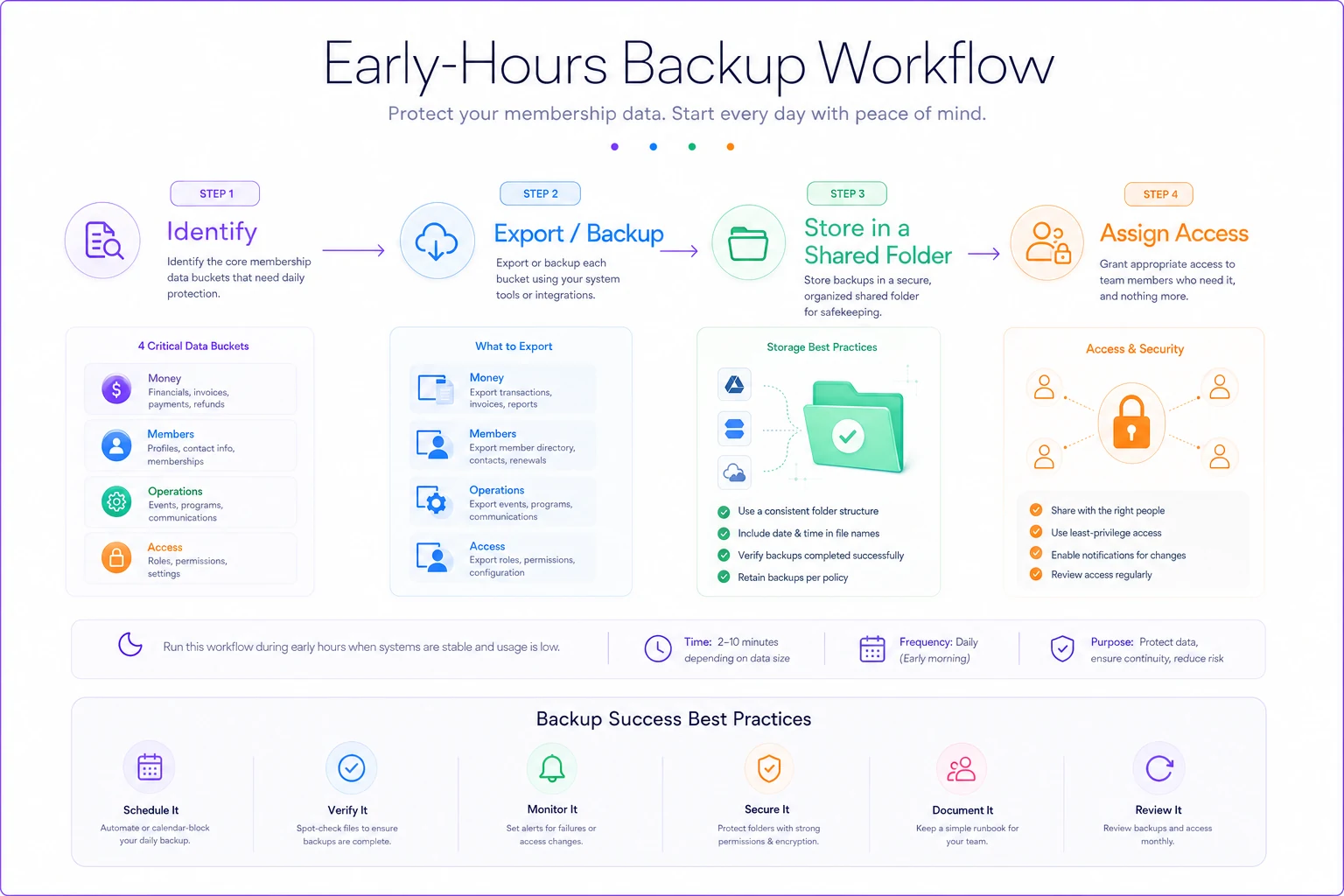
Focus on four buckets:
| Bucket | What to grab | Where it usually hides |
|---|---|---|
| Money | Bank access, processor login, pending payouts, outstanding invoices | Personal accounts, a treasurer's laptop |
| Members | Current roster export, dues status, contact info | One master spreadsheet, the membership platform |
| Operations | Vendor contacts, venue agreements, insurance docs | Email threads, a shared drive nobody uses |
| Access | Password list, recovery emails, admin roles | The departing person's browser, sticky notes |
Export a fresh member roster and dues status the moment you have access — before anything gets accidentally changed or a subscription lapses and wipes data. A CSV sitting in a shared folder is ugly but bulletproof.
Here's a quick visual of the backup workflow for the four buckets.
This is also where centralized systems quietly earn their keep. Clubs that already run their membership, dues, and vendor records through a single operational platform instead of scattered spreadsheets and personal inboxes have a much easier 24-hour window, because the backup already exists and access is a matter of changing an admin role, not hunting through someone's Gmail. That's not a pitch to go buy something in the middle of a crisis — it's just an observation about which clubs sail through handovers and which ones scramble. The scramblers are almost always the ones where critical info lived in one human's head and one human's laptop.
Hour 24 to 48: the quick documentation templates
By now access is secure and you've grabbed the essentials. The next 24 hours are about writing down just enough so the next person — or the temporary stand-in — can function. Not a manual. A survival guide.
Keep every template to a single screen. If it doesn't fit on one page, nobody in a volunteer club will read it, let alone maintain it.
Template 1 — The Access Sheet One row per account: name of service, what it's for, who has admin access now, and how recovery works. That's it. No passwords in the doc itself — point to wherever you store them securely.
Template 2 — The Recurring Tasks Card List anything that happens on a schedule and would break if ignored:
-
Dues run
when it happens, how it's triggered, what to check afterward
-
Renewal reminders
automatic or manual, who owns them
-
Monthly financial reconciliation
what "done" looks like
-
Any recurring vendor payment or subscription
Template 3 — The "If This Breaks" Sheet The most valuable and most-skipped document. Three columns: what could break, how you'd know, who to call. This is where you capture the tribal knowledge — "if the payment portal shows a red banner, it's usually the expired card on file, email this person at the processor."
Template 4 — The Handover Note A short plain-language summary from whoever's stepping in temporarily: what's stable, what's fragile, what needs a real decision in the next month. Two paragraphs is fine.
One thing most clubs miss: documentation written during a crisis is often more useful than documentation written in calm times, because you only write down what actually matters. The panic filters out the fluff. Capture it while the pressure is on, then clean it up later.
Hour 48 to 72: assign, communicate, and stabilize
Assign temporary owners, even imperfect ones. Every critical task needs a name next to it — not a committee, a person. "The board will handle finances" means nobody handles finances. "Priya watches the dues run and the bank until we recruit a treasurer" is a real answer.
Communicate deliberately, and less than you think. Members don't need to know the internal drama. They need to know their dues, events, and membership are unaffected. A short, calm message — "we've had a leadership transition and everything is running normally" — prevents the rumor spiral. Over-explaining a departure almost always backfires.
Set a review date. Put a hard date roughly two to three weeks out to check whether the temporary setup is holding. This prevents "temporary" from silently becoming "permanent and undocumented," which is how you end up right back in this situation next year.
The immediate action checklist
-
- [ ] Change recovery email on the core account
-
- [ ] Confirm a second authorized user on bank and payment processor
-
- [ ] Check domain/website registrar ownership and renewal
-
- [ ] Rotate all shared passwords
-
- [ ] Export a fresh member roster and dues status to a shared folder
-
- [ ] Screenshot pending payouts and outstanding invoices
-
- [ ] Fill the Access Sheet and Recurring Tasks Card
-
- [ ] Assign a named temporary owner to each critical task
-
- [ ] Send one calm, minimal member communication
-
- [ ] Set a 2–3 week review date
Print this. Use it the day someone leaves.
A real scenario: the community garden club that lost its organizer
A community garden club — around 180 members, all-volunteer, dues of about $35 a year — lost its long-time coordinator with almost no notice when she moved for family reasons. She'd run everything: the plot assignments, the dues collection through a personal Venmo, the email list, and the water-utility account under her name.
The first weekend was chaos. Nobody could reach the utility company because the account was personal. Roughly 40 renewal payments went to a Venmo the board couldn't access, and about $1,400 sat in limbo for a few weeks. Two members nearly lost plots because the only assignment record was a spreadsheet on the coordinator's home laptop.
What actually saved them was boring: one board member spent a Saturday doing exactly the access-first sequence above. They got the utility account transferred by proving the club paid the bills, recovered the member list from an old email export, and set up a shared club account for dues going forward. Within about three weeks they'd moved from "one person holds everything" to "three people share the load with everything written down." The recovered Venmo money took closer to six weeks, but nobody lost a plot, and the following year's transition — when a new coordinator rotated in — took an afternoon instead of a month.
When a 72-hour scramble is the wrong approach
This playbook is for emergencies. If you have any warning at all, don't use it — do a planned handover instead. A rushed access-and-document sprint creates real risk: you rotate a password someone still needed, you miss a recurring task nobody remembered, you communicate something to members you later regret.
If a departure is coming in a month, you want overlap and mentoring, not a fire drill. The whole point of building a proper succession system with SOPs and mentoring overlaps is so you never end up in a 72-hour window in the first place. And if the departure is a symptom of deeper problems — burnout, conflict, unclear authority — patching the handover won't fix the root cause. A lot of these sudden exits trace back to governance mistakes that were building quietly for months.
The one habit that makes all of this unnecessary
Every step in this playbook exists because information lived in one person's head and one person's accounts. The clubs that handle handovers easily aren't smarter or better resourced — they just never let a single volunteer become a single point of failure.
You don't need a formal continuity plan that runs dozens of pages. You need three things maintained on an ongoing basis: a current access sheet, a fresh data export, and a named backup for every critical task. Keep those three things alive, and a departure that would've been a three-day emergency becomes a Tuesday-afternoon inconvenience.
Ready to streamline your club operations?
Join 500+ clubs using Clubyly to save time, boost member engagement, and grow their communities.