

There's a specific moment that tells you your volunteer onboarding is broken. It's 6:45pm, your event starts at 7, and someone is standing at the registration table holding the card reader like it might bite them. Nobody told them how to process a tap payment. Technically they were "trained" — someone walked them through it three weeks ago during a 40-minute group session where half the room was checking their phones.
That gap between "attended training" and "can actually do the task unsupervised" is where most clubs quietly lose hours every single week. Not because volunteers are unwilling, but because nobody ever confirmed they could do the thing before handing them the shift.
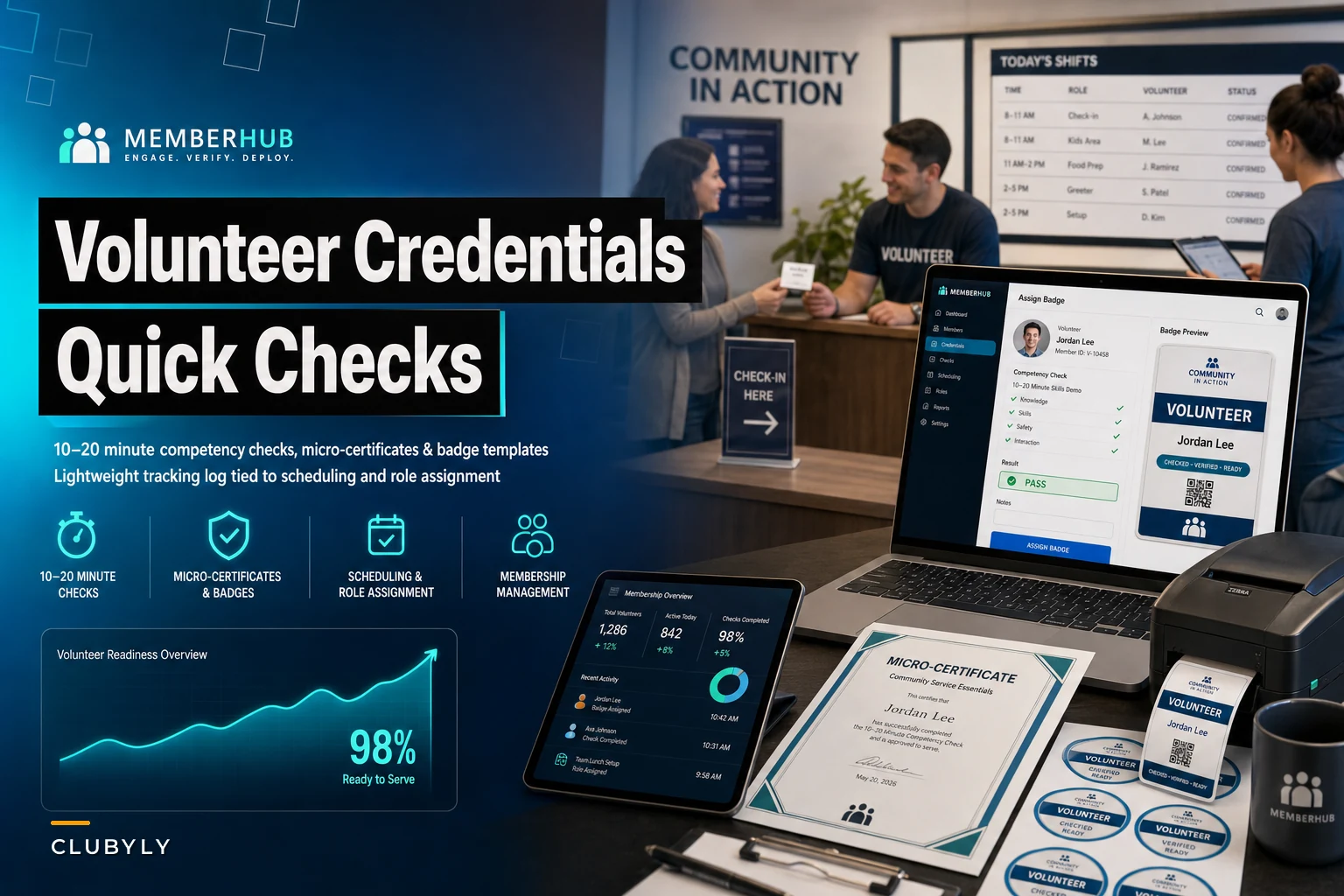
Micro-certification fixes this. Not the corporate LMS version with modules and quizzes nobody finishes — the lightweight version: a 10–20 minute competency check, a small badge, and a log that tells your scheduler who's cleared for what. That's it. This post is about building that system without it becoming another thing you have to maintain.
Why "they went to training" tells you almost nothing
Group training sessions measure attendance, not ability. Those are completely different things, and clubs treat them as the same all the time.
Here's the mechanical reason it fails. In a group session, one or two confident people answer every question, demonstrate every task, and everyone else nods along. The quiet volunteer who's never touched a Square reader watches someone else do it, thinks "okay, got it," and leaves without ever having done it themselves. Three weeks later they're on their own at the table, and the knowledge was never actually theirs.
A competency check flips the burden of proof. Instead of "did you sit through the explanation," it asks "can you do this right now, in front of me, start to finish." That's a much harder thing to fake, and it takes way less time than people assume.
The pattern across volunteer-heavy organizations is pretty consistent: clubs drowning in supervision load are almost always the ones certifying by attendance. The clubs running smooth shifts are the ones who, somewhere along the way, started checking the actual skill.
What a 10–20 minute competency check actually looks like
The whole point is speed. If a check takes 45 minutes to run, nobody runs it, and you're back to attendance-based guessing. So you design each check around a single, observable task that someone either can or can't complete.
Keep your membership organized and engaged.
Clubyly simplifies member management, event coordination, and payment collection—effortlessly.
- Unified member database
- Automated payment tracking
- Event scheduling & reminders
No credit card required
A good competency check has four parts:
-
A clear task — "Process a $25 card payment, issue a receipt, and void a mistaken charge."
-
A pass condition — specific and binary. They did it unassisted or they didn't.
-
A failure recovery step — what you tell them if they miss, so the check doubles as teaching.
-
A time box — most checks should fit in 10–15 minutes. Complex ones (running the AV setup solo) might stretch to 20.
No written quiz. For operational roles, watching someone do the task once is worth more than ten multiple-choice questions. You're not testing whether they remember the policy — you're testing whether they can execute it when it's 6:45 and the line is forming.
Here's a rough breakdown of how different roles map to check formats:
| Volunteer role | Check format | Time | Pass condition |
|---|---|---|---|
| Registration / check-in | Live demo | 10 min | Process payment + handle a no-record attendee |
| AV / tech setup | Live demo | 20 min | Boot system, connect mic, fix one planted fault |
| Greeter / floor | Verbal walkthrough | 10 min | Explain escalation path + locate exits |
| Social media poster | Supervised live post | 15 min | Publish on-brand post, apply consent rules |
| Cash/float handling | Live demo + count | 15 min | Reconcile a float accurately twice |
The "planted fault" trick for the AV check is worth stealing. You intentionally leave one cable unplugged or one input on the wrong channel. If they catch and fix it, you know they actually understand the setup instead of following a memorized sequence. That single detail separates "can set up when everything's perfect" from "can set up on a real event night when something's always slightly wrong."
Micro-certificates and badges: keep them dumb-simple
The badge is not the point. The badge is a lookup token. Its only job is to let anyone — especially your scheduler — instantly answer "is this person cleared for this task?"
Don't overbuild this. A micro-certificate for a single competency needs maybe five fields:
-
Volunteer name
-
Competency name (e.g., "Registration Desk — Payments")
-
Date cleared
-
Who ran the check
-
Expiry or review date
Whether you render it as a digital badge image, a row in a tracking sheet, or a tag on a volunteer's profile doesn't matter operationally — what matters is that it's queryable and has an expiry.
The expiry is the part people skip, and skipping it is a mistake. A volunteer who ran registration flawlessly 14 months ago may never have touched the current card reader, because you switched vendors in between. Competencies decay, equipment changes, policies update. A badge with no expiry slowly becomes a lie. A 6–12 month review window works for most cases, depending on how often the task changes and how regularly the person actually does it.
A simple badge template you can copy
COMPETENCY: Registration Desk — Payments HOLDER: [name] CLEARED: 2026-03-14 VERIFIED BY: [checker name] REVIEW BY: 2026-09-14 NOTES: Cleared on new Square terminal. Comfortable with voids.
Keep the notes field. It's where you record the thing a pass/fail can't capture — "a little slow on voids, pair with experienced person first shift." That one line saves your floor lead a headache down the road.
The tracking log is where this actually pays off
A pile of badges with nowhere to look them up is useless. The tracking log is the connective tissue — it ties competency to scheduling and role assignment, which is the whole reason you're doing any of this.
The log should answer three questions at a glance:
-
Who is cleared for which competencies right now?
-
Whose certifications are about to expire?
-
For any given shift, do I have at least one cleared person per critical role?
That third question is the one that quietly prevents disasters. When you're building a schedule and the system (or the sheet) can flag "this Saturday event has no cleared cash-handler assigned," you fix it on Tuesday instead of discovering it at 6:45pm.
This connects directly to how you build rosters. If you've already set up rotation, backfill and reminder rules for volunteer schedules, competency tags slot right in as a constraint — you're not just filling a slot, you're filling it with someone who's actually cleared for it. Backfill logic gets smarter too: when someone drops, the system looks for a replacement who holds the same badge, not just anyone who's free.
Here's the workflow in plain terms:
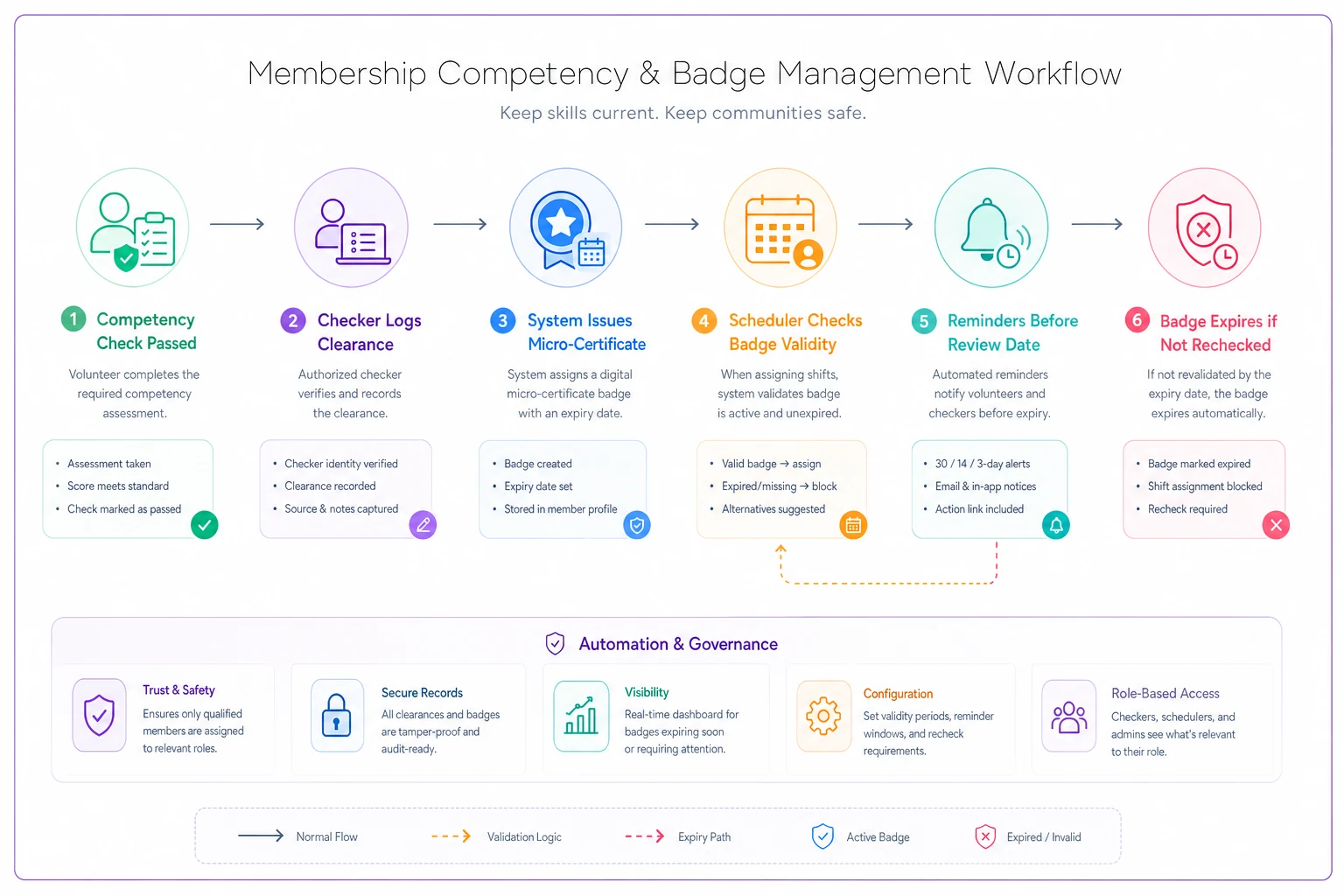
A volunteer passes their registration-desk check. The checker marks them cleared in the log, which sets a review date six months out. When you schedule the next event and assign them to the desk, the roster confirms their badge is valid. Two weeks before their review date, a reminder fires so you can re-check them before the badge lapses. If they never get re-checked, the badge expires and the scheduler stops offering them that role automatically. No supervisor has to remember any of this.
That last part is where a proper operations platform earns its keep — not by replacing the human judgment of the competency check itself, but by handling the tedious tracking, expiry reminders, and "is this person cleared for this slot" cross-referencing that nobody wants to do manually in a spreadsheet at midnight.
A real scenario: the Saturday market stall
A community food club ran a weekly market stall — roughly 50–60 transactions per Saturday, plus setup, float handling, and a produce-weighing station. They rotated through around 18 volunteers.
The problem was consistency. Because they certified by "came to the spring training day," the quality of any given Saturday depended entirely on who showed up. Good weeks were smooth. Bad weeks had miscounted floats — they were coming up short $15–$40 some weeks with no clear cause — slow lines, and the stall coordinator spending the whole morning hovering over the till instead of doing her own job.
They introduced three competency checks: payments, float reconciliation, and produce weighing. Each ran under 15 minutes. Over about a month they re-checked everyone. Eleven passed all three on the first attempt; the rest needed a second go at float reconciliation specifically, which told them exactly where the real weakness was.
The float shortages mostly disappeared once only cleared people handled cash. The coordinator stopped shadowing the till and got her Saturdays back — she figured she reclaimed close to two hours every market day. And new volunteers now get cleared in a single 20-minute session before their first solo shift instead of being thrown in and corrected live in front of customers.
Nothing fancy happened. They just stopped assuming attendance meant ability and started checking.
When this makes sense — and when it doesn't
Micro-certification is worth the setup when:
-
You have recurring operational tasks where mistakes are visible or costly (payments, safety, equipment).
-
Supervision load is eating your lead volunteers' time.
-
You rotate through enough volunteers that you can't personally remember who knows what.
It's probably overkill when:
-
Your tasks are genuinely trivial and self-correcting (stacking chairs, handing out flyers).
-
You have a tiny, stable crew of five people who've all done everything for years and you already carry the whole competency map in your head.
One honest warning: don't certify things that don't need certifying. The fastest way to kill this system is to create 15 badges for a 20-person club. You'll spend more time maintaining the framework than it saves. Start with your two or three genuinely critical tasks — the ones where a mistake costs money, safety, or reputation — and expand only if there's a clear reason.
Fitting checks into recruitment without scaring people off
There's a legitimate worry here: will competency checks make volunteering feel like a job interview and put off casual helpers? It can, if you frame it wrong.
The trick is to position the check as part of the role, not a hurdle before it. When someone signs up for a specific task, the check is simply "the last 15 minutes of your first session where we make sure you're set up to succeed." Framed that way, most volunteers actually appreciate it — nobody enjoys being thrown onto a live till with no confirmation they're ready.
This pairs naturally with how you structure intake. If you're already using short role packs and micro-task trials in your recruitment funnel, the competency check is just the graduation step from "trying it out" to "cleared and scheduled." The trial shows them whether they like the task; the check confirms they can do it. Those two things working together turn a vague sign-up into a reliable, slot-ready volunteer.
Where most clubs go wrong
A few patterns worth avoiding, because they're the ones that quietly sink these systems:
-
Making checks too hard. A competency check is pass/fail on a real task, not an exam. If your first-attempt pass rate is below 60%, the check is probably testing edge cases instead of core competence.
-
Not logging who ran the check. When something goes wrong later, you want to know who cleared the person — not to blame them, but to calibrate your checks.
-
Letting badges never expire. Already covered, but it's the most common failure. A certification system with no decay is just a graveyard of old assumptions.
-
Certifying people, not tasks. "Trained volunteer" is meaningless. "Cleared for payments and float handling" is useful. Keep competencies granular and task-specific.
Keep competencies granular and task-specific.
The real win here isn't the badges or the log. It's that you stop guessing. Right now, a lot of clubs run every shift on a quiet hope that whoever shows up actually knows what they're doing — and they find out they were wrong at the worst possible moment.
A 15-minute competency check moves that discovery to a controlled moment, before the shift, where a miss costs nothing. Tie it to a badge, tie the badge to an expiry, and tie the whole thing to your scheduling so the roster itself refuses to put an uncleared person in a critical role. Do that for your two or three most important tasks, and the supervision load that's been eating your lead volunteers' evenings starts to shrink — not because people got better overnight, but because you finally built a way to know who's ready before the doors open.
Ready to streamline your club operations?
Join 500+ clubs using Clubyly to save time, boost member engagement, and grow their communities.