
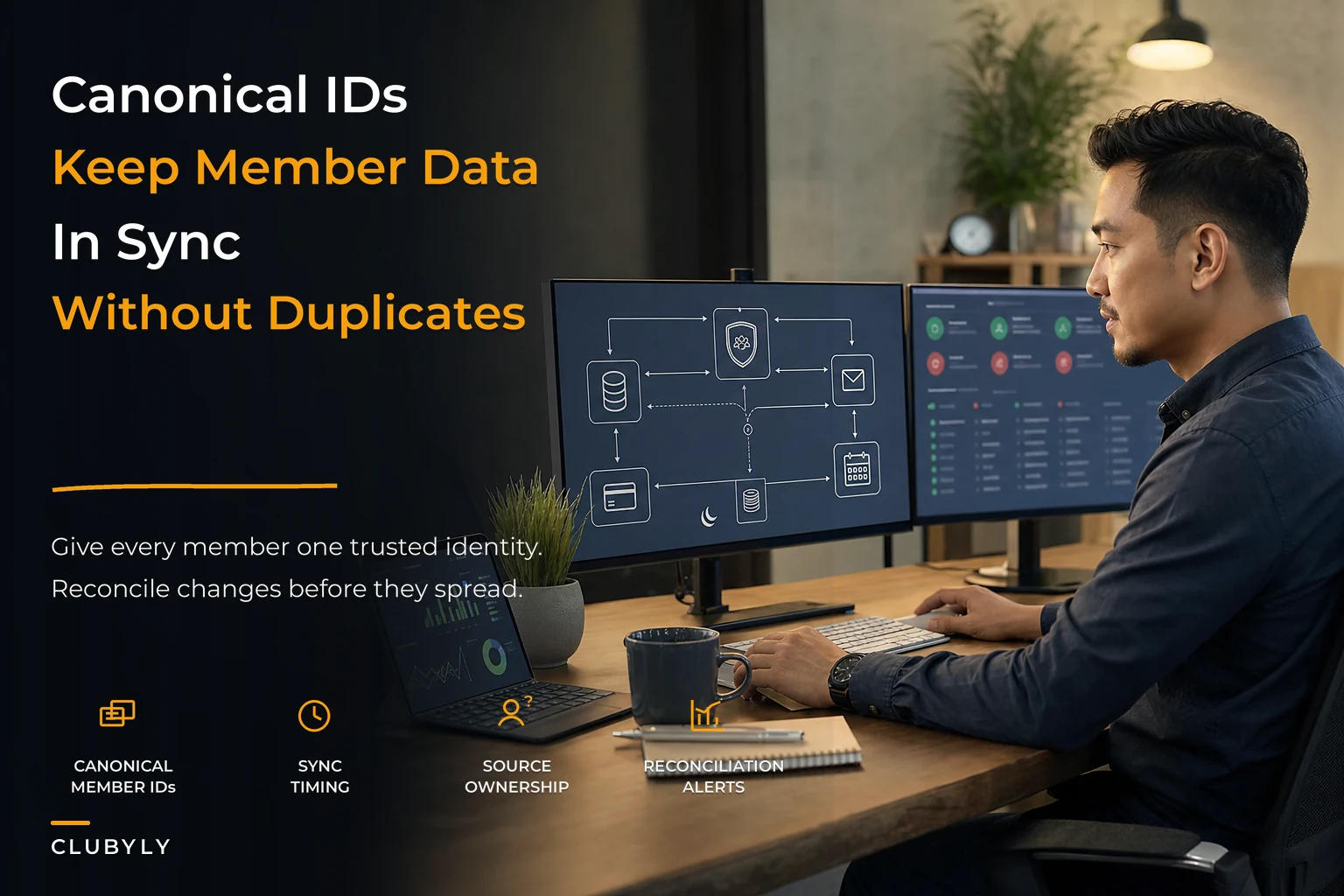

Most membership messes don't start with bad data. They start with duplicate data that nobody agreed was duplicate. Your event platform thinks "J. Rivera" and "Jessica Rivera" are two people. Your email tool imported a spreadsheet from 2022 that still lists her old address. The payment processor has her under a work email she stopped using. Each tool is internally consistent and externally wrong, and the club has no single place that says this is her, this is the authoritative version, everything else points here.
That missing piece is the canonical ID. For a club running on three to six integrated tools, getting the membership canonical id architecture right is the difference between a directory you trust and one you quietly stop trusting — which is exactly how most clubs end up back in spreadsheets.
This isn't a theory piece. Below is a minimal, club-sized topology you can actually implement: which system owns the truth, how often things sync, how to decide when two records are the same person, and — the part everyone skips — how to roll back and reconcile when the sync inevitably does something dumb at 2am.
Why identity breaks in small clubs specifically
Big organizations have an MDM (master data management) team. You have a volunteer treasurer and a part-time admin who both think their tool is the source of truth. That disagreement is the whole problem.
The pattern that keeps coming up: a club adopts tools one at a time, over years, never as a system. Eventbrite came first because someone needed ticketing. Mailchimp came because someone wanted a newsletter. Stripe came when dues went online. Each one became a de facto member database, and now you have four member databases that disagree about who exists and how to spell their name.
What makes clubs different from businesses is volume versus churn asymmetry. You might only have 400–900 members, which feels small enough to manage by hand. But members join through events before they ever pay dues, change emails constantly, get added by well-meaning volunteers at signup tables, and come back after lapsing. Small dataset, high mutation rate, no engineering team watching it. That combination is exactly where identity drift hides.
The symptom everyone eventually notices: you send a renewal reminder to someone who renewed last week, or you count 612 "active members" in one tool and 548 in another, and the board asks which number is real. Nobody can answer confidently. That's an identity architecture failure, not a reporting failure.
The minimal topology: pick one authoritative source, make everything else downstream
The single most important decision is choosing your system of record — the one place that holds the canonical ID and the authoritative version of each member. Everything else becomes a subscriber that receives identity, not a place that creates it.
Keep your membership organized and engaged.
Clubyly simplifies member management, event coordination, and payment collection—effortlessly.
- Unified member database
- Automated payment tracking
- Event scheduling & reminders
No credit card required
For most clubs, the right system of record is your membership/CRM tool (or your database if you've migrated off spreadsheets — if you haven't, that's the prerequisite, and the risk-minimizing migration playbook covers how to get there without blowing up your live data).
The canonical ID itself should be a stable, meaningless string. Not the email. Not the name. Not the phone number. All of those change. Use something like MBR-00428 or a UUID — something assigned once that never changes even if every other field on the record does. Email is a lookup key, not an identity.
| Data field | Authoritative source | Everything else... |
|---|---|---|
| Canonical member ID | Membership CRM | reads it, never writes it |
| Legal/display name | Membership CRM | subscribes |
| Primary email | Membership CRM | subscribes (email tool does NOT own this) |
| Payment status / dues paid | Payment processor | writes back to CRM |
| Event attendance | Event platform | writes back to CRM |
| Consent & communication prefs | Membership CRM | per your data governance rules |
The rule that prevents most of the chaos: a field can only be owned by one system. The payment tool owns "did they pay," the CRM owns "who they are." When your email platform lets a member update their own address through a preference center, that change has to flow back to the CRM first and then out again — not sit only in the email tool where the CRM never learns about it.
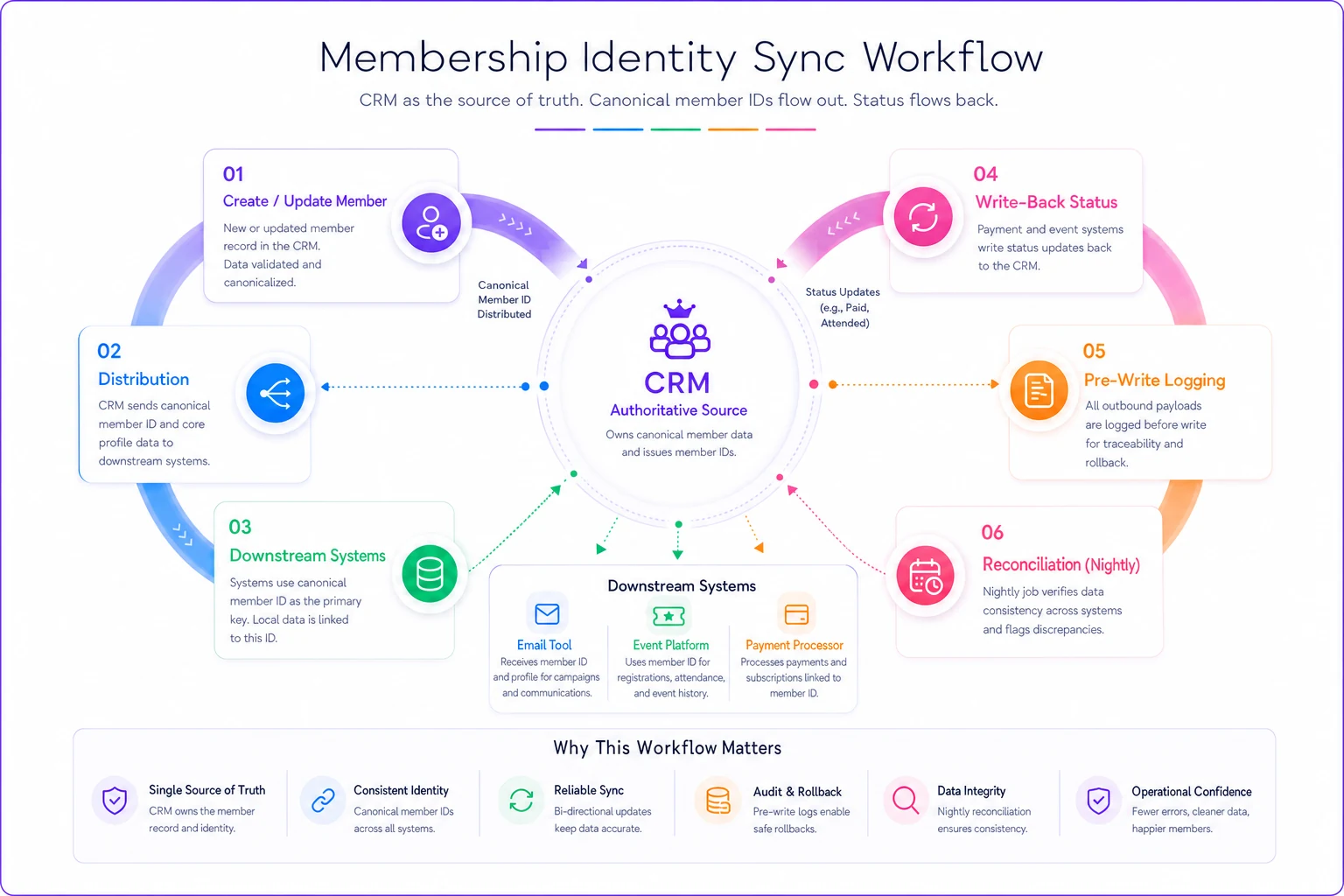
A visual of this flow helps volunteers see why the CRM matters: one source of truth, many subscribers, a small set of writebacks, and a nightly reconciliation loop.
Sync timing: slower than you think, and that's correct
New implementers almost always reach for real-time sync everywhere. Don't. Real-time sync multiplies the blast radius of every mistake, and for a club it buys you nothing. Nobody is harmed if an email address propagates in 15 minutes instead of 2 seconds.
A sane cadence for club-sized systems:
-
Identity changes (name, email, new member) batch sync every 15–30 minutes, CRM → everything else
-
Payment events near-real-time into the CRM (so renewals reflect fast), because this is the one place members notice delay
-
Event attendance daily batch, usually overnight
-
Full reconciliation pass nightly, compares all systems against the CRM and flags mismatches
The reason to batch most things is recoverability. A 20-minute batch window gives you a natural checkpoint. If a volunteer accidentally bulk-edits 200 records, you want that caught at the next batch boundary and held for review — not splattered across five tools instantly.
make every sync log before it writes.
One pattern worth stealing: make every sync log before it writes. Each batch should record what it's about to change before it changes it. That log is your rollback tape. Clubs that skip this always regret it the first time a sync goes sideways, because they have no idea what the records looked like beforehand.
Dedupe rules you can actually defend
Deduplication is where good intentions produce catastrophic merges. The failure mode: an aggressive auto-merge combines two different people because they share a common name, and now you've mixed one member's payment history with another's attendance, and un-merging is brutal.
-
Auto-merge only on exact match of a strong key — same verified email, OR same canonical ID. Nothing else auto-merges.
-
Flag for human review on fuzzy matches — same name + same phone, or same name + same postal address. These go into a review queue, not a merge.
-
Never match on name alone. "Chris Taylor" is not evidence of anything. In a 700-person club you probably have two.
When you do merge, the canonical ID of the older, more active record wins, and the merged record keeps a note of the absorbed ID so nothing orphans. Keep the losing ID as an alias pointer rather than deleting it — old event links and payment receipts may still reference it.
A realistic example of this going wrong: a regional hobby club with around 740 members ran a naive dedupe that matched on name similarity. It merged roughly 30 record pairs overnight, 4 of which were genuinely different people. The treasurer spent most of a weekend untangling who actually owed dues. Had those fuzzy matches gone to a review queue instead of auto-merging, a volunteer would've cleared the real duplicates in about 20 minutes and caught the 4 false matches right away.
Rollback recipes: what to actually do when sync misbehaves
This is the section almost every integration guide omits, and it's the one you'll actually need. Here are concrete recipes you can adapt.
Recipe 1 — Bad bulk identity change (someone edited many records wrong):
-
Pause all outbound syncs from the CRM (stop propagation first, always).
-
Pull the pre-change snapshot from your sync log for the affected batch.
-
Restore the affected fields from the snapshot into the CRM.
-
Run a single targeted re-sync of only those member IDs downstream.
-
Resume normal sync.
Recipe 2 — Duplicate explosion (a reimport created hundreds of dupes):
-
Pause syncs.
-
Identify the import batch ID (always tag imports with a batch ID — this is why).
-
Soft-delete the imported records, don't hard-delete; mark them
quarantine. -
Reconcile quarantined records against existing members before deciding what's genuinely new.
-
Promote the truly-new ones, discard the rest.
Recipe 3 — Downstream drift (email tool and CRM disagree and you're not sure which is right):
-
Trust the CRM by definition, because you decided it's authoritative. Overwrite the email tool from the CRM, not the reverse. The entire point of naming an authoritative source is so you never have to adjudicate this in a panic. If the CRM was the one that was wrong, Recipe 1 applies.
The meta-rule across all of these: pause propagation before you fix anything. The instinct is to fix the data fast. The correct move is to stop the bleeding first so your fix doesn't itself get synced into a worse state.
Reconciliation queries every club should run nightly
You don't need a data warehouse. You need a handful of comparison checks that run against your CRM and each connected tool and surface mismatches. These are the ones that catch real problems:
-
Orphan check members in the email tool or payment processor that have no canonical ID in the CRM. These are identities that leaked in without going through the front door.
-
Count drift check active member count in the CRM vs. each downstream system. Any gap over a small threshold (say, 2–3%) gets flagged.
-
Email mismatch check records where the downstream email differs from the CRM's authoritative email — tells you where member self-edits bypassed the system of record.
-
Payment-without-identity check payments in Stripe not linked to a canonical ID. These are the ones that quietly become "who paid this?" mysteries at renewal time.
-
Stale consent check flag members whose communication preferences in a tool don't match the authoritative consent record — this ties directly into keeping your governance clean.
Run these overnight, write results to a simple table with a date stamp, and you've built yourself a trend line. The day the orphan count jumps from 3 to 40, you know something upstream broke that day, not three weeks later when a member complains.
Volunteer-friendly monitoring: dashboards a non-technical board member can read
The hard truth about club tooling: if the person watching the dashboard needs a data background, nobody watches it. Your monitoring has to be legible to a volunteer who checks it once a week between a day job and dinner.
-
Members in sync — a single big number and a green/yellow/red state. Green means all systems agree within threshold.
-
Open review queue — how many fuzzy-match duplicates are waiting for a human. If this climbs past ~15, someone needs to spend 20 minutes clearing it.
-
Last successful reconciliation — a timestamp. If it's older than 36 hours, something's stuck.
-
Orphan count trend — the one leading indicator that catches integration breakage early.
For alerts, resist the urge to alert on everything. Alert fatigue kills volunteer-run monitoring faster than anything. A workable alert set:
-
Red alert (someone gets a text/email now) reconciliation hasn't run in 36+ hours, OR orphan count jumped more than 10 in a day, OR an auto-merge touched more than 5 records (that should basically never happen).
-
Weekly digest (no urgency) review queue size, count drift summary, any mismatches cleared that week.
Two alert tiers. If a volunteer gets a red alert, it genuinely means stop and look. Everything else waits for the weekly digest.
Where lightweight automation actually earns its place
Everything above can run on manual batches and a volunteer checking a dashboard — and for the smallest clubs, it should. But the reconciliation passes, the pre-write logging, the review-queue routing, and the nightly comparison queries are exactly the kind of repetitive, rule-based work that AI-assisted operational platforms handle without a volunteer babysitting them.
The practical win isn't "AI runs your club." It's narrower than that: a workflow platform with AI automation can run the nightly reconciliation, hold ambiguous matches in a review queue instead of auto-merging them, draft a plain-English summary of what drifted and why, and only surface the handful of records that genuinely need a human decision. That turns a 90-minute weekly data-cleanup chore into a 10-minute "approve these three merges, ignore the rest." The identity architecture is still yours — the tooling just enforces the rules you defined so they don't quietly rot the first week a volunteer gets busy.
If you're thinking about how this monitoring fits into broader club metrics, it pairs naturally with a measurement operating system so your identity health sits alongside your engagement and retention numbers instead of being a separate thing nobody owns.
When this full architecture makes sense — and when it's overkill
Do this if: you're running three or more connected tools, you've had at least one "which number is real" argument at a board meeting, members join through multiple front doors (events, dues, signup tables), or you're migrating off spreadsheets and want to not recreate the chaos in a nicer tool.
Skip most of this if: you're under ~150 members in a single tool with no integrations. One authoritative list in one place is your architecture. Adding canonical IDs and reconciliation queries to a 120-member single-tool club is solving a problem you don't have yet. Note the field-ownership idea so you're ready, and move on.
Who should NOT do this alone: the volunteer who's "good with computers" but will hand off the club in a year. Identity architecture that only one person understands is a continuity risk. Document the authoritative-source map and the rollback recipes somewhere the next person inherits, or the whole thing degrades the moment they leave.
The one idea to walk away with
Identity drift isn't a data-entry problem you can scold volunteers into fixing. It's a structural problem: when no system is officially in charge of who is who, every system invents its own answer, and those answers diverge a little more every week. Naming one authoritative source, giving every member a stable canonical ID, syncing on a slow-enough cadence to be recoverable, and watching a small set of reconciliation checks — that's the whole discipline. It's not fancy. It's just decided. And the clubs that decide it early are the ones that never have to spend a weekend untangling which Jessica Rivera actually paid her dues.
Ready to streamline your club operations?
Join 500+ clubs using Clubyly to save time, boost member engagement, and grow their communities.