

Most clubs find out their incident response plan doesn't exist at the worst possible time: a treasurer's email gets spoofed and three members have already wired "renewal fees" to a fake account, or someone notices the member spreadsheet is sitting in a public Google Drive link that got forwarded into a WhatsApp group. The panic that follows isn't really about the breach itself. It's about the fact that nobody knows who decides what, who talks to members, who touches the systems, and in what order any of it happens.
That's the gap this article is about. Not "install antivirus and use strong passwords" — you already know that. The real problem is that club cybersecurity incident response is an operational system, and clubs almost never build it as one. They build fragments. A password policy here, a privacy notice there, maybe a line in the bylaws about data. Then an incident hits and the fragments don't connect, because nobody rehearsed how they're supposed to.
Volunteer-run organizations have a specific disadvantage here that corporate IT teams don't face: the person who understands the member database might be on vacation, the board chair might not check email for two days, and the one volunteer who set up the email forwarding rules left the club eight months ago. So the response plan can't assume expertise, availability, or memory. It has to be runnable by whoever happens to be holding the phone when it rings.
Why incident response breaks differently in volunteer organizations
In a company, incident response fails because of complexity — too many systems, too many stakeholders, unclear ownership across departments. In a club, it fails for almost the opposite reason: too little structure, and too much dependence on a few individuals who carry everything in their heads.
A few patterns show up again and again:
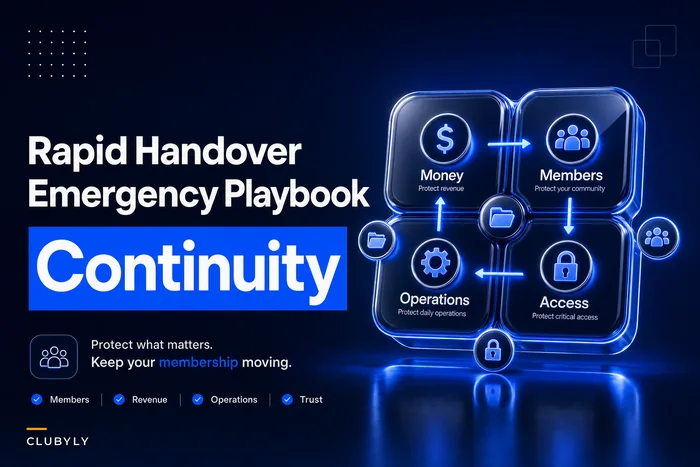
The knowledge is tribal, not written. One volunteer knows the admin password to the email platform. Another knows which third-party tool actually stores member payment info. When an incident happens, half the response time gets eaten just figuring out where the data even lives. This is the same weakness that makes rapid handover between volunteers so painful — if continuity isn't documented, neither is your breach response.
Authority is fuzzy. Who is allowed to tell members "your data may have been exposed"? The president? The secretary? The webmaster who caused the problem? In most clubs this has never been decided, so it gets decided during the crisis, usually badly, often with a group text where seventeen people weigh in and nobody acts.
Everything is volunteer-time-constrained. A corporate team can pull people off their day jobs for an all-hands response. A club cannot. Your incident response has to work in 30-minute volunteer windows, across time zones, with handoffs between people who may never speak on the phone.
The reputational stakes are weirdly high. Clubs run on trust. A members' organization that mishandles a breach — or worse, hides it — can lose a chunk of its base in a single renewal cycle. People forgive the breach. They don't forgive the silence.
So the system you need isn't a shrunken version of an enterprise plan. It's a different shape: fewer moving parts, more pre-written decisions, and explicit handoff points so no single person becomes the bottleneck.
The two clocks: 24-hour containment, 72-hour disclosure
The cleanest way to structure a club's response is around two timelines running in parallel. One is about stopping the bleeding. The other is about telling the right people in the right order. They are not the same job and should not be done by the same person.
Keep your membership organized and engaged.
Clubyly simplifies member management, event coordination, and payment collection—effortlessly.
- Unified member database
- Automated payment tracking
- Event scheduling & reminders
No credit card required
| Window | Primary goal | Who leads | Core actions |
|---|---|---|---|
| Hour 0–4 | Detect & triage | Incident Lead | Confirm it's real, classify severity, start the log |
| Hour 4–24 | Contain | Technical Volunteer | Cut access, rotate credentials, isolate affected systems |
| Hour 24–48 | Assess scope | Incident Lead + Data Owner | Determine what data, how many members, what regulators care |
| Hour 48–72 | Notify & disclose | Communications Lead | Member notice, board notice, any legal/regulatory reporting |
| Day 3–7 | Recover & review | Whole team | Restore operations, run the post-incident review |
The 72-hour mark matters beyond being tidy. Several data protection regimes (GDPR being the well-known one) expect notification of certain breaches within 72 hours of becoming aware. Even if your club isn't legally bound, treating 72 hours as a self-imposed deadline forces the assessment and communication work to actually happen instead of drifting for two weeks while everyone hopes it blows over.
The gap that breaks this timeline in practice is between hour 4 and hour 24. Containment requires technical access, and the person with that access is frequently not the person who noticed the problem. If you don't have a pre-agreed way to reach your technical volunteer — and a backup for when they don't answer — your 24-hour clock quietly becomes a 60-hour clock.
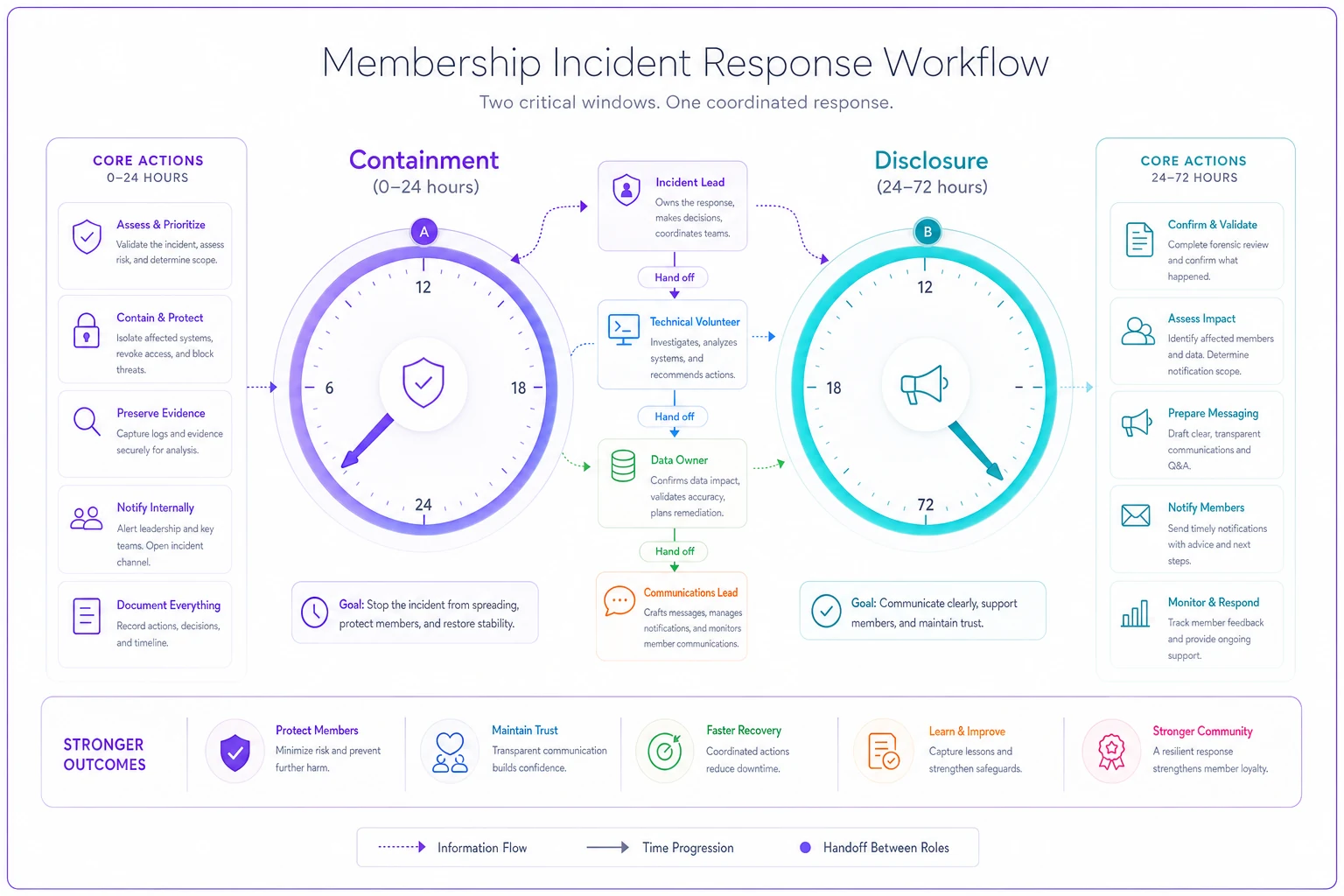
A simple diagram illustrating the two clocks and handoffs helps volunteers see who acts when and avoid the 'who does what' confusion.
Roles that survive the fact that people aren't available
The single most useful thing you can do before any incident is assign roles to functions, not names, then map at least two humans to each function. Named-person plans collapse the moment that named person is unreachable.
A workable minimal role set for a club:
-
Incident Lead — owns the decision log, declares severity, keeps the two clocks moving. This is a coordinator, not a technician.
-
Technical Volunteer — has or can get admin access to email, website, and the member database. Executes containment.
-
Data Owner — knows what member data exists and where. Often the membership secretary. Drives the scope assessment.
-
Communications Lead — writes and sends member and board messages. Nobody else sends breach comms. This is deliberate.
-
Board Liaison — one person whose only job is keeping the board informed so the other four aren't fielding fifteen "what's happening" messages mid-crisis.
Four of these five roles require almost no technical skill. That's intentional. The bottleneck in club incident response is rarely technical ability — it's coordination, decision authority, and clean communication. A plan that over-indexes on the "cyber" part and under-invests in the "who decides and who speaks" part will fail in the first hour.
One pattern worth flagging: clubs often collapse the Incident Lead and Communications Lead into one person "to keep it simple." It isn't simpler. The Incident Lead is firefighting; the Communications Lead needs calm, careful wording that has been checked. One person cannot do both well under pressure. Split them even if the same person drafts the comms — have a second set of eyes approve before anything goes out.
Copy-ready communications that don't make it worse
The communications failure mode in breaches is almost always the same: either total silence, or an over-promising message that creates legal and trust problems ("We guarantee your data is completely safe" — you don't know that yet). The fix is to pre-write skeletons so that under stress, people are filling blanks rather than composing from scratch.
Three templates cover most situations. Keep them short.
Holding notice (sent early, when you know something happened but not the full scope): > We're writing to let you know we identified a security issue affecting some club systems on [date]. We're actively investigating, we've taken steps to secure the affected systems, and we'll follow up within [timeframe] with specifics about whether your information was involved. If you have immediate concerns, reply to this email or contact [name/role].
Confirmed-exposure notice (sent once scope is known): > Our investigation found that the following information may have been accessed: [specific data types]. This affected approximately [number] members. Here's what we've done: [containment actions]. Here's what we recommend you do: [concrete steps — reset passwords, watch for phishing, etc.]. We take responsibility for protecting your information and we're sorry this happened.
All-clear / resolution notice: > We've completed our response to the security issue reported on [date]. [What was done.] [What changed so it's less likely to recur.] Thank you for your patience, and please reach out with any questions.
The discipline here is naming specific data types and approximate numbers rather than vague reassurance. "Your name and email address" lands very differently than "your personal data," and members trust the specific version more. This connects directly to your underlying member data governance — you can only disclose accurately what data was exposed if you already have a clear map of what you collect and where it sits.
Minimal technical mitigations a volunteer can actually enact
The containment phase intimidates people because it sounds like it needs a security engineer. For the overwhelming majority of club incidents, it doesn't. The common breaches are boring: a compromised email account, an exposed shared file, a reused password that leaked somewhere else, a phishing email that tricked a member into paying a fake invoice.
A containment checklist a non-technical volunteer can run with a laptop and the right logins:
-
Change the password on the affected account immediately, and any account sharing that password.
-
Turn on two-factor authentication if it wasn't already — this alone stops most account takeovers from continuing.
-
Revoke active sessions (most email and cloud platforms have a "sign out of all devices" button).
-
Check and remove forwarding rules — attackers often add a secret rule that copies incoming mail to themselves. This is the step everyone forgets.
-
Lock down the exposed file — change sharing from "anyone with link" to specific people, and generate a new link so the old one dies.
-
Check connected apps and remove any third-party app authorizations you don't recognize.
-
Preserve evidence before deleting anything — screenshot the suspicious rule, the sharing settings, the weird login locations. You may need them for the review and any report.
Screenshot suspicious forwarding rules and sharing settings before you remove them so the post-incident review has clear evidence.
That last point gets skipped constantly. People's instinct is to delete the malicious forwarding rule and move on. But if you don't screenshot it first, your post-incident review has nothing to work from, and if there's any regulatory follow-up you've destroyed your own documentation.
The rehearsal is the part everyone skips — and it's the part that works
A plan that has never been run is a document, not a capability. The clubs that handle incidents well aren't the ones with the thickest binder. They're the ones that spent 90 minutes once or twice a year walking through a fake scenario out loud.
A tabletop rehearsal for a club doesn't need to be elaborate. Here's a simple runnable format:
-
Pick a scenario and read it aloud. "The treasurer's email was compromised and a fake dues-payment message went to 200 members. Three have already paid a scammer." Keep it realistic to your actual systems.
-
Start the clock. Someone tracks elapsed "incident time" even if the rehearsal is slower.
-
Make people say who does what, out loud. Don't let them point at the binder — make them articulate the first three actions and who's taking them.
-
Inject a complication halfway. "The technical volunteer isn't answering their phone." Now watch whether the backup kicks in or everyone stalls. This is where you find your real gaps.
-
Draft the holding notice in real time. Give them 10 minutes. Read it aloud. Would you actually send it? Usually the first draft over-promises or under-informs.
-
Debrief and capture artifacts. What was unclear? What login did nobody have? What decision had no owner? Those answers are the output.
The complication injection in step 4 is where the real learning lives. Smooth rehearsals teach nothing. The point is to surface the handoff that breaks when a person is missing — because in a real incident, someone will be missing.
Walk away with three things: an updated contact tree with backups, a confirmed list of who holds which logins, and a one-page "first 60 minutes" sheet that lives somewhere everyone can find at 11pm on a Sunday.
Escalation triggers: deciding when this stops being routine
A surprising amount of damage comes from under-escalating — treating a real breach as a minor glitch because nobody wanted to "overreact" and bother the board. Pre-defined triggers remove that judgment call from the stressed individual.
Reasonable escalation triggers for a club:
-
Any member financial data involved → escalate to Incident Lead + Board Liaison immediately.
-
More than ~10 members affected, or any vulnerable members (minors, for youth-serving clubs) → full team activation.
-
Money has already moved (members paid a scammer, funds left the club account) → loop in the treasurer and consider law enforcement/bank fraud reporting.
-
Media or public exposure risk (something's being discussed publicly, or a journalist asks) → Communications Lead owns all outward messaging, nobody freelances.
-
You genuinely can't tell how bad it is after 4 hours → escalate anyway. Uncertainty is itself a trigger.
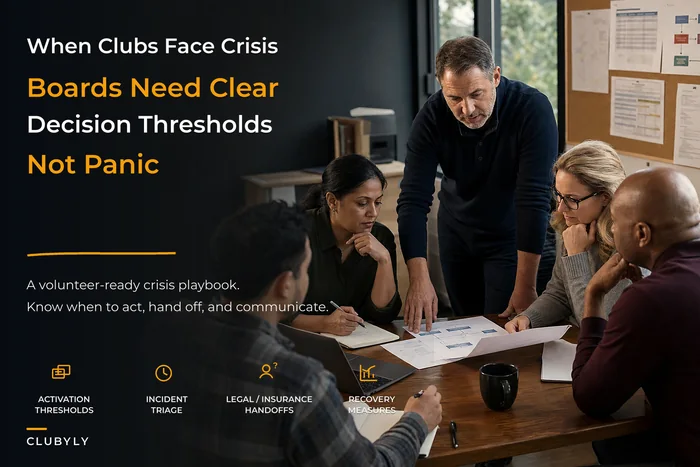
Tie these triggers into your broader board-ready crisis playbook so a cyber incident doesn't live in a separate universe from how your club handles every other emergency. The board should encounter one consistent escalation logic, not a different one for every type of crisis.
A real scenario: the spoofed treasurer
A regional hobbyist club with around 480 members had their treasurer's email address spoofed — not even truly hacked, just impersonated — during renewal season. A message went out asking members to pay dues via a new payment link. By the time anyone noticed, roughly 14 members had clicked, and about 6 had actually paid somewhere in the $400–$500 range to the scammer.
What went wrong operationally: nobody had decided who was allowed to send a club-wide correction, so the first three hours were a board email thread arguing about wording while more members kept paying. The eventual correction went out nearly a full day after the first report.
After that incident they built the two-clock structure described here. The next time something suspicious surfaced — a member flagged a weird login alert on the shared mailbox — the response looked completely different. The technical volunteer rotated the password and killed sessions within about 40 minutes. The Communications Lead sent a pre-drafted holding notice the same evening. Total member-facing confusion was close to zero, and no money moved. The incident that could have been another day-long scramble was essentially closed by the next morning.
The difference wasn't better technology. It was that the decisions had already been made before the incident started.
When a full incident OS is overkill — and when it isn't
When this makes sense: You store member contact info, handle any payments or dues online, have more than a handful of volunteers with system access, or your members would be genuinely harmed by a data leak. Basically — if you have a member database, you need at least the lightweight version.
When it's overkill: A tiny club of 20 friends with no online payments and a single shared calendar doesn't need a five-role structure. For them, "two people know all the passwords and we have 2FA on everything" is a reasonable plan. Don't build enterprise ceremony for a book club.
Who should not try to run this alone: Clubs serving minors or handling health and financial data shouldn't treat this as purely internal. Build the OS, but also know your actual legal reporting obligations and have a contact — a sympathetic board member who's a lawyer, or a low-cost legal clinic — who you can call. The plan tells you when to call them; it doesn't replace them.
How the pieces connect as you grow
A 50-member club can keep the whole system in a shared document and a group chat. The failure point at that size is simply that it exists only in one person's head.
By a few hundred members with real payment flows, the coordination load changes. You now have multiple people who might detect an incident, multiple systems where data lives, and enough members that notification is a logistical task, not a quick email. This is the stage where clubs benefit from centralizing their operational playbooks — contact trees, role assignments, login inventories, and templates — in one place instead of scattered across personal drives and someone's memory. Operational platforms that manage membership data, communications, and volunteer workflows can hold these artifacts where the next volunteer can actually find them, and can automate the dull-but-critical parts: reminding the team to re-run the tabletop, keeping the contact tree current as volunteers rotate, and making sure your data map stays accurate enough that scope assessment doesn't start from zero.
Across multiple chapters, the same incident logic has to be shared without becoming bureaucratic — each chapter runs the playbook locally, but escalation triggers and disclosure standards stay consistent so one chapter's mishandled breach doesn't become every chapter's reputation problem.
The through-line at every size is the same: incident response isn't a document you write once. It's a set of decisions you make before you need them, roles you assign to functions rather than people, and a rehearsal habit that keeps the whole thing from quietly rotting between crises. The clubs that recover fast aren't luckier or more technical. They just did the deciding in advance.
The through-line at every size is the same: incident response isn't a document you write once. It's a set of decisions you make before you need them, roles you assign to functions rather than people, and a rehearsal habit that keeps the whole thing from quietly rotting between crises. The clubs that recover fast aren't luckier or more technical. They just did the deciding in advance.
Ready to streamline your club operations?
Join 500+ clubs using Clubyly to save time, boost member engagement, and grow their communities.