
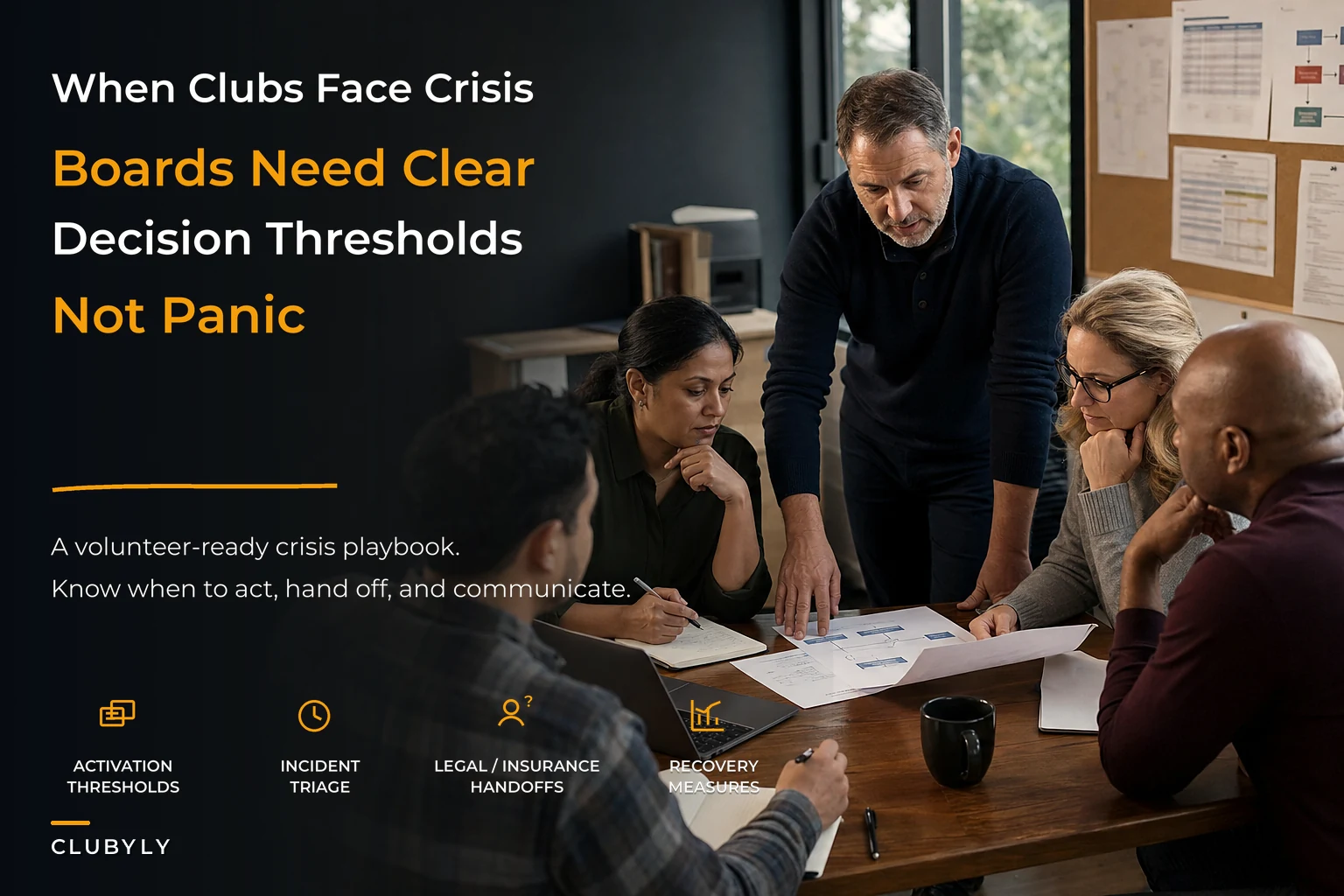

Most clubs don't fail during a crisis because they lacked good intentions. They fail because nobody knew who was allowed to make which call, how fast, and with what authority. A payment processor freezes your account mid-renewal season. A volunteer is accused of misconduct at an event. A member's data leaks. Someone posts something online that misrepresents the club and three local reporters pick it up.
In the first two hours, the quality of your response depends almost entirely on decisions you made months earlier — when nothing was on fire. That's the whole point of a board crisis playbook for clubs: to pre-decide the hard stuff so volunteers who already have day jobs aren't inventing governance from scratch while adrenaline is wrecking their judgment.
This isn't about imitating a corporate crisis team with a 40-page legal binder. You don't have that, and you don't need it. What you need is a small set of thresholds, handoffs, and sequences that fit on a few pages and actually get used.
The core failure: everything is "the board's job," so nothing happens fast
The pattern that shows up again and again in volunteer-run organizations: authority is technically shared across the whole board, which sounds democratic and responsible. In a crisis, it becomes paralysis. Seven people need to agree, two are unreachable, one wants to "wait and see," and the clock keeps running.
The deeper problem is that volunteer boards tend to treat all decisions as roughly equal — a venue change gets the same deliberation as a safeguarding allegation. There's no tiering. So either everything escalates and the board drowns in trivia, or nothing escalates until it's already a public mess.
What breaks at scale is coordination, not effort. A 60-member hobby club can muddle through on group texts. A 400-member organization with paid staff, multiple events a month, sponsor contracts, and a social media following cannot. The number of things that could go wrong grows faster than the board's capacity to improvise responses. That's why you need decision thresholds written down before you need them.
Decision thresholds: who can act, and when they MUST
The single most useful artifact in a crisis playbook is a simple table that answers one question: at what severity does a decision move up the chain, and who's empowered to act at each level?
Keep your membership organized and engaged.
Clubyly simplifies member management, event coordination, and payment collection—effortlessly.
- Unified member database
- Automated payment tracking
- Event scheduling & reminders
No credit card required
| Tier | Trigger signals | Who acts | Required speed | Board involvement |
|---|---|---|---|---|
| 1 – Routine | No harm to people, under ~$500 impact, contained, no outside parties | On-shift lead or ops volunteer | Same event / same day | Logged, no action |
| 2 – Elevated | Minor injury, member complaint, ~$500–$5k exposure, one external party involved | Club manager + one officer | Within a few hours | President notified |
| 3 – Serious | Allegation of misconduct, data breach, significant financial loss, media inquiry, insurance-relevant event | President + 2 officers (quorum of a crisis cell) | Within 1 hour | Full board within 24h |
| 4 – Existential | Safeguarding/criminal matter, lawsuit threat, event-wide safety failure, loss that threatens solvency | Full board emergency session | Immediate | Emergency meeting called |
What makes this work isn't the exact dollar figures — adjust those to your club. It's that you've named a crisis cell: a small empowered group (usually president, one officer, and the manager) who are pre-authorized to act at Tier 3 without convening the full board. That pre-authorization is what buys you speed.
A common failure point: boards write the tiers but never formally delegate authority to the crisis cell in their bylaws or a board resolution. When the moment comes, someone asks "wait, are we actually allowed to decide this?" and you're back to paralysis. Pass the resolution now.
For more on where governance structures quietly break down before a crisis even starts, common governance mistakes small clubs make covers the escalation gaps that feed directly into this.
The legal and insurance handoff: the checklist that saves you later
In a Tier 3 or 4 event, the first few things you don't do matter more than what you do. Volunteers tend to over-communicate, over-apologize in writing, and promise things that commit the club legally — all before anyone's talked to an insurer or a lawyer.
The handoff checklist exists to create a short pause and route the situation to the right people before words get permanent.
-
[ ] Freeze outbound comms — no emails, posts, or on-the-record replies until the crisis cell signs off
-
[ ] Preserve evidence — screenshots, incident logs, photos, witness names, timestamps
-
[ ] Identify whether it's a notifiable matter (data breach, injury, safeguarding) with legal reporting deadlines
-
[ ] Pull the insurance policy and find the notification clause — many policies require you to report within a set window or coverage lapses
-
[ ] Contact your insurer's claims line before admitting fault to anyone
-
[ ] Note any regulated deadlines (breach notification laws often give you 72 hours)
-
[ ] Assign one named person to be the sole point of contact for legal/insurance
Clubs regularly discover after an incident that their general liability policy didn't cover the specific thing that happened, or that a late notification voided the claim. The time to read your policy's exclusions and notification windows is during a quiet board meeting, not during a claim. Build a one-page "insurance facts" sheet — policy numbers, claims phone, notification window, what's covered, what's excluded — and keep it with the playbook.
Comms sequences: public and private, templated in advance
The reason you template communications ahead of time isn't laziness. Under stress, people either go silent (which reads as guilt or chaos) or over-share (which creates legal exposure and contradicts the next person who speaks). A pre-built sequence keeps the message consistent and the cadence sane.
Think of comms as two parallel tracks running at different speeds.
Private track (members, volunteers, affected parties):
-
Acknowledge fast, commit to nothing. "We're aware of [situation], we're looking into it, and we'll update you by [specific time]." Sent within the response window for the tier.
-
Hold with a real timestamp. Even if there's nothing new, a "we're still working on it, next update by X" prevents the information vacuum that breeds rumors.
-
Substantive update once facts are confirmed and legal/insurance has cleared the language.
-
Resolution and next steps, including what you're changing so it doesn't recur.
Public track (social, press, general audience):
-
Usually slower and quieter than the private track. You rarely need to get ahead of the public unless media is already involved or the issue is visibly public.
-
One designated spokesperson. Everyone else's answer is "I'm going to point you to [name], who's handling our response."
-
Short, factual, no speculation, no naming individuals in disciplinary or safeguarding matters.
The pattern that gets clubs in trouble: a well-meaning board member replies personally in a Facebook comment thread "to be transparent," and now there are two official-seeming versions of events. Lock down who speaks. One voice.
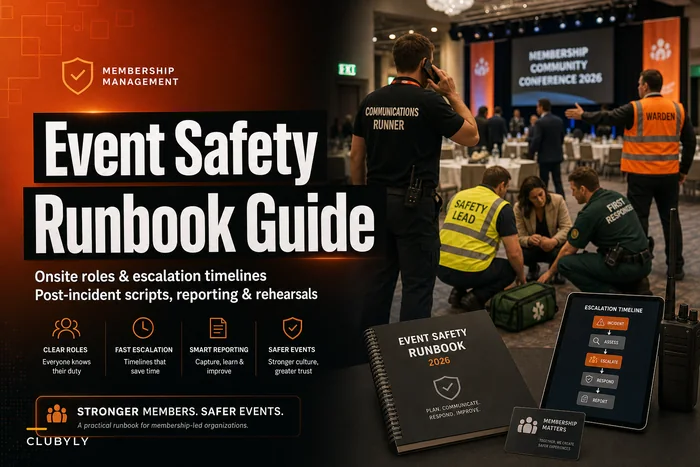
Keep the templates with blanks — [situation], [time], [contact] — so the crisis cell is filling in gaps, not drafting from zero at midnight. This connects directly to the on-the-ground scripting in the event safety runbook for small clubs, which handles the onsite incident moment that often triggers these comms sequences in the first place.
Stakeholder mapping: knowing who needs what, and in what order
Most clubs skip stakeholder mapping because it feels like a corporate exercise. In a real incident though, the question "who do we need to tell, and in what order?" eats up a surprising amount of time if you haven't answered it in advance.
A workable stakeholder map for a small club sorts people along two axes: how affected they are and how much influence they have over the outcome.
-
High affected, high influence (e.g., an injured member's family, a major sponsor, a regulator): direct, personal, early contact. Often a phone call, not an email.
-
High affected, low influence (e.g., volunteers at the event)
honest, prompt, but grouped communication.
-
Low affected, high influence (e.g., the broader membership, local media): controlled, factual, on your timeline.
-
Low affected, low influence (general public)
usually nothing proactive unless it goes public.
The key is sequencing. The affected family should never learn something from a public post before they hear it from you directly. Clubs blow up their own reputation by getting the order wrong — being "transparent" publicly before being decent privately. Map the order now so you're not guessing under pressure.
Incident triage: a matrix the crisis cell can run in two minutes
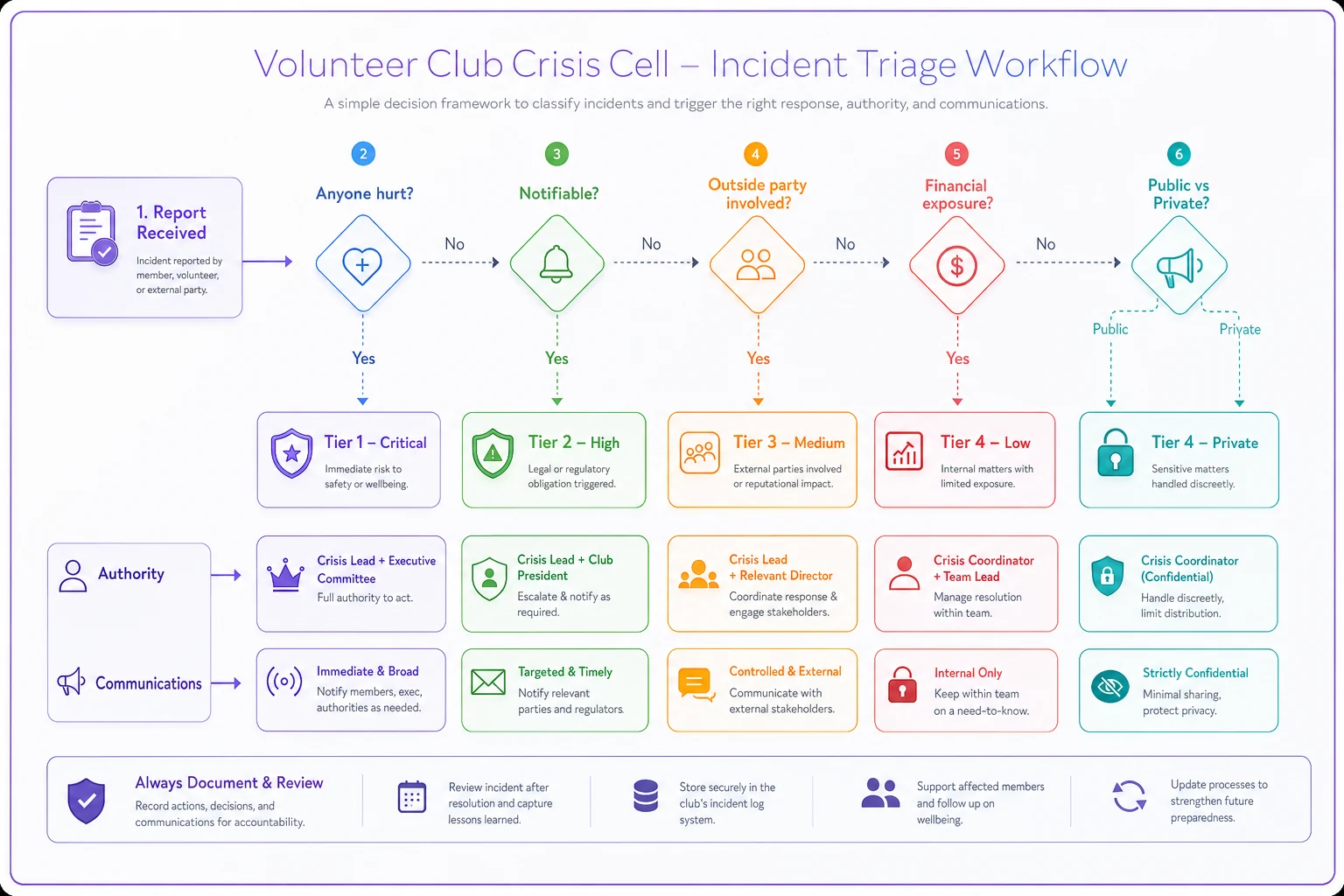
When the call comes in, the crisis cell needs a fast way to classify what they're dealing with. The tier drives everything else — speed, authority, comms, legal handoff.
A simple triage flow that works under pressure:
-
Is anyone hurt or at risk right now? If yes, that's at least Tier 3, and immediate safety actions come before anything administrative.
-
Is this notifiable? Data breach, safeguarding, serious injury — these have legal clocks. Start the clock mentally.
-
Is an outside party already involved? Media, lawyer, insurer, regulator, police. External involvement bumps the tier up.
-
What's the financial exposure? Rough band, not a precise figure — under $500, under $5k, or "this could threaten us."
-
Is it public or private? Something already circulating online needs a different comms posture than a contained internal matter.
Run those five questions, land on a tier, and the playbook tells you who acts and how fast. The whole point is removing judgment calls about process so the cell can spend its judgment on the actual situation.
One underrated triage mistake: treating reputational heat as automatically worse than quiet harm. A viral complaint feels like a five-alarm fire, while a quietly mishandled data issue feels manageable — but the data issue may carry legal penalties and the viral complaint may blow over in a day. Triage on actual harm and legal exposure, not on how loud something is.
Post-incident recovery: metrics and timelines that keep you honest
The crisis doesn't end when the fire's out. It ends when you've learned from it and the risk of recurrence is actually lower. Most volunteer boards skip this part because everyone's exhausted and relieved — and that's exactly why the same incident happens again a year later with different volunteers.
| Phase | Timeframe | What happens | How you know it worked |
|---|---|---|---|
| Stabilize | 0–72 hours | Immediate response, comms sent, legal/insurance engaged | No new harm; affected parties contacted |
| Document | Within 1 week | Written incident timeline, decisions logged, evidence preserved | Complete record exists, not just memory |
| Debrief | Within 2 weeks | Blameless review with the crisis cell + board | Root cause named, not just symptoms |
| Fix | Within 30 days | Policy/process changes, training, bylaw updates if needed | Specific changes assigned to owners with dates |
| Verify | 60–90 days | Confirm changes are in place and holding | Recurrence risk demonstrably reduced |
A few metrics worth tracking lightly: time to first acknowledgment (how fast did you respond?), time to resolution, number of decisions made outside the crisis cell (if that's high, your authority structure leaked), and whether the fix actually got implemented — most don't. Assign an owner and a date or it evaporates.
The debrief should be blameless. The moment volunteers fear being scapegoated, they stop reporting problems early. Early reporting is your single best defense against Tier 4 events. You want a culture where someone flags a small issue at Tier 1 instead of hiding it until it's Tier 4.
A real scenario: the sponsor-data slip
A regional cycling club — roughly 350 members, run by a volunteer board with one part-time paid coordinator. A volunteer exported the member list to pull contact info for a sponsored event and accidentally sent the full spreadsheet, including emails and emergency contacts, to the sponsor's marketing rep instead of just the opt-in list.
Before they had a playbook, the instinct would've been to panic-email all 350 members an apology (creating a bigger public story), argue internally for two days about who was to blame, and never check whether any of this was legally notifiable.
With thresholds in place, it ran differently. The coordinator recognized it as Tier 3 — data exposure, external party involved — paused outbound comms, and looped in the crisis cell within the hour. They confirmed the exposure scope, asked the sponsor to delete and confirm in writing, checked their notification obligations, and sent a calm, specific private message only to the affected members with a clear next-update time. No public post, because nothing was public. The whole thing closed in under a week, with a fixed process afterward: no raw exports, access limited to two people, a logged request process.
The difference wasn't competence — the same volunteers were involved. It was having pre-decided the tier, the authority, and the sequence. If your member data handling isn't tight to begin with, the deeper fixes live in member data governance for clubs.
When a full playbook is overkill — and when it's non-negotiable
If you're a 40-person book club with no money changing hands, no events with physical risk, and no data beyond a contact list, a four-tier crisis structure is theater. Write down a single page: who to call, your insurance basics (if any), and a rule that nobody speaks for the group publicly without checking. Done.
The playbook becomes non-negotiable once you cross a few lines: you hold money and have sponsor contracts, you run in-person events where someone could get hurt, you store member data beyond names, or you have any public profile that a complaint could attach to. At that point, the cost of not having pre-decided thresholds shows up as frozen decision-making, voided insurance claims, and reputational damage that outlasts the incident by years.
The group that should be most worried is the one in between — large enough to carry real risk, small enough to still run on goodwill and group chats. That's where improvised crisis response fails hardest, because the stakes have outgrown the informal methods that used to work.
Keeping it usable: the playbook has to survive volunteer turnover
A crisis playbook that lives in one person's head or one person's inbox isn't a playbook. The most common reason these documents fail isn't that they're wrong — it's that the people who wrote them cycled off the board and the knowledge left with them. This is the same continuity problem that haunts every part of volunteer operations, and the discipline of structured handovers in the 72-hour continuity playbook for small clubs applies directly here.
Keep the whole thing centralized and accessible to the current crisis cell — thresholds, handoff checklist, comms templates, insurance facts sheet, stakeholder map, and incident log, in one place that survives people leaving. Whatever system holds your governance records, membership data, and volunteer roles should hold this too, so a new president inherits a working playbook instead of a rumor that one exists.
Review it once a year, update the dollar figures and contacts, and run one tabletop scenario so the cell has actually practiced before the real thing hits. That last part gets skipped almost every time, and it's probably the most valuable hour you'll spend on governance all year.
Bringing it together
A crisis playbook for a volunteer club isn't about predicting what will go wrong — you can't. It's about pre-deciding how you decide when something does.
The four-tier threshold table tells people who's allowed to act and how fast. The legal and insurance handoff keeps a bad day from becoming a lawsuit. Templated comms keep your message consistent and your spokesperson singular. The stakeholder map gets the order of contact right. The triage matrix lets a tired volunteer classify a situation in a couple of minutes. And the recovery timeline makes sure you actually learn something instead of just surviving it.
None of this requires enterprise resources. It requires a few quiet hours before the crisis, a board resolution that gives your crisis cell real authority, and the discipline to keep it current as volunteers come and go. The clubs that handle crises well aren't braver or smarter in the moment — they just did the thinking early, so the moment didn't have to be.
A crisis playbook for a volunteer club isn't about predicting what will go wrong — you can't. It's about pre-deciding how you decide when something does.
None of this requires enterprise resources. It requires a few quiet hours before the crisis, a board resolution that gives your crisis cell real authority, and the discipline to keep it current as volunteers come and go. The clubs that handle crises well aren't braver or smarter in the moment — they just did the thinking early, so the moment didn't have to be.
Ready to streamline your club operations?
Join 500+ clubs using Clubyly to save time, boost member engagement, and grow their communities.