


Most club leaders don't have a systems problem. They have a sequencing problem. They know things are messy — dues tracking in one place, volunteer sign-ups in another, event RSVPs somewhere else entirely — but when everything feels broken at once, it's genuinely hard to know what to touch first. So they either fix nothing, or fix whatever's making the most noise right now, which is rarely the thing actually holding the club back.
A maturity model fixes that. Not the corporate consulting kind with 40 dimensions and a scoring rubric nobody uses twice — a practical one built for volunteer-run reality, where the treasurer changes every two years and half your "systems" are somebody's personal Google account.
The idea is straightforward: your club operates at a stage, each function within it might be at a different stage, and the highest-leverage move is almost always to lift your weakest function up one level — not to leapfrog your strongest one to the top.
The four stages, and what they actually feel like
Here's the shorthand before we go deeper. The stages aren't about sophistication. They're about how much the club depends on specific people remembering to do specific things.
| Stage | What it feels like | Who holds the club together | What breaks it |
|---|---|---|---|
| 1. Ad-hoc | "Ask Dana, she knows" | One or two people's memory | Those people leave or burn out |
| 2. Repeatable | "There's a doc for that" | Written processes people mostly follow | Nobody owns the doc; it goes stale |
| 3. Governed | "We have owners and cadences" | Defined roles, review rhythms, decision rules | Growth outpaces manual coordination |
| 4. Scalable | "It mostly runs without heroics" | Systems + light automation + clear handoffs | Over-engineering for a size you're not at |
The trap almost nobody warns you about is at the bottom right of that table. Plenty of small clubs read maturity content and decide they need Stage 4 tooling when they have 80 members and no recurring events. That's how you end up with a member management platform that costs more than your annual dues revenue and that three board members refuse to log into.
Maturity is directional, not aspirational. You want to be one stage ahead of your pain, not four.
Stage 1 → 2: Getting out of people's heads
This is the most common place small clubs live, and honestly it works fine until it doesn't. At the ad-hoc stage, the club runs on institutional memory. The membership chair knows who's lapsed because she's been doing it for six years. The events person knows which vendors to call. Nothing is written down because nothing needs to be — everyone knows their part.
Keep your membership organized and engaged.
Clubyly simplifies member management, event coordination, and payment collection—effortlessly.
- Unified member database
- Automated payment tracking
- Event scheduling & reminders
No credit card required
The failure mode is brutally predictable: someone leaves. Not always dramatically. Sometimes they just get a new job, have a kid, or quietly disengage. And suddenly the club discovers that "the renewal process" was actually "Dana checking a spreadsheet she built and reconciling it against her memory of who paid at the fall event."
What's happening at this stage is that knowledge and execution are fused into the same person. You can't hand off the task without also handing off years of context, which means you basically can't hand it off at all.
The move to repeatable isn't complicated, but it's boring, which is why it gets skipped. You write things down. Specifically:
-
The membership lifecycle — how someone joins, gets welcomed, renews, and what happens when they lapse
-
The event runbook — the sequence of tasks from "we decided to do this" to "post-event cleanup"
-
The money flow — who can spend, who approves, how it's recorded
-
The comms basics — what goes out, when, and who sends it
Minimum-viable controls at this stage are almost embarrassingly simple: a single shared location for these docs, and one named person responsible for each. Not a committee. One name next to each process.
The mistake people make here is writing aspirational documentation — the process as they wish it happened. Write down what actually happens now, warts included. A messy-but-accurate doc beats a beautiful fictional one every time, because the next person needs to know reality, not intentions.
When Stage 1 is actually fine
If your club has fewer than roughly 50 members, meets a few times a year, and has stable leadership that isn't going anywhere soon — you might genuinely not need to move yet. Documenting processes for a club that barely has processes is busywork. The real signal to move is turnover risk, not size. If any single person leaving would cause a two-week scramble, you've outgrown ad-hoc whether you feel it or not.
Stage 2 → 3: When documentation isn't enough
Repeatable clubs have docs. Governed clubs have docs that stay true.
That's the whole difference, and it's a bigger gap than it sounds. Documentation rots. A process doc written in January describes a world that's changed by June — new payment processor, new event format, a board that quietly stopped doing the thing the doc describes. At the repeatable stage, nobody owns keeping the docs current, so within a year or two your "systems" are a graveyard of half-accurate PDFs nobody trusts.
Governance is what makes processes durable. It adds three things:
-
Owners — every important process has a person accountable for it working, not just doing it
-
Cadences — regular review points where things get checked and updated
-
Decision rules — pre-agreed answers to recurring judgment calls, so you're not relitigating the same question every time
That third one is underrated. A huge amount of volunteer friction comes from re-deciding things that should have been decided once. Can a member get a refund? What's the threshold for a spend that needs board approval? When does a lapsed member get removed from the directory? At Stage 2, someone makes a judgment call each time — and different people call it differently. At Stage 3, there's a rule, and the rule handles 90% of cases so people only escalate the genuinely weird ones.
Here's a concrete example. A hobby club with around 220 members kept having the same fight every renewal season: what to do about members who paid late. Some board members waived reinstatement, others enforced it, and members noticed the inconsistency and complained. The fix wasn't a new tool. It was a one-paragraph decision rule — 30-day grace, automatic reinstatement inside the window, board vote required outside it — agreed once and written into the renewal doc. The recurring fight just stopped.
This is also the stage where reporting stops being ad-hoc. Governed clubs know their numbers on a rhythm — membership count, renewal rate, event margins, reserve level — not because someone asked, but because the cadence produces them automatically.
The governance checklist
-
Every core process has a named owner responsible for it working
-
There's a scheduled review cadence for docs (quarterly is plenty for most clubs)
-
Recurring decisions have written rules, not case-by-case rulings
-
Board reporting happens on a fixed rhythm with defined metrics
-
There's a clear escalation path for exceptions
-
Financial controls separate who spends from who approves
-
Member data lives in one canonical place, not scattered across personal accounts
That last point deserves emphasis. The single biggest silent blocker to governance is data spread across five spreadsheets and three people's inboxes. You cannot govern what you can't see in one place. If your member records are fragmented, that's often the first thing to consolidate — there's a full migration playbook for moving off scattered spreadsheets with rollback steps, because doing this badly is worse than not doing it at all.
Stage 3 → 4: When manual coordination becomes the bottleneck
Governance works beautifully until the coordination overhead eats your volunteers alive.
A well-governed club at 200 members runs smoothly on manual effort. The same governance model at 600 members — or across four chapters — starts to buckle, not because the rules are wrong but because executing them by hand takes more volunteer hours than anyone has. The membership chair spends her Sunday sending renewal reminders one at a time. The events lead manually cross-checks the RSVP list against the payment list against the volunteer roster. Everything is governed — it's just exhausting.
Scale is the stage where you stop paying with human attention and start paying with systems that handle the routine so people can handle the exceptions.
What actually breaks at this transition is the handoff. In a Stage 3 club, coordination happens through people talking to each other — the treasurer emails the events lead, who texts the volunteer coordinator. That works at low volume. As things grow, those informal handoffs multiply until information gets dropped constantly: a member who paid but never got added to the roster, a volunteer who signed up but never got confirmed, an event that overspent because two people were both authorized to book vendors and neither told the other.
Here's the routine flow that should be automated:
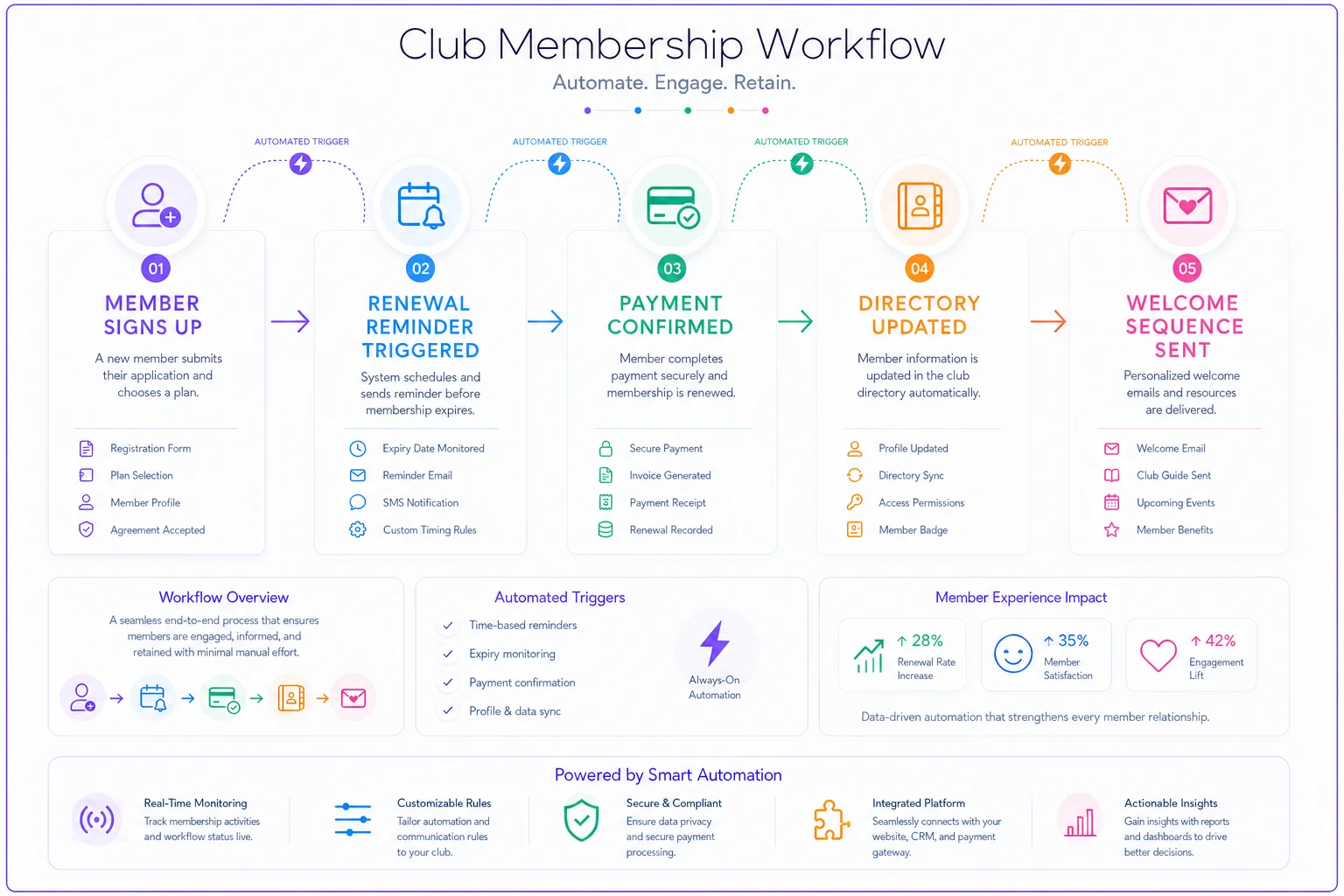
The Stage 4 shift is making routine flows connect without a person carrying each message. Renewals that trigger reminders automatically. New members who flow into the welcome sequence, the directory, and the mailing list from a single sign-up. Reporting that assembles itself instead of someone rebuilding a spreadsheet the night before the board meeting.
This is the transition where a genuine operational platform earns its keep — not because automation is trendy, but because at a certain volume, manual coordination is the bottleneck. The value isn't replacing people; it's freeing your volunteers from the drudge-work of moving data between systems so they can focus on the parts that actually need a human. The case for this is laid out in more detail in the single operational system approach to member lifecycles — the core idea being that decisions, metrics, and routine actions should live in one connected place rather than a patchwork of tools that don't talk to each other.
Who should NOT push for Stage 4
Plenty of clubs, honestly. If you're under a few hundred members with stable, predictable operations and no chapter structure, chasing scalability usually costs more than it returns. You'll spend money on tooling and — worse — spend volunteer goodwill forcing people to adopt systems they don't need. Over-engineering is a real failure mode, and it's harder to walk back than under-building.
Multi-chapter clubs are a special case here, because scaling wrong can create political messes that are painful to unwind. If that's your situation, be deliberate — we've written specifically about the centralization mistakes multi-chapter clubs make and how to decide what to centralize versus leave local.
A real scenario: a regional professional association
A regional professional networking association — roughly 480 members, monthly events, a five-person volunteer board — sat firmly at Stage 2. They had documentation. What they didn't have was durability. Their renewal process was documented, but reminders went out whenever the membership chair remembered, which meant renewal rate swung between good years and bad years depending entirely on how busy she was.
Their diagnosis wasn't "we need better software." It was "our membership function is at Stage 2 while our events function is honestly at Stage 3." The events team had owners, a cadence, and decision rules. Membership had a doc and a tired volunteer.
So they lifted the weak function, not the whole club. They assigned membership an owner accountable for the outcome (renewal rate), set a fixed reminder cadence tied to renewal dates, and wrote three decision rules for the recurring judgment calls. The reminders themselves got automated so they stopped depending on someone remembering to send them.
Over the following year, renewal rate moved from the low 70s to around the low 80s — and stayed stable rather than swinging. The bigger win was less visible: the membership chair got roughly an evening a month of her life back, which is the kind of thing that keeps volunteers from quitting.
Note what they didn't do. They didn't overhaul events, which were already working. They didn't buy a giant platform. They lifted one function one stage. That's the whole method.
How to actually prioritize your next move
The point of the model isn't to admire it — it's to decide what to do next month. Here's the process:
-
Rate each core function separately. Membership, events, finance, volunteers, comms, reporting. Don't give the club one score; give each function its own stage. You'll almost always find a spread.
-
Find your weakest function. The one sitting at the lowest stage is usually where a single person leaving would cause chaos, or where the same fire keeps restarting.
-
Check the effort-to-impact ratio. Lifting a function from ad-hoc to repeatable — writing things down, assigning owners — is nearly always low-effort/high-impact. Lifting from governed to scalable is higher-effort and only worth it if manual coordination is genuinely the bottleneck.
-
Do the one-stage lift. Don't try to move a function two stages at once. Ad-hoc to governed skips the documentation that governance depends on. Get it repeatable first.
-
Reassess after a quarter. Once your weakest function catches up, a different function becomes your new bottleneck. Maturity is a rolling process, not a destination.
When rating functions, involve the volunteers who do the work — they surface hidden single points of failure you won't see from the board room.
The prioritization rule that saves the most wasted effort: low-effort/high-impact almost always means moving your weakest function up one level, not making your strongest function fancier. The instinct is to improve what you're already good at because it feels good. Resist it.
Rough timelines to set expectations
-
Ad-hoc → Repeatable a few weekends of documentation work, spread over 4–6 weeks so it doesn't burn anyone out
-
Repeatable → Governed a full quarter, mostly to establish cadences and let the first review cycle actually run
-
Governed → Scalable several months, because tooling adoption is a people problem more than a technical one, and rushing it creates resentment
Those are rough. A motivated board moves faster; a stretched one moves slower. The timelines matter less than the sequence.
The pattern worth remembering
Clubs rarely fail because they picked the wrong tool. They stall because they tried to fix everything at once, or fixed the wrong thing loudly while the real bottleneck sat quiet in the corner.
The maturity model is really just a forcing function — a way to look at each part of your operation honestly, admit which parts run on one person's memory, and lift the weakest one before it collapses. Do that on a rolling basis — one function, one stage, one quarter at a time — and the club gets steadily more resilient without any single heroic overhaul. Not becoming sophisticated. Becoming durable, so the club survives the turnover, growth, and change that eventually tests every volunteer organization.
The maturity model is really just a forcing function — a way to look at each part of your operation honestly, admit which parts run on one person's memory, and lift the weakest one before it collapses. Do that on a rolling basis — one function, one stage, one quarter at a time — and the club gets steadily more resilient without any single heroic overhaul. Not becoming sophisticated. Becoming durable, so the club survives the turnover, growth, and change that eventually tests every volunteer organization.
Ready to streamline your club operations?
Join 500+ clubs using Clubyly to save time, boost member engagement, and grow their communities.