


Most clubs don't have a governance problem. They have a fragmentation problem that only looks like a governance problem when something goes wrong.
The risk register lives in one treasurer's head. The contract folder is a shared drive nobody's opened since the last venue renewal. Privacy decisions get made in a Slack thread and then forgotten. The board report gets rebuilt from scratch every quarter by whoever volunteered last. Each piece works fine on its own — until a sponsor contract, a data breach scare, and a cash-flow crunch all land in the same month, and suddenly nobody knows who decides what, or whether anyone decided at all.
A governance operating system for clubs isn't a binder of policies. It's the connective tissue: the thresholds that trigger a decision, the named owner who handles it, the template that captures it, and the escalation path when it exceeds one person's authority. The whole point is that a volunteer who joined four months ago can open one page and know exactly what to do.
This piece walks through how those pieces actually connect — and where they come apart when a club grows from 80 members to 800.
Why governance fragments in volunteer organizations specifically
Paid staff organizations hide fragmentation because someone is in the building forty hours a week holding the threads together. Volunteer clubs don't have that. The person who understood how finance, risk, and contracts fit together rotates off the board, and the institutional memory walks out with them.
What comes up repeatedly across membership organizations is that governance doesn't fail at the policy level. The policies are usually fine — often copied from a bigger organization's handbook. It fails at the handoff level. A decision gets made, but the next owner never learns it happened. A contract gets signed, but it never makes it into the risk register, so nobody tracks the liability it created.
-
Thresholds are implicit. Everyone "knows" that big spends go to the board, but nobody's defined "big." So a $900 expense gets argued over while a $4,000 commitment slips through because the person signing assumed someone else had approved it.
-
Ownership is ceremonial. The bylaws say the Secretary maintains records. In practice three people touch records and none of them owns the outcome.
-
Reporting is reconstructed, not maintained. Instead of a living dashboard, each report is an archaeology project. That's why board meetings spend forty minutes on "what are the actual numbers" instead of making decisions.
If you want the deeper breakdown of how these failures escalate, the practical risk-and-escalation playbook on common governance mistakes covers the failure modes in detail. This article is about building the connected system that prevents them.
The five streams that have to live on one page
The reason governance feels overwhelming is that people treat risk, finance, privacy, contracts, and reporting as five separate programs. For a club running on volunteer labor, that's five programs you can't staff. The trick is recognizing they share the same spine: a threshold, an owner, a cadence, and an escalation route.
Keep your membership organized and engaged.
Clubyly simplifies member management, event coordination, and payment collection—effortlessly.
- Unified member database
- Automated payment tracking
- Event scheduling & reminders
No credit card required
Here's how they map against each other once you lay them side by side.
| Stream | What triggers a decision | Default owner | Escalates to | Cadence it shows up in reporting |
|---|---|---|---|---|
| Finance | Spend over threshold, reserve dips below floor | Treasurer | Finance committee → Board | Monthly dashboard |
| Risk | New activity type, incident, insurance gap | Risk/Ops lead | Board | Quarterly review |
| Privacy | New data collection, directory change, vendor with member data | Data steward | Board + legal if needed | Quarterly review |
| Contracts | Any commitment over term/value threshold | Whoever negotiates + Secretary logs | President co-signs | Monthly (active contracts list) |
| Reporting | N/A — it's the output | Each stream owner feeds it | Board consumes | Monthly one-pager + quarterly deep-dive |
The key insight here: reporting isn't a sixth stream — it's the surface where the other four become visible. When clubs treat reporting as its own separate chore, they end up manually re-collecting information that should have flowed in automatically from the moment a decision was made. Build the capture into the decision, and the report mostly writes itself.
Decision thresholds: the single highest-leverage artifact
If you only build one thing from this whole article, build the threshold table. It's the difference between a board that decides and a board that litigates.
Thresholds answer one question: at what point does this stop being one person's call? Without them, every decision is either over-escalated (volunteers burn out asking permission for $40) or under-escalated (someone commits the club to a two-year lease solo).
Financial thresholds
-
Under $250
owner's discretion, logged in monthly report
-
$250–$1,500
requires a second signer (Treasurer + President)
-
Over $1,500
board approval required before commitment
-
Reserve floor
if operating reserve drops below roughly 3 months of expenses, automatic board notification
Contract thresholds
-
Any multi-year commitment
board approval regardless of dollar value
-
Any contract that touches member data
privacy review before signing
-
Auto-renewing contracts
flagged 60 days before renewal, not after
Privacy thresholds
-
New field collected from members
data steward sign-off
-
Sharing directory data with any third party
board approval
-
Any vendor processing member PII
added to the risk register automatically
Notice the contract thresholds aren't purely about money. A $0 "free" venue agreement that locks you into an exclusive catering vendor can cost more than a $1,500 invoice. Dollar-only thresholds miss exactly this kind of commitment — which is one of the most common ways volunteer boards get quietly trapped.
Owner RACI: making "accountable" mean one name
RACI gets a bad reputation because people turn it into a 40-row spreadsheet nobody reads. For a volunteer club, compress it. The only distinction that matters in practice is who's Accountable — the single name whose job it is to make sure it happens — versus everyone who's merely Consulted or Informed.
-
Finance health — Accountable
Treasurer. Consulted: Finance committee. Informed: Board.
-
Risk register upkeep — Accountable
Ops/Risk lead. Consulted: insurers, event leads. Informed: Board.
-
Privacy & consent — Accountable
Data steward. Consulted: communications lead. Informed: Board.
-
Contract intake & log — Accountable
Secretary. Consulted: whoever negotiated. Informed: President.
-
Board reporting — Accountable
one report owner (often Secretary or VP). Consulted: all stream owners. Informed: full board + membership if you publish summaries.
The failure mode to watch: two people listed as Accountable for the same thing. That's not shared responsibility, that's a gap waiting to happen. When a venue cancels three days before an event and both the events lead and the ops lead assumed the other owned vendor communication, nobody called the venue. One name. Always.
Insurance coordination quietly belongs here too — the risk owner should be the same person who actually knows what the policy covers, because the gap between "we have insurance" and "we have the right insurance" is where clubs get hurt. The operational insurance playbook goes deeper on matching coverage to actual club activities.
The handoff artifacts that keep the system alive through turnover
This is the part most governance writeups skip entirely: the system has to survive annual volunteer churn. A governance OS that only the current treasurer understands is a time bomb set to the next election.
Handoff artifacts are deliberately low-tech because volunteers won't maintain anything complicated. The goal is artifacts so simple they get updated by default rather than abandoned.
The three that matter most:
-
The one-page role card. Not a job description — a card that says: here's what you own, here are your thresholds, here's who you escalate to, here's the one report you're responsible for feeding, and here's where the templates live. A new volunteer should be functional in fifteen minutes of reading.
-
The living log, not the pristine archive. A single running document per stream where decisions get appended with a date and a name. Ugly is fine. The risk register that's a messy but current Google Doc beats the beautiful register last updated eleven months ago.
-
The "state of the stream" snapshot. Before any owner rotates off, they fill a half-page: what's open, what's at risk, what's decided but not yet done, and what the incoming person needs to know this week. Cheapest insurance against institutional amnesia there is.
A workflow in practice looks like this:
-
A sponsor offers an in-kind donation that requires signage rights.
-
The events volunteer recognizes it crosses the contract threshold and logs it in the contract tracker.
-
The privacy steward gets flagged because the sponsor wants attendee emails.
-
The Treasurer notes the value against the sponsorship budget line.
Simple workflow view.
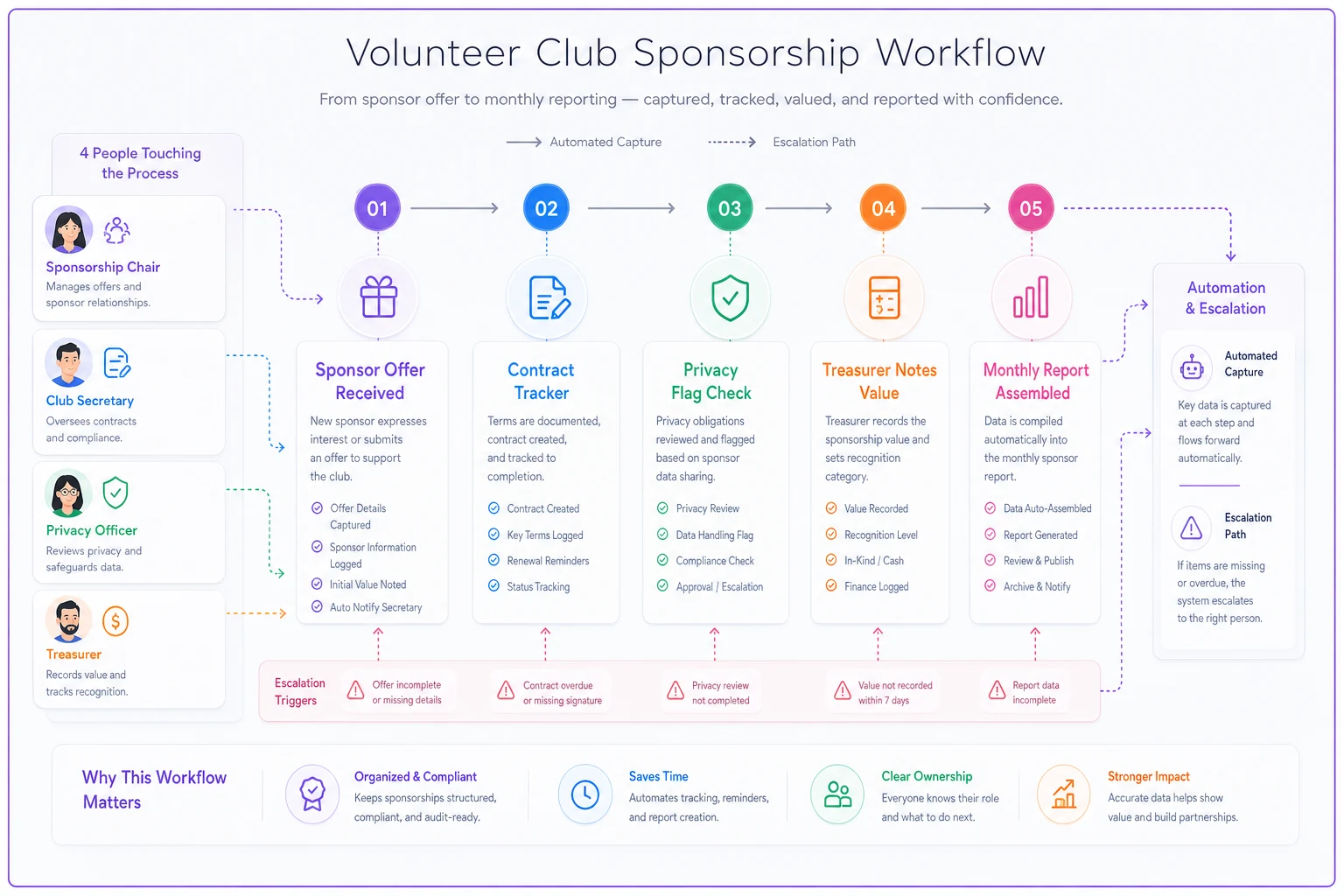
Four people touched it, each did one small thing, and all four actions landed in the monthly report automatically because the log is the report input. No one rebuilt anything. No decision lived only in someone's memory.
Board report templates: compact enough that they actually get used
The board report is where governance either compounds or collapses. If it takes six hours to produce, it gets produced badly and late. If it fits on a page, it gets produced on time and people actually read it.
A monthly one-pager structure that works:
-
Top line 3–4 numbers with a threshold color. Cash position vs. reserve floor, membership count vs. target, open risks (count), contracts expiring in 90 days.
-
Decisions needed this meeting bulleted, each with the owner and the threshold it crossed.
-
Changes since last month new contracts, new risks, resolved issues.
-
Watch list things not yet decisions but trending toward one.
The quarterly report adds the deeper reviews — full risk register walkthrough, finance trend lines, privacy/consent audit. Keeping monthly and quarterly distinct stops you from either overwhelming every meeting or letting the deep stuff go unreviewed for a year.
The mistake clubs make is trying to make the monthly report comprehensive. Comprehensive is the enemy of current. A board that sees four numbers every month and acts on them governs better than a board that sees forty numbers quarterly and acts on none.
The escalation matrix: sized for people who aren't on call
Corporate escalation matrices assume someone's reachable within an hour. Volunteer clubs can't assume that. So the escalation matrix has to account for realistic response times and build in fallbacks.
Structure it by severity, not by stream:
-
Routine (threshold crossed, no urgency)
owner handles, reports at next meeting.
-
Needs a decision before next meeting owner contacts the designated second signer; if no response in 48 hours, defaults to President.
-
Urgent — financial, legal, or member safety immediate notification to President + relevant stream owner, with a named backup for each role.
The detail people consistently forget: every role in the urgent tier needs a named backup. The President is on vacation exactly when the venue floods. If the matrix only names one person per tier, it fails at the worst possible moment.
For genuine emergencies — the ones that threaten the club's reputation, finances, or members all at once — the escalation matrix should hand off cleanly into a prepared crisis process rather than improvising. The board-ready crisis playbook covers how that handoff should work and what the board needs ready in advance.
A real scenario: what consolidation actually changes
Consider a regional hobby association — around 420 members, four event weekends a year, roughly $90k through the books annually. Before consolidating, governance lived across two spreadsheets, a shared drive of contracts, a risk list someone made in 2022, and a board report the Secretary rebuilt by email the week before each meeting.
The symptoms were ordinary. A sponsor contract auto-renewed because nobody tracked the renewal date, locking in an unfavorable rate for another year — a few hundred dollars' difference, but it stung. Board meetings routinely ran 90+ minutes just reconstructing financials. When the Treasurer stepped down mid-year, it took the replacement nearly two months to understand what commitments were outstanding.
After moving to a single governance page — thresholds defined, one-name RACI, a living log per stream feeding one monthly report — the changes were unglamorous but real. Board meetings tightened to under an hour because the numbers arrived settled, not debated. The contract tracker's 60-day renewal flag caught the next three renewals, including one they chose to renegotiate. The next officer handoff took a weekend instead of two months because the "state of the stream" snapshot actually existed.
No revenue miracle. No dramatic turnaround. Just a club that stopped losing small amounts of money and large amounts of volunteer time to disorganization — which, for a volunteer board, is exactly the win that matters.
When this makes sense — and when it's overkill
When it makes sense: You're past roughly 150–200 members, you handle real money (contracts, sponsors, reserves), you've had at least one "who was supposed to handle that?" moment, or you're facing a board turnover and want the system to survive it. Multi-event, multi-committee clubs hit the fragmentation wall fastest.
When it's overkill: A 40-member club with one annual event and a single bank account doesn't need an escalation matrix. A shared decisions log and one clear treasurer is enough. Building the full apparatus too early just creates maintenance work nobody has time for.
Who should NOT do this: Clubs where the real problem is a people conflict dressed up as a process problem. If two board members fundamentally disagree on direction, no RACI chart fixes that. Build the system when you have willing owners — not as a substitute for having them.
Bringing the streams together without drowning in tools
You can run most of this in shared documents if your club is disciplined. Thresholds in a table, a living log per stream, a one-page report template — none of it requires software. The software question only becomes worth asking when manual coordination starts failing at scale: when flagging renewals by hand gets missed, when feeding five streams into one report by email eats a weekend every month, when handoffs between owners keep dropping things.
That's where a workflow platform that centralizes the streams earns its keep — one place where a logged contract automatically surfaces in the renewal watch list, where crossing a threshold pings the right owner, where the monthly report assembles from the logs instead of from memory. Not because the technology is impressive, but because it removes the quiet coordination tax that burns out volunteer boards. The tool should do the remembering so your people can do the deciding.
Start with the thresholds and the one-name RACI. Those two artifacts, written on a single page, prevent more governance failures than any system you could buy. Everything else — the templates, the escalation matrix, the eventual software — is just scaffolding to keep those two things honest as the club grows and the people change.
Ready to streamline your club operations?
Join 500+ clubs using Clubyly to save time, boost member engagement, and grow their communities.