


Most clubs treat insurance as a once-a-year renewal email. Someone forwards the broker's quote, the treasurer squints at it, the board approves it because last year's version was approved, and everyone moves on. The problem shows up later — usually at the worst possible moment — when a vendor shows up without a certificate, a volunteer gets hurt setting up a tent, or a sponsor asks you to name them as additional insured and nobody knows what that means or whether your policy even allows it.
A real club insurance playbook isn't the policy document. It's the set of decisions, thresholds, and intake steps that sit between your governance decisions and your actual coverage. It answers the operational questions: who decides when we need more coverage, what counts as a high-risk event, which vendors must hand over certificates before they set up, and how do you check once a year that none of this quietly drifted out of date.
That translation layer is where small clubs fall apart. Not because they don't have insurance, but because the insurance isn't wired into how the club actually operates.
Why the gap exists in almost every club
Insurance lives in a weird spot. It's legal, it's financial, and it's operational all at once — which means it usually has no clear owner. The treasurer thinks of it as a line item. The board thinks of it as compliance. Event leads treat it as background noise until something goes wrong.
What tends to happen across volunteer-run organizations is that the coverage itself is usually fine. The decisions around the coverage are where things break. A policy sits untouched while the club's activity changes underneath it. You started as a book club, now you're running a 400-person outdoor festival with food vendors and a climbing wall, and you're still operating on a general liability policy written for monthly meetings in a library basement.
The failure is rarely "we had no insurance." It's "we had the wrong insurance for what we were actually doing, and nobody noticed because nobody was responsible for noticing."
This connects directly to how clubs handle risk escalation in general. If your board doesn't have a clean way to escalate decisions, insurance decisions get skipped too — which is exactly the pattern covered in common governance mistakes small clubs make. Insurance is just one more decision that falls through the cracks.
Translating governance into decision thresholds
The core move is converting vague governance language — "the board shall ensure adequate coverage" — into specific, numeric triggers that a volunteer can actually apply without calling the broker every time.
Keep your membership organized and engaged.
Clubyly simplifies member management, event coordination, and payment collection—effortlessly.
- Unified member database
- Automated payment tracking
- Event scheduling & reminders
No credit card required
Think of it as a decision table. Each row is an event or activity attribute, each threshold tells you what changes.
| Event attribute | Standard coverage is fine | Escalate: review before confirming |
|---|---|---|
| Expected attendance | Under ~150 | Over 150, or ticketed + public |
| Venue | Club-owned or regular rented space | New venue requiring their own COI |
| Physical activity | Low (talks, meetings, social) | Sports, water, heights, physical contest |
| Alcohol served | None | Any alcohol, especially if sold |
| Vendors/contractors on site | None | Any paid vendor, food, inflatables, equipment |
| Minors present | None/incidental | Programs serving minors directly |
| Sponsor/venue contract | None | Contract requiring additional insured status |
The point of thresholds is that they remove judgment from the moment of panic. A volunteer planning a summer BBQ with a bouncy castle doesn't need to understand liability law — they just need to see that "inflatables" and "alcohol" each cross a line, which triggers a review before the event is confirmed, not after someone's already paid a deposit.
A typical example looks like this: a 300-person club runs four event types a year. Three sit comfortably under every threshold. The fourth — their annual outdoor fundraiser — crosses four lines at once. That single event is where 90% of their real exposure lives, and now it's flagged automatically instead of discovered by accident.
One mistake worth naming: clubs set thresholds once and never revisit them after a growth jump. The threshold that made sense at 150 members quietly becomes nonsense at 600. Thresholds need a review date, same as the policy.
Certificate of insurance intake: the workflow that actually prevents problems
The certificate of insurance (COI) is the single most ignored operational artifact in club insurance. Everyone knows they're supposed to collect them. Almost nobody has a real workflow for it, so it becomes a frantic text message the morning of the event: "hey can you send me your insurance thing."
Here's the intake workflow that holds up at scale:
-
Request at contract, not at arrival. The moment a vendor is confirmed, the COI request goes out with a hard deadline — typically 10 business days before the event. Attach your exact requirements, not a vague "send us proof."
-
Specify what you actually need. Minimum coverage amount, that your club is listed as additional insured, and the specific event date and location. Vague requests get vague certificates back.
-
Check three things on receipt. Coverage limits meet your threshold, the policy dates cover the event, and your club name is spelled correctly as additional insured. This takes two minutes and catches most problems.
-
Store it where the event lead can find it. Not in someone's inbox. A shared, event-tagged location so that if a question comes up on site, the document is one search away.
-
Set a no-COI-no-setup rule. This is the enforcement piece. If the certificate isn't in hand, the vendor doesn't set up. It feels harsh until the one time it saves you.
Use a shared status board showing requested / received / verified for COIs.
A quick visual of the intake workflow:
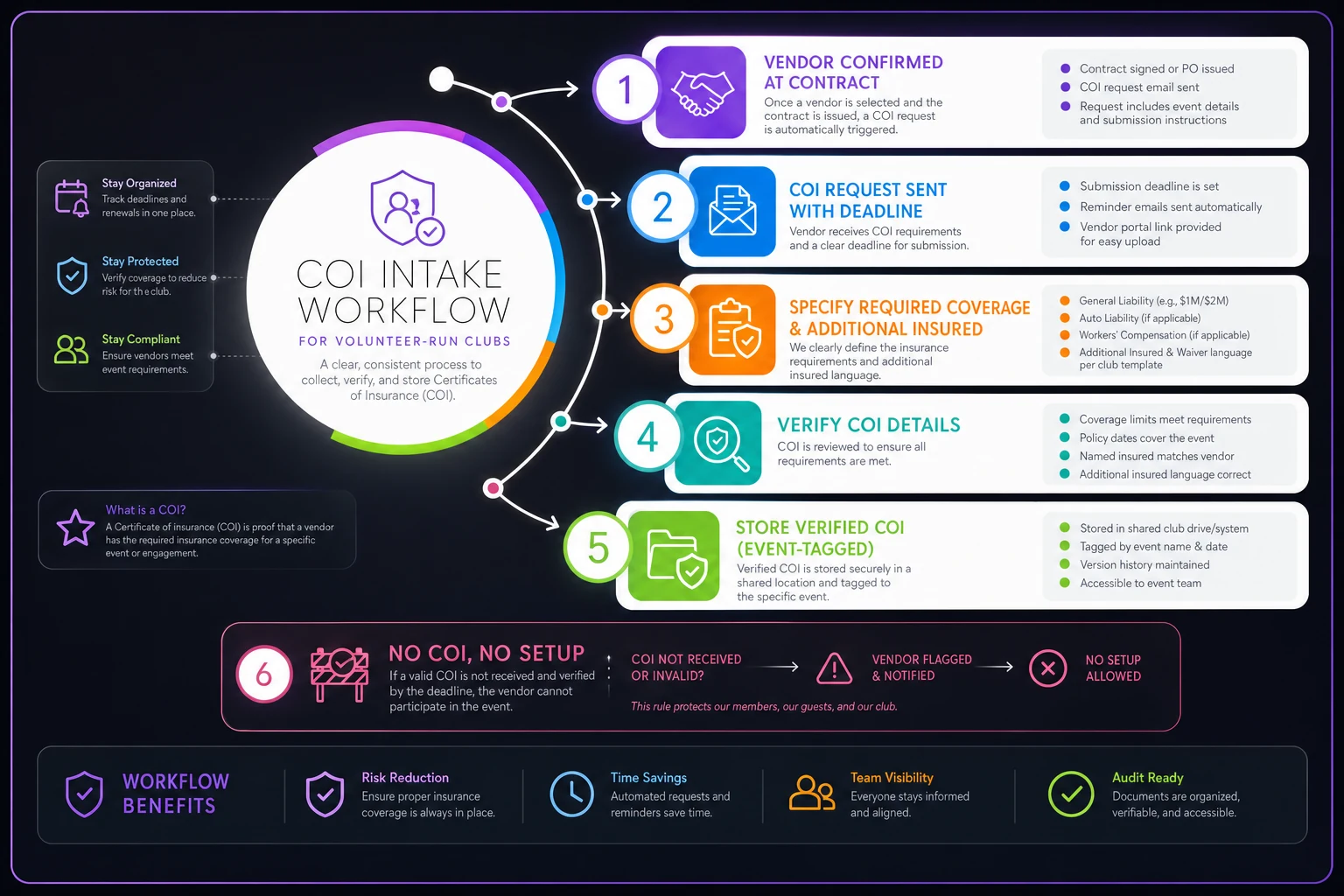
The breakdown almost always happens at step 3. Clubs collect the certificate, feel relieved, and never actually read it. A certificate that expired two days before your event, or lists a coverage limit a third of what you required, is worse than no certificate — it gave you false confidence.
What changes at scale: when you run two events a year, chasing COIs manually is annoying but survivable. At twenty events with dozens of vendors, manual tracking collapses. This is one of those workflows where a shared tracking system — even a simple status board showing requested / received / verified — prevents the "wait, did anyone check the caterer's certificate?" conversation that always happens 48 hours out. Some clubs wire this into their broader operations platform so certificate status sits next to the event record itself, but the principle matters more than the tool: the status has to be visible to the person running the event, not buried with the treasurer.
Vendor indemnity checklists: reading the fine print before you sign
Indemnity clauses are where clubs unknowingly take on risk that belongs to someone else. A vendor's standard contract will often include language that makes you responsible for their mistakes. Volunteers sign these without reading them because the event is next week and the vendor seems nice.
Before any vendor contract gets signed, run it through this checklist:
-
Who indemnifies whom? The clause should protect your club from the vendor's negligence — not the other way around. If it's one-directional against you, flag it.
-
Is there a mutual indemnity option? Mutual is usually fair and often acceptable to both sides.
-
Does the vendor carry their own insurance? Indemnity promises are worthless if the vendor has no coverage to back them. Cross-reference with their COI.
-
Are there caps or carve-outs? Watch for language limiting the vendor's liability to the contract value while leaving yours unlimited.
-
Hold harmless scope. Understand exactly what activities the hold-harmless language covers.
-
Does it survive the event? Some claims surface weeks later. Make sure the protection doesn't evaporate the day after.
Clubs tend to focus entirely on price and availability when selecting vendors, and the contract terms become an afterthought. But a cheap vendor with a hostile indemnity clause and no insurance is more expensive than a pricier one who carries their own coverage and signs mutual terms. This is the same evaluation discipline worth applying to any outside provider — it rhymes with the scorecard approach in technology procurement for volunteer-run clubs. You're scoring vendors on risk, not just cost.
When to actually walk away: if a vendor's contract makes you liable for their negligence and they can't produce proof of their own insurance, that's a walk-away, not a negotiation. The convenience is never worth the exposure.
A volunteer-friendly annual audit checklist
The annual audit is where you catch the slow drift — all the little ways your actual operations diverged from your coverage over twelve months. The trick is making it simple enough that a non-expert volunteer can run it in an afternoon.
Here's the annual checklist, built to be done by someone who is not an insurance professional:
-
[ ] Pull the current policy and read the summary page. Confirm coverage types and limits match what you think you have.
-
[ ] List every event type you actually ran this year. Compare against your decision thresholds. Did any new activity emerge that your policy doesn't contemplate?
-
[ ] Check membership and attendance growth. Has the club grown enough to cross a threshold since the last review?
-
[ ] Confirm named individuals are current. Board members, officers, and anyone named on the policy — are they still the right people?
-
[ ] Review all vendor COIs collected. Were any missing? Any that came in non-compliant and got used anyway?
-
[ ] Verify policy renewal dates and payment status. A lapsed policy because an auto-payment failed is more common than anyone admits.
-
[ ] Check for new assets or equipment. New sound system, trailer, or storage unit? Those may need coverage.
-
[ ] Confirm your certificate requests are standardized. Is everyone using the same template and thresholds?
-
[ ] Document gaps and assign owners. Every gap gets a name and a date attached, not just a note.
The mistake to avoid: running the audit as a solo task with no handoff. One person reviews everything, finds three gaps, and the findings die in their notebook because there's no mechanism to escalate. The audit only has value if gaps flow into a decision — which means it should feed straight into your board's risk process. If you've already got a crisis-response structure in place, the audit output should slot into it. The board-ready crisis playbook for small clubs is a natural home for anything the audit surfaces as an active risk.
A real scenario: the festival that almost wasn't covered
A regional hobby club — roughly 450 members — ran a modest annual meetup for years. Attendance crept up, and by one summer they were hosting a public outdoor event with food trucks, a sponsor tent, and around 700 attendees. Their policy hadn't changed in four years.
Six weeks out, a new volunteer happened to ask the broker whether food vendors were covered. They weren't — not the way the club assumed. The club had been operating on a policy written for 150-person indoor gatherings. Two of their three food vendors had no COI on file at all.
The fix cost them a rider plus a short scramble to collect certificates — somewhere in the range of a few hundred dollars and about two weeks of back-and-forth. Compare that to the downside: a single injury claim at an uncovered public event could run into the tens of thousands, and for a volunteer-led club that's existential.
What actually changed afterward wasn't the policy. It was the process. They built decision thresholds, a COI intake step tied to vendor confirmation, and an annual audit on the calendar. The next year, the same event ran with every vendor certificate verified two weeks ahead and no last-minute scramble. The coverage was almost identical. The difference was that someone finally owned the translation between what the club was doing and what it was insured for.
Who should slow down before overbuilding this
Not every club needs the full apparatus. A 40-person book club that meets in a member's living room does not need a seven-row decision table and a vendor indemnity checklist. For them, "do we have basic general liability, and did we read it" covers most of reality.
The playbook earns its weight when you cross into any of these: public events, paid vendors, physical activities, alcohol, minors, or sponsor contracts that impose requirements on you. If you're doing none of those, keep it light. If you're doing even two of them regularly, the structure here is the difference between a manageable renewal and a very bad surprise.
Insurance isn't a document you buy — it's a set of decisions you keep making as the club changes. The clubs that get burned aren't uninsured. They're the ones whose operations outgrew their coverage while nobody was assigned to notice. Build the thresholds, wire the certificate intake into how events actually get confirmed, read the indemnity clauses before you sign, and run the audit once a year with a real owner. That's the whole game.
Ready to streamline your club operations?
Join 500+ clubs using Clubyly to save time, boost member engagement, and grow their communities.