



Most clubs don't decide to become a federation. It happens to them. A second city asks to run its own events. A member moves and wants to start a group where they land. Suddenly you've got two chapters, then four, and nobody actually designed the structure that now holds thousands of members, a shared bank account, and a volunteer board that never signed up to run a multi-site operation.
The failure mode here isn't dramatic. It's slow. Chapter two does dues differently than chapter one. Chapter three keeps its own member list in a spreadsheet nobody else can see. By the time you have six chapters, you have six versions of the truth, three incompatible payment flows, and a treasurer who can't close the books because two chapters haven't reconciled since spring.
This is a roadmap for doing it on purpose instead. Not a growth pitch — an operational sequence with clear decision points, so you know what to centralize, when, and what has to be true before you add the next chapter. The guiding principle: expand capability before you expand footprint. Most clubs do it backwards.
Why scaling breaks differently than single-chapter problems
A single chapter's problems are local. If your event sign-up is messy, one group of volunteers feels the pain and fixes it. Federation problems are structural — they live in the seams between chapters, which means no single group owns them and no single group can fix them.
-
Coordination cost shows up. With one chapter, decisions happen in a group chat. With five, you need a decision rule or every small question becomes a federation-wide debate.
-
Data stops being one list. Members join through different chapters, move between them, hold roles in two at once. The question "how many members do we have" becomes genuinely hard to answer.
-
Money crosses boundaries. Shared costs — insurance, software, a national event — have to be split, billed, and collected. That's where politics enters, usually loudly.
Clubs that scale badly tend to treat these as familiar problems, just bigger. They're not. A federation is a structurally different kind of organization, and the mistakes compound.
Before going further, it's worth being honest about where you actually are on the operations maturity curve, because a club that can't reliably close its own books has no business adding a third chapter.
The stage-gate model: five stages, four gates
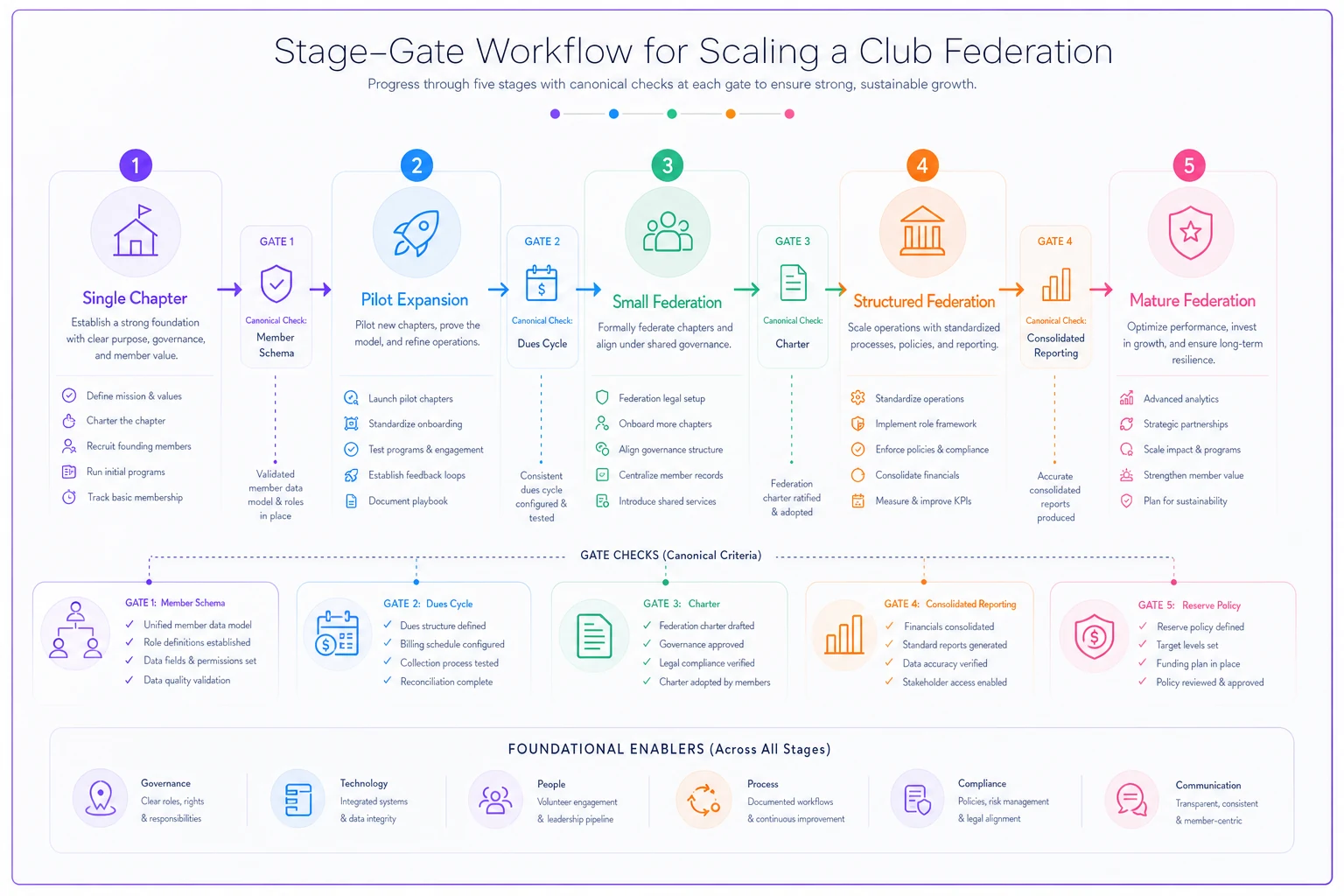
Think of scaling as five stages with a gate between each. A gate is a set of conditions that must be true before you spend money or energy on the next stage. The whole point is to stop clubs from skipping ahead because one enthusiastic volunteer in another city is eager to launch.
Keep your membership organized and engaged.
Clubyly simplifies member management, event coordination, and payment collection—effortlessly.
- Unified member database
- Automated payment tracking
- Event scheduling & reminders
No credit card required
| Stage | What it looks like | Gate to pass before advancing |
|---|---|---|
| 1. Single chapter | One group, one bank account, one member list | Documented SOPs for dues, events, onboarding that someone other than the founder can run |
| 2. Pilot second chapter | Two chapters, shared brand, separate finances | Both chapters using the same member schema and dues cycle; one quarter of clean books |
| 3. Small federation (3–5) | Multiple chapters, emerging shared services | A written charter, defined shared-services list, a chargeback method everyone agreed to |
| 4. Structured federation (6–12) | Central coordination layer exists | Consolidated reporting working; chapters can onboard from a repeatable blueprint, not a phone call |
| 5. Mature federation (12+) | Formal governance, paid or semi-paid roles | Reserve policy at federation level; rollback and chapter-closure procedures tested |
The uncomfortable truth in this table is Stage 1's gate. A surprising number of clubs can't actually pass it.
If the only person who knows how onboarding works is the founder, you don't have a chapter you can replicate — you have a founder you can't clone. Fix that before anything else.
This diagram shows the stages and gates as a simple workflow.
Fix that before anything else.
Stage 2: the pilot chapter is a test, not a launch
The second chapter should be treated like a pilot program, with the honest possibility that you pull it back. Pick a chapter lead who's organized and a little skeptical, not the loudest volunteer. Give them your SOPs and watch what breaks.
What usually breaks first is the member schema. Chapter one has been tracking members with fields that made sense locally — maybe a "committee" field, maybe a free-text "notes" column full of institutional memory. Chapter two doesn't have that history and invents its own fields. Within a couple months you have two data models that can never be merged cleanly.
So the pilot's real job is to force a canonical schema. Everyone records members the same way: same required fields, same status values, same definition of "active." This is boring work, and it's also the single most valuable thing you'll do during scaling. Get it wrong and every later migration inherits the mess.
A pilot also tests the dues cycle. If chapter one renews annually in January and chapter two renews on each member's join date, your treasurer now reconciles two completely different cash-flow patterns. Pick one model before the pilot, not after.
Pilot cutover checklist
-
Member records match the canonical schema — no extra fields, no missing required ones
-
Dues cycle and amounts are documented and match the federation standard (or there's a written exception)
-
A shared place exists for chapter documents that the central team can see
-
The chapter lead has run one full event using the shared SOP
-
There's a named person who handles the chapter's money and knows the reporting deadline
-
You've agreed what "rollback" means — if the pilot fails, who holds those members and that money
That last point matters more than people think. A rollback trigger might be: the pilot chapter misses two consecutive reporting deadlines, or dues collection falls below a threshold that makes it financially unviable. Decide these before emotions are involved.
Stage 3: writing a charter that volunteers will actually follow
Around three to five chapters, informal agreements stop working. You need a charter — but one written like a legal document will sit unread. The version that works for volunteer teams is short and answers the questions that actually cause fights.
A workable charter covers:
-
What's decided centrally vs. locally. Brand, member data standards, and insurance are usually central. Event themes, local pricing within a band, and volunteer recruitment stay local. Writing this down prevents the slow creep where the center grabs decisions it doesn't need. If you're unsure where to draw the line, this breakdown of centralization mistakes in multi-chapter clubs is worth reading before you draft anything.
-
Money split. What costs are shared, how they're allocated, and when chapters pay.
-
Admission and closure of chapters. How a new chapter joins, and — this gets skipped constantly — how a dying chapter winds down and what happens to its members and funds.
-
Dispute handling. A named escalation path so disagreements don't become chat-thread wars.
-
Data and privacy obligations. Who can see whose member data across chapter lines, which is both an ethical and increasingly a legal question.
The mistake is writing the charter for the federation you imagine having in five years. Write it for the one you have now, with a clause that says how it gets amended. Over-engineered governance dies of neglect.
Shared services: decision rules, not a free-for-all
Shared services — a common software platform, bulk insurance, a single payment processor — are where federations find real savings and real conflict. The conflict comes from one question: who pays, and how much?
A simple decision rule for whether something should be shared at all:
-
Share it if it's cheaper at scale AND the same for everyone (insurance, member software, accounting).
-
Keep it local if quality depends on local knowledge (event programming, partnerships, volunteer culture).
-
Offer it optionally if some chapters want it and others don't — and bill only the ones who use it.
Once you've decided to share something, you need a chargeback method. The three common ones:
| Chargeback method | How it works | Best when |
|---|---|---|
| Flat per-chapter | Every chapter pays the same | Costs don't scale with size; chapters are roughly equal |
| Per-member | Split by active member count | Large and small chapters coexist; usage tracks membership |
| Usage-based | Pay for what you consume | Optional services, uneven adoption |
Per-member is usually the fairest for core shared costs and the easiest to defend when a small chapter complains it's subsidizing a large one. The mechanics of setting this up without a political mess — SLAs, a chargeback calculator, billing templates — are worth getting right early. This guide on inter-chapter shared services covers the lightweight version that doesn't require a finance committee to run.
One rule that prevents a lot of resentment: never let shared-service costs be invisible. When a chapter can see exactly what they're paying for and why, they argue less. Hidden cross-subsidies are what blow up federation finances, usually at the worst possible moment.
The data and finance migration: the part everyone underestimates
Technically merging or consolidating chapter data is where scaling quietly fails. The pattern that burns people: a federation decides to move everyone onto one system, does it all in a single weekend, discovers two chapters' member lists had overlapping and conflicting records, and spends the next month untangling it while members get double-billed.
Do it in phases instead.
Phase 1 — Freeze and snapshot. Before touching anything, each chapter exports its current member list and financial records as of a fixed date. This is your rollback point. If migration goes sideways, you can return to exactly this state.
Phase 2 — Normalize offline. Map every chapter's fields to the canonical schema in a staging copy, not the live system. This is where you find the duplicates — the member who belongs to two chapters, the three records that are actually the same person. Resolve these before anything goes live.
Phase 3 — Migrate one chapter at a time. Move the cleanest chapter first. Let it run live for a full dues cycle or at least a few weeks. Watch for billing errors, login problems, missing members. Only then move the next.
Phase 4 — Reconcile finances. For each migrated chapter, confirm that the dues collected in the new system match what was expected from the snapshot. A single unreconciled chapter can hide a real cash problem for months.
Rollback triggers worth defining in advance
-
More than a small percentage of members can't access their accounts after migration
-
Payment processing errors above an agreed threshold
-
Any chapter's financial records can't be reconciled to its pre-migration snapshot
-
A chapter lead reports they've lost confidence they can run operations on the new system
Hitting a trigger doesn't always mean full rollback — sometimes it means pausing further migrations while you fix the issue. "We'll figure it out if something breaks" is not a plan. Decide the thresholds while everyone's calm.
A real scenario: a hobby federation that scaled the hard way, then the right way
A regional interest club — a few hundred members across a metro area — grew to four chapters in about eighteen months. Each chapter had collected dues its own way: one through an online form, one through cash at meetings, one through a treasurer's personal payment app. Consolidated membership was somewhere "around 600," but nobody could produce the real number because the lists overlapped and nobody trusted any single export.
The first attempt at consolidation was a big-bang migration over a holiday weekend. It failed. Around 40–50 members ended up duplicated across chapters, a batch of renewal emails went to people who'd already paid, and two chapter leads nearly quit over the double-billing complaints.
They rebuilt the approach around stage gates. First they froze everyone's data and built a canonical schema, which surfaced that the "600" was really closer to 540 once duplicates were merged. Then they migrated the smallest, cleanest chapter first and let it run a full renewal cycle before touching the others. Dues collection, which had been leaking an estimated few thousand dollars a year to missed and untracked renewals, tightened up noticeably once every chapter billed on the same cycle through one system. The whole migration took about a quarter instead of a weekend — and it actually held.
The lesson wasn't "use better software." It was "sequence the work so a failure in one chapter can't take down the federation."
Chapter onboarding, sized for volunteers
By Stage 4 you should be able to onboard a new chapter from a blueprint, not a series of favors from the founder. A volunteer-sized onboarding blueprint has three parts: a short role pack for the chapter lead, a 30-day setup sequence, and a defined support contact for the first quarter.
The setup sequence in plain terms:
-
Week 1 — Charter signed, chapter lead gets access to shared systems and SOPs, member schema explained.
-
Week 2 — Payment and dues setup on the standard cycle; first members entered using canonical fields.
-
Week 3 — First event planned using the shared runbook; central team reviews before it goes live.
-
Week 4 — First reporting cycle completed, even if numbers are tiny. The habit matters more than the data at this point.
The reason this needs to be a blueprint and not a mentorship is capacity. Your founder cannot personally onboard the ninth chapter the way they onboarded the second. If onboarding doesn't become repeatable, your growth ceiling is literally one person's calendar.
When this roadmap makes sense — and when it doesn't
This makes sense when you have genuine demand in multiple locations, a stable core chapter that can model good operations, and at least one or two people willing to do unglamorous coordination work. Federation is overhead; it only pays off if the local energy is real.
This is a bad idea when your core chapter is still shaky. Scaling a broken operation just gives you more broken operations in more places. If chapter one can't close its books or keep a clean member list, fix that first.
Who should not do this: clubs chasing growth for its own sake, or because a board member likes the idea of "going national." If nobody's asking to start a chapter, don't manufacture one. And if your volunteer base is already stretched thin, adding coordination overhead will burn out the people you depend on faster than any single-chapter problem would.
Where software quietly helps — and where it doesn't
A shared operational platform earns its keep in exactly the places manual coordination breaks: keeping one canonical member list across chapters, running the same dues cycle everywhere, and giving the treasurer consolidated numbers without chasing six spreadsheets. Automated dues reminders and reconciliation cut the drip of missed renewals that every federation leaks. Modern platforms handle a lot of this matching and routing automatically, which is genuinely useful when the alternative is a volunteer manually de-duplicating lists at midnight.
But software won't write your charter, decide your chargeback rule, or tell you whether that third chapter is ready. Those are judgment calls, and no tool makes them for you. The clubs that scale well treat the platform as the thing that enforces decisions they already made — not as a substitute for making them.
The bottom line
Scaling to a federation is mostly about sequencing and honesty. Sequencing, so failures stay contained to one chapter instead of cascading. Honesty, about whether your core operation is actually ready to be copied. The stage gates exist to make you pause at exactly the moments when enthusiasm wants to skip ahead — and enthusiasm, more than any technical problem, is what sinks most multi-chapter scaling efforts. Build the capability first. The footprint can wait a quarter.
Ready to streamline your club operations?
Join 500+ clubs using Clubyly to save time, boost member engagement, and grow their communities.