

Most new systems in volunteer-led clubs don't fail because the tool was bad. They fail because adoption was treated like a launch instead of a slow pull-through across people who each have maybe 90 minutes a week to give you — and that's on a good week.
You roll out the new membership platform. Three enthusiastic volunteers log in. Everyone else keeps using the old spreadsheet, the Facebook group, or whatever lives in their head. Six weeks later you're running two systems in parallel, the data is split, and the board is asking why the "upgrade" made things slower. That's not a technology problem. That's an adoption design problem.
A real volunteer adoption playbook treats your rollout like a sequence of tiny, survivable commitments — small enough that busy people actually do them, structured enough that you can measure whether they're sticking. This is the full template: a six-week micro-training and pilot cohort, with the scripts, KPIs, rollback triggers, and dashboards you can run without hiring anyone or begging for extra hours.
Why adoption breaks in volunteer orgs specifically
Paid staff adopt systems because their manager told them to and their paycheck depends on it. Volunteers adopt systems because the new way is obviously less annoying than the old way — or they don't adopt at all. There's no leverage. You can't fire a volunteer for not updating the CRM.
-
The enthusiasm cliff. Week one everyone's excited. Week three the novelty's gone, nobody's reinforced anything, and people quietly revert. Adoption that depended on motivation always collapses around the three-week mark.
-
The single-champion trap. One tech-comfortable volunteer does 80% of the real usage. When they go on vacation or burn out, the whole thing stalls. You didn't build adoption; you built a dependency.
-
The silent fork. Half the team uses the new system, half uses the old one, and nobody says so out loud. You find out when two people email the same lapsed member about renewal, using two different data sources.
What ties all three together: nobody defined what "adopted" actually means, so nobody could tell it wasn't happening. Adoption without a measurement is just hope.
The structure: why six weeks and why a cohort
Six weeks is long enough to get past the enthusiasm cliff and short enough that volunteers can see the finish line. A cohort — a defined small group going through it together on the same schedule — beats "everyone learn at their own pace" because shared timing creates gentle peer accountability without you having to nag anyone.
Keep your membership organized and engaged.
Clubyly simplifies member management, event coordination, and payment collection—effortlessly.
- Unified member database
- Automated payment tracking
- Event scheduling & reminders
No credit card required
Keep the first cohort small. Four to eight people. Resist the urge to put everyone in at once. A tight pilot group gives you something a full rollout never does: the ability to catch problems while they're cheap to fix, and a group of credible internal advocates who can later teach the next wave. You want a rollback path that doesn't torch the whole org.
Here's the week-by-week shape. The weekly time cost per volunteer is the number that matters most — if any week demands more than about 30 minutes, people fall off.
| Week | Focus | Volunteer time | What you're actually testing |
|---|---|---|---|
| 1 | Onboarding + first real task | ~20 min | Can they log in and complete one meaningful action unaided? |
| 2 | Core workflow, repeated | ~25 min | Does the main task stick without hand-holding? |
| 3 | Edge cases + the "annoying" step | ~30 min | Where does friction actually live? |
| 4 | Independent run, light support | ~20 min | Can they do it without the champion? |
| 5 | Peer teaching + data check | ~25 min | Can they explain it to the next person? |
| 6 | Pilot review + go/no-go | ~30 min | Do we expand, hold, or roll back? |
Notice weeks 4 and 5. The real goal of adoption isn't "people can use it" — it's "people can use it when you're not there, and can hand it to the next volunteer." That's the difference between adoption and a hostage situation.
Week-by-week: what actually happens
Weeks 1–2: get one real task done, not a tour
The most common onboarding mistake is giving a full feature tour. Volunteers don't retain tours. They retain doing one thing that mattered. Week one isn't "here's everything the system does" — it's "log in and complete this single real task that you'd have done anyway."
For a membership system, that might be: update your own volunteer profile and check in to the next event. For a scheduling tool, it's claiming one shift. Real data, real stakes, tiny scope.
> Hey [name] — you're in the pilot group for [system], thanks for jumping in. This week there's just one thing: log in here [link], update your profile, and check into Saturday's event. Should take under 15 minutes. If anything's confusing, reply here — that confusion is exactly what we're trying to catch. Not a you problem, a system problem.
That last line matters more than it looks. It reframes every stumble as useful data instead of personal failure, which is what keeps people from going quiet when they get stuck.
Week 3: deliberately hit the friction
Every system has an annoying step — the double entry, the confusing field, the thing that takes four clicks. Week three is where you walk people straight into it, on purpose, with support standing by.
Why on purpose? Because if you hide the friction, volunteers discover it alone later, decide the system is bad, and quietly leave. If you surface it together, you either fix it or build a shared workaround, and the group stops treating it as a dealbreaker.
This is also where your rollback triggers start earning their keep. If week three reveals that the "annoying step" is actually a core workflow nobody can complete reliably, that's not a training issue — that's a signal the tool might be wrong for your club. Better to learn it now, with six people, than after you've migrated 400 member records.
Weeks 4–5: remove the champion on purpose
In week four, the person who's been answering every question goes quiet. Not gone — just hands-off. Available for emergencies, but no proactive help.
This is the single best test of real adoption. If usage holds when the champion steps back, you have a system. If it collapses, you have a champion with a tool, which is fragile. Clubs lose adoption constantly this way, and it ties directly into the broader problem of volunteer leadership gaps — any capability that lives in one person's head walks out the door when they do.
Week five flips it: each pilot volunteer teaches one incoming person a single task. Teaching forces mastery and seeds your next cohort simultaneously. You're not training ten people one at a time; you're training a group that trains the next group.
Week 6: the honest go/no-go
Week six is a 30-minute review with a real decision at the end, not a celebration. Three outcomes allowed: expand (roll to the next cohort), hold (fix specific issues, extend the pilot two weeks), or roll back (this tool isn't working, revert cleanly).
Most clubs skip the rollback option emotionally — too much was invested to admit it's not landing. That's exactly why you defined rollback triggers up front, before anyone was attached.
Here's a simple visual of the six-week workflow.
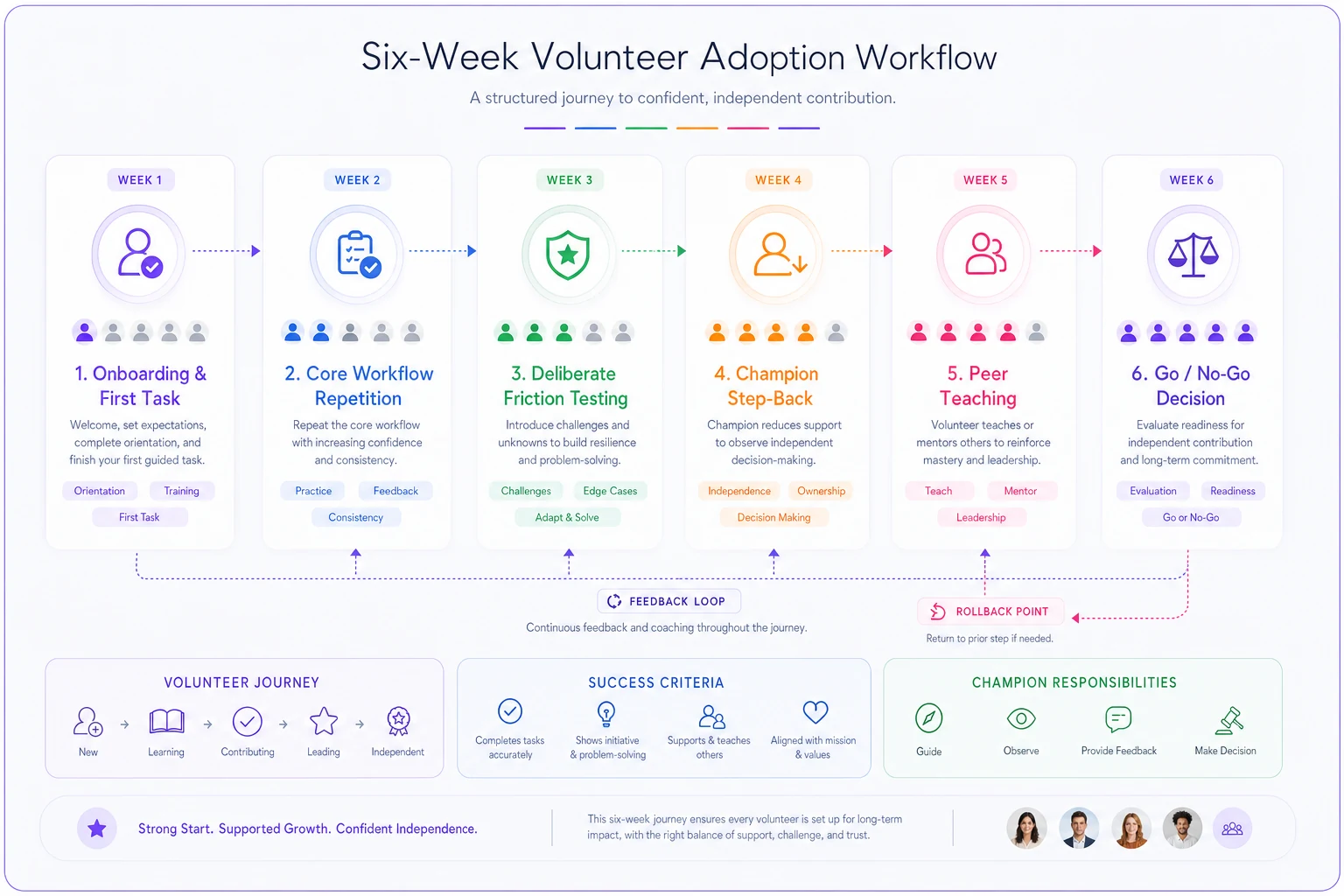
Week six is a 30-minute review with a real decision at the end, not a celebration. Three outcomes allowed: expand (roll to the next cohort), hold (fix specific issues, extend the pilot two weeks), or roll back (this tool isn't working, revert cleanly).
KPI definitions you can actually track
Vague adoption goals ("get everyone using it") can't be measured, so they can't be managed. Four concrete signals is plenty.
-
Activation rate — % of pilot members who completed the week-one task unaided. Target: 80%+. Below that, your onboarding is too heavy.
-
Sustained usage — % still completing the core task in weeks 4–5 without prompting. This is the number that predicts real adoption. Target: 70%+.
-
Champion dependency — % of tasks that required the champion's help. You want this falling week over week. If it's flat into week 4, adoption isn't transferring.
-
Fork rate — how often people still used the old system or spreadsheet for the same task. Anything above roughly 20% by week 4 means you've got a silent fork forming.
The trick is that these are tiny to collect. A short weekly pulse — "did you complete the task? did you need help? did you also use the old way?" — three yes/no questions — gives you all four KPIs. You're not building analytics infrastructure here.
Rollback triggers: decide before you're emotional
Write these down in week zero and get the board or lead to agree. The whole point is to make the hard call mechanical instead of political.
-
Sustained usage drops below 50% by week 4 → hold and diagnose; this isn't working as designed.
-
Fork rate stays above 30% past week 3 → the old system is winning; find out why before expanding.
-
A core workflow can't be completed by more than one or two people → likely a tool-fit problem, not a training problem.
-
Champion dependency hasn't fallen at all by week 5 → you're building a single point of failure; stop and restructure.
Any single trigger doesn't mean abandon ship — it means pause the expansion and look. Rollback isn't failure. Rolling a broken system out to the whole club is. This same mindset applies to any technology procurement decision — you commit in stages, not in one leap.
Pilot rules that keep it small and honest
A few guardrails keep the cohort from sprawling:
-
No parallel full rollout. The pilot group uses the new system for the piloted task; everyone else waits. Running both at full scale guarantees a fork.
-
One task at a time. Don't pilot the whole platform. Pilot one workflow — event check-in, shift claiming, member updates. Expand scope only after the first one sticks.
-
The champion schedules themselves out. The step-back in week 4 is non-negotiable; it's the test, not a scheduling accident.
-
Friction gets logged, not absorbed. Every stumble goes in a shared doc. If three people hit the same wall, that's a system issue to fix, not three separate "user errors."
-
The go/no-go is honest. Week six allows rollback as a real, respected outcome.
Week six allows rollback as a real, respected outcome.
A tiny-team adoption dashboard
You don't need software to track this. A single shared sheet with one row per pilot volunteer and one column per week does the job. Each cell holds a simple status:
-
✅ completed task, no help
-
🟡 completed, needed help
-
🔴 didn't complete
-
🔁 used the old system instead
Scan the grid weekly. Green spreading right across means adoption's taking hold. A column full of 🔁 means a fork. A row stuck on 🟡 means one person needs a nudge before they go silent. The visual pattern tells you more in ten seconds than a report would.
Make the "needed help" column required in the sheet so you can quickly calculate champion dependency without extra steps.
One thing worth noting: once a workflow is genuinely adopted, that's when automation actually pays off. A reminder or backfill rule bolted onto a system nobody uses just annoys people. But layered onto an adopted workflow — like the kind of reminder logic in automated volunteer schedules — it quietly removes the manual chasing that burns volunteers out. Adoption first, automation second. Reverse that order and the automation becomes noise.
A real scenario
A regional hobbyist club, around 180 members run entirely by volunteers, moved from a shared spreadsheet to a proper membership and event system. Their first attempt — full rollout, one training call, "please start using it" — produced the classic split. Maybe three of fifteen active volunteers actually used it after a month. The rest kept the spreadsheet alive because it was familiar, and two members got double-contacted about dues from conflicting lists.
They reset and ran a six-week cohort instead. Five volunteers, one task to start: event check-in. Week one activation was four of five. The friction surfaced in week three was a clunky search field; they built a shared shortcut rather than fighting it. The champion stepped back in week four and usage held — four of five still checking members in unaided. By week six they expanded to a second cohort, and the pilot volunteers did the teaching.
The numbers weren't dramatic, which is kind of the point. Sustained usage sat around 75–80% instead of the roughly 20% from the first attempt. The fork basically closed. And the thing they actually bought with those six weeks wasn't speed — it was a system that survived one volunteer going on a three-week trip without quietly dying.
When this makes sense — and when it doesn't
This cohort approach is worth the effort when the system genuinely changes how volunteers work day to day: a new CRM, scheduling platform, event tool, anything with recurring tasks. The slow pull-through is what gets you past the enthusiasm cliff.
It's overkill for a truly trivial change — swapping one email tool for a near-identical one where the task is unchanged. Don't run a six-week pilot to change a button color. And it falls apart when leadership won't honor the go/no-go. If the decision to adopt was already made politically and rollback isn't allowed, the pilot is theater, and your volunteers will sense it. Who should not do this: anyone trying to roll a new system to their entire volunteer base at once to "save time." That shortcut is what creates the two-system mess in the first place. Slower and staged genuinely gets you there faster.
The real takeaway
Adoption in a volunteer org isn't won in the training session. It's won in week four, when the champion goes quiet and you find out whether you built a system or just a dependency. Everything in this playbook — the tiny tasks, the deliberate friction, the step-back, the honest go/no-go — exists to answer one question early and cheaply: does this survive without the person who set it up?
Get that right with five people over six weeks, and expanding to the whole club becomes almost boring. Skip it, and you'll be running two systems in parallel, wondering why the upgrade made everything harder. The playbook isn't about the tool. It's about building something your next volunteer can inherit without you in the room.
Ready to streamline your club operations?
Join 500+ clubs using Clubyly to save time, boost member engagement, and grow their communities.