


Most clubs don't have a volunteer problem. They have a continuity problem dressed up as a volunteer problem.
You'll hear it phrased a dozen different ways. "We can't find people." "Our best volunteer burned out." "Nobody wants to lead next year." But when you actually map what's happening, the shortage isn't the root cause. The root cause is that recruitment, onboarding, scheduling, retention, and succession are all run as separate, disconnected efforts — usually by different people, in different tools, with no shared memory. Someone recruits enthusiastically in September, but nobody tracks whether those recruits ever got a real role. Someone builds a solid schedule, but nobody notices when a volunteer quietly stops showing up. Someone panics in June because the treasurer is leaving and there's no successor.
Each piece works fine on its own. The system fails at the seams.
This article is about those seams. Instead of treating volunteer management as five separate jobs, we'll treat it as one lifecycle with defined handoffs, a small set of KPIs that actually matter, and a reusable playbook you can copy per role. The goal is a volunteer operations system for clubs that connects the day someone raises their hand to the day they hand off responsibility to the next person — without anything falling through the cracks in between.
The lifecycle is one pipeline, not five departments
The mental shift that changes everything: a volunteer isn't "recruited" then later "scheduled" then eventually part of "succession planning." They move through a single pipeline, and every stage feeds the next.
-
Recruitment — someone expresses interest and gets matched to a role
-
Onboarding — they get context, access, and a first real task
-
Scheduling — they show up on a predictable rhythm
-
Retention — they stay engaged, feel useful, and don't burn out
-
Succession — they help train or mentor whoever comes next
The reason clubs struggle is that these stages are owned by different people who rarely talk to each other. The membership chair recruits. The events lead schedules. The board worries about succession. Nobody owns the transitions between stages, and those transitions are exactly where volunteers get lost.
A typical example: a club runs a recruitment drive and signs up 18 new volunteers at an open house. Everyone celebrates. Three months later, maybe 4 of those 18 are actually doing anything. What happened to the other 14? They filled out a form and then nothing — no handoff to onboarding, no first task, no follow-up. The recruitment worked. The handoff didn't.
That's not a recruitment failure. That's a pipeline with a broken seam between stage one and stage two.
Why this breaks the same way in almost every club
The pattern repeats across clubs of wildly different sizes and purposes — hobby groups, sports leagues, professional associations, alumni chapters. The specifics differ, the failure mode doesn't.
Keep your membership organized and engaged.
Clubyly simplifies member management, event coordination, and payment collection—effortlessly.
- Unified member database
- Automated payment tracking
- Event scheduling & reminders
No credit card required
Volunteer roles rely on individual memory, not documented process. The person who runs registration knows how because they've done it for three years. None of it is written down. When they leave, the knowledge leaves with them, and the next person rebuilds from scratch — usually badly, and usually while stressed.
No single view of where each volunteer sits in the lifecycle. Interest lives in an email inbox. The schedule lives in a spreadsheet. Who's about to quit lives in someone's head. Because the data is scattered, nobody can look at one place and say "we have four people stuck at onboarding and two flight risks in retention."
Handoffs depend on someone remembering to do them. When a recruit signs up, does anyone get automatically notified to reach out? Usually not. It depends on the membership chair remembering — and the membership chair is a volunteer too, with a day job and a life.
Everything is reactive. Clubs tend to only think about succession when someone announces they're leaving, only think about retention when someone's already gone, and only think about recruitment when they're already short-handed. By the time the problem is visible, the cheap window to fix it has closed.
The through-line is coordination. In a small volunteer team, coordination overhead is the silent killer. Nobody has spare hours to chase status updates, so status updates just don't happen, and the pipeline quietly leaks at every stage.
What actually breaks as the club grows
A 20-person club can run on memory and goodwill. A 200-person club cannot, and the failure isn't gradual — it hits a wall.
| Aspect | Small club (~20 volunteers) | Growing club (~80+ volunteers) |
|---|---|---|
| Recruitment tracking | One person remembers everyone | Sign-ups get lost; no one owns follow-up |
| Onboarding | Informal, over coffee | Inconsistent — depends who greets you |
| Scheduling | A shared spreadsheet works | Conflicts, no-shows, constant swap chaos |
| Retention signals | You notice when someone's fading | People disappear unnoticed for months |
| Succession | Founder does most critical roles | Multiple single points of failure emerge |
The dangerous part is the middle. At around 40–70 active volunteers, the informal system feels like it's still working — right up until two or three key people leave in the same quarter and the whole thing wobbles. That's when boards suddenly realize half their operations depended on three exhausted individuals who never wrote anything down.
Scale exposes single points of failure you didn't know you had. The treasurer who also secretly manages vendor relationships. The events lead who's the only person with the venue contacts. The webmaster who set up the email system four years ago and is the only one with the password. None of these are problems until that person leaves — and then they're all problems at once.
The core design principle: define the handoffs, not just the roles
Most clubs that try to fix this start by writing role descriptions. That's fine, but it misses the actual failure point. Roles aren't where things break. Transitions are.
So the design principle for a working system is simple: for every stage, define what triggers the move to the next stage, who's responsible, and what information travels with the volunteer.
Walking through the pipeline makes this concrete, because seeing the handoffs is the whole point.
Below is a simple workflow diagram that shows the handoffs.
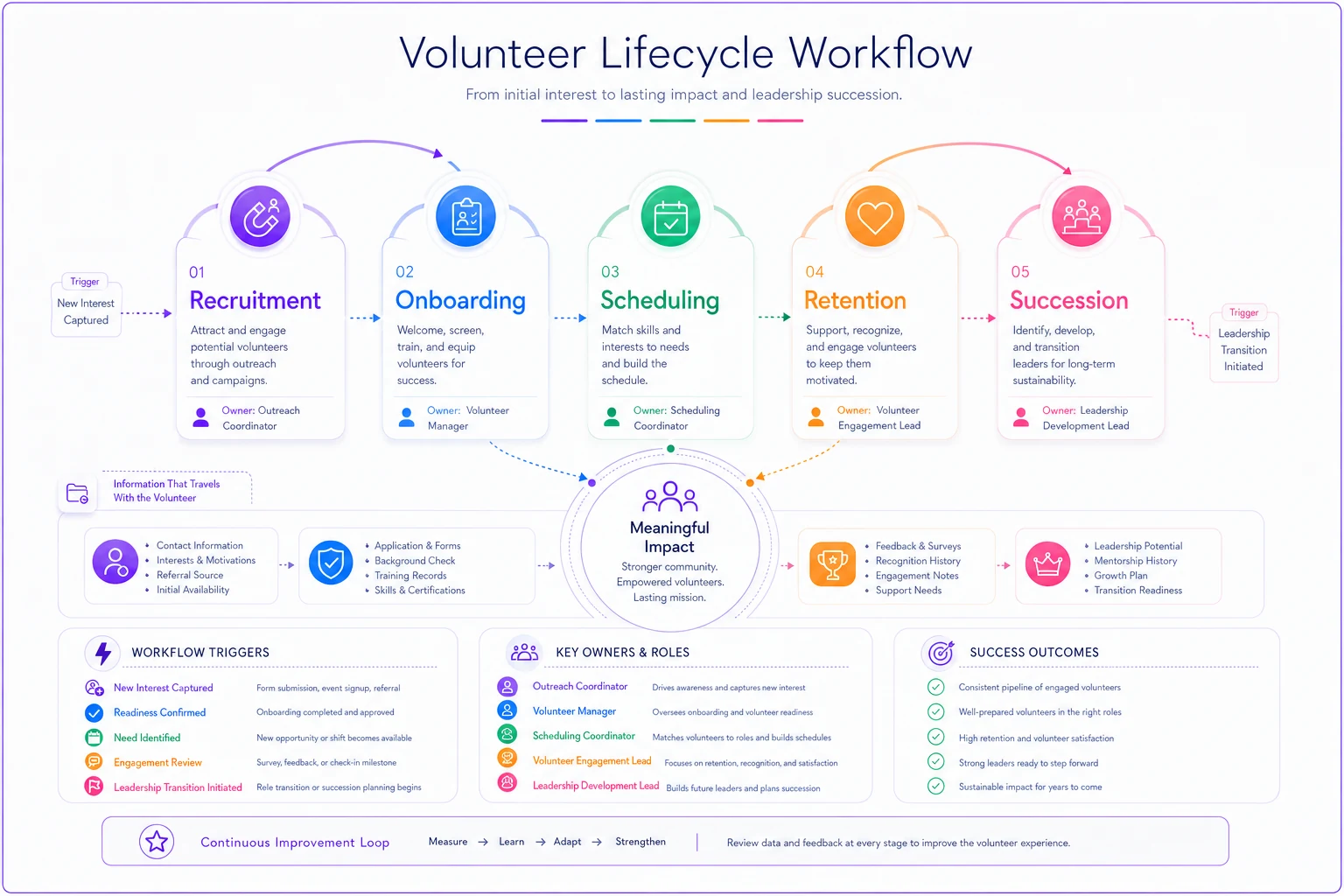
graph TD A[Volunteer Expresses Interest] --> B[Recruitment: Match to Role] B --> C{48hr Follow-Up?} C -- Yes --> D[Onboarding: First Task Assigned] C -- No --> Z[Volunteer Lost] D --> E{First Task Completed?} E -- Yes --> F[Added to Schedule / Rotation] E -- No --> Y[Re-engage or Exit] F --> G[Retention Monitoring] G --> H{Missed Shifts or Fading?} H -- No --> I{Reliable for 2-3 Cycles?} H -- Yes --> X[Retention Check-In] I -- Yes --> J[Succession: Mentorship / Shadow Role] I -- No --> G J --> K[Hands Off Role to Next Person]
Recruitment → Onboarding. Trigger: someone submits interest. Handoff: within 48 hours, a named onboarding owner reaches out with a specific first task. Information that travels: what role they're interested in, their availability, any skills they mentioned. The mistake here is treating "signed up" as the finish line. Signed up is the starting line — the recruit is fragile and forgets you within a week if nothing happens. If you want to get the top of the funnel right in the first place, the mechanics in the volunteer recruitment funnel for small clubs matter a lot, because a clean funnel makes every downstream handoff easier.
Onboarding → Scheduling. Trigger: the volunteer completes their first real task successfully. Handoff: they get added to the rotation for their role. Information that travels: what they're actually good at, what they'd prefer to do, and their real availability — not the availability they guessed at during sign-up. The mistake here is scheduling someone before they're onboarded. Throwing a brand-new volunteer onto a shift with no context is a reliable way to make sure they don't come back.
Scheduling → Retention. This one isn't really a "handoff" — it's continuous. But the trigger for concern is a missed shift or a declining response rate. A well-run schedule is itself a retention tool, because predictability reduces burnout. Once rotation, backfill, and reminders are handled consistently, volunteers stop dropping out from sheer frustration. The rules for automating volunteer schedules to cut burnout are worth getting right early, because chaotic scheduling drives away good people faster than almost anything else.
Retention → Succession. Trigger: a volunteer has been reliable in a role for two or three cycles. Handoff: they're invited to mentor a newer volunteer or shadow a leadership role. Information that travels: what they know, documented as they go. The mistake — and it's nearly universal — is skipping this stage until it's an emergency. Succession should be a natural graduation from retention, not a fire drill. The full approach to preventing volunteer leadership gaps with SOPs and mentoring overlaps covers this in depth, but the key idea is overlap: the outgoing person and the incoming person work together for a stretch, so knowledge transfers by doing rather than by document dump.
Every transition has a trigger, an owner, and traveling information. That's the whole system. If you can answer those three questions for each seam, your pipeline stops leaking.
The KPIs that actually tell you the pipeline is healthy
You don't need a dashboard with 30 metrics. You need a handful that map to the seams, because the seams are where you lose people. Track these per stage:
-
Recruitment % of sign-ups who complete a first task within 2 weeks. (If this is under ~40%, your recruitment→onboarding handoff is broken.)
-
Onboarding % of onboarded volunteers who reach a second task. (Drop-off here means the first task was a bad experience.)
-
Scheduling no-show rate and shift-fill rate. (Rising no-shows are an early burnout signal.)
-
Retention active volunteers this quarter vs. last quarter, plus average tenure. (A shrinking tenure means people leave before they mature into leaders.)
-
Succession number of critical roles with a named, trained backup. (This should never be zero.)
The one people ignore most is the last one. Every club can tell you how many members they have. Almost none can tell you how many critical roles have a trained backup ready to step in tomorrow. That single number predicts whether your club survives a bad year better than anything else on this list.
A reusable playbook template you can copy per role
For each significant role in your club, fill out this same template. It takes maybe 30 minutes per role and it's the difference between a role that survives turnover and one that collapses with the person.
-
Role name & purpose — one sentence on why this role exists.
-
Recruitment source — where do people for this role usually come from? (Existing members? New sign-ups? A specific event?)
-
First task — the small, concrete thing a new person does in week one to prove the role fits.
-
Onboarding checklist — access needed, context to share, who to introduce them to.
-
Schedule pattern — how often, what commitment, how swaps and backfill work.
-
Retention checkpoints — when someone checks in (e.g., 30 days, 90 days, end of season).
-
Documentation location — where the how-to for this role actually lives.
-
Succession plan — who's the named backup, and are they currently shadowing?
The magic isn't any single field. Filling this out forces you to confront the gaps. You'll write "succession plan" and realize there isn't one. Good — now you know your most fragile role.
Here's a quick decision rule for prioritizing which roles to document first:
-
If losing this person would stop operations within a week → document immediately.
-
If losing this person would cause noticeable disruption within a month → document this quarter.
-
If losing this person would be inconvenient but recoverable → document eventually.
Most clubs have two or three roles in that first bucket. Start there. Don't try to document all 15 roles at once — you'll burn out the same way your volunteers do.
A real scenario: a regional hobby club, ~90 members
A regional model-building club with around 90 members and roughly 25 active volunteers kept hitting the same cliff every year. Recruitment at their spring showcase was strong — 15 to 20 interested people most years. By mid-summer, only a handful were still involved, and every fall the board scrambled because one or two leadership roles came open with no obvious successor.
When they mapped the pipeline, the leaks were obvious. Sign-up sheets from the showcase sat in a folder for weeks before anyone followed up. New volunteers who did stick around got thrown onto event shifts with zero onboarding and quietly stopped responding. And nobody had ever documented how the events role worked — it lived entirely in one person's head.
They didn't buy anything fancy. They defined the five handoffs, assigned an owner to each seam, and wrote role playbooks for their three most critical roles. The first task after any sign-up became a 48-hour personal follow-up with one specific small assignment.
Over the next cycle, the share of sign-ups who did something real within two weeks went from maybe 1 in 5 to closer to half. No-shows on scheduled shifts dropped noticeably once reminders and backfill rules were consistent. And for the first time, two of their three critical roles had a named person shadowing the current lead heading into transition season. Nothing dramatic happened overnight — it was more that the annual panic stopped being an annual event.
Where lightweight tooling fits (and where it doesn't)
You can run this whole system on a spreadsheet and a shared calendar, and plenty of small clubs should. The system is the point, not the software.
That said, coordination overhead is where volunteer time gets eaten alive — the chasing, the reminders, the "did anyone follow up with that new person?" question that never has a clean answer. An AI-powered operational platform earns its place when it handles handoffs automatically: a sign-up triggers a follow-up task assigned to a named owner, a missed shift flags a retention check, a role sitting without a backup shows up on the board's view without anyone building a report. The value isn't automation for its own sake — it's removing the human memory dependency at exactly the seams where clubs leak volunteers.
But be honest about scale. If you have 15 volunteers and one person who knows everyone, adding software adds overhead without solving a real problem. Tools make sense once coordination is genuinely costing you people — usually somewhere past 50 or 60 active volunteers, or when you have multiple chapters and no single shared view.
This is a bad idea when: your club is tiny, turnover is low, and the informal system genuinely works. Don't fix what isn't leaking.
Start with a spreadsheet and a shared calendar; introduce software only when coordination gaps are clearly costing you volunteers.
Who should NOT do this yet: brand-new clubs still figuring out what their roles even are. You can't write a role playbook for a role you haven't defined. Get a season or two of operations under your belt first, then document.
Bringing it together
The reason clubs cycle through the same volunteer crises year after year isn't that they can't find people or that their volunteers don't care. It's that they run five disconnected efforts and hope the gaps between them take care of themselves.
A volunteer operations system that connects recruitment to succession isn't about more tools or more meetings. It's about naming the seams, deciding who owns each transition, and writing down enough that the club survives losing any single person. Do that, and the annual scramble turns into something closer to a rhythm — people come in at the top, grow into contributors, and eventually train whoever replaces them. Which is, when you strip everything else away, exactly what a healthy club is supposed to do.
A volunteer operations system that connects recruitment to succession isn't about more tools or more meetings. It's about naming the seams, deciding who owns each transition, and writing down enough that the club survives losing any single person. Do that, and the annual scramble turns into something closer to a rhythm — people come in at the top, grow into contributors, and eventually train whoever replaces them. Which is, when you strip everything else away, exactly what a healthy club is supposed to do.
Ready to streamline your club operations?
Join 500+ clubs using Clubyly to save time, boost member engagement, and grow their communities.